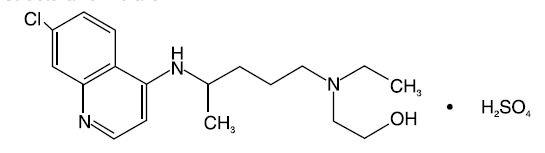
Resistant strains of malaria: Hydroxychloroquine sulfate tablets are not effective against
chloroquine-resistant strains of P. falciparum (see CLINICAL PHARMACOLOGY-Microbiology).
Ocular: Irreversible retinal damage has been observed in some patients who had received hydroxychloroquine sulfate. Significant risk factors for retinal damage Include dally doses of hydroxychloroquine sulfate greater than 6.5 mg/kg (5 mg/kg base) of actual body weight, durations of use greater than five years, subnormal glomerular filtration, use of some concomitant drug products such as tamoxifen citrate and concurrent macular disease.
A baseline ocular examination is recommended within the first year of starting hydroxychloroquine sulfate tablets. The baseline exam should include: best corrected distance visual acuity (BCVA), an automated threshold visual field (VF) of the central 10 degrees (with retesting if an abnormality is noted), and spectral domain ocular coherence tomography (SD-OCT).
For individuals with significant risk factors (daily dose of hydroxychloroquine sulfate greater than 5.0 mg/kg base of actual body weight, subnormal glomerular filtration, use of tamoxifen citrate or concurrent macular disease) monitoring should include annual examinations which include BCVA, VF and SD-OCT. For individuals without significant risk factors, annual exams can usually be deferred until five years of treatment.
In individuals of Asian descent, retinal toxicity may first be noticed outside the macula. In patients of Asian descent, it is recommended that visual field testing be performed in the central 24 degrees instead of the central 10 degrees.
It is recommended that hydroxychloroquine be discontinued if ocular toxicity is suspected and the patient should be closely observed given that retinal changes (and visual disturbances) may progress even after cessation of therapy.
Cardiac Effects, Including Cardiomyopathy and QT prolongation: Postmarketing cases of
life-threatening and fatal cardiomyopathy have been reported with use of hydroxychloroquine
sulfate tablets as well as with use of chloroquine. Patients may present wtth atrloventrlcular block, pulmonary hypertension, sick sinus syndrome or with cardiac complications. ECG findings may include atrioventricular, right or left bundle branch block. Signs or symptoms of cardiac compromise have appeared during acute and chronic treatment. Clinical monitoring for signs and symptoms of cardiomyopathy is advised, including use of appropriate diagnostic tools such as ECG to monitor patients for cardiomyopathy during hydroxychloroquine sulfate tablets therapy. Chronic toxicity should be considered when conduction disorders (bundle branch block/atrio-ventricular heart block) or biventricular hypertrophy are diagnosed. If cardiotoxicity is suspected, prompt discontinuation of hydroxychloroquine sulfate tablets may prevent life-threatening complications.
Hydroxychloroquine sulfate tablets prolong the QT interval. Ventricular arrhythmias and torsades de pointes have been reported in patients taking hydroxychloroquine sulfate tablets (see
OVERDOSAGE). Therefore, hydroxychloroquine sulfate tablets should not be administered with other drugs that have the potential to prolong the QT interval (see DRUG INTERACTIONS).
Worsening of psoriasis and porphyria: Use of hydroxychloroquine sulfate tablets in patients with psoriasis may precipitate a severe attack of psoriasis. When used in patients with porphyria the condition may be exacerbated. The preparation should not be used in these conditions unless in the judgment of the physician the benefit to the patient outweighs the possible hazard.
Proximal Myopathy and Neuropathy: Skeletal muscle myopathy or neuropathy leading to progressive weakness and atrophy of proximal muscle groups, depressed tendon reflexes, and
abnormal nerve conduction, have been reported. Muscle and nerve biopsies have been associated
with curvilinear bodies and muscle fiber atrophy with vacuolar changes. Assess muscle strength
and deep tendon reflexes periodically in patients on long-term therapy wtth hydroxychloroquine
sulfate tablets.
Neuropsychiatric events, including suicidafity: Suicidal behavior has been rarely reported in
patients treated with hydroxychloroquine sulfate tablets.
Hypoglycemia: Hydroxychloroquine sulfate tablets have been shown to cause severe
hypoglycemia including loss of consciousness that could be life threatening in patients treated with or without antidiabetic medications (see DRUG INTERACTIONS and ADVERSE REACTIONS). Patients treated with hydroxychloroquine sulfate tablets should be warned about the risk of hypoglycemia and the associated clinical signs and symptoms. Patients presenting with clinical symptoms suggestive of hypoglycemia during treatment with hydroxychloroquine sulfate tablets should have their blood glucose checked and treatment reviewed as necessary.
Use with caution in patients with gastrointestinal, neurological, or blood disorders, and in those with a sensitivity to quinine.
Hepatic/Renal Disease: Antimalarial compounds should be used with caution in patients with hepatic disease or alcoholism or in conjunction with known hepatotoxic drugs. A reduction in
dosage may be necessary in patients with hepatic or renal disease, as well as in those taking
medicines known to affect these organs.
Hematologic Effects/Laboratory Tests: Antimalarial compounds should be used with caution in patients with hepatic disease or alcoholism or in conjunction with known hepatotoxic drugs. Periodic blood cell counts should be performed tt patients are given prolonged therapy. If any severe blood disorder such as aplastic anemia, agranulocytosis, leukopenia, or thrombocytopenia, appears which is not attributable to the disease under treatment, consider discontinuation of
hydroxychloroquine sulfate tablets.
Hydroxychloroquine sulfate tablets should be administered with caution in patients having
glucose-6-phosphate dehydrogenase (G-6-PD) deficiency.
Dermatologic Effects: Dermatologic reactions to hydroxychloroquine sulfate tablets may occur
and, therefore, proper care should be exercised when it is administered to any patient receiving a
drug with a significant tendency to produce dermatitis.