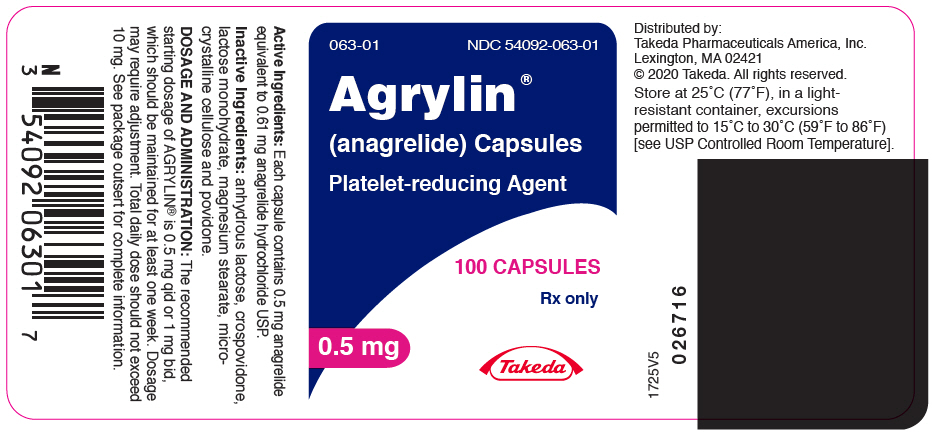
Adults: The recommended starting dosage of AGRYLIN is 0.5 mg four times daily or 1 mg twice daily.
Pediatric Patients: The recommended starting dosage of AGRYLIN is 0.5 mg daily.
Clinical Studies in Adult Patients
In three single-arm clinical studies, 942 patients [see Clinical Trials (14)] diagnosed with myeloproliferative neoplasms of varying etiology (ET: 551; PV: 117; OMPN: 274) were exposed to anagrelide with a mean duration of approximately 65 weeks. Serious adverse reactions reported in these patients included the following: congestive heart failure, myocardial infarction, cardiomyopathy, cardiomegaly, complete heart block, atrial fibrillation, cerebrovascular accident, pericardial effusion [see Warnings and Precautions (5.1)], pleural effusion, pulmonary infiltrates, pulmonary fibrosis, pulmonary hypertension, and pancreatitis. Of the 942 patients treated with anagrelide, 161 (17%) were discontinued from the study because of adverse reactions or abnormal laboratory test results. The most common adverse reactions for treatment discontinuation were headache, diarrhea, edema, palpitations, and abdominal pain.
The most frequently reported adverse reactions to anagrelide (in 5% or greater of 942 patients with myeloproliferative neoplasms) in clinical trials were listed in Table 1.
Table 1 Adverse Reactions Reported in Clinical Studies in at least 5% of Patients| Adverse reactions | AGRYLIN
(N=942)
(%) |
|---|
| Cardiac disorders | |
| Palpitations | 26% |
| Tachycardia | 8% |
| Chest pain | 8% |
| General disorders and administration site conditions | |
| Asthenia | 23% |
| Edema | 21% |
| Pain | 15% |
| Fever | 9% |
| Peripheral edema | 9% |
| Malaise | 6% |
| Gastrointestinal disorders | |
| Diarrhea | 26% |
| Nausea | 17% |
| Abdominal pain | 16% |
| Vomiting | 10% |
| Flatulence | 10% |
| Anorexia | 8% |
| Dyspepsia | 5% |
| Respiratory, thoracic and mediastinal disorders | |
| Dyspnea | 12% |
| Cough | 6% |
| Skin and subcutaneous tissue disorders | |
| Rash | 8% |
| Pruritus | 6% |
| Musculoskeletal and connective tissue disorders | |
| Back pain | 6% |
| Nervous system disorders | |
| Headache | 44% |
| Dizziness | 15% |
| Paresthesia | 6% |
Adverse Reactions (frequency 1% to < 5%) included:
General disorders and administration site conditions: Flu symptoms, chills.
Cardiac disorders: Arrhythmia, angina pectoris, heart failure, syncope.
Vascular disorders: Hemorrhage, hypertension, postural hypotension, vasodilatation.
Gastrointestinal disorders: Constipation, gastrointestinal hemorrhage, gastritis.
Blood and lymphatic system disorders: Anemia, thrombocytopenia, ecchymosis.
Hepatobiliary disorders: Elevated liver enzymes.
Musculoskeletal and connective tissue disorders: Arthralgia, myalgia.
Psychiatric disorders: Depression, confusion, nervousness.
Nervous system disorders: Somnolence, insomnia, amnesia, migraine headache.
Respiratory, thoracic and mediastinal disorders: Epistaxis, pneumonia.
Skin and subcutaneous tissue disorders: Alopecia.
Eye disorders: Abnormal vision, diplopia.
Ear and labyrinth disorders: Tinnitus
Renal and urinary disorders: Hematuria, renal failure.
Other less frequent adverse reactions (<1%) were:
Cardiac disorders: Ventricular tachycardia, supraventricular tachycardia.
Nervous system disorders: Hypoesthesia.
Clinical Study in Pediatric Patients
The frequency of adverse events observed in pediatric patients was similar to adult patients. The most common adverse events observed in pediatric patients were fever, epistaxis, headache, and fatigue during the 3-month anagrelide treatment in the study. Episodes of increased pulse and decreased systolic or diastolic blood pressure beyond the normal ranges in the absence of clinical symptoms were observed. Adverse events that had been reported in these pediatric patients prior to the study and were considered to be related to anagrelide treatment based on retrospective review were; palpitations, headache, nausea, vomiting, abdominal pain, back pain, anorexia, fatigue, and muscle cramps.
CYP1A2 inhibitors: Anagrelide and its active metabolite are primarily metabolized by CYP1A2. Drugs that inhibit CYP1A2 (e.g., fluvoxamine, ciprofloxacin) could increase the exposure of anagrelide. Monitor patients for cardiovascular events and titrate doses accordingly when CYP1A2 inhibitors are co-administered.
CYP1A2 inducers: CYP1A2 inducers could decrease the exposure of anagrelide. Patients taking concomitant CYP1A2 inducers (e.g., omeprazole) may need to have their dose titrated to compensate for the decrease in anagrelide exposure.
CYP1A2 substrates: Anagrelide demonstrates limited inhibitory activity towards CYP1A2 in vitro and may alter the exposure of concomitant CYP1A2 substrates (e.g. theophylline, fluvoxamine, ondansetron).
Risk Summary
There are no adequate and well-controlled studies with AGRYLIN in pregnant women. In animal embryo-fetal studies, delayed development (delayed skeletal ossification and reduced body weight) was observed in rats administered anagrelide hydrochloride during organogenesis at doses substantially higher than the maximum clinical dose of 10 mg/day. AGRYLIN should be used during pregnancy only if the potential benefit justifies the potential risk to the fetus.
Animal Data
Anagrelide hydrochloride was administered orally to pregnant rats and rabbits during the period of organogenesis at doses up to 900 mg/kg/day in rats and up to 20 mg/kg/day in rabbits (875 and 39 times, respectively, the maximum clinical dose of 10 mg/day based on body surface area). In rats, developmental delays were observed including reductions in fetal weight at 300 and 900 mg/kg/day and delays in skeletal ossification at doses of 100 mg/kg/day and higher. The dose of 100 mg/kg/day (600 mg/m2/day) in rats is approximately 97 times the maximum clinical dose based on body surface area. No adverse embryo-fetal effects were detected in rabbits at the highest dose of 20 mg/kg/day (39 times the maximal clinical dose based on body surface area).
In a pre- and post-natal study conducted in female rats, anagrelide hydrochloride at oral doses of 60 mg/kg/day (58 times the maximum clinical dose based on body surface area) or higher produced delay or blockage of parturition, deaths of non-delivering pregnant dams and their fully developed fetuses, and increased mortality in the pups born.
In a placental transfer study, a single oral dose of [14C]-anagrelide hydrochloride was administered to pregnant rats on gestation Day 17. Drug-related radioactivity was detected in maternal and fetal tissue.
Risk Summary
It is not known whether anagrelide is excreted in human milk. Anagrelide or its metabolites have been detected in the milk of lactating rats. Because many drugs are excreted into human milk and because of the potential for serious adverse reaction in nursing infants from anagrelide, a decision should be made whether to discontinue nursing or to discontinue the drug, taking into account the importance of the drug to the mother.
Data
In a rat milk secretion study, a single oral dose of [14C]-anagrelide hydrochloride was administered to lactating female rats on postnatal Day 10. Drug-related radioactivity was detected in the maternal milk and blood.
Cardiac Electrophysiology
The effect of anagrelide dose (0.5 mg and 2.5 mg single doses) on the heart rate and QTc interval prolongation potential was evaluated in a double-blind, randomized, placebo- and active-controlled, cross-over study in 60 healthy adult men and women.
A dose-related increase in heart rate was observed, with the maximum increase occurring around the time of maximal drug concentration (0.5 – 4 hours). The maximum change in mean heart rate occurred at 2 hours after administration and was +7.8 beats per minute (bpm) for 0.5 mg and +29.1 bpm for 2.5 mg.
Dose-related increase in mean QTc was observed. The maximum mean (95% upper confidence bound) change in QTcI (individual subject correction) from placebo after baseline-correction was 7.0 (9.8) ms and 13.0 (15.7) ms following anagrelide doses of 0.5 mg and 2.5 mg, respectively.
Absorption
Following oral administration of AGRYLIN, at least 70% is absorbed from the gastrointestinal tract. In fasted subjects, anagrelide peak plasma concentrations occur within about 1 hour after administration.
Pharmacokinetic data obtained from healthy volunteers comparing the pharmacokinetics of anagrelide in the fed and fasted states showed that administration of a 1 mg dose of anagrelide with food decreased the Cmax by 14%, but increased the AUC by 20%. Food decreased the Cmax of the active metabolite 3-hydroxy-anagrelide by 29%, although it had no effect on the AUC.
Metabolism
Anagrelide is primarily metabolized by CYP1A2 to the active metabolite, 3-hydroxy-anagrelide, which is subsequently metabolized by CYP1A2 to the inactive metabolite, RL603. Less than 1% of the administered dose is recovered in the urine as anagrelide, and approximately 3% and 16-20% of the administered dose is recovered as 3-hydroxy-anagrelide and RL603, respectively.
Elimination
Anagrelide and 3-hydroxy-anagrelide are eliminated with plasma half-lives of approximately 1.5 and 2.5 hours, respectively. Anagrelide and 3-hydroxy-anagrelide do not accumulate in plasma when the clinical dose regimens are administered.
Drug Interactions
Aspirin: In two pharmacodynamic interaction studies in healthy subjects, co-administration of single-dose anagrelide 1 mg and aspirin 900 mg or repeat-dose anagrelide 1 mg once daily and aspirin 75 mg once daily showed greater ex vivo anti-platelet aggregation effects than administration of aspirin alone. Co-administered anagrelide 1mg and aspirin 900mg single-doses had no effect on bleeding time, prothrombin time (PT) or activated partial thromboplastin time (aPTT).
Digoxin or warfarin: In vivo interaction studies in humans have demonstrated that anagrelide does not affect the pharmacokinetic properties of digoxin or warfarin, nor does digoxin or warfarin affect the pharmacokinetic properties of anagrelide.
Specific Populations
Pediatric: Dose-normalized Cmax and AUC of anagrelide were higher in children and adolescents (age range 7-16 years) with essential thrombocythemia, by 17% and 56%, respectively, than in adult patients (19-57 years).
Geriatric: Cmax and AUC of anagrelide were 36% and 61% higher, respectively, in elderly patients (age range 65-75 years), than in younger adults (age range 22-50 years), but Cmax and AUC of the active metabolite, 3-hydroxy anagrelide, were 42% and 37% lower, respectively, in the elderly patients.
Renal Impairment: Pharmacokinetic study at a single dose of 1 mg anagrelide in subjects with severe renal impairment (creatinine clearance <30 mL/min) showed no significant effects on the pharmacokinetics of anagrelide.
Hepatic Impairment: A pharmacokinetic study at a single dose of 1 mg anagrelide in subjects with moderate hepatic impairment (Child Pugh score 7-9) showed a 2-fold increase in mean anagrelide Cmax and an 8-fold increase in total exposure (AUC) to anagrelide compared with healthy subjects. Additionally, subjects with moderate hepatic impairment showed 24% lower mean 3-hydroxy-anagrelide Cmax and 77% higher mean 3-hydroxy-anagrelide AUC compared to healthy subjects.
Clinical Studies in Adult Patients:
A total of 942 patients with myeloproliferative neoplasms including 551 patients with Essential Thrombocythemia (ET), 117 patients with Polycythemia Vera (PV), 178 patients with Chronic Myelogenous Leukemia (CML), and 96 patients with other myeloproliferative neoplasms (OMPN), were treated with AGRYLIN in three clinical trials. Patients with OMPN included 87 patients who had Myeloid Metaplasia with Myelofibrosis (MMM), and 9 patients who had unclassified myeloproliferative neoplasms.
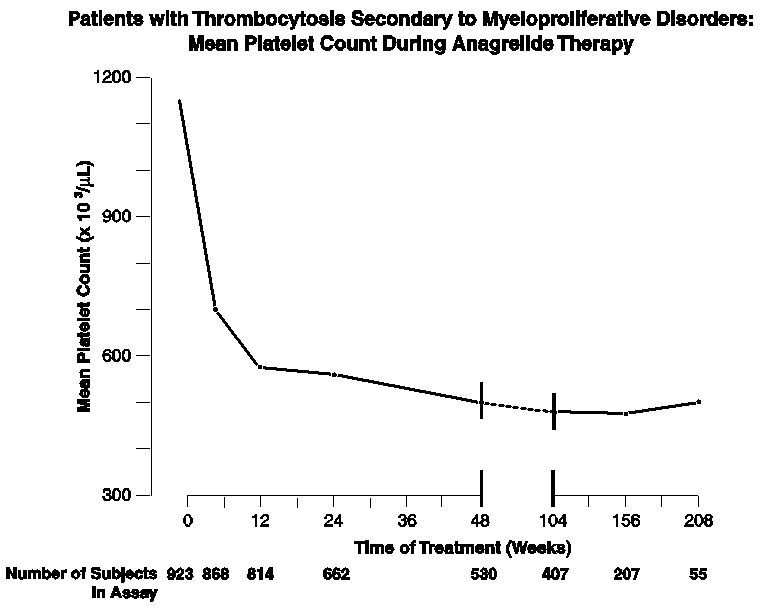
Patients were enrolled in clinical trials if their platelet count was ≥ 900,000/µL on two occasions or ≥ 650,000/µL on two occasions with documentation of symptoms associated with thrombocythemia. The mean duration of anagrelide therapy for ET, PV, CML, and OMPN patients was 65, 67, 40, and 44 weeks, respectively; 23% of patients received treatment for 2 years. Patients were treated with AGRYLIN starting at doses of 0.5-2.0 mg every 6 hours. The dose was increased if the platelet count was still high, but to no more than 12 mg each day. Efficacy was defined as reduction of platelet count to or near physiologic levels (150,000-400,000/µL). The criteria for defining subjects as "responders" were reduction in platelets for at least 4 weeks to ≤600,000/µL, or by at least 50% from baseline value. Subjects treated for less than 4 weeks were not considered evaluable. The results are depicted graphically below:
Patients with Thrombocytosis Secondary to Myeloproliferative Disorders:
Mean Platelet Count During Anagrelide Therapy |
|
| | Time on Treatment |
|---|
| | | Weeks | | Years | |
|---|
| Baseline | 4 | 12 | 24 | 48 | | 2 | 3 | 4 | |
|---|
| Mean × 103/µL | 1131 | 683 | 575 | 526 | 484 | | 460 | 437 | 457 | |
| N | 923 Nine hundred and forty-two subjects with myeloproliferative neoplasms were enrolled in three research studies. Of these, 923 had platelet counts measured over the duration of the studies. | 868 | 814 | 662 | 530 | | 407 | 207 | 55 | |
AGRYLIN was effective in phlebotomized patients as well as in patients treated with other concomitant therapies including hydroxyurea, aspirin, interferon, radioactive phosphorus, and alkylating agents.
Clinical Study in Pediatric Patients:
An open label safety and PK/PD study was conducted in 18 pediatric patients 7-16 years of age (8 patients 7-11 years of age and 10 patients 12-16 years of age, mean age of 12 years; 8 males and 10 females) with thrombocythemia secondary to ET as compared to 17 adult patients (mean age of 66 years, 9 males and 8 females). Prior to entry on to the study, 17 of 18 pediatric patients and 12 of 17 adult patients had received anagrelide treatment for an average of 2 years. The median starting total daily dose, determined by retrospective chart review, for pediatric and adult patients with ET who had received anagrelide prior to study entry was 1mg for each of the three age groups (7-11 and 12-16 year old patients and adults). The starting dose for 6 anagrelide-naive patients at study entry was 0.5 mg once daily. At study completion, the median total daily maintenance doses were similar across age groups, median of 1.75 mg for patients of 7-11 years of age, 2.25 mg in patients 12-16 years of age, and 1.5 mg for adults.
Manufactured for Shire US Inc., 300 Shire Way, Lexington, MA 02421, USA
AGRYLIN® is a registered trademark of Shire LLC.
© 2018 Shire US Inc.
Printed in USA