Limitations of Use
Pediatric patients 12 years and younger experienced higher plasma exposure than patients 13 years and older at the same dose, and experienced higher rates of adverse reactions, mainly insomnia and decreased appetite [see Use in Specific Populations (8.4)].
Adult Use (18 to 55 years)
The recommended starting dose of MYDAYIS is 12.5 mg once daily in the morning upon awakening. Initial doses of 25 mg once daily may be considered for some patients. Dosage may be adjusted in increments of 12.5 mg no sooner than weekly, up to a maximum dose of 50 mg once daily, based on the therapeutic needs and response of the patient. Doses above 50 mg daily have shown no additional clinically meaningful benefit.
Pediatric Use (13 to 17 years)
The recommended starting dose is 12.5 mg once daily in the morning upon awakening. Dosage may be adjusted in increments of 12.5 mg no sooner than weekly, up to a recommended maximum dose of 25 mg once daily. The dose should be individualized according to the needs and response of the patient. Doses higher than 25 mg have not been evaluated in clinical trials in pediatric patients.
Exacerbation of Pre-existing Psychosis
CNS stimulants may exacerbate symptoms of behavior disturbance and thought disorder in patients with a pre-existing psychotic disorder.
Induction of a Manic Episode in Patients with Bipolar Disorder
CNS stimulants may induce a mixed/manic episode in patients with bipolar disorder. Prior to initiating treatment, screen patients for risk factors for developing a manic episode (e.g., comorbid or history of depressive symptoms or a family history of suicide, bipolar disorder, and depression).
New Psychotic or Manic Symptoms
CNS stimulants, at recommended doses, may cause psychotic or manic symptoms, e.g., hallucinations, delusional thinking, or mania in patients without a prior history of psychotic illness or mania. If such symptoms occur, consider discontinuing MYDAYIS. In a pooled analysis of multiple short-term, placebo-controlled studies of CNS stimulants, psychotic or manic symptoms occurred in 0.1% of CNS stimulant-treated patients compared to 0% in placebo-treated patients.
Adverse Reactions Leading to Discontinuation of Treatment
In pooled controlled trials of adult patients, 9% (54/626) of MYDAYIS-treated patients discontinued due to adverse reactions compared to 2% (7/328) of placebo-treated patients. The most frequent adverse reactions leading to discontinuation (i.e. leading to discontinuation in at least 1% of MYDAYIS-treated patients and at a rate at least twice that of placebo) were insomnia (2%, n=15), blood pressure increased (2%, n=10), decreased appetite (1%, n=5), and headache (1%, n= 4).
In a controlled trial including adolescent patients (13 to 17 years), 5% (4/78) of MYDAYIS-treated patients discontinued due to adverse reactions compared to 0% (0/79) of placebo-treated patients. The most frequent adverse reaction leading to discontinuation (i.e. leading to discontinuation in at least 1% of MYDAYIS-treated patients and at a rate at least twice that of placebo) were dizziness (1%, n=1), depression (1%, n=1), abdominal pain upper (1%, n=1), and viral infection (1%, n=1).
Adverse Reactions Occurring at an Incidence of ≥2% and at Least Twice Placebo Among MYDAYIS-Treated Adults in Clinical Trials
The most common adverse reactions reported in adults were insomnia, decreased appetite, dry mouth, decreased weight, heart rate increased, and anxiety. Table 1 lists the adverse reactions that occurred ≥2% compared to placebo. The most common adverse reaction (insomnia) generally occurred early during treatment with MYDAYIS.
Table 1 Adverse Reactions Reported by 2% or More of Adults Taking MYDAYIS and at least Twice the Incidence in Patients Taking Placebo in 3 Clinical Trials (4, 6, and 7-Weeks)| Body System | Adverse Reaction | MYDAYIS
(N= 626) | Placebo
(N= 328) |
|---|
| Nervous System |
| Anxiety | 7% | 3% |
| Feeling Jittery | 2% | 1% |
| Agitation | 2% | 0% |
| Bruxism | 2% | 0% |
| Psychiatric disorders | | | |
| Insomnia | 31% | 8% |
| Depression | 3% | 0% |
| Metabolism and nutritional disorders | | | |
| Decreased Appetite | 30% | 4% |
| Weight Decreased | 9% | 0% |
| Gastrointestinal System | | | |
| Dry Mouth | 23% | 4% |
| Diarrhea | 3% | 1% |
| Cardiovascular System | | | |
| Heart Rate Increased | 9% | 0% |
| Palpitations | 4% | 2% |
| Genitourinary System | | | |
| Dysmenorrhea | 4% | 2% |
| Erectile Dysfunction | 2% | 1% |
Adverse Reactions Occurring at an Incidence of 2% or more and at Least Twice Placebo Among MYDAYIS-Treated Adolescents (13 to 17 years) in a 4-week Clinical Trial
The most common adverse reactions reported in adolescents were decreased appetite, nausea, insomnia, abdominal pain upper, irritability, and weight decreased. Table 2 lists the adverse reactions that occurred ≥2% compared to placebo.
Table 2 Adverse Reactions Reported by ≥2% or More of Adolescents Taking MYDAYIS and at least Twice the Incidence in Patients Taking Placebo in a 4-Week Clinical Trial | Body System | Adverse Reaction | MYDAYIS
(N= 78) | Placebo
(N= 79) |
|---|
| Nervous System |
| Dizziness | 4% | 0% |
| Metabolism and nutrition disorders |
| Decreased appetite | 22% | 6% |
| Weight decreased | 5% | 1% |
| Psychiatric disorders |
| Irritability | 6% | 3% |
| Insomnia | 8% | 3% |
| Gastrointestinal disorders |
| Nausea | 8% | 4% |
| Abdominal pain upper | 4% | 1% |
Risk Summary
The limited available data from published literature and postmarketing reports on use of amphetamine in pregnant women are not sufficient to inform a drug-associated risk for major birth defects and miscarriage. Adverse pregnancy outcomes, including premature delivery and low birth weight, have been seen in infants born to mothers dependent on amphetamines [see Clinical Considerations].
In an embryofetal development study, amphetamine (d- to l- enantiomer ratio of 3:1, the same as in MYDAYIS) had no effects on embryofetal morphological development or survival when administered to pregnant rats and rabbits throughout the period of organogenesis up to doses 10 times the maximum recommended human dose (MRHD) of 25 mg/day given to adolescents, on a mg/m2 body surface area basis. However, in a pre- and post-natal development study, amphetamine (d- to l- ratio of 3:1) administered orally to pregnant rats during gestation and lactation caused a decrease in pup survival and a decrease in pup body weight that correlated with a delay in developmental landmarks at clinically relevant doses of amphetamine. In addition, adverse effects on reproductive performance were observed in pups whose mothers were treated with amphetamine. Long-term neurochemical and behavioral effects have also been reported in animal developmental studies using clinically relevant doses of amphetamine [see Data].
The estimated background risk of major birth defects and miscarriage for the indicated population is unknown. All pregnancies have a background risk of birth defect, loss or other adverse outcomes. In the U.S. general population, the estimated background risk of major birth defects and miscarriage in clinically recognized pregnancies is 2-4% and 15- 20%, respectively.
Clinical Considerations
Fetal/Neonatal Adverse Reactions
Amphetamines, such as MYDAYIS, cause vasoconstriction and thereby may decrease placental perfusion. In addition, amphetamines can stimulate uterine contractions increasing the risk of premature delivery. Infants born to amphetamine-dependent mothers have an increased risk of premature delivery and low birth weight.
Monitor infants born to mothers taking amphetamines for symptoms of withdrawal such as feeding difficulties, irritability, agitation, and excessive drowsiness.
Data
Animal Data
Amphetamine (d- to l- enantiomer ratio of 3:1, the same as in MYDAYIS) had no apparent effects on embryofetal morphological development or survival when administered orally to pregnant rats and rabbits throughout the period of organogenesis at doses of up to 6 and 16 mg/kg/day, respectively. These doses are approximately 2 and 10 times, respectively, the maximum recommended human dose (MRHD) of 25 mg/day given to adolescents, on a mg/m2 body surface area basis. Fetal malformations and death have been reported in mice following parenteral administration of d-amphetamine doses of 50 mg/kg/day (approximately 8 times the MRHD given to adolescents on a mg/m2 basis) or greater to pregnant animals. Administration of these doses was also associated with severe maternal toxicity.
A pre- and postnatal development study was conducted with amphetamine (d- to l- enantiomer ratio of 3:1) in which pregnant rats received daily oral doses of 2, 6, and 10 mg/kg from gestation day 6 to lactation day 20. These doses are approximately 0.6, 2, and 3 times the MRHD of 25 mg/day amphetamine (d- to l- ratio of 3:1) given to adolescents, on a mg/m2 basis. All doses caused hyperactivity and decreased weight gain in the dams. A decrease in pup survival was seen at all doses. A decrease in pup body weight was seen at 6 and 10 mg/kg which correlated with delays in developmental landmarks, such as preputial separation and vaginal opening. Increased pup locomotor activity was seen at 10 mg/kg on day 22 postpartum but not at 5 weeks postweaning. When pups were tested for reproductive performance at maturation, gestational weight gain, number of implantations, and number of delivered pups were decreased in the group whose mothers had been given 10 mg/kg.
A number of studies from the literature in rodents indicate that prenatal or early postnatal exposure to amphetamine (d- or d, l-) at doses similar to those used clinically can result in long-term neurochemical and behavioral alterations. Reported behavioral effects include learning and memory deficits, altered locomotor activity, and changes in sexual function.
Risk Summary
Based on limited case reports in published literature, amphetamine (d- or d, l-) is present in human milk, at relative infant doses of 2% to 13.8% of the maternal weight-adjusted dosage and a milk/plasma ratio ranging between 1.9 and 7.5. There are no reports of adverse effects on the breastfed infant. Long-term neurodevelopmental effects on infants from amphetamine exposure are unknown. It is possible that large dosages of dextroamphetamine might interfere with milk production, especially in women whose lactation is not well established. Because of the potential for serious adverse reactions in nursing infants, including serious cardiovascular reactions, blood pressure and heart rate increase, suppression of growth, and peripheral vasculopathy, advise patients that breastfeeding is not recommended during treatment with MYDAYIS.
Growth Suppression
Growth should be monitored during treatment with stimulants, including MYDAYIS, in pediatric patients 13 to 17 years who are not growing or gaining weight as expected may need to have their treatment interrupted [see Warnings and Precautions (5.5), Adverse Reactions (6.1)].
Juvenile Animal Toxicity Data
Juvenile rats treated with mixed amphetamine salts (same as in MYDAYIS) early in the postnatal period through sexual maturation demonstrated transient changes in motor activity. Learning and memory was impaired at approximately 8 times the maximum recommended human dose (MRHD) given to children on a mg/m2 basis. No recovery was seen following a drug free period. A delay in sexual maturation was observed at a dose approximately 8 times the MRHD given to children on a mg/m2 basis, although there was no effect on fertility.
In a juvenile developmental study, rats received daily oral doses of amphetamine (d to l enantiomer ratio of 3:1, the same as in MYDAYIS) of 2, 6, or 20 mg/kg on days 7-13 of age; from day 14 to approximately day 60 of age these doses were given b.i.d. for total daily doses of 4, 12, or 40 mg/kg. The latter doses are approximately 0.8, 2, and 8 times the MRHD of 25 mg/day given to children on a mg/m2 basis. Post-dosing hyperactivity was seen at all doses; motor activity measured prior to the daily dose was decreased during the dosing period but the decreased motor activity was largely absent after an 18 day drug-free recovery period. Performance in the Morris water maze test for learning and memory was impaired at the 40 mg/kg dose, and sporadically at the lower doses, when measured prior to the daily dose during the treatment period; no recovery was seen after a 19 day drug-free period. A delay in the developmental milestones of vaginal opening and preputial separation was seen at 40 mg/kg but there was no effect on fertility.
Tolerance
Tolerance (a state of adaptation in which exposure to a specific dose of a drug results in a reduction of the drug's desired and/or undesired effects over time, in such a way that a higher dose of the drug is required to produce the same effect that was once obtained at a lower dose) may occur during the chronic therapy of CNS stimulants including MYDAYIS.
Dependence
Physical dependence (a state of adaptation manifested by a withdrawal syndrome produced by abrupt cessation, rapid dose reduction, or administration of an antagonist) may occur in patients treated with CNS stimulants including MYDAYIS. Withdrawal symptoms after abrupt cessation of CNS stimulants include extreme fatigue and depression.
Inactive Ingredients and Colors: The inactive ingredients in MYDAYIS capsules include: hard gelatin capsules, ethylcellulose, hydroxypropyl methylcellulose, methacrylic acid copolymer, methyl acrylate, methyl methacrylate, methacrylic acid copolymer, opadry beige, sugar spheres, talc, and triethyl citrate. The gelatin capsules for all four strengths contain gelatin, titanium dioxide, yellow iron oxide, and edible inks. The 12.5 mg and 25 mg strength gelatin capsules also contain FD&C Blue #2. The 37.5 mg strength also contains red iron oxide. The 50 mg strength capsule also contains D&C Red #28, D&C Red #33, and FD&C Blue #1.
Absorption
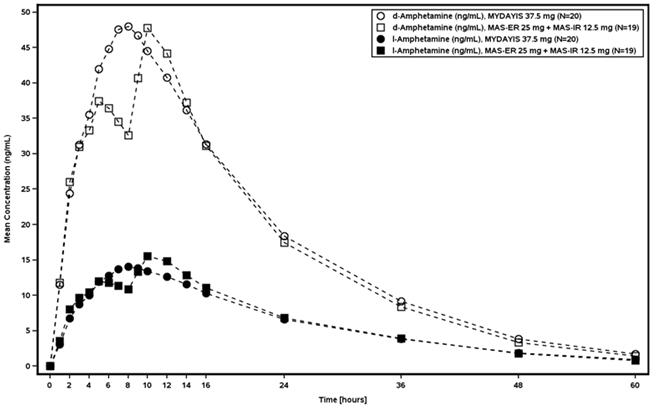
MYDAYIS exhibits linear dose proportionality over the range of 12.5 to 50 mg. Steady-state is achieved between Days 7 and 8 of dosing with mean accumulation ratio of 1.6. A single dose of MYDAYIS 37.5 mg capsules provided comparable plasma concentration profiles of both d- and l-amphetamine to mixed amphetamine salts extended release (MAS-ER) 25 mg followed by 12.5 mg immediate release amphetamine administered 8 hours later (Figure 1).
Figure 1 Mean Plasma Concentrations of d- and l-amphetamine Following Oral Administration of MYDAYIS 37.5 mg vs MAS-ER 25 mg Followed by Immediate-Release MAS-IR 12.5 mg 8 Hours Later in Adults
Effect of Food
High fat meal does not affect the extent of absorption of d- and l-amphetamine when taken with MYDAYIS. Tmax is prolonged by 5 hours (from 7.0 hours at fasted state to 12.0 hours after a high-fat meal) for d-amphetamine and 4.5 hours (from 7.5 hours at fasted state to 12 hours after a high-fat meal) for l-amphetamine after administration of MYDAYIS 50 mg with high fat meal. Opening the capsule and sprinkling the contents on applesauce results in comparable absorption and exposure to the intact capsule taken in the fasted state [see Dosing and Administration (2.3)]
Effect of Alcohol
The in vitro testing showed increases in amphetamine release rate from MYDAYIS capsules in the presence of 20% and, more noticeably, 40% alcohol. There is no in vivo study conducted for the effect of alcohol on drug exposure.
Elimination
Metabolism
Amphetamine is reported to be oxidized at the 4 position of the benzene ring to form 4-hydroxyamphetamine, or on the side chain α or β carbons to form alpha-hydroxy-amphetamine or norephedrine, respectively. Norephedrine and 4-hydroxy-amphetamine are both active and each is subsequently oxidized to form 4-hydroxy-norephedrine. Alpha-hydroxy-amphetamine undergoes deamination to form phenylacetone, which ultimately forms benzoic acid and its glucuronide and the glycine conjugate hippuric acid. Although the enzymes involved in amphetamine metabolism have not yet been clearly defined, CYP2D6 is known to be involved with formation of 4-hydroxy-aphetamine. Since CYP2D6 is genetically polymorphic, population variations in amphetamine metabolism are a possibility.
Amphetamine is known to inhibit monoamine oxidase. Amphetamines are not an in vitro inhibitor of the major human CYP450 isoforms (CYP1A2, CYP2C9, CYP2C19, CYP2D6, and CYP3A4), nor was it an in vitro inducer of CYP1A2, CYP2B6 or CYP3A4/5. Amphetamines are not an in vitro substrate for P-gp.
Excretion
The renal excretion is the primary route for elimination of d- and l-amphetamine and its metabolites after administration of MYDAYIS.
At normal urine pHs, approximately half of an administered dose of amphetamine is recoverable in urine as derivatives of alpha-hydroxy-amphetamine and approximately another 30%-40% of the dose is recoverable in urine as amphetamine itself. Urinary recovery of amphetamine is highly dependent on pH and urine flow rates. Alkaline urine pHs result in less ionization and reduced renal elimination, and acidic pHs and high flow rates result in increased renal elimination. Urinary recovery of amphetamine has been reported to range from 1% to 75%, and the fraction of a dose hepatically metabolized is dependent on urine pH. Consequently, both hepatic and renal dysfunctions have the potential to alter the elimination of amphetamine and could result in prolonged exposures [see Drug Interactions (7.1)].
Specific Populations
Age
Comparison of the pharmacokinetics of d- and l-amphetamine after oral administration of MYDAYIS in pediatric patients with ADHD 13 to 17 years old and healthy adult subjects (19 to 52 years) indicates that body weight is the primary determinant of apparent differences in the pharmacokinetics of d- and l-amphetamine across the age range.
PK data from patients age 13 to 17 years (n=14) who received a single 25 mg MYDAYIS capsule was scaled (based on PK proportionality) and compared with PK data from adult patients 19 to 51 years (n =20) who received 37.5 mg. Based on dose proportionality, a single dose MYDAYIS capsule administered to pediatric patients age 13 to 17 years (n=14) would produce about 21-31% higher Cmax for d- and l-amphetamine and 21-31% higher AUC for d- and l-amphetamine, compared to the same dose of MYDAYIS capsule administered to adults (age 19 to 51 years).
Male and Female Patients
In pharmacokinetic studies, systemic exposure to d- and l-amphetamine was similar in women (N=41) and in men (N=61).
Racial Groups
Formal pharmacokinetic studies for race have not been conducted. However, amphetamine pharmacokinetics appeared to be comparable among white (N=41), Blacks (N=27), and Hispanics (N=34).
Patients with Renal impairment
The effect of renal impairment on d- and l-amphetamine after administration of MYDAYIS has not been studied.
In a pharmacokinetic study of lisdexamfetamine in adult subjects with normal and impaired renal function mean d-amphetamine clearance was reduced from 0.7 L/hr/kg in normal subjects to 0.4 L/hr/kg in subjects with severe renal impairment (GFR 15 to < 30 mL/min/1.73 m2) patients. Dialysis did not significantly affect the clearance of d-amphetamine. The impact of renal impairment on the disposition of amphetamine would be expected to be similar between oral administration of lisdexamfetamine and MYDAYIS [see Use in Specific Populations (8.6)].
Carcinogenesis
No evidence of carcinogenicity was found in studies in which d, l-amphetamine (enantiomer ratio of 1:1) was administered to mice and rats in the diet for 2 years at doses of up to 30 mg/kg/day in male mice, 19 mg/kg/day in female mice, and 5 mg/kg/day in male and female rats. These doses are approximately 3, 2, and 1 times, respectively, the maximum recommended human dose of 50 mg/day on a mg/m2 body surface area basis in adults.
Mutagenesis
Amphetamine, in the enantiomer ratio present, d- to l- ratio of 3:1, was not clastogenic in the mouse bone marrow micronucleus test in vivo and was negative when tested in the E. coli component of the Ames test in vitro. d, l-Amphetamine (1:1 enantiomer ratio) has been reported to produce a positive response in the mouse bone marrow micronucleus test, an equivocal response in the Ames test, and negative responses in the in vitro sister chromatid exchange and chromosomal aberration assays.
Impairment of Fertility
Amphetamines, in the enantiomer ratio, d- to l- ratio of 3:1, did not adversely affect fertility or early embryonic development in the rat at doses of up to 20 mg/kg/day (approximately 6 times the maximum recommended human dose of 25 mg/day given to adolescents on a mg/m2 body surface area basis).
Adult patients (18 to 55 years) with ADHD
The approved adult doses, 12.5 mg, 25 mg, and 37.5 mg are based on Studies 1 and 3 and the 50 mg dose efficacy is based on Study 2. Doses up to 75 mg per day (1.5 times the maximum recommended adult dosage) were evaluated, but demonstrated no additional clinical benefit.
A 4-week, randomized, double-blind, multi-center, placebo-controlled, forced-dose titration, safety and efficacy study (Study 1) was conducted in adults aged 18 to 55 years (N=275) who met DSM-5 criteria for ADHD. Patients were randomized in a 1:1:1 ratio, to two MYDAYIS treatment groups and a placebo group. Group 1 received a dose of 12.5 mg/day throughout the study. Group 2 were titrated on a weekly basis from the initial dose 12.5 mg until target dose of 37.5 mg/day was reached by Week 3 and were maintained at 37.5 mg throughout the study. Group 3 received placebo.
The primary efficacy endpoint was defined as the change from baseline of the adult ADHD-Rating Scale (RS) with prompts total score at Week 4. Baseline adult ADHD-RS with prompts total score was defined as the last valid adult ADHD-RS with prompts total score assessment prior to taking the first dose of double-blind investigational product, usually at Visit 2. The primary comparison of interest was at Week 4 for each MYDAYIS dose compared with placebo. MYDAYIS demonstrated a statistically significant treatment effect compared with placebo on change of ADHD-RS total score from baseline at visit 6 (Week 4), for both 12.5 mg and 37.5 mg doses respectively (Study 1 in Table 4). Patients on MYDAYIS also showed statistically significantly greater improvement on the Clinical Global Impression of Improvement (CGI-I) score compared with placebo treatment.
Two multi-center, randomized, double-blind, placebo-controlled, crossover studies of MYDAYIS 25 mg/day (Study 3) and 50 mg/day (Study 2) were conducted in adult patients who met DSM-IV TR criteria for ADHD. The efficacy was determined using the Permanent Product Measure of Performance (PERMP), a skill-adjusted math test that measures attention in ADHD. PERMP total score results from the sum of the number of math problems attempted plus the number of math problems answered correctly. Efficacy assessments were conducted at 2, 4, 8, 12, 14, and 16 hours post-dose using the PERMP. MYDAYIS treatment, compared to placebo, reached statistical significance at either 2 hours (Study 2) or 4 hours (Study 3) post-dose to 16 hours post-dose in both studies. In a pre-specified supplementary analysis for Study 2, the maximum approved dose of MYDAYIS (50 mg) demonstrated a statistically significant treatment effect compared with placebo beginning at 2 to 16 hours post-dose (Study 2 and Study 3 in Table 4).
Pediatric patients (13 to 17 years) with ADHD
A 4-week, randomized, double-blind, multi-center, placebo-controlled, dose-optimization, safety and efficacy study (Study 4) was conducted. In Study 4, the 157 pediatric patients 13 to 17 years old who met DSM-IV TR criteria for ADHD, were randomized in a 1:1 ratio to MYDAYIS or placebo group. Subjects were titrated from a dose of 12.5 mg/day until an optimal dose was reached (up to a maximum dose of 25 mg); this dose was maintained during the dose-maintenance period (Study 4 in Table 4).
The primary efficacy endpoint was defined as the change from baseline of the ADHD-RS-IV Total Score at Week 4. The baseline ADHD-RS-IV Total Score was defined as the last valid ADHD-RS-IV Total Score assessment prior to taking the first dose of double-blind investigational product, usually at Visit 2. MYDAYIS demonstrated a statistically significant treatment effect compared with placebo on the change of ADHD RS-IV total scores from baseline at Visit 6 (Week 4). MYDAYIS also showed statistically significantly greater improvement on the Clinical Global Impression of Improvement (CGI-I) score at Visit 6 (Week 4).
A multi-center, randomized, double-blind, placebo-controlled, crossover study of MYDAYIS 25 mg/day (Study 5) was conducted in adolescent patients who met DSM-IV TR criteria for ADHD. The efficacy was determined using the Permanent Product Measure of Performance (PERMP), a skill-adjusted math test that measures attention in ADHD. PERMP total score results from the sum of the number of math problems attempted plus the number of math problems answered correctly. Efficacy assessments were conducted at 2, 4, 8, 12, 14, and 16 hours post-dose using the PERMP. MYDAYIS treatment, compared to placebo, reached statistical significance at 2 to 16 hours post-dose (Study 5 in Table 4, Figure 2).
Figure 2 LS Mean (SE) PERMP Total score by Treatment and Time-point for Adolescents Ages 13 to 17 with ADHD after 1 Week of Double Blind Treatment (Study 5)
LS Mean: least-squares mean; SE: standard error
In both adults and pediatric patients, examination of a population subset based on gender or race did not reveal any differences.
Table 4: Summary of Primary Efficacy Results from Short-term Studies of MYDAYIS in Adult and Pediatric Patients with ADHD| Study Number (Age range) | Primary Endpoint | Treatment Group | Mean Baseline Score (SD) | LS Mean Change from Baseline | Placebo-subtracted Difference (95% CI) |
|---|
| SD: standard deviation; LS Mean: least-squares mean; CI: confidence interval. |
| Adult Studies |
Study 1
(18-55 years) | ADHD-RS | MYDAYIS (12.5 mg/day) | 39.8 (6.38) | -18.5 | -8.1 (-11.7, -4.4) |
| MYDAYIS (37.5 mg/day | 39.9 (7.07) | -23.8 | -13.4 (-17.1, -9.7) |
| Placebo | 40.5 (6.52) | -10.4 | |
Study 2
(18-55 years) | Average PERMP | MYDAYIS (50mg/day) | 239.2 (75.6) | 293.23 | 18.38 (11.28, 25.47) |
| Placebo | 249.6 (76.7) | 274.85 | |
Study 3
(18-55 years) | Average PERMP | MYDAYIS (25 mg/day) | 217.5 (59.6) | 267.96 | 19.29 (10.95, 27.63)
|
| Placebo | 226.9 (61.7) | 248.67 | |
| Pediatric Studies |
Study 4
(13-17 years) | ADHD-RS-IV | MYDAYIS (12.5-25 mg/day) | 36.7 (6.15) | -20.3 | -8.7 (-12.6, -4.8) |
| Placebo | 38.3 (6.67) | -11.6 | |
Study 5
(13-17 years) | Average PERMP | MYDAYIS (25 mg/day) | 214.5 (87.8) | 272.67 | 41.26 (32.24, 50.29) |
| Placebo | 228.7 (101) | 231.41 | |
How Supplied
MYDAYIS Extended-Release capsules are available as:
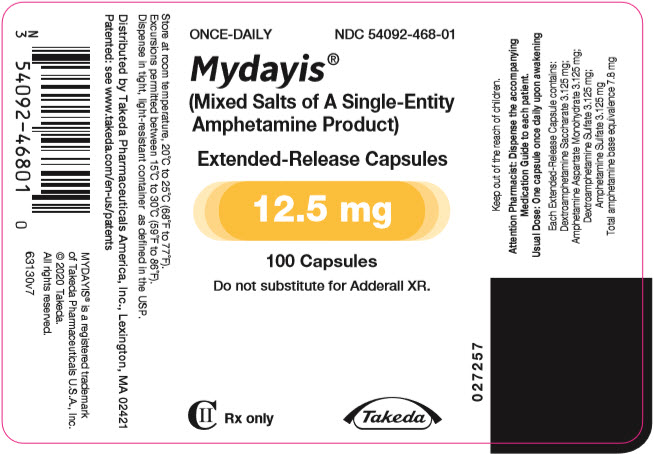
- 12.5 mg: Green body/green cap (imprinted with black SHIRE 465 and 12.5 mg), bottles of 100, NDC 54092-468-01
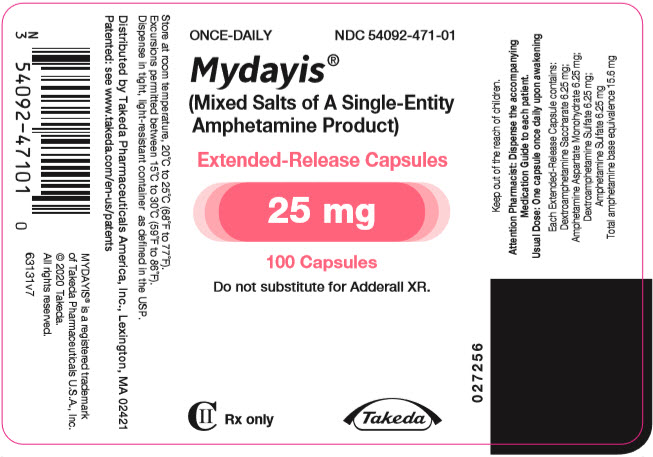
- 25 mg: Ivory body/green cap (imprinted with black SHIRE 465 and 25 mg), bottles of 100, NDC 54092-471-01
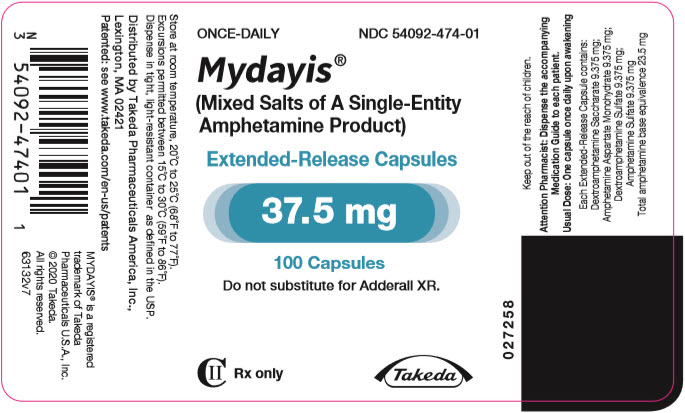
- 37.5 mg: Ivory body/caramel cap (imprinted with black SHIRE 465 and 37.5 mg), bottles of 100, NDC 54092-474-01
- 50 mg: Ivory body/purple cap (imprinted with black SHIRE 465 and 50 mg), bottles of 100, NDC 54092-477-01
Disposal
Comply with local laws and regulations on drug disposal of CNS stimulants. Dispose of remaining, unused, or expired MYDAYIS by a medicine take-back program.
Comply with local laws and regulations on drug disposal of CNS stimulants. Dispose of remaining, unused, or expired MYDAYIS at authorized collection sites such as retail pharmacies, hospital or clinic pharmacies, and law enforcement locations. If no take-back program or authorized collector is available, mix MYDAYIS with an undesirable, nontoxic substance to make it less appealing to children and pets. Place the mixture in a container such as a sealed plastic bag and discard MYDAYIS in the household trash.
Controlled Substance Status/High Potential for Abuse and Dependence
Advise patients and their caregivers that MYDAYIS is a federally controlled substance because it can be abused or lead to dependence. Advise patients to store MYDAYIS in a safe place, preferably locked, to prevent abuse. Advise patients to comply with laws and regulations on drug disposal. Advise patients to dispose of remaining, unused, or expired MYDAYIS by a medicine take-back program if available [see Boxed Warning, Warnings and Precautions (5.1), Drug Abuse and Dependence (9)].
Serious Cardiovascular Risks
Advise patients, caregivers, and family members that there is a potential serious cardiovascular risk including sudden death, myocardial infarction, stroke, and hypertension with MYDAYIS use. Instruct patients to contact a healthcare provider immediately if they develop symptoms such as exertional chest pain, unexplained syncope, or other symptoms suggestive of cardiac disease [see Warnings and Precautions (5.2)].
Blood Pressure and Heart Rate Increases
Instruct patients that MYDAYIS can cause elevations of their blood pressure and pulse rate and they should be monitored for such effects [see Warnings and Precautions (5.3)].
Psychiatric Risks
Advise patients that MYDAYIS, at recommended doses, may cause psychotic or manic symptoms even in patients without prior history of psychotic symptoms or mania [see Warnings and Precautions (5.4)].
Long-Term Suppression of Growth
Advise patients, family members, and caregivers that amphetamines may cause slowing of growth including weight loss [see Warnings and Precautions (5.5)].
Circulation Problems in Fingers and Toes [Peripheral Vasculopathy, including Raynaud's Phenomenon]
Instruct patients beginning treatment with MYDAYIS about the risk of peripheral vasculopathy, including Raynaud's phenomenon, and associated signs and symptoms: fingers or toes may feel numb, cool, painful, and/or may change from pale, to blue, to red. Instruct patients to report to their physician any new numbness, pain, skin color change, or sensitivity to temperature in fingers or toes. Instruct patients to call their physician immediately with any signs of unexplained wounds appearing on fingers or toes while taking MYDAYIS. Further clinical evaluation (e.g. rheumatology referral) may be appropriate for certain patients [see Warnings and Precautions (5.6)].
Seizures
Caution patient that MYDAYIS may lower the convulsive threshold. Advise patients to contact their healthcare provider immediately and to discontinue MYDAYIS if a seizure occurs [see Warnings and Precautions (5.7)].
Serotonin Syndrome
Caution patients about the risk of serotonin syndrome with concomitant use of MYDAYIS and other serotonergic drugs including SSRIs, SNRIs, triptans, tricyclic antidepressants, fentanyl, lithium, tramadol, tryptophan, buspirone, St. John's Wort, and with drugs that impair metabolism of serotonin (in particular MAOIs, both those intended to treat psychiatric disorders and also others such as linezolid [see Contraindications (4), Warnings and Precautions (5.8) and Drug Interactions (7.1)]. Advise patients to contact their healthcare provider or report to the emergency room if they experience signs or symptoms of serotonin syndrome.
Concomitant Medications
Advise patients to notify their physicians if they are taking, or plan to take, any prescription or over-the-counter drugs because there is a potential for interactions [see Drug Interactions (7.1)].
Pregnancy
Advise patients of the potential fetal effects from the use of MYDAYIS during pregnancy. Advise patients to notify their healthcare provider if they become pregnant or intend to become pregnant during treatment with MYDAYIS [see Use in Specific Populations (8.1)].
Lactation
Advise women not to breastfeed if they are taking MYDAYIS [see Use in Specific Populations (8.2)].
Alcohol
Advise patients to avoid alcohol while taking MYDAYIS. Consumption of alcohol while taking MYDAYIS may result in a more rapid release of the dose of mixed amphetamine salts [see Clinical Pharmacology (12.3)].
Manufactured for: Shire US Inc., 300 Shire Way, Lexington, MA 02421
Made in USA
For more information call 1-800-828-2088
MYDAYIS is a trademark of Shire LLC
©2017 Shire. All rights reserved.
US Pat No. RE41148, US Pat No. RE42096, US Pat. No. US 6913768, US Pat. No. 8,846,100, and US Pat. No. 9,173,857