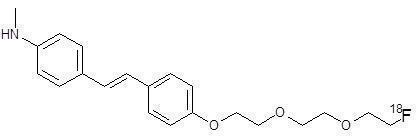
Neuraceq (doses ranging from 240 MBq to 360 MBq) was evaluated in three single arm clinical studies (Study A-C) that examined images from adults with a range of cognitive function, including some end-of-life patients who had agreed to participate in a post-mortem brain donation program. Subjects underwent Neuraceq injection and scan, then had images interpreted by independent readers masked to all clinical information.
The Standard of Truth (SoT) was based on the histopathologic examination using Bielschowsky silver staining (BSS) of six brain regions assessed by a Pathology Consensus Panel masked to all clinical information (including PET scan results). Neuraceq PET imaging results (negative or positive) corresponded to a histopathology derived plaque score based on the Consortium to Establish a Registry for Alzheimer’s Disease (CERAD) criteria using neuritic plaque counts (Table 5). For the subject level SoT, if in any of the six regions β-amyloid neuritic plaques were more than sparse, the subject was classified as positive; if in none of the regions the β-amyloid neuritic plaques were assessed as being more than sparse, the subject was classified as negative.
Table 5: ß-Amyloid Neuritic Plaque Counts Correlation to Image Results | Plaque Counts | CERAD Score | Neuraceq PET Image Result |
| <1 | None | Negative |
| 1 - 5 | Sparse |
| 6 - 19 | Moderate | Positive |
| ≥20 | Frequent |
Study A evaluated Neuraceq PET images from 205 subjects and compared the results to postmortem truth standard assessments of brain β-amyloid neuritic plaque density in subjects who died during the study. The median age was 79 years (range 48 to 98 years) and 52% of the subjects were male. By medical history 137 study participants had AD, 31 had other non-AD dementia, 5 had dementia with Lewy Bodies (DLB), and 32 had no clinical evidence of dementia. Interpretation of images from 82 autopsied subjects was compared to the subject level histopathology SoT. Three readers, after undergoing in-person tutoring, interpreted images using a clinically applicable image interpretation methodology [see Dosage and Administration (2.4)]. At autopsy, the subject level brain β-amyloid neuritic plaque density category was: frequent (n = 31); moderate (n = 21); sparse (n = 17); or none (n = 13). Results from Study A are presented in Table 6 and Table 7.
In Study B five independent, blinded readers underwent the Electronic Media Training in the clinically applicable image interpretation methodology [see Dosage and Administration (2.4)] and assessed images from the same 82 end-of-life subjects who enrolled in Study A. The time interval between the Neuraceq scan and death was less than one year for 45 patients, between one and two years for 23 patients and more than two years for 14 patients. Results from Study B can also be found in Table 6 and Table 7.
Study C evaluated the reliability and reproducibility of the clinically applicable image interpretation methodology [see Dosage and Administration (2.4)] using the Electronic Media Training; 461 images from previous clinical studies were included from subjects with a range of diagnoses. Five new readers assessed randomly provided images from subjects with a truth standard (54 subjects who underwent an autopsy) and without a truth standard (51 subjects with mild cognitive impairment, 182 subjects with AD, 35 subjects with other dementias, 5 subjects with Parkinson’s Disease and 188 healthy volunteers). Among the 461 subjects, the median age was 72 years (range 22 to 98), 197 were females, and 359 were Caucasian. Image reproducibility data for various subject groups in Study C are presented in Table 8. Inter-reader agreement across all 5 readers had a kappa coefficient of 0.79 (95% CI 0.77, 0.83). The performance characteristics in 54 subjects with SoT were similar to those measured in Studies A and B. Additionally, intra-reader reproducibility was assessed from 46 images (10%); the percentage of intra- reader agreement for the 5 readers ranged from 91% to 98%.
Table 6: Neuraceq Results by Reader Training Method using BSS as Standard of Truth| Read Result | In-Person Training (Study A) | Electronic Media Training (Study B) |
| n=82 | n=82 |
| Sensitivity (%) | Median | 98 | 96 |
| Range among the readers | 96-98 | 90-100 |
| Specificity (%) | Median | 80 | 77 |
| Range among the readers | 77-83 | 47-80 |
Table 7: Neuraceq Correct and Erroneous Read Results by Reader Training Method| Read Result | In-Person Training (Study A) | Electronic Media Training (Study B) |
| Reader | Reader |
| 1 | 2 | 3 | 4 | 5 | 6 | 7 | 8 |
| Correct | 75 | 74 | 75 | 73 | 65 | 71 | 73 | 69 |
| False Negative | 2 | 1 | 1 | 3 | 1 | 5 | 2 | 0 |
| False Positive | 5 | 7 | 6 | 6 | 16 | 6 | 7 | 13 |
BSS was the Histopathology Standard of Truth
Table 8: Reproducibility of Scan Results among Readers in Various Subject Groupsa | Subject Group by Cognitive Status and Standard of Truth (SoT) | Positive Scans nb | Kappa (95% CI) | Percent of Scans with Inter-reader Agreement |
| 3 of 5 readers agreed | 4 of 5 readers agreed | 5 of 5 readers agreed |
| All subjects (n=454) | 212 | 0.80
(0.77, 0.83) | 6 | 15 | 78 |
| Subjects without SoT (n=394) | 175 | 0.80
(0.77, 0.83) | 6 | 15 | 79 |
| Subjects with SoT (n=60) | 37 | 0.75
(0.67, 0.83) | 10 | 15 | 75 |
| AD (n=176) | 139 | 0.77
(0.72, 0.81) | 7 | 10 | 83 |
| HV (n=188) | 26 | 0.55
(0.49, 0.58) | 7 | 15 | 77 |
| MCI (n=50, all without SoT) | 28 | 0.84
(0.75, 0.92) | 0 | 20 | 80 |
| Other Dementias (n=40) | 18 | 0.65
(0.55, 0.74) | 8 | 33 | 60 |
aSubjects with missing scan interpretation (2 to 6% per group) were excluded from the analyses.
bShown is the median number of scans interpreted as positive across the 5 readers for each group of subjects listed in the first column.
Alzheimer’s disease (AD), Mild cognitive impairment (MCI), healthy volunteer (HV). Other dementias include DLB, fronto-temporal lobe dementia, vascular dementia, and dementia associated with PD.