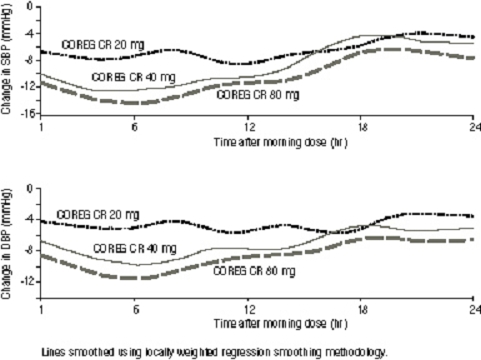
COREG CR was evaluated for safety in an 8-week double-blind trial in 337 subjects with essential hypertension. The profile of adverse events observed with COREG CR was generally similar to that observed with immediate-release carvedilol. The overall rates of discontinuations due to adverse events were similar between COREG CR and placebo.
Table 3. Adverse Events (%) Occurring More Frequently With COREG CR Than With Placebo in Patients With Hypertension (Incidence ≥1% in Patients Treated With Carvedilol, Regardless of Causality) | COREG CR (n = 253) | Placebo (n = 84) |
| Nasopharyngitis | 4 | 0 |
| Dizziness | 2 | 1 |
| Nausea | 2 | 0 |
| Edema peripheral | 2 | 1 |
| Nasal congestion | 1 | 0 |
| Paresthesia | 1 | 0 |
| Sinus congestion | 1 | 0 |
| Diarrhea | 1 | 0 |
| Insomnia | 1 | 0 |
The following information describes the safety experience in hypertension with immediate-release carvedilol.
Carvedilol has been evaluated for safety in hypertension in more than 2,193 patients in US clinical trials and in 2,976 patients in international clinical trials. Approximately 36% of the total treated population received carvedilol for at least 6 months. In general, carvedilol was well tolerated at doses up to 50 mg daily. Most adverse events reported during carvedilol therapy were of mild to moderate severity. In US controlled clinical trials directly comparing carvedilol monotherapy in doses up to 50 mg (n = 1,142) to placebo (n = 462), 4.9% of carvedilol patients discontinued for adverse events versus 5.2% of placebo patients. Although there was no overall difference in discontinuation rates, discontinuations were more common in the carvedilol group for postural hypotension (1% versus 0). The overall incidence of adverse events in US placebo-controlled trials was found to increase with increasing dose of carvedilol. For individual adverse events this could only be distinguished for dizziness, which increased in frequency from 2% to 5% as total daily dose increased from 6.25 mg to 50 mg as single or divided doses.
Table 4 shows adverse events in US placebo-controlled clinical trials for hypertension that occurred with an incidence of ≥1% regardless of causality, and that were more frequent in drug-treated patients than placebo-treated patients.
Table 4. Adverse Events (% Occurrence) in US Placebo-Controlled Hypertension Trials With Immediate-Release Carvedilol (Incidence ≥1% in Patients Treated With Carvedilol, Regardless of Causality)* | Carvedilol (n = 1,142) | Placebo (n = 462) |
| Cardiovascular | | |
| Bradycardia | 2 | — |
| Postural hypotension | 2 | — |
| Peripheral edema | 1 | — |
| Central Nervous System | | |
| Dizziness | 6 | 5 |
| Insomnia | 2 | 1 |
| Gastrointestinal | | |
| Diarrhea | 2 | 1 |
| Hematologic | | |
| Thrombocytopenia | 1 | — |
| Metabolic | | |
| Hypertriglyceridemia | 1 | — |
* Shown are events with rate >1% rounded to nearest integer.
Dyspnea and fatigue were also reported in these studies, but the rates were equal or greater in patients who received placebo.
The following adverse events not described above were reported as possibly or probably related to carvedilol in worldwide open or controlled trials with carvedilol in patients with hypertension or heart failure.
Incidence >0.1% to ≤1%
Cardiovascular: Peripheral ischemia, tachycardia.
Central and Peripheral Nervous System: Hypokinesia.
Gastrointestinal: Bilirubinemia, increased hepatic enzymes (0.2% of hypertension patients and 0.4% of heart failure patients were discontinued from therapy because of increases in hepatic enzymes) [see Adverse Reactions (6.2)].
Psychiatric: Nervousness, sleep disorder, aggravated depression, impaired concentration, abnormal thinking, paroniria, emotional lability.
Respiratory System: Asthma [see Contraindications (4)].
Reproductive, male: Decreased libido.
Skin and Appendages: Pruritus, rash erythematous, rash maculopapular, rash psoriaform, photosensitivity reaction.
Special Senses: Tinnitus.
Urinary System: Micturition frequency increased.
Autonomic Nervous System: Dry mouth, sweating increased.
Metabolic and Nutritional: Hypokalemia, hypertriglyceridemia.
Hematologic: Anemia, leukopenia.
The following events were reported in ≤0.1% of patients and are potentially important: Complete AV block, bundle branch block, myocardial ischemia, cerebrovascular disorder, convulsions, migraine, neuralgia, paresis, anaphylactoid reaction, alopecia, exfoliative dermatitis, amnesia, GI hemorrhage, bronchospasm, pulmonary edema, decreased hearing, respiratory alkalosis, increased BUN, decreased HDL, pancytopenia, and atypical lymphocytes.
The mechanism by which β-blockade produces an antihypertensive effect has not been established.
β-adrenoreceptor blocking activity has been demonstrated in animal and human studies showing that carvedilol (1) reduces cardiac output in normal subjects; (2) reduces exercise- and/or isoproterenol-induced tachycardia; and (3) reduces reflex orthostatic tachycardia. Significant β-adrenoreceptor blocking effect is usually seen within 1 hour of drug administration.
α1-adrenoreceptor blocking activity has been demonstrated in human and animal studies, showing that carvedilol (1) attenuates the pressor effects of phenylephrine; (2) causes vasodilation; and (3) reduces peripheral vascular resistance. These effects contribute to the reduction of blood pressure and usually are seen within 30 minutes of drug administration.
Due to the α1-receptor blocking activity of carvedilol, blood pressure is lowered more in the standing than in the supine position, and symptoms of postural hypotension (1.8%), including rare instances of syncope, can occur. Following oral administration, when postural hypotension has occurred, it has been transient and is uncommon when immediate-release carvedilol is administered with food at the recommended starting dose and titration increments are closely followed [see Dosage and Administration (2)].
In a randomized, double-blind, placebo-controlled trial, the β1-blocking effect of COREG CR, as measured by heart rate response to submaximal bicycle ergometry, was shown to be equivalent to that observed with immediate-release carvedilol at steady state in adult patients with essential hypertension.
In hypertensive patients with normal renal function, therapeutic doses of carvedilol decreased renal vascular resistance with no change in glomerular filtration rate or renal plasma flow. Changes in excretion of sodium, potassium, uric acid, and phosphorus in hypertensive patients with normal renal function were similar after carvedilol and placebo.
Carvedilol has little effect on plasma catecholamines, plasma aldosterone, or electrolyte levels, but it does significantly reduce plasma renin activity when given for at least 4 weeks. It also increases levels of atrial natriuretic peptide.
For corresponding dose levels [see Dosage and Administration (2)], the pharmacokinetics (AUC, Cmax, and trough concentrations) observed with administration of COREG CR were equivalent (±20%) to those observed with immediate-release carvedilol tablets following repeat dosing in patients with essential hypertension.