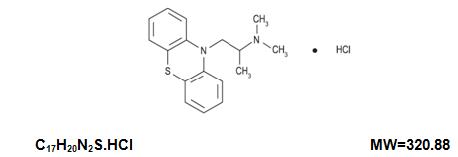
Promethazine hydrochloride injection can cause severe chemical irritation and damage to tissues, regardless of the route of administration. Irritation and damage can also result from perivascular extravasation, unintentional intra-arterial injection, and intraneuronal or perineuronal infiltration. Adverse event reports include burning, pain, erythema, swelling, sensory loss, palsies, paralysis, severe spasms of distal vessels, thrombophlebitis, venous thrombosis, phlebitis, abscesses, tissue necrosis, and gangrene. In some cases surgical intervention, including fasciotomy, skin graft, and/or amputation have been required.
Because of the risks of intravenous injection, the preferred route of administration of promethazine hydrochloride injection is deep intramuscular injection (see DOSAGE AND ADMINISTATION). Subcutaneous injection is contraindicated. Due to close proximity of arteries and veins in the areas most commonly used for intravenous injection, extreme care should be exercised to avoid perivascular extravasation or unintentional intra-arterial injection as pain, severe chemical irritation, severe spasm of distal vessels, and resultant gangrene requiring amputation are likely under such circumstances. Aspiration of dark blood does not preclude intra-arterial needle placement because blood is discolored upon contact with promethazine hydrochloride injection. Use of syringes with rigid plungers or small-bore needles might obscure typical arterial backflow if this is relied upon.
In the event that a patient complains of pain during intravenous injection of promethazine hydrochloride injection, the injection should be stopped immediately to evaluate for possible arterial injection or perivascular extravasation.
There is no proven successful management of unintentional intra-arterial injection or perivascular extravasation after it occurs. Sympathetic block and heparinization have been employed during the acute management of unintentional intra-arterial injection, because of the results of animal experiments with other known arteriolar irritants.
Promethazine hydrochloride injection can cause severe chemical irritation and damage to tissues, regardless of the route of administration. Irritation and damage can also result from perivascular extravasation, unintentional intra-arterial injection, and intraneuronal or perineuronal infiltration. Adverse event reports include burning, pain, erythema, swelling, sensory loss, palsies, paralysis, severe spasms of distal vessels, thrombophlebitis, venous thrombosis, phlebitis, abscesses, tissue necrosis, and gangrene. In some cases surgical intervention, including fasciotomy, skin graft, and/or amputation have been required (see WARNINGS – Severe Tissue Injury, Including Gangrene: and DOSAGE AND ADMINISTRATION).