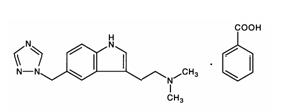
- 5 mg orally disintegrating tablets are white to off-white, round lyophilized tablets debossed with a modified triangle on one side.
- 10 mg orally disintegrating tablets are white to off-white, round lyophilized tablets debossed with a modified square on one side.
Adults
Incidence in Controlled Clinical Trials
Adverse reactions to MAXALT were assessed in controlled clinical trials that included over 3700 adult patients who received single or multiple doses of MAXALT Tablets. The most common adverse reactions during treatment with MAXALT (≥5% in either treatment group and greater than placebo) were asthenia/fatigue, somnolence, pain/pressure sensation and dizziness. These adverse reactions appeared to be dose related.
Table 1 lists the adverse reactions (incidence ≥2% and greater than placebo) after a single dose of MAXALT in adults.
Table 1: Incidence (≥2% and Greater than Placebo) of Adverse Reactions After a Single Dose of MAXALT Tablets or Placebo in Adults | % of Patients |
|---|
| Adverse Reactions | MAXALT
5 mg
(N=977) | MAXALT
10 mg
(N=1167) | Placebo
(N=627) |
|---|
| Atypical Sensations | 4 | 5 | 4 |
| Paresthesia | 3 | 4 | <2 |
| Pain and other Pressure Sensations | 6 | 9 | 3 |
| Chest Pain: | | | |
| tightness/pressure and/or heaviness | <2 | 3 | 1 |
| Neck/throat/jaw: | | | |
| pain/tightness/pressure | <2 | 2 | 1 |
| Regional Pain: | | | |
| tightness/pressure and/or heaviness | <1 | 2 | 0 |
| Pain, location unspecified | 3 | 3 | <2 |
| Digestive | 9 | 13 | 8 |
| Dry Mouth | 3 | 3 | 1 |
| Nausea | 4 | 6 | 4 |
| Neurological | 14 | 20 | 11 |
| Dizziness | 4 | 9 | 5 |
| Headache | <2 | 2 | <1 |
| Somnolence | 4 | 8 | 4 |
| Other | | | |
| Asthenia/fatigue | 4 | 7 | 2 |
The frequencies of adverse reactions in clinical trials did not increase when up to three doses were taken within 24 hours. Adverse reaction frequencies were also unchanged by concomitant use of drugs commonly taken for migraine prophylaxis (including propranolol), oral contraceptives, or analgesics. The incidences of adverse reactions were not affected by age or gender. There were insufficient data to assess the impact of race on the incidence of adverse reactions.
Other Events Observed in Association with the Administration of MAXALT in Adults
In the following section, the frequencies of less commonly reported adverse events are presented that were not reported in other sections of the labeling. Because the reports include events observed in open studies, the role of MAXALT in their causation cannot be reliably determined. Furthermore, variability associated with adverse event reporting, the terminology used to describe adverse events, limit the value of the quantitative frequency estimates provided. Event frequencies are calculated as the number of patients who used MAXALT and reported an event divided by the total number of patients exposed to MAXALT (N=3716). All reported events occurred at an incidence ≥1%, or are believed to be reasonably associated with the use of the drug. Events are further classified within body system categories and enumerated in order of decreasing frequency using the following definitions: frequent adverse events are those defined as those occurring in at least (>)1/100 patients; infrequent adverse experiences are those occurring in 1/100 to 1/1000 patients; and rare adverse experiences are those occurring in fewer than 1/1000 patients.
General: Infrequent was facial edema. Rare were syncope and edema/swelling.
Atypical Sensations: Frequent were warm sensations.
Cardiovascular: Frequent was palpitation. Infrequent were tachycardia, cold extremities, and bradycardia.
Digestive: Frequent were diarrhea and vomiting. Infrequent were dyspepsia, tongue edema and abdominal distention.
Musculoskeletal: Infrequent were muscle weakness, stiffness, myalgia and muscle cramp/spasm.
Neurological/Psychiatric: Frequent were hypoesthesia, euphoria and tremor. Infrequent were vertigo, insomnia, confusion/disorientation, gait abnormality, memory impairment, and agitation.
Respiratory: Frequent was dyspnea. Infrequent was pharyngeal edema.
Special Senses: Infrequent were blurred vision and tinnitus. Rare was eye swelling.
Skin and Skin Appendage: Frequent was flushing. Infrequent were sweating, pruritus, rash, and urticaria. Rare was erythema, hot flashes.
The adverse reaction profile seen with MAXALT-MLT Orally Disintegrating Tablets was similar to that seen with MAXALT Tablets.
Pediatric Patients 6 to 17 Years of Age
Incidence in Controlled Clinical Trials in Pediatric Patients
Adverse reactions to MAXALT-MLT were assessed in a controlled clinical trial in the acute treatment of migraines (Study 7) that included a total of 1382 pediatric patients 6-17 years of age, of which 977 (72%) administered at least one dose of study treatment (MAXALT-MLT and/or placebo) [see Clinical Studies (14.2)]. The incidence of adverse reactions reported for pediatric patients in the acute clinical trial was similar in patients who received MAXALT to those who received placebo. The adverse reaction pattern in pediatric patients is expected to be similar to that in adults.
Other Events Observed in Association with the Administration of MAXALT-MLT in Pediatric Patients
In the following section, the frequencies of less commonly reported adverse events are presented. Because the reports include events observed in open studies, the role of MAXALT-MLT in their causation cannot be reliably determined. Furthermore, variability associated with adverse event reporting, the terminology used to describe adverse events, limit the value of the quantitative frequency estimates provided.
Event frequencies are calculated as the number of pediatric patients 6 to 17 years of age who used MAXALT-MLT and reported an event divided by the total number of patients exposed to MAXALT-MLT (N=1068). All reported events occurred at an incidence ≥1%, or are believed to be reasonably associated with the use of the drug. Events are further classified within system organ class and enumerated in order of decreasing frequency using the following definitions: frequent adverse events are those occurring in (>)1/100 pediatric patients; infrequent adverse experiences are those occurring in 1/100 to 1/1000 pediatric patients; and rare adverse experiences are those occurring in fewer than 1/1000 patients.
General: Frequent was fatigue.
Ear and labyrinth disorders: Infrequent was hypoacusis.
Gastrointestinal disorders: Frequent was abdominal discomfort.
Nervous system disorders: Infrequent were coordination abnormal, disturbance in attention, and presyncope.
Psychiatric disorders: Infrequent was hallucination.
Absorption
Rizatriptan is completely absorbed following oral administration. The mean oral absolute bioavailability of the MAXALT Tablet is about 45%, and mean peak plasma concentrations (Cmax) are reached in approximately 1-1.5 hours (Tmax). The presence of a migraine headache did not appear to affect the absorption or pharmacokinetics of rizatriptan. Food has no significant effect on the bioavailability of rizatriptan but delays the time to reach peak concentration by an hour. In clinical trials, MAXALT was administered without regard to food.
The bioavailability and Cmax of rizatriptan were similar following administration of MAXALT Tablets and MAXALT-MLT Orally Disintegrating Tablets, but the rate of absorption is somewhat slower with MAXALT-MLT, with Tmax delayed by up to 0.7 hour. AUC of rizatriptan is approximately 30% higher in females than in males. No accumulation occurred on multiple dosing.
Distribution
The mean volume of distribution is approximately 140 liters in male subjects and 110 liters in female subjects. Rizatriptan is minimally bound (14%) to plasma proteins.
Metabolism
The primary route of rizatriptan metabolism is via oxidative deamination by monoamine oxidase-A (MAO-A) to the indole acetic acid metabolite, which is not active at the 5-HT1B/1D receptor. N-monodesmethyl-rizatriptan, a metabolite with activity similar to that of parent compound at the 5-HT1B/1D receptor, is formed to a minor degree. Plasma concentrations of N-monodesmethyl-rizatriptan are approximately 14% of those of parent compound, and it is eliminated at a similar rate. Other minor metabolites, the N-oxide, the 6-hydroxy compound, and the sulfate conjugate of the 6-hydroxy metabolite are not active at the 5-HT1B/1D receptor.
Elimination
The total radioactivity of the administered dose recovered over 120 hours in urine and feces was 82% and 12%, respectively, following a single 10 mg oral administration of 14C-rizatriptan. Following oral administration of 14C-rizatriptan, rizatriptan accounted for about 17% of circulating plasma radioactivity. Approximately 14% of an oral dose is excreted in urine as unchanged rizatriptan while 51% is excreted as indole acetic acid metabolite, indicating substantial first pass metabolism.
The plasma half-life of rizatriptan in males and females averages 2-3 hours.
Cytochrome P450 Isoforms
Rizatriptan is not an inhibitor of the activities of human liver cytochrome P450 isoforms 3A4/5, 1A2, 2C9, 2C19, or 2E1; rizatriptan is a competitive inhibitor (Ki=1400 nM) of cytochrome P450 2D6, but only at high, clinically irrelevant concentrations.
Special Populations
Geriatric: Rizatriptan pharmacokinetics in healthy elderly non-migraineur volunteers (age 65-77 years) were similar to those in younger non-migraineur volunteers (age 18-45 years).
Pediatric: The pharmacokinetics of rizatriptan was determined in pediatric migraineurs 6 to 17 years of age. Exposures following single dose administration of 5 mg MAXALT-MLT to pediatric patients weighing 20-39 kg (44-87 lb) or 10 mg MAXALT-MLT to pediatric patients weighing ≥40 kg (88 lb) were similar to those observed following single dose administration of 10 mg MAXALT-MLT to adults.
Gender: The mean AUC0-∞ and Cmax of rizatriptan (10 mg orally) were about 30% and 11% higher in females as compared to males, respectively, while Tmax occurred at approximately the same time.
Hepatic impairment: Following oral administration in patients with hepatic impairment caused by mild to moderate alcoholic cirrhosis of the liver, plasma concentrations of rizatriptan were similar in patients with mild hepatic insufficiency compared to a control group of subjects with normal hepatic function; plasma concentrations of rizatriptan were approximately 30% greater in patients with moderate hepatic insufficiency.
Renal impairment: In patients with renal impairment (creatinine clearance 10-60 mL/min/1.73 m2), the AUC0-∞ of rizatriptan was not significantly different from that in subjects with normal renal function. In hemodialysis patients, (creatinine clearance <2 mL/min/1.73 m2), however, the AUC for rizatriptan was approximately 44% greater than that in patients with normal renal function.
Race: Pharmacokinetic data revealed no significant differences between African American and Caucasian subjects.
Monoamine oxidase inhibitors: Rizatriptan is principally metabolized via monoamine oxidase, 'A' subtype (MAO-A). Plasma concentrations of rizatriptan may be increased by drugs that are selective MAO-A inhibitors (e.g., moclobemide) or nonselective MAO inhibitors [type A and B] (e.g., isocarboxazid, phenelzine, tranylcypromine, and pargyline). In a drug interaction study, when MAXALT 10 mg was administered to subjects (n=12) receiving concomitant therapy with the selective, reversible MAO-A inhibitor, moclobemide 150 mg t.i.d., there were mean increases in rizatriptan AUC and Cmax of 119% and 41% respectively; and the AUC of the active N-monodesmethyl metabolite of rizatriptan was increased more than 400%. The interaction would be expected to be greater with irreversible MAO inhibitors. No pharmacokinetic interaction is anticipated in patients receiving selective MAO-B inhibitors [see Contraindications (4) and Drug Interactions (7.5)].
Propranolol: In a study of concurrent administration of propranolol 240 mg/day and a single dose of rizatriptan 10 mg in healthy adult subjects (n=11), mean plasma AUC for rizatriptan was increased by 70% during propranolol administration, and a four-fold increase was observed in one subject. The AUC of the active N-monodesmethyl metabolite of rizatriptan was not affected by propranolol [see Dosage and Administration (2.4) and Drug Interactions (7.1)].
Nadolol/Metoprolol: In a drug interactions study, effects of multiple doses of nadolol 80 mg or metoprolol 100 mg every 12 hours on the pharmacokinetics of a single dose of 10 mg rizatriptan were evaluated in healthy subjects (n=12). No pharmacokinetic interactions were observed.
Paroxetine: In a study of the interaction between the selective serotonin reuptake inhibitor (SSRI) paroxetine 20 mg/day for two weeks and a single dose of MAXALT 10 mg in healthy subjects (n=12), neither the plasma concentrations of rizatriptan nor its safety profile were affected by paroxetine [see Warnings and Precautions (5.7), Drug Interactions (7.4), and Patient Counseling Information (17)].
Oral contraceptives: In a study of concurrent administration of an oral contraceptive during 6 days of administration of MAXALT (10-30 mg/day) in healthy female volunteers (n=18), rizatriptan did not affect plasma concentrations of ethinyl estradiol or norethindrone.
Carcinogenesis: Oral carcinogenicity studies were conducted in mice (100 weeks) and rats (106 weeks) at doses of up to 125 mg/kg/day. Plasma exposures (AUC) at the highest dose tested were approximately 150 (mice) and 240 times (rats) that in humans at the maximum recommended daily dose (MRDD) of 30 mg/day. There was no evidence of an increase in tumor incidence related to rizatriptan in either species.
Mutagenesis: Rizatriptan was neither mutagenic nor clastogenic in a battery of in vitro and in vivo genetic toxicity studies, including: the microbial mutagenesis (Ames) assay, in vitro mammalian cell mutagenesis and chromosomal aberration assays, and the in vivo chromosomal aberration assay in mouse.
Impairment of Fertility: In a fertility study in rats, altered estrus cyclicity and delays in time to mating were observed in females treated orally with 100 mg/kg/day rizatriptan. The no-effect dose was 10 mg/kg/day (approximately 15 times the human exposure at the MRDD). There were no other fertility-related effects in the female rats. There was no impairment of fertility or reproductive performance in male rats treated with up to 250 mg/kg/day (approximately 550 times the human exposure at the MRDD).
MAXALT-MLT Orally Disintegrating Tablets
The efficacy of MAXALT-MLT was established in two multicenter, randomized, placebo-controlled trials that were similar in design to the trials of MAXALT Tablets (Studies 5 and 6). Patients were instructed to treat a moderate to severe headache. Patients treated in these studies were primarily female (88%) and Caucasian (95%), with a mean age of 42 years (range 18-72).
In both studies, the percentage of patients achieving headache response 2 hours after treatment was significantly greater in patients who received either MAXALT-MLT 5 or 10 mg compared to those who received placebo. The results from Studies 5 and 6 are summarized in Table 3.
Table 3: Response Rates 2 Hours Following Treatment of Initial Headache in Studies 5 and 6| Study | Placebo | MAXALT-MLT
5 mg | MAXALT-MLT
10 mg |
|---|
| 5 | 47% (n=98) | 66% p-value <0.01 in comparison with placebo (n=100) | 66% (n=113) |
| 6 | 28% (n=180) | 59% (n=181) | 74%, p-value <0.01 in comparison with 5 mg (n=186) |
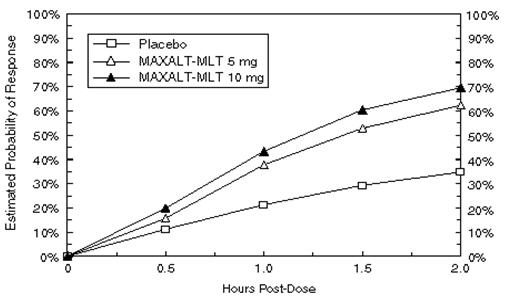
The estimated probability of achieving an initial headache response by 2 hours following treatment with MAXALT-MLT in pooled Studies 5 and 6 is depicted in Figure 3.
Figure 3: Estimated Probability of Achieving an Initial Headache Response with MAXALT-MLT by 2 Hours in Pooled Studies 5 and 6Figure 3 shows the Kaplan-Meier plot of the probability over time of obtaining headache response (no or mild pain) following treatment with MAXALT-MLT or placebo. The averages displayed are based on pooled data from 2 placebo-controlled, outpatient trials providing evidence of efficacy (Studies 5 and 6). Patients taking additional treatment or not achieving headache response prior to 2 hours were censored at 2 hours.
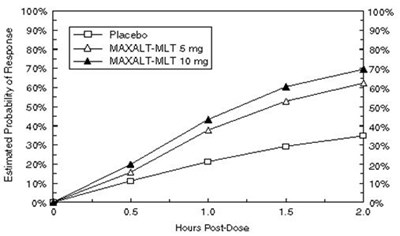 Image Of Figure 3 (Maxalt 04) |
For patients with migraine-associated photophobia and phonophobia at baseline, there was a decreased incidence of these symptoms following administration of MAXALT-MLT as compared to placebo.
Two to 24 hours following the initial dose of study treatment, patients were allowed to use additional treatment for pain response in the form of a second dose of study treatment or other medication. The estimated probability of patients taking a second dose or other medication for migraine over the 24 hours following the initial dose of study treatment is summarized in Figure 4.
Figure 4: Estimated Probability of Patients Taking a Second Dose of MAXALT-MLT or Other Medication for Migraines Over the 24 Hours Following the Initial Dose of Study Treatment in Pooled Studies 5 and 6This Kaplan-Meier plot is based on data obtained in 2 placebo-controlled outpatient clinical trials (Studies 5 and 6). Patients not using additional treatments were censored at 24 hours. The plot includes both patients who had headache response at 2 hours and those who had no response to the initial dose. Remedication was not allowed within 2 hours post-dose.
 Image Of Figure 4 (Maxalt 05) |
Risk of Myocardial Ischemia and/or Infarction, Prinzmetal's Angina, Other Vasospasm-related Events, and Cerebrovascular Events
Inform patients that MAXALT may cause serious cardiovascular side effects such as myocardial infarction or stroke. Although serious cardiovascular events can occur without warning symptoms, patients should be alert for the signs and symptoms of chest pain, shortness of breath, weakness, slurring of speech, and should ask for medical advice when observing any indicative sign or symptoms. Patients should be apprised of the importance of this follow-up [see Warnings and Precautions (5.1, 5.2, 5.4, 5.5)].
Serotonin Syndrome
Patients should be cautioned about the risk of serotonin syndrome with the use of MAXALT or other triptans, particularly during combined use with selective serotonin reuptake inhibitors (SSRIs) or serotonin norepinephrine reuptake inhibitors (SNRIs) [see Warnings and Precautions (5.7), Drug Interactions (7.4), and Clinical Pharmacology (12.3)].
Ability To Perform Complex Tasks
Since migraines or treatment with MAXALT may cause somnolence and dizziness, instruct patients to evaluate their ability to perform complex tasks during migraine attacks and after administration of MAXALT.
Medication Overuse Headache
Inform patients that use of acute migraine drugs for 10 or more days per month may lead to an exacerbation of headache, and encourage patients to record headache frequency and drug use (e.g., by keeping a headache diary) [see Warnings and Precautions (5.6)].
Handling of Orally Disintegrating Tablets Packages
Instruct patients not to remove the blister from the outer aluminum pouch until ready to use the orally disintegrating tablet inside [see Dosage and Administration (2.3)].
Patients with Phenylketonuria
Inform phenylketonuric patients that MAXALT-MLT Orally Disintegrating Tablets contain phenylalanine (a component of aspartame). Each 5-mg orally disintegrating tablet contains 1.1 mg phenylalanine, and each 10-mg orally disintegrating tablet contains 2.1 mg phenylalanine [see Use in Specific Populations (8.6)].
MAXALT Tablets are manufactured for:
Merck Sharp & Dohme Corp., a subsidiary of
MERCK & CO., INC., Whitehouse Station, NJ 08889, USA
By:
MSD, Ltd.
Cramlington, Northumberland, NE23 3JU, UK
MAXALT-MLT Orally Disintegrating Tablets are manufactured for:
Merck Sharp & Dohme Corp., a subsidiary of
MERCK & CO., INC., Whitehouse Station, NJ 08889, USA
By:
Catalent UK Swindon, Zydis Ltd.
Swindon, Wiltshire, SN5 8RU, UK
US Patent No.: 5,298,520
Copyright © 1998, 2006, 2011 Merck Sharp & Dohme Corp., a subsidiary of Merck & Co., Inc.
All rights reserved.
Revised: 12/2011
9652510
Relabeling and Repackaging by:
Physicians Total Care, Inc.
Tulsa, Oklahoma 74146
MAXALT Tablets are manufactured for:
Merck Sharp & Dohme Corp., a subsidiary of
MERCK & CO., INC., Whitehouse Station, NJ 08889, USA
By:
MSD, Ltd.
Cramlington, Northumberland, NE23 3JU, UK
MAXALT-MLT Orally Disintegrating Tablets are manufactured for:
Merck Sharp & Dohme Corp., a subsidiary of
MERCK & CO., INC., Whitehouse Station, NJ 08889, USA
By:
Catalent UK Swindon, Zydis Ltd.
Swindon, Wiltshire, SN5 8RU, UK
US Patent No.: 5,298,520
The brands listed are the trademarks of their respective owners.
Copyright © 1998, 2006, 2011 Merck Sharp & Dohme Corp., a subsidiary of Merck & Co., Inc.
All rights reserved.
Revised: 12/2011
9652510