The antihypertensive effects of AVAPRO (irbesartan) were examined
in 7 major placebo-controlled 8 to 12 week trials in patients with baseline
diastolic blood pressures of 95 mmHg to 110 mmHg. Doses of 1 mg to 900 mg
were included in these trials in order to fully explore the dose-range of
irbesartan. These studies allowed comparison of once- or twice-daily regimens
at 150 mg/day, comparisons of peak and trough effects, and
comparisons of response by gender, age, and race. Two of the 7 placebo-controlled
trials identified above examined the antihypertensive effects of irbesartan
and hydrochlorothiazide in combination.
The 7 studies of irbesartan monotherapy included a total of 1915
patients randomized to irbesartan (1-900 mg) and 611 patients randomized to
placebo. Once-daily doses of 150 mg and 300 mg provided statistically and
clinically significant decreases in systolic and diastolic blood pressure
with trough (24 hours post-dose) effects after 6 to 12 weeks of treatment
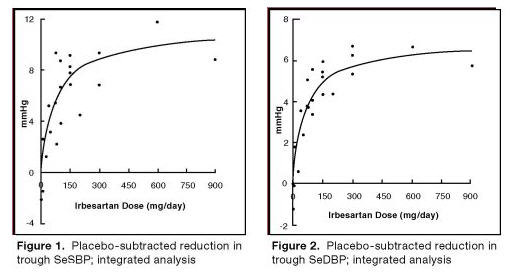
compared to placebo, of about 8-10/5-6 mmHg and 8-12/5-8 mmHg, respectively.
No further increase in effect was seen at dosages greater than 300 mg. The
dose-response relationships for effects on systolic and diastolic pressure
are shown in Figures 1 and 2.

Avapro Figures 1 And 2 (Avapro Figs1 2)
Once-daily administration of therapeutic doses of irbesartan gave
peak effects at around 3 to 6 hours and, in one ambulatory blood pressure
monitoring study, again around 14 hours. This was seen with both once-daily
and twice-daily dosing. Trough-to-peak ratios for systolic and diastolic response
were generally between 60% to 70%. In a continuous ambulatory blood pressure
monitoring study, once-daily dosing with 150 mg gave trough and mean 24-hour
responses similar to those observed in patients receiving twice-daily dosing
at the same total daily dose.
In controlled trials, the addition of irbesartan to hydrochlorothiazide
doses of 6.25 mg, 12.5 mg, or 25 mg produced
further dose-related reductions in blood pressure similar to those achieved
with the same monotherapy dose of irbesartan. HCTZ also had an approximately
additive effect.
Analysis of age, gender, and race subgroups of patients showed
that men and women, and patients over and under 65 years of age, had generally
similar responses. Irbesartan was effective in reducing blood pressure regardless
of race, although the effect was somewhat less in blacks (usually a low-renin
population).
The effect of irbesartan is apparent after the first dose, and
it is close to its full observed effect at 2 weeks. At the end of an 8-week
exposure, about 2/3 of the antihypertensive effect was still present one week
after the last dose. Rebound hypertension was not observed. There was essentially
no change in average heart rate in irbesartan-treated patients in controlled
trials.
AVAPRO (irbesartan) is indicated for the treatment of hypertension.
It may be used alone or in combination with other antihypertensive agents.
AVAPRO has been evaluated for safety in more than 4300 patients
with hypertension and about 5000 subjects overall. This experience includes
1303 patients treated for over 6 months and 407 patients for 1 year or more.
Treatment with AVAPRO was well-tolerated, with an incidence of adverse events
similar to placebo. These events generally were mild and transient with no
relationship to the dose of AVAPRO.
In placebo-controlled clinical trials, discontinuation of therapy
due to a clinical adverse event was required in 3.3% of patients treated with
AVAPRO, versus 4.5% of patients given placebo.
In placebo-controlled clinical trials, the following adverse event
experiences reported in at least 1% of patients treated with AVAPRO (n=1965)
and at a higher incidence versus placebo (n=641), excluding those too general
to be informative and those not reasonably associated with the use of drug
because they were associated with the condition being treated or are very
common in the treated population, include: diarrhea (3% vs 2%), dyspepsia/heartburn
(2% vs 1%), and fatigue (4% vs 3%).
The following adverse events occurred at an incidence of 1% or
greater in patients treated with irbesartan, but were at least as frequent
or more frequent in patients receiving placebo: abdominal pain, anxiety/nervousness,
chest pain, dizziness, edema, headache, influenza, musculoskeletal pain, pharyngitis,
nausea/vomiting, rash, rhinitis, sinus abnormality, tachycardia, and urinary
tract infection.
Irbesartan use was not associated with an increased incidence of
dry cough, as is typically associated with ACE inhibitor use. In placebo-controlled
studies, the incidence of cough in irbesartan-treated patients was 2.8% versus
2.7% in patients receiving placebo.
The incidence of hypotension or orthostatic hypotension was low
in irbesartan-treated patients (0.4%), unrelated to dosage, and similar to
the incidence among placebo-treated patients (0.2%). Dizziness, syncope, and
vertigo were reported with equal or less frequency in patients receiving irbesartan
compared with placebo.
In addition, the following potentially important events occurred
in less than 1% of the 1965 patients and at least 5 patients (0.3%) receiving
irbesartan in clinical studies, and those less frequent, clinically significant
events (listed by body system). It cannot be determined whether these events
were causally related to irbesartan:
Body as a Whole: fever, chills, facial edema,
upper extremity edema
Cardiovascular: flushing, hypertension, cardiac
murmur, myocardial infarction, angina pectoris, arrhythmic/conduction disorder,
cardio-respiratory arrest, heart failure, hypertensive crisis
Dermatologic: pruritus, dermatitis, ecchymosis,
erythema face, urticaria
Endocrine/Metabolic/Electrolyte Imbalances: sexual
dysfunction, libido change, gout
Gastrointestinal: constipation, oral lesion, gastroenteritis,
flatulence, abdominal distention
Musculoskeletal/Connective Tissue: extremity swelling,
muscle cramp, arthritis, muscle ache, musculoskeletal chest pain, joint stiffness,
bursitis, muscle weakness
Nervous System: sleep disturbance, numbness, somnolence,
emotional disturbance, depression, paresthesia, tremor, transient ischemic
attack, cerebrovascular accident
Renal/Genitourinary: abnormal urination, prostate
disorder
Respiratory: epistaxis, tracheobronchitis, congestion,
pulmonary congestion, dyspnea, wheezing
Special Senses: vision disturbance, hearing abnormality,
ear infection, ear pain, conjunctivitis, other eye disturbance, eyelid abnormality,
ear abnormality
In controlled clinical trials, clinically important differences
in laboratory tests were rarely associated with administration of AVAPRO.
Creatinine, Blood Urea Nitrogen: Minor increases
in blood urea nitrogen (BUN) or serum creatinine were observed in less than
0.7% of patients with essential hypertension treated with AVAPRO alone versus
0.9% on placebo. (See PRECAUTIONS: Impaired Renal
Function.)
Hematologic: Mean decreases in hemoglobin of 0.2
g/dL were observed in 0.2% of patients receiving AVAPRO compared to 0.3% of
placebo-treated patients. Neutropenia (<1000 cells/mm3)
occurred at similar frequencies among patients receiving AVAPRO (0.3%) and
placebo-treated patients (0.5%).
The recommended initial dose of AVAPRO (irbesartan) is 150 mg once
daily. Patients requiring further reduction in blood pressure should be titrated
to 300 mg once daily.
A low dose of a diuretic may be added, if blood pressure is not
controlled by AVAPRO alone. Hydrochlorothiazide has been shown to have an
additive effect (see CLINICAL PHARMACOLOGY: Clinical
Studies). Patients not adequately treated by the maximum dose
of 300 mg once daily are unlikely to derive additional benefit from a higher
dose or twice-daily dosing.
No dosage adjustment is necessary in elderly patients, or in patients
with hepatic impairment or mild to severe renal impairment.