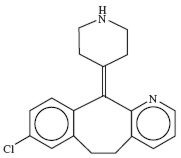
Mechanism of Action
Desloratadine is a long-acting tricyclic histamine antagonist
with selective H1-receptor histamine antagonist activity.
Receptor binding data indicate that at a concentration of 2–3 ng/mL (7
nanomolar), desloratadine shows significant interaction with the human histamine
H1-receptor. Desloratadine inhibited histamine release
from human mast cells in vitro.
Results of a radiolabeled tissue distribution study in rats and a radioligand
H1-receptor binding study in guinea pigs showed that
desloratadine did not readily cross the blood brain barrier.
PharmacokineticsAbsorption
Following oral administration of desloratadine 5 mg once daily
for 10 days to normal healthy volunteers, the mean time to maximum plasma
concentrations (Tmax) occurred at approximately 3 hours
post dose and mean steady state peak plasma concentrations (Cmax) and area under the concentration-time curve (AUC) of 4
ng/mL and 56.9 ng∙hr/mL were observed, respectively. Neither food nor grapefruit
juice had an effect on the bioavailability (Cmax and AUC)
of desloratadine.
The pharmacokinetic profile of CLARINEX Syrup was evaluated in a three-way
crossover study in 30 adult volunteers. A single dose of 10 mL of CLARINEX Syrup
containing 5 mg of desloratadine was bioequivalent to a single dose of 5 mg
CLARINEX Tablet. Food had no effect on the bioavailability (AUC and Cmax) of CLARINEX Syrup.
The pharmacokinetic profile of CLARINEX RediTabs Tablets was evaluated in a
three-way crossover study in 24 adult volunteers. A single CLARINEX RediTabs
Tablet containing 5 mg of desloratadine was bioequivalent to a single 5 mg
CLARINEX RediTabs Tablet (original formulation) for both desloratadine and
3-hydroxydesloratadine. Water had no effect on the bioavailability (AUC and
Cmax) of CLARINEX RediTabs Tablets.
Distribution
Desloratadine and 3-hydroxydesloratadine are approximately 82% to
87% and 85% to 89%, bound to plasma proteins, respectively. Protein binding of
desloratadine and 3-hydroxydesloratadine was unaltered in subjects with impaired
renal function.
Metabolism
Desloratadine (a major metabolite of loratadine) is extensively
metabolized to 3-hydroxydesloratadine, an active metabolite, which is
subsequently glucuronidated. The enzyme(s) responsible for the formation of
3-hydroxydesloratadine have not been identified. Data from clinical trials
indicate that a subset of the general population has a decreased ability to form
3-hydroxydesloratadine, and are poor metabolizers of desloratadine. In
pharmacokinetic studies (n=3748), approximately 6% of subjects were poor
metabolizers of desloratadine (defined as a subject with an AUC ratio of
3-hydroxydesloratadine to desloratadine less than 0.1, or a subject with a
desloratadine half-life exceeding 50 hours). These pharmacokinetic studies
included subjects between the ages of 2 and 70 years, including 977 subjects
aged 2–5 years, 1575 subjects aged 6–11 years, and 1196 subjects aged 12–70
years. There was no difference in the prevalence of poor metabolizers across age
groups. The frequency of poor metabolizers was higher in Blacks (17%, n=988) as
compared to Caucasians (2%, n=1462) and Hispanics (2%, n=1063). The median
exposure (AUC) to desloratadine in the poor metabolizers was approximately
6-fold greater than in the subjects who are not poor metabolizers. Subjects who
are poor metabolizers of desloratadine cannot be prospectively identified and
will be exposed to higher levels of desloratadine following dosing with the
recommended dose of desloratadine. In multidose clinical safety studies, where
metabolizer status was identified, a total of 94 poor metabolizers and 123
normal metabolizers were enrolled and treated with CLARINEX Syrup for 15–35
days. In these studies, no overall differences in safety were observed between
poor metabolizers and normal metabolizers. Although not seen in these studies,
an increased risk of exposure-related adverse events in patients who are poor
metabolizers cannot be ruled out.
Elimination
The mean elimination half-life of desloratadine was 27 hours.
Cmax and AUC values increased in a dose proportional
manner following single oral doses between 5 and 20 mg. The degree of
accumulation after 14 days of dosing was consistent with the half-life and
dosing frequency. A human mass balance study documented a recovery of
approximately 87% of the 14C-desloratadine dose, which
was equally distributed in urine and feces as metabolic products. Analysis of
plasma 3-hydroxydesloratadine showed similar Tmax and
half-life values compared to desloratadine.
Special PopulationsGeriatric
In older subjects (> 65 years old; n=17) following multiple-dose
administration of CLARINEX Tablets, the mean Cmax and AUC
values for desloratadine were 20% greater than in younger subjects (< 65
years old). The oral total body clearance (CL/F) when normalized for body weight
was similar between the two age groups. The mean plasma elimination half-life of
desloratadine was 33.7 hr in subjects > 65 years old. The pharmacokinetics for
3-hydroxydesloratadine appeared unchanged in older versus younger subjects.
These age-related differences are unlikely to be clinically relevant and no
dosage adjustment is recommended in elderly subjects.
Pediatric Subjects
In subjects 6 to 11 years old, a single dose of 5 mL of CLARINEX
Syrup containing 2.5 mg of desloratadine resulted in desloratadine plasma
concentrations similar to those achieved in adults administered a single 5 mg
CLARINEX Tablet. In subjects 2 to 5 years old, a single dose of 2.5 mL of
CLARINEX Syrup containing 1.25 mg of desloratadine resulted in desloratadine
plasma concentrations similar to those achieved in adults administered a single
5 mg CLARINEX Tablet. However, the Cmax and AUCt of the metabolite (3-OH desloratadine) were 1.27 and 1.61
times higher for the 5 mg dose of syrup administered in adults compared to the
Cmax and AUCt obtained in children
2–11 years of age receiving 1.25–2.5 mg of CLARINEX Syrup.
A single dose of either 2.5 mL or 1.25 mL of CLARINEX Syrup containing 1.25
mg or 0.625 mg, respectively, of desloratadine was administered to subjects 6 to
11 months of age and 12 to 23 months of age. The results of a population
pharmacokinetic analysis indicated that a dose of 1 mg for subjects aged 6 to 11
months and 1.25 mg for subjects 12 to 23 months of age is required to obtain
desloratadine plasma concentrations similar to those achieved in adults
administered a single 5 mg dose of CLARINEX Syrup.
The CLARINEX RediTabs Tablet 2.5 mg tablet has not been evaluated in
pediatric patients. Bioequivalence of the CLARINEX RediTabs Tablet and the
original CLARINEX RediTabs Tablets was established in adults. In conjunction
with the dose finding studies in pediatrics described, the pharmacokinetic data
for CLARINEX RediTabs Tablet supports the use of the 2.5 mg dose strength in
pediatric patients 6–11 years of age.
Renally Impaired
Desloratadine pharmacokinetics following a single dose of 7.5 mg
were characterized in patients with mild (n=7; creatinine clearance 51–69
mL/min/1.73 m2), moderate (n=6; creatinine clearance
34–43 mL/min/1.73 m2), and severe (n=6; creatinine
clearance 5–29 mL/min/1.73 m2) renal impairment or
hemodialysis-dependent (n=6) patients. In patients with mild and moderate renal
impairment, median Cmax and AUC values increased by
approximately 1.2- and 1.9-fold, respectively, relative to subjects with normal
renal function. In patients with severe renal impairment or who were
hemodialysis dependent, Cmax and AUC values increased by
approximately 1.7- and 2.5-fold, respectively. Minimal changes in
3-hydroxydesloratadine concentrations were observed. Desloratadine and
3-hydroxydesloratadine were poorly removed by hemodialysis. Plasma protein
binding of desloratadine and 3-hydroxydesloratadine was unaltered by renal
impairment. Dosage adjustment for patients with renal impairment is recommended
(see DOSAGE AND ADMINISTRATION
section).
Hepatically Impaired
Desloratadine pharmacokinetics were characterized following a
single oral dose in patients with mild (n=4), moderate (n=4), and severe (n=4)
hepatic impairment as defined by the Child-Pugh classification of hepatic
function and 8 subjects with normal hepatic function. Patients with hepatic
impairment, regardless of severity, had approximately a 2.4-fold increase in AUC
as compared with normal subjects. The apparent oral clearance of desloratadine
in patients with mild, moderate, and severe hepatic impairment was 37%, 36%, and
28% of that in normal subjects, respectively. An increase in the mean
elimination half-life of desloratadine in patients with hepatic impairment was
observed. For 3-hydroxydesloratadine, the mean Cmax and
AUC values for patients with hepatic impairment were not statistically
significantly different from subjects with normal hepatic function. Dosage
adjustment for patients with hepatic impairment is recommended (see DOSAGE AND ADMINISTRATION section).
Gender
Female subjects treated for 14 days with CLARINEX Tablets had 10%
and 3% higher desloratadine Cmax and AUC values,
respectively, compared with male subjects. The 3-hydroxydesloratadine Cmax and AUC values were also increased by 45% and 48%,
respectively, in females compared with males. However, these apparent
differences are not likely to be clinically relevant and therefore no dosage
adjustment is recommended.
Race
Following 14 days of treatment with CLARINEX Tablets, the Cmax and AUC values for desloratadine were 18% and 32% higher,
respectively, in Blacks compared with Caucasians. For 3-hydroxydesloratadine
there was a corresponding 10% reduction in Cmax and AUC
values in Blacks compared to Caucasians. These differences are not likely to be
clinically relevant and therefore no dose adjustment is recommended.