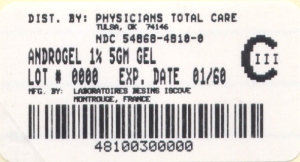
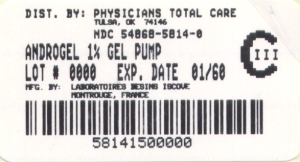
Multi-Dose Pump
Patients should be instructed to prime the pump before using it for the first time by fully depressing the pump mechanism (actuation) 3 times and discard this portion of the product to assure precise dose delivery. After the priming procedure, patients should completely depress the pump one time (actuation) for every 1.25 g (AndroGel Pump) of product required to achieve the daily prescribed dosage. The product may be delivered directly into the palm of the hand and then applied to the desired application sites, either one pump actuation at a time or upon completion of all pump actuations required for the daily dose. Alternatively, the product can be applied directly to the application sites. Application directly to the sites may prevent loss of product that may occur during transfer from the palm of the hand onto the application sites. Table 1 has specific dosing guidelines for adult males when the 75 g AndroGel Pump is used.
Table 1: Specific Dosing Guidelines for Using the Adult Multi-Dose Pump | Prescribed Daily Dose | Number of Pump Actuations in 75 g Pump |
|---|
| 5 g | 4 (once daily) |
| 7.5 g | 6 (once daily) |
| 10 g | 8 (once daily) |
Packets
The entire contents should be squeezed into the palm of the hand and immediately applied to the application sites. Alternately, patients may squeeze a portion of the gel from the packet into the palm of the hand and apply to application sites. Repeat until entire contents have been applied.
Clinical Trials in Hypogonadal Men
Table 2 shows the incidence of all adverse events judged by the investigator to be at least possibly related to treatment with AndroGel and reported by >1% of patients in a 180 Day, Phase 3 study.
Table 2: Adverse Events Possibly, Probably or Definitely Related to Use of AndroGel in the 180-Day Controlled Clinical Trial *Lab test abnormal occurred in nine patients with one or more of the following events reported: elevated hemoglobin or hematocrit, hyperlipidemia, elevated triglycerides, hypokalemia, decreased HDL, elevated glucose, elevated creatinine, elevated total bilirubin. |
**Prostate disorders included five patients with enlarged prostate, one with BPH, and one with elevated PSA results. |
***Testis disorders were reported in two patients: one with left varicocele and one with slight sensitivity of left testis. |
| Adverse Event | Dose of AndroGel |
| 5 g | 7.5 g | 10 g |
| | N = 77 | N = 40 | N = 78 |
| Acne | 1% | 3% | 8% |
| Alopecia | 1% | 0% | 1% |
| Application Site Reaction | 5% | 3% | 4% |
| Asthenia | 0% | 3% | 1% |
| Depression | 1% | 0% | 1% |
| Emotional Lability | 0% | 3% | 3% |
| Gynecomastia | 1% | 0% | 3% |
| Headache | 4% | 3% | 0% |
| Hypertension | 3% | 0% | 3% |
| Lab Test Abnormal* | 6% | 5% | 3% |
| Libido Decreased | 0% | 3% | 1% |
| Nervousness | 0% | 3% | 1% |
| Pain Breast | 1% | 3% | 1% |
| Prostate Disorder** | 3% | 3% | 5% |
| Testis Disorder*** | 3% | 0% | 0% |
Other less common adverse reactions, reported in fewer than 1% of patients included: amnesia, anxiety, discolored hair, dizziness, dry skin, hirsutism, hostility, impaired urination, paresthesia, penis disorder, peripheral edema, sweating, and vasodilation.
In this 180 day clinical trial, skin reactions at the site of application were reported with AndroGel, but none was severe enough to require treatment or discontinuation of drug.
Six patients (4%) in this trial had adverse events that led to discontinuation of AndroGel. These events included: cerebral hemorrhage, convulsion (neither of which were considered related to AndroGel administration), depression, sadness, memory loss, elevated prostate specific antigen, and hypertension. No AndroGel patient discontinued due to skin reactions.
In a separate uncontrolled pharmacokinetic study of 10 patients, two had adverse events associated with AndroGel; these were asthenia and depression in one patient and increased libido and hyperkinesia in the other.
In a 3 year, flexible dose, extension study, the incidence of all adverse events judged by the investigator to be at least possibly related to treatment with AndroGel and reported by > 1% of patients is shown in Table 3.
Table 3: Adverse Events Possibly, Probably or Definitely Related to Use of AndroGel in the 3 Year, Flexible Dose, Extension Study | Adverse Event | Percent of Subjects |
|---|
| | (N = 162) |
|---|
+Lab test abnormal occurred in 15 patients with one or more of the following events reported: elevated AST, elevated ALT, elevated testosterone, elevated hemoglobin or hematocrit, elevated cholesterol, elevated cholesterol/LDL ratio, elevated triglycerides, elevated HDL, elevated serum creatinine. |
*Urinary symptoms included nocturia, urinary hesitancy, urinary incontinence, urinary retention, urinary urgency and weak urinary stream. |
**Testis disorders included three patients. There were two with a non-palpable testis and one with slight right testicular tenderness. |
| Lab Test Abnormal+ | 9.3 |
| Skin dry | 1.9 |
| Application Site Reaction | 5.6 |
| Acne | 3.1 |
| Pruritus | 1.9 |
| Enlarged Prostate | 11.7 |
| Carcinoma of Prostate | 1.2 |
| Urinary Symptoms* | 3.7 |
| Testis Disorder** | 1.9 |
| Gynecomastia | 2.5 |
| Anemia | 2.5 |
Two patients reported serious adverse events considered possibly related to treatment: deep vein thrombosis (DVT) and prostate disorder requiring a transurethral resection of the prostate (TURP).
Discontinuation for adverse events in this study included: two patients with application site reactions, one with kidney failure, and five with prostate disorders (including increase in serum PSA in 4 patients, and increase in PSA with prostate enlargement in a fifth patient).
Increases in Serum PSA Observed in Clinical Trials of Hypogonadal Men
During the initial 6-month study, the mean change in PSA values had a statistically significant increase of 0.26 ng/mL. Serum PSA was measured every 6 months thereafter in the 162 hypogonadal men on AndroGel in the 3-year extension study. There was no additional statistically significant increase observed in mean PSA from 6 months through 36 months. However, there were increases in serum PSA observed in approximately 18% of individual patients. The overall mean change from baseline in serum PSA values for the entire group from month 6 to 36 was 0.11 ng/mL.
Twenty-nine patients (18%) met the per-protocol criterion for increase in serum PSA, defined as >2X the baseline or any single serum PSA >6 ng/mL. Most of these (25/29) met this criterion by at least doubling of their PSA from baseline. In most cases where PSA at least doubled (22/25), the maximum serum PSA value was still <2 ng/mL. The first occurrence of a pre-specified, post-baseline increase in serum PSA was seen at or prior to Month 12 in most of the patients who met this criterion (23 of 29; 79%).
Four patients met this criterion by having a serum PSA >6 ng/mL and in these, maximum serum PSA values were 6.2 ng/mL, 6.6 ng/mL, 6.7 ng/mL, and 10.7 ng/mL. In two of these patients, prostate cancer was detected on biopsy. The first patient's PSA levels were 4.7 ng/mL and 6.2 ng/mL at baseline and at Month 6/Final, respectively. The second patient's PSA levels were 4.2 ng/mL, 5.2 ng/mL, 5.8 ng/mL, and 6.6 ng/mL at baseline, Month 6, Month 12, and Final, respectively.
Secondary Exposure to Testosterone in Children
Cases of secondary exposure to testosterone resulting in virilization of children have been reported in postmarket surveillance. Signs and symptoms of these reported cases have included enlargement of the clitoris (with surgical intervention) or the penis, development of pubic hair, increased erections and libido, aggressive behavior, and advanced bone age. In most cases with a reported outcome, these signs and symptoms were reported to have regressed with removal of the testosterone gel exposure. In a few cases, however, enlarged genitalia did not fully return to age appropriate normal size, and bone age remained modestly greater than chronological age. In some of the cases, direct contact with the sites of application on the skin of men using testosterone gel was reported. In at least one reported case, the reporter considered the possibility of secondary exposure from items such as the testosterone gel user's shirts and/or other fabric, such as towels and sheets [see Warnings and Precautions (5.2)].
Hypogonadal Men
Table 4 includes adverse reactions that have been identified postmarketing.
Table 4: Adverse Drug Reactions from Postmarketing Experience of AndroGel by MedDRA System Organ Class | Blood and the lymphatic system disorders: | Elevated Hgb, Hct (polycythemia) |
| Endocrine disorders: | Hirsutism |
| Gastrointestinal disorders: | Nausea |
| General disorders and administration site reactions: | Asthenia, edema, malaise |
| Genitourinary disorders: | Impaired urination |
| Hepatobiliary disorders: | Abnormal liver function tests (e.g. transaminases, elevated GGTP, bilirubin) |
| Investigations: | Elevated PSA, electrolyte changes (nitrogen, calcium, potassium, phosphorus, sodium), changes in serum lipids (hyperlipidemia, elevated triglycerides, decreased HDL), impaired glucose tolerance, fluctuating testosterone levels, weight increase |
| Neoplasms benign, malignant and unspecified (cysts and polyps): | Prostate cancer |
| Nervous system: | Headache, dizziness, sleep apnea, insomnia |
| Psychiatric disorders: | Depression, emotional lability, decreased libido, nervousness, hostility, amnesia, anxiety |
| Reproductive system and breast disorders: | Gynecomastia, mastodynia, prostatic enlargement, testicular atrophy, oligospermia, priapism (frequent or prolonged erections) |
| Respiratory disorders: | Dyspnea |
| Skin and subcutaneous tissue disorders: | Acne, alopecia, application site reaction (pruritus, dry skin, erythema, rash, discolored hair, paresthesia), sweating |
| Vascular disorders: | Hypertension, vasodilation (hot flushes) |
Adult Males
Absorption
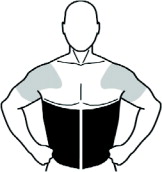
AndroGel delivers physiologic amounts of testosterone, producing circulating testosterone concentrations that approximate normal levels (298 – 1043 ng/dL) seen in healthy men. AndroGel provides continuous transdermal delivery of testosterone for 24 hours following a single application to intact, clean, dry skin of the shoulders, upper arms and/or abdomen.
AndroGel is a hydroalcoholic formulation that dries quickly when applied to the skin surface. The skin serves as a reservoir for the sustained release of testosterone into the systemic circulation. Approximately 10% of the testosterone dose applied on the skin surface from AndroGel is absorbed into systemic circulation. Therefore, 5 g and 10 g of AndroGel systemically deliver approximately 5 mg and 10 mg of testosterone, respectively. In a study with 10 g of AndroGel, all patients showed an increase in serum testosterone within 30 minutes, and eight of nine patients had a serum testosterone concentration within normal range by 4 hours after the initial application. Absorption of testosterone into the blood continues for the entire 24-hour dosing interval. Serum concentrations approximate the steady-state level by the end of the first 24 hours and are at steady state by the second or third day of dosing.
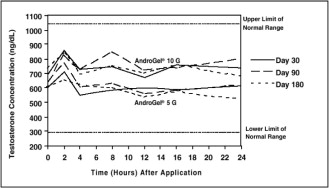
With single daily applications of AndroGel, follow-up measurements 30, 90 and 180 days after starting treatment have confirmed that serum testosterone concentrations are generally maintained within the eugonadal range. Figure 1 summarizes the 24-hour pharmacokinetic profiles of testosterone for hypogonadal men (<300 ng/dL) maintained on 5 g or 10 g of AndroGel for 30 days. The average (± SD) daily testosterone concentration produced by AndroGel 10 g on Day 30 was 792 (± 294) ng/dL and by AndroGel 5 g 566 (± 262) ng/dL.
Figure 1: Mean (± SD) Steady-State Serum Testosterone Concentrations on Day 30 in Patients Applying AndroGel Once Daily
When AndroGel treatment is discontinued after achieving steady state, serum testosterone levels remain in the normal range for 24 to 48 hours but return to their pretreatment levels by the fifth day after the last application.
Distribution
Circulating testosterone is primarily bound in the serum to sex hormone-binding globulin (SHBG) and albumin. Approximately 40% of testosterone in plasma is bound to SHBG, 2% remains unbound (free) and the rest is bound to albumin and other proteins.
Metabolism
There is considerable variation in the half-life of testosterone as reported in the literature, ranging from 10 to 100 minutes. Testosterone is metabolized to various 17-keto steroids through two different pathways. The major active metabolites of testosterone are estradiol and DHT.
DHT concentrations increased in parallel with testosterone concentrations during AndroGel treatment. After 180 days of treatment in adult males, mean DHT concentrations were within the normal range with 5 g AndroGel and were about 7% above the normal range after a 10 g dose. The mean steady-state DHT/T ratio during 180 days of AndroGel treatment remained within normal limits and ranged from 0.23 to 0.29 (5 g/day) and from 0.27 to 0.33 (10 g/day).
Excretion
About 90% of a dose of testosterone given intramuscularly is excreted in the urine as glucuronic and sulfuric acid conjugates of testosterone and its metabolites; about 6% of a dose is excreted in the feces, mostly in the unconjugated form. Inactivation of testosterone occurs primarily in the liver.
Disposal
Used AndroGel pumps or used AndroGel packets should be discarded in household trash in a manner that prevents accidental application or ingestion by children or pets.
Additional barcode label applied by:
Physicians Total Care, Inc.
Tulsa, Oklahoma 74146