Treatment-Emergent Adverse Reactions in Treatment-Naive Patients
The safety profile of REYATAZ in treatment-naive adults is based on 1625 HIV-1 infected patients in clinical trials. 536 patients received REYATAZ 300 mg with ritonavir 100 mg and 1089 patients received REYATAZ 400 mg or higher (without ritonavir).
The most common adverse reactions are nausea, jaundice/scleral icterus, and rash.
Selected clinical adverse reactions of moderate or severe intensity reported in ≥2% of treatment-naive patients receiving combination therapy including REYATAZ 300 mg with ritonavir 100 mg and REYATAZ 400 mg (without ritonavir) are presented in Tables 4 and 5, respectively.
Table 4: Selected Treatment-Emergent Adverse Reactionsa of Moderate or Severe Intensity Reported in ≥2% of Adult Treatment-Naive Patients,b Study AI424-138| | 96 weeksc | 96 weeksc |
|---|
| | REYATAZ 300 mg with ritonavir
100 mg (once daily) and tenofovir
with emtricitabined | lopinavir 400 mg with ritonavir
100 mg (twice daily)
and tenofovir
with emtricitabined |
|---|
| | (n=441) | (n=437) |
|---|
| * None reported in this treatment arm. |
| a Includes events of possible, probable, certain, or unknown relationship to treatment regimen. |
| b Based on the regimen containing REYATAZ. |
| c Median time on therapy. |
| d As a fixed-dose combination: 300 mg tenofovir, 200 mg emtricitabine once daily. |
| Digestive System | | |
| Nausea | 4% | 8% |
| Jaundice/scleral icterus | 5% | * |
| Diarrhea | 2% | 12% |
| Skin and Appendages | | |
| Rash | 3% | 2% |
Table 5: Selected Treatment-Emergent Adverse Reactionsa of Moderate or Severe Intensity Reported in ≥2% of Adult Treatment-Naive Patients,b Studies AI424-034, AI424-007, and AI424-008| | Study AI424-034 | Studies AI424-007, -008 |
|---|
64 weeksc
REYATAZ 400 mg once daily + lamivudine + zidovudinee | 64 weeksc
efavirenz 600 mg once daily + lamivudine + zidovudinee | 120 weeksc,d
REYATAZ 400 mg once daily + stavudine + lamivudine or didanosine | 73 weeksc,d
nelfinavir 750 mg TID or 1250 mg BID + stavudine + lamivudine or didanosine |
|---|
| (n=404) | (n=401) | (n=279) | (n=191) |
|---|
| * None reported in this treatment arm. |
| a Includes events of possible, probable, certain, or unknown relationship to treatment regimen. |
| b Based on regimens containing REYATAZ. |
| c Median time on therapy. |
| d Includes long-term follow-up. |
| e As a fixed-dose combination: 150 mg lamivudine, 300 mg zidovudine twice daily. |
| Body as a Whole |
| Headache | 6% | 6% | 1% | 2% |
| Digestive System |
| Nausea | 14% | 12% | 6% | 4% |
Jaundice/scleral
icterus | 7% | * | 7% | * |
| Vomiting | 4% | 7% | 3% | 3% |
| Abdominal pain | 4% | 4% | 4% | 2% |
| Diarrhea | 1% | 2% | 3% | 16% |
| Nervous System |
| Insomnia | 3% | 3% | <1% | * |
| Dizziness | 2% | 7% | <1% | * |
Peripheral neurologic
symptoms | <1% | 1% | 4% | 3% |
| Skin and Appendages |
| Rash | 7% | 10% | 5% | 1% |
Treatment-Emergent Adverse Reactions in Treatment-Experienced Patients
The safety profile of REYATAZ in treatment-experienced adults is based on 119 HIV-1 infected patients in clinical trials.
The most common adverse reactions are jaundice/scleral icterus and myalgia.
Selected clinical adverse reactions of moderate or severe intensity reported in ≥2% of treatment-experienced patients receiving REYATAZ/ritonavir are presented in Table 6.
Table 6: Selected Treatment-Emergent Adverse Reactionsa of Moderate or Severe Intensity Reported in ≥2% of Adult Treatment-Experienced Patients,b Study AI424-045| | 48 weeksc
REYATAZ/ritonavir 300/100 mg
once daily + tenofovir + NRTI | 48 weeksc
lopinavir/ritonavir 400/100 mg
twice dailyd + tenofovir + NRTI |
|---|
| (n=119) | (n=118) |
|---|
| * None reported in this treatment arm. |
| a Includes events of possible, probable, certain, or unknown relationship to treatment regimen. |
| b Based on the regimen containing REYATAZ. |
| c Median time on therapy. |
| d As a fixed-dose combination. |
| Body as a Whole |
| Fever | 2% | * |
| Digestive System |
| Jaundice/scleral icterus | 9% | * |
| Diarrhea | 3% | 11% |
| Nausea | 3% | 2% |
| Nervous System |
| Depression | 2% | <1% |
| Musculoskeletal System |
| Myalgia | 4% | * |
Laboratory Abnormalities in Treatment-Naive Patients
The percentages of adult treatment-naive patients treated with combination therapy including REYATAZ (atazanavir sulfate) 300 mg with ritonavir 100 mg and REYATAZ 400 mg (without ritonavir) with Grade 3–4 laboratory abnormalities are presented in Tables 7 and 8, respectively.
Table 7: Grade 3–4 Laboratory Abnormalities Reported in ≥2% of Adult Treatment-Naive Patients,a Study AI424-138 | a Based on the regimen containing REYATAZ. |
| b Median time on therapy. |
| c ULN = upper limit of normal. |
| d As a fixed-dose combination: 300 mg tenofovir, 200 mg emtricitabine once daily. |
| Variable | Limitc | 96 weeksb | 96 weeksb |
REYATAZ 300 mg
with ritonavir 100 mg
(once daily) and tenofovir
with emtricitabined | lopinavir 400 mg
with ritonavir 100 mg
(twice daily) and tenofovir
with emtricitabined |
| (n=441) | (n=437) |
| Chemistry | High | | |
| SGOT/AST | ≥5.1 x ULN | 3% | 1% |
| SGPT/ALT | ≥5.1 x ULN | 3% | 2% |
| Total Bilirubin | ≥2.6 x ULN | 44% | <1% |
| Lipase | ≥2.1 x ULN | 2% | 2% |
| Creatine Kinase | ≥5.1 x ULN | 8% | 7% |
| Total Cholesterol | ≥240 mg/dL | 11% | 25% |
| Hematology | Low | | |
| Neutrophils | <750 cells/mm3 | 5% | 2% |
Table 8: Grade 3–4 Laboratory Abnormalities Reported in ≥2% of Adult Treatment-Naive Patients,a Studies AI424-034, AI424-007, and AI424-008| Variable | Limitd | Study AI424-034 | Studies AI424-007, -008 |
|---|
| 64 weeksb | 64 weeksb | 120 weeksb,c | 73 weeksb,c |
|---|
REYATAZ
400 mg
once daily
+ lamivudine
+ zidovudinee | efavirenz
600 mg
once daily
+ lamivudine
+ zidovudinee | REYATAZ
400 mg
once daily
+ stavudine
+ lamivudine or
+ stavudine
+ didanosine | nelfinavir
750 mg TID or
1250 mg BID
+ stavudine
+ lamivudine or
+ stavudine
+ didanosine |
|---|
| (n=404) | (n=401) | (n=279) | (n=191) |
|---|
| * None reported in this treatment arm. |
| a Based on regimen(s) containing REYATAZ. |
| b Median time on therapy. |
| c Includes long-term follow-up. |
| d ULN = upper limit of normal. |
| e As a fixed-dose combination: 150 mg lamivudine, 300 mg zidovudine twice daily. |
| Chemistry | High | |
| SGOT/AST | ≥5.1 x ULN | 2% | 2% | 7% | 5% |
| SGPT/ALT | ≥5.1 x ULN | 4% | 3% | 9% | 7% |
| Total Bilirubin | ≥2.6 x ULN | 35% | <1% | 47% | 3% |
| Amylase | ≥2.1 x ULN | * | * | 14% | 10% |
| Lipase | ≥2.1 x ULN | <1% | 1% | 4% | 5% |
| Creatine Kinase | ≥5.1 x ULN | 6% | 6% | 11% | 9% |
| Total Cholesterol | ≥240 mg/dL | 6% | 24% | 19% | 48% |
| Triglycerides | ≥751 mg/dL | <1% | 3% | 4% | 2% |
| Hematology | Low | |
| Hemoglobin | <8.0 g/dL | 5% | 3% | <1% | 4% |
| Neutrophils | <750 cells/mm3 | 7% | 9% | 3% | 7% |
Laboratory Abnormalities in Treatment-Experienced Patients
The percentages of adult treatment-experienced patients treated with combination therapy including REYATAZ/ritonavir with Grade 3–4 laboratory abnormalities are presented in Table 9.
Table 9: Grade 3–4 Laboratory Abnormalities Reported in ≥2% of Adult Treatment-Experienced Patients, Study AI424-045a| Variable | Limitc | 48 weeksb | 48 weeksb |
|---|
REYATAZ/ritonavir
300/100 mg once daily
+ tenofovir + NRTI | lopinavir/ritonavir
400/100 mg twice dailyd
+ tenofovir + NRTI |
|---|
| (n=119) | (n=118) |
|---|
| a Based on regimen(s) containing REYATAZ. |
| b Median time on therapy. |
| c ULN = upper limit of normal. |
| d As a fixed-dose combination. |
| Chemistry | High | |
| SGOT/AST | ≥5.1 x ULN | 3% | 3% |
| SGPT/ALT | ≥5.1 x ULN | 4% | 3% |
| Total Bilirubin | ≥2.6 x ULN | 49% | <1% |
| Lipase | ≥2.1 x ULN | 5% | 6% |
| Creatine Kinase | ≥5.1 x ULN | 8% | 8% |
| Total Cholesterol | ≥240 mg/dL | 25% | 26% |
| Triglycerides | ≥751 mg/dL | 8% | 12% |
| Glucose | ≥251 mg/dL | 5% | <1% |
| Hematology | Low | |
| Platelets | <50,000 cells/mm3 | 2% | 3% |
| Neutrophils | <750 cells/mm3 | 7% | 8% |
Lipids, Change from Baseline in Treatment-Naive Patients
For Study AI424-138 and Study AI424-034, changes from baseline in LDL-cholesterol, HDL-cholesterol, total cholesterol, and triglycerides are shown in Tables 10 and 11, respectively.
Table 10: Lipid Values, Mean Change from Baseline, Study AI424-138| | REYATAZ/ritonavira,b | lopinavir/ritonavirb,c |
|---|
| Baseline | Week 48 | Week 96 | Baseline | Week 48 | Week 96 |
|---|
| mg/dL | mg/dL | Changed | mg/dL | Changed | mg/dL | mg/dL | Changed | mg/dL | Changed |
|---|
| (n=428e) | (n=372e) | (n=372e) | (n=342e) | (n=342e) | (n=424e) | (n=335e) | (n=335e) | (n=291e) | (n=291e) |
|---|
| a REYATAZ 300 mg with ritonavir 100 mg once daily with the fixed-dose combination: 300 mg tenofovir, 200 mg emtricitabine once daily. |
| b Values obtained after initiation of serum lipid-reducing agents were not included in these analyses. At baseline, serum lipid-reducing agents were used in 1% in the lopinavir/ritonavir treatment arm and 1% in the REYATAZ/ritonavir arm. Through Week 48, serum lipid-reducing agents were used in 8% in the lopinavir/ritonavir treatment arm and 2% in the REYATAZ/ritonavir arm. Through Week 96, serum lipid-reducing agents were used in 10% in the lopinavir/ritonavir treatment arm and 3% in the REYATAZ/ritonavir arm. |
| c Lopinavir 400 mg with ritonavir 100 mg twice daily with the fixed-dose combination 300 mg tenofovir, 200 mg emtricitabine once daily. |
| d The change from baseline is the mean of within-patient changes from baseline for patients with both baseline and Week 48 or Week 96 values and is not a simple difference of the baseline and Week 48 or Week 96 mean values, respectively. |
| e Number of patients with LDL-cholesterol measured. |
| f Fasting. |
| LDL-Cholesterolf | 92 | 105 | +14% | 105 | +14% | 93 | 111 | +19% | 110 | +17% |
| HDL-Cholesterolf | 37 | 46 | +29% | 44 | +21% | 36 | 48 | +37% | 46 | +29% |
| Total Cholesterolf | 149 | 169 | +13% | 169 | +13% | 150 | 187 | +25% | 186 | +25% |
| Triglyceridesf | 126 | 145 | +15% | 140 | +13% | 129 | 194 | +52% | 184 | +50% |
Table 11: Lipid Values, Mean Change from Baseline, Study AI424-034 | REYATAZa,b | efavirenzb,c |
|---|
| Baseline | Week 48 | Week 48 | Baseline | Week 48 | Week 48 |
|---|
| mg/dL | mg/dL | Changed | mg/dL | mg/dL | Changed |
|---|
| (n=383e) | (n=283e) | (n=272e) | (n=378e) | (n=264e) | (n=253e) |
|---|
| a REYATAZ 400 mg once daily with the fixed-dose combination: 150 mg lamivudine, 300 mg zidovudine twice daily. |
| b Values obtained after initiation of serum lipid-reducing agents were not included in these analyses. At baseline, serum lipid-reducing agents were used in 0% in the efavirenz treatment arm and <1% in the REYATAZ arm. Through Week 48, serum lipid-reducing agents were used in 3% in the efavirenz treatment arm and 1% in the REYATAZ arm. |
| c Efavirenz 600 mg once daily with the fixed-dose combination: 150 mg lamivudine, 300 mg zidovudine twice daily. |
| d The change from baseline is the mean of within-patient changes from baseline for patients with both baseline and Week 48 values and is not a simple difference of the baseline and Week 48 mean values. |
| e Number of patients with LDL-cholesterol measured. |
| f Fasting. |
| LDL-Cholesterolf | 98 | 98 | +1% | 98 | 114 | +18% |
| HDL-Cholesterol | 39 | 43 | +13% | 38 | 46 | +24% |
| Total Cholesterol | 164 | 168 | +2% | 162 | 195 | +21% |
| Triglyceridesf | 138 | 124 | -9% | 129 | 168 | +23% |
Lipids, Change from Baseline in Treatment-Experienced Patients
For Study AI424-045, changes from baseline in LDL-cholesterol, HDL-cholesterol, total cholesterol, and triglycerides
are shown in Table 12. The observed magnitude of dyslipidemia was less with REYATAZ/ritonavir than with lopinavir/ritonavir. However, the clinical impact
of such findings has not been demonstrated.
Table 12: Lipid Values, Mean Change from Baseline, Study AI424-045| | REYATAZ/ritonavira,b | lopinavir/ritonavirb,c |
|---|
| Baseline | Week 48 | Week 48 | Baseline | Week 48 | Week 48 |
|---|
| mg/dL | mg/dL | Changed | mg/dL | mg/dL | Changed |
|---|
| (n=111e) | (n=75e) | (n=74e) | (n=108e) | (n=76e) | (n=73e) |
|---|
| a REYATAZ 300 mg once daily + ritonavir + tenofovir + 1 NRTI. |
| b Values obtained after initiation of serum lipid-reducing agents were not included in these analyses. At baseline, serum lipid-reducing agents were used in 4% in the lopinavir/ritonavir treatment arm and 4% in the REYATAZ/ritonavir arm. Through Week 48, serum lipid-reducing agents were used in 19% in the lopinavir/ritonavir treatment arm and 8% in the REYATAZ/ritonavir arm. |
| c Lopinavir/ritonavir (400/100 mg) BID + tenofovir + 1 NRTI. |
| d The change from baseline is the mean of within-patient changes from baseline for patients with both baseline and Week 48 values and is not a simple difference of the baseline and Week 48 mean values. |
| e Number of patients with LDL-cholesterol measured. |
| f Fasting. |
| LDL-Cholesterolf | 108 | 98 | -10% | 104 | 103 | +1% |
| HDL-Cholesterol | 40 | 39 | -7% | 39 | 41 | +2% |
| Total Cholesterol | 188 | 170 | -8% | 181 | 187 | +6% |
| Triglyceridesf | 215 | 161 | -4% | 196 | 224 | +30% |
Effects on Electrocardiogram
Concentration- and dose-dependent prolongation of the PR interval in the electrocardiogram has been observed in healthy volunteers receiving atazanavir. In a placebo-controlled study (AI424-076), the mean (±SD) maximum change in PR interval from the predose value was 24 (±15) msec following oral dosing with 400 mg of atazanavir (n=65) compared to 13 (±11) msec following dosing with placebo (n=67). The PR interval prolongations in this study were asymptomatic. There is limited information on the potential for a pharmacodynamic interaction in humans between atazanavir and other drugs that prolong the PR interval of the electrocardiogram. [See Warnings and Precautions (5.2).]
Electrocardiographic effects of atazanavir were determined in a clinical pharmacology study of 72 healthy subjects. Oral doses of 400 mg and 800 mg were compared with placebo; there was no concentration-dependent effect of atazanavir on the QTc interval (using Fridericia’s correction). In 1793 HIV-infected patients receiving antiretroviral regimens, QTc prolongation was comparable in the atazanavir and comparator regimens. No atazanavir-treated healthy subject or HIV-infected patient in clinical trials had a QTc interval >500 msec. [See Warnings and Precautions (5.2).]
In a pharmacokinetic study between atazanavir 400 mg once daily and diltiazem 180 mg once daily, a CYP3A substrate, there was a 2-fold increase in the diltiazem plasma concentration and an additive effect on the PR interval. In a pharmacokinetic study between atazanavir 400 mg once daily and atenolol 50 mg once daily, there was no substantial additive effect of atazanavir and atenolol on the PR interval. [See Warnings and Precautions (5.2).]
Absorption
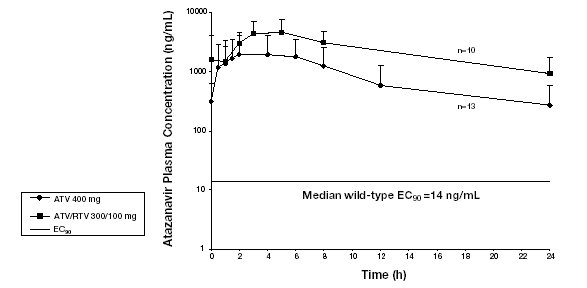
Atazanavir is rapidly absorbed with a Tmax of approximately 2.5 hours. Atazanavir demonstrates nonlinear pharmacokinetics with greater than dose-proportional increases in AUC and Cmax values over the dose range of 200–800 mg once daily. Steady state is achieved between Days 4 and 8, with an accumulation of approximately 2.3-fold.
Food Effect
Administration of REYATAZ with food enhances bioavailability and reduces pharmacokinetic variability. Administration of a single 400-mg dose of REYATAZ with a light meal (357 kcal, 8.2 g fat, 10.6 g protein) resulted in a 70% increase in AUC and 57% increase in Cmax relative to the fasting state. Administration of a single 400-mg dose of REYATAZ with a high-fat meal (721 kcal, 37.3 g fat, 29.4 g protein) resulted in a mean increase in AUC of 35% with no change in Cmax relative to the fasting state. Administration of REYATAZ (atazanavir sulfate) with either a light meal or high-fat meal decreased the coefficient of variation of AUC and Cmax by approximately one-half compared
to the fasting state.
Coadministration of a single 300-mg dose of REYATAZ and a 100-mg dose of ritonavir with a light meal (336 kcal, 5.1 g fat, 9.3 g protein) resulted in a 33% increase in the AUC and a 40% increase in both the Cmax and the 24-hour concentration of atazanavir relative to the fasting state. Coadministration with a high-fat meal (951 kcal, 54.7 g fat, 35.9 g protein) did not affect the AUC of atazanavir relative to fasting conditions and the Cmax was within 11% of fasting values. The 24-hour concentration following a high-fat meal was increased by approximately 33% due to delayed absorption; the median Tmax increased from 2.0 to 5.0 hours. Coadministration of REYATAZ with ritonavir with either a light or a high-fat meal decreased the coefficient of variation of AUC and Cmax by approximately 25% compared to the fasting state.
Distribution
Atazanavir is 86% bound to human serum proteins and protein binding is independent of concentration. Atazanavir
binds to both alpha-1-acid glycoprotein (AAG) and albumin to a similar extent (89% and 86%, respectively). In a multiple-dose study in HIV-infected patients
dosed with REYATAZ 400 mg once daily with a light meal for 12 weeks, atazanavir was detected in the cerebrospinal fluid and semen. The cerebrospinal fluid/plasma ratio for atazanavir (n=4) ranged between 0.0021 and 0.0226 and seminal fluid/plasma ratio (n=5) ranged between 0.11 and 4.42.
Metabolism
Atazanavir is extensively metabolized in humans. The major biotransformation pathways of atazanavir in humans consisted of monooxygenation and dioxygenation. Other minor biotransformation pathways for atazanavir or its metabolites consisted of glucuronidation, N-dealkylation, hydrolysis, and oxygenation with dehydrogenation. Two minor metabolites of atazanavir in plasma have been characterized. Neither metabolite demonstrated in vitro antiviral activity. In vitro studies using human liver microsomes suggested that atazanavir is metabolized by CYP3A.
Elimination
Following a single 400-mg dose of 14C-atazanavir, 79% and 13% of the total radioactivity was recovered in the feces and urine, respectively. Unchanged drug accounted for approximately 20% and 7% of the administered dose in the feces and urine, respectively. The mean elimination half-life of atazanavir in healthy volunteers (n=214) and HIV-infected adult patients (n=13) was approximately 7 hours at steady state following a dose of 400 mg daily with a light meal.
Special Populations
Pediatrics
The pharmacokinetic parameters for atazanavir at steady state in pediatric patients were predicted by a population pharmacokinetic model and are summarized in Table 15 by weight ranges that correspond to the recommended doses. [See Dosage and Administration (2.2).]
Table 15: Predicted Steady-State Pharmacokinetics of Atazanavir (capsule formulation) with ritonavir in HIV-Infected Pediatric PatientsBody Weight
(range in kg) | atazanavir/ritonavir
Dose (mg) | Cmax ng/mL
Geometric Mean
(CV%) | AUC ng•h/mL
Geometric Mean
(CV%) | Cmin ng/mL
Geometric Mean
(CV%) |
|---|
| 15–<20 | 150/100 | 5213 (78.7%) | 42902 (77.0%) | 504 (99.5%) |
| 20–<40 | 200/100 | 4954 (81.7%) | 42999 (78.5%) | 562 (98.9%) |
| ≥40 | 300/100 | 5040 (84.6%) | 46777 (80.6%) | 691 (98.5%) |
Pregnancy
The pharmacokinetic data from HIV-infected pregnant women receiving REYATAZ Capsules with ritonavir are presented in Table 16.
Table 16: Steady-State Pharmacokinetics of Atazanavir with ritonavir in HIV-Infected Pregnant Women in the Fed State
| | Atazanavir 300 mg with ritonavir 100 mg |
|---|
| Pharmacokinetic Parameter | 2nd Trimester
(n=5a) | 3rd Trimester
(n=20) | Postpartumb
(n=34) |
|---|
| a Available data during the 2nd trimester are limited. |
| b Atazanavir peak concentrations and AUCs were found to be approximately 28–43% higher during the postpartum period (4–12 weeks) than those observed historically in HIV-infected, non-pregnant patients. Atazanavir plasma trough concentrations were approximately 2.2-fold higher during the postpartum period when compared to those observed historically in HIV-infected, non-pregnant patients. |
| c Cmin is concentration 24 hours post-dose. |
| Cmax ng/mL | 3078.85 | 3291.46 | 5721.21 |
| Geometric mean (CV%) | (50) | (48) | (31) |
| AUC ng∙h/mL | 27657.1 | 34251.5 | 61990.4 |
| Geometric mean (CV%) | (43) | (43) | (32) |
| Cmin ng/mLc | 538.70 | 668.48 | 1462.59 |
| Geometric mean (CV%) | (46) | (50) | (45) |
Drug Interaction Data
Atazanavir is a metabolism-dependent CYP3A inhibitor, with a Kinact value of 0.05 to 0.06
min-1 and Ki value of 0.84 to 1.0 µM. Atazanavir is also a direct inhibitor for UGT1A1 (Ki=1.9 µM) and CYP2C8 (Ki=2.1 µM).
Atazanavir has been shown in vivo not to induce its own metabolism, nor to increase the biotransformation of some drugs metabolized by CYP3A. In a multiple-dose study, REYATAZ decreased the urinary ratio of endogenous
6β-OH cortisol to cortisol versus baseline, indicating that CYP3A production was not induced.
Drug interaction studies were performed with REYATAZ and other drugs likely to be coadministered and some drugs commonly used as probes for pharmacokinetic interactions. The effects of coadministration of REYATAZ on the AUC, Cmax, and Cmin are summarized in Tables 17 and 18. For information regarding clinical recommendations, see Drug Interactions (7).
Table 17: Drug Interactions: Pharmacokinetic Parameters for Atazanavir in the Presence of Coadministered Drugsa| Coadministered Drug | Coadministered Drug
Dose/Schedule | REYATAZ
Dose/Schedule | Ratio (90% Confidence Interval) of Atazanavir Pharmacokinetic Parameters with/without
Coadministered Drug;
No Effect = 1.00 |
|---|
| Cmax | AUC | Cmin |
|---|
| a Data provided are under fed conditions unless otherwise noted. |
| b All drugs were given under fasted conditions. |
| c 400 mg ddI EC and REYATAZ were administered together with food on Days 8 and 19. |
| d REYATAZ 300 mg plus ritonavir 100 mg once daily coadministered with famotidine 40
mg twice daily resulted in atazanavir geometric mean Cmax that was similar and AUC and Cmin values that were 1.79-
and 4.46-fold higher relative to REYATAZ 400 mg once daily alone. |
| e Similar results were noted when famotidine 20 mg BID was administered 2 hours after and 10 hours before atazanavir 300 mg and ritonavir 100 mg plus tenofovir 300 mg. |
| f Atazanavir/ritonavir/tenofovir was administered after a light meal. |
| g Study was conducted in HIV-infected individuals. |
| h Compared with atazanavir 400 mg historical data without nevirapine (n=13), the ratio of geometric means
(90% confidence intervals) for Cmax, AUC, and Cmin were 1.42 (0.98, 2.05), 1.64 (1.11, 2.42), and 1.25 (0.66, 2.36), respectively,
for atazanavir/ritonavir 300/100 mg; and 2.02 (1.42, 2.87), 2.28 (1.54, 3.38), and 1.80 (0.94, 3.45), respectively, for atazanavir/ritonavir 400/100 mg. |
| i Parallel group design; n=23 for atazanavir/ritonavir plus nevirapine, n=22 for atazanavir 300 mg/ritonavir
100 mg without nevirapine. Subjects were treated with nevirapine prior to study entry. |
| j Omeprazole 40 mg was administered on an empty stomach 2 hours before REYATAZ. |
| k Omeprazole 20 mg was administered 30 minutes prior to a light meal in the morning and REYATAZ 300 mg plus ritonavir 100 mg in the evening after a light meal, separated by 12 hours from omeprazole. |
| l REYATAZ 300 mg plus ritonavir 100 mg once daily separated by 12 hours from omeprazole
20 mg daily resulted in increases in atazanavir geometric mean AUC (10%) and Cmin (2.4-fold), with a decrease in Cmax (29%)
relative to REYATAZ 400 mg once daily in the absence of omeprazole (study days 1−6). |
| m Omeprazole 20 mg was given 30 minutes prior to a light meal in the morning and REYATAZ
400 mg plus ritonavir 100 mg once daily after a light meal, 1 hour after omeprazole. Effects on atazanavir concentrations were similar when REYATAZ 400 mg plus ritonavir 100 mg was separated from omeprazole 20 mg by 12 hours. |
| n REYATAZ 400 mg plus ritonavir 100 mg once daily administered with omeprazole 20 mg
once daily resulted in increases in atazanavir geometric mean AUC (32%) and Cmin (3.3-fold), with a decrease in Cmax (26%)
relative to REYATAZ 400 mg once daily in the absence of omeprazole (study days 1−6). |
| o Compared with atazanavir 400 mg QD historical data, administration of atazanavir/ritonavir
300/100 mg QD increased the atazanavir geometric mean values of Cmax, AUC, and Cmin by 18%, 103%, and 671%, respectively. |
| p Note that similar results were observed in studies where administration of tenofovir
and REYATAZ was separated by 12 hours. |
| q Ratio of atazanavir plus ritonavir plus tenofovir to atazanavir plus ritonavir.
Atazanavir 300 mg plus ritonavir 100 mg results in higher atazanavir exposure than atazanavir 400 mg (see footnote o). The geometric
mean values of atazanavir pharmacokinetic parameters when coadministered with ritonavir and tenofovir were: Cmax = 3190 ng/mL, AUC
= 34459 ng•h/mL, and Cmin = 491 ng/mL. Study was conducted in HIV-infected individuals. |
| atenolol | 50 mg QD, d 7−11 (n=19) and d 19−23 | 400 mg QD, d 1−11 (n=19) | 1.00
(0.89, 1.12) | 0.93
(0.85, 1.01) | 0.74
(0.65, 0.86) |
| clarithromycin | 500 mg BID, d 7−10 (n=29) and d 18−21 | 400 mg QD, d 1−10 (n=29) | 1.06
(0.93, 1.20) | 1.28
(1.16, 1.43) | 1.91
(1.66, 2.21) |
| didanosine (ddI) (buffered tablets) plus stavudine (d4T)b | ddI: 200 mg x 1 dose,
d4T: 40 mg x 1 dose (n=31) | 400 mg x 1 dose simultaneously with ddI and d4T (n=31) | 0.11
(0.06, 0.18) | 0.13
(0.08, 0.21) | 0.16
(0.10, 0.27) |
| | ddI: 200 mg x 1 dose,
d4T: 40 mg x 1 dose (n=32) | 400 mg x 1 dose 1 h after ddI + d4T (n=32) | 1.12
(0.67, 1.18) | 1.03
(0.64, 1.67) | 1.03
(0.61, 1.73) |
| ddI (enteric-coated [EC] capsules)c | 400 mg d 8 (fed) (n=34) 400 mg d 19 (fed) (n=31) | 400 mg QD, d 2−8 (n=34) 300 mg/ritonavir 100 mg QD, d 9−19 (n=31) | 1.03
(0.93, 1.14)
1.04
(1.01, 1.07) | 0.99
(0.91, 1.08)
1.00
(0.96, 1.03) | 0.98
(0.89, 1.08)
0.87
(0.82, 0.92) |
| diltiazem | 180 mg QD, d 7−11 (n=30) and d 19−23 | 400 mg QD, d 1−11 (n=30) | 1.04
(0.96, 1.11) | 1.00
(0.95, 1.05) | 0.98
(0.90, 1.07) |
| efavirenz | 600 mg QD, d 7−20 (n=27) | 400 mg QD, d 1−20 (n=27) | 0.41
(0.33, 0.51) | 0.26
(0.22, 0.32) | 0.07
(0.05, 0.10) |
| | 600 mg QD, d 7−20 (n=13) | 400 mg QD, d 1−6 (n=23) then 300 mg/ritonavir 100 mg QD, 2 h before efavirenz, d 7−20 (n=13) | 1.14
(0.83, 1.58) | 1.39
(1.02, 1.88) | 1.48
(1.24, 1.76) |
| | 600 mg QD, d 11–24 (pm) (n=14) | 300 mg QD/ritonavir 100 mg QD, d 1–10 (pm) (n=22), then 400 mg QD/ritonavir 100 mg QD, d 11–24 (pm), (simultaneous with efavirenz) (n=14) | 1.17
(1.08, 1.27) | 1.00
(0.91, 1.10) | 0.58
(0.49, 0.69) |
| famotidine | 40 mg BID, d 7−12 (n=15) | 400 mg QD, d 1−6 (n=45), d 7−12 (simultaneous administration) (n=15) | 0.53
(0.34, 0.82) | 0.59
(0.40, 0.87) | 0.58
(0.37, 0.89) |
| | 40 mg BID, d 7−12 (n=14) | 400 mg QD (pm), d 1−6 (n=14), d 7−12 (10 h after, 2 h before famotidine) (n=14) | 1.08
(0.82, 1.41) | 0.95
(0.74, 1.21) | 0.79
(0.60, 1.04) |
| | 40 mg BID, d 11−20 (n=14)d | 300 mg QD/ritonavir 100 mg QD, d 1−10 (n=46), d 11−20d (simultaneous administration) (n=14) | 0.86
(0.79, 0.94) | 0.82
(0.75, 0.89) | 0.72
(0.64, 0.81) |
| | 20 mg BID, d 11−17 (n=18) | 300 mg QD/ ritonavir 100 mg QD/tenofovir 300 mg QD, d 1−10 (am) (n=39), d 11−17 (am) (simultaneous administration with am famotidine) (n=18)e,f | 0.91
(0.84, 0.99) | 0.90
(0.82, 0.98) | 0.81
(0.69, 0.94) |
| | 40 mg QD (pm),
d 18−24 (n=20) | 300 mg QD/ ritonavir 100 mg QD/tenofovir 300 mg QD, d 1−10 (am) (n=39), d 18−24 (am) (12 h after pm famotidine) (n=20)f | 0.89
(0.81, 0.97) | 0.88
(0.80, 0.96) | 0.77
(0.63, 0.93) |
| | 40 mg BID, d 18−24 (n=18) | 300 mg QD/ritonavir 100 mg QD/tenofovir 300 mg QD, d 1−10 (am) (n=39), d 18−24 (am) (10 h after pm famotidine and 2 h before am famotidine) (n=18)f | 0.74
(0.66, 0.84) | 0.79
(0.70, 0.88) | 0.72
(0.63, 0.83) |
| | 40 mg BID, d 11−20 (n=15) | 300 mg QD/ritonavir 100 mg QD, d 1−10 (am) (n=46), then 400 mg QD/ritonavir 100 mg QD, d 11−20 (am) (n=15) | 1.02
(0.87, 1.18) | 1.03
(0.86, 1.22) | 0.86
(0.68, 1.08) |
| fluconazole | 200 mg QD, d 11−20 (n=29) | 300 mg QD/ ritonavir 100 mg QD, d 1−10 (n=19), d 11−20 (n=29) | 1.03
(0.95, 1.11) | 1.04
(0.95, 1.13) | 0.98
(0.85, 1.13) |
| ketoconazole | 200 mg QD, d 7−13 (n=14) | 400 mg QD, d 1−13 (n=14) | 0.99
(0.77, 1.28) | 1.10
(0.89, 1.37) | 1.03
(0.53, 2.01) |
| nevirapineg,h | 200 mg BID, d 1–23 (n=23) | 300 mg QD/ritonavir 100 mg QD, d 4–13, then 400 mg QD/ritonavir 100 mg QD, d 14–23 (n=23)i | 0.72
(0.60, 0.86)
1.02
(0.85, 1.24) | 0.58
(0.48, 0.71)
0.81
(0.65, 1.02) | 0.28
(0.20, 0.40)
0.41
(0.27, 0.60) |
| omeprazole | 40 mg QD, d 7−12 (n=16)j | 400 mg QD, d 1−6 (n=48), d 7−12 (n=16) | 0.04
(0.04, 0.05) | 0.06
(0.05, 0.07) | 0.05
(0.03, 0.07) |
| | 40 mg QD, d 11−20 (n=15)j | 300 mg QD/ritonavir 100 mg QD, d 1−20 (n=15) | 0.28
(0.24, 0.32) | 0.24
(0.21, 0.27) | 0.22
(0.19, 0.26) |
| | 20 mg QD, d 17−23 (am) (n=13) | 300 mg QD/ritonavir 100 mg QD, d 7−16 (pm) (n=27), d 17−23 (pm) (n=13)k,l | 0.61
(0.46, 0.81) | 0.58
(0.44, 0.75) | 0.54
(0.41, 0.71) |
| | 20 mg QD, d 17−23 (am) (n=14) | 300 mg QD/ritonavir 100 mg QD, d 7−16 (am) (n=27), then 400 mg QD/ritonavir 100 mg QD, d 17−23 (am) (n=14)m,n | 0.69
(0.58, 0.83) | 0.70
(0.57, 0.86) | 0.69
(0.54, 0.88) |
| rifabutin | 150 mg QD, d 15−28 (n=7) | 400 mg QD, d 1−28 (n=7) | 1.34
(1.14, 1.59) | 1.15
(0.98, 1.34) | 1.13
(0.68, 1.87) |
| rifampin | 600 mg QD, d 17−26 (n=16) | 300 mg QD/ritonavir 100 mg QD, d 7−16 (n=48), d 17−26 (n=16) | 0.47
(0.41, 0.53) | 0.28
(0.25, 0.32) | 0.02
(0.02, 0.03) |
| ritonaviro | 100 mg QD, d 11−20 (n=28) | 300 mg QD, d 1−20 (n=28) | 1.86
(1.69, 2.05) | 3.38
(3.13, 3.63) | 11.89
(10.23, 13.82) |
| tenofovirp | 300 mg QD, d 9−16 (n=34) | 400 mg QD, d 2−16 (n=34) | 0.79
(0.73, 0.86) | 0.75
(0.70, 0.81) | 0.60
(0.52, 0.68) |
| | 300 mg QD, d 15−42 (n=10) | 300 mg/ritonavir 100 mg QD, d 1−42 (n=10) | 0.72q
(0.50, 1.05) | 0.75q
(0.58, 0.97) | 0.77q
(0.54, 1.10) |
Table 18: Drug Interactions: Pharmacokinetic Parameters for Coadministered Drugs in the Presence of REYATAZa| Coadministered Drug | Coadministered Drug
Dose/Schedule | REYATAZ
Dose/Schedule | Ratio (90% Confidence Interval) of Coadministered Drug Pharmacokinetic Parameters
with/without REYATAZ;
No Effect = 1.00 |
|---|
| Cmax | AUC | Cmin |
|---|
| a Data provided are under fed conditions unless otherwise noted. |
| b All drugs were given under fasted conditions. |
| c 400 mg ddI EC and REYATAZ were administered together with food on Days 8 and 19. |
| d Upon further dose normalization of ethinyl estradiol 25 mcg with atazanavir relative to ethinyl
estradiol 35 mcg without atazanavir, the ratio of geometric means (90% confidence intervals) for Cmax, AUC, and Cmin were
0.82 (0.73, 0.92), 1.06 (0.95, 1.17), and 1.35 (1.11, 1.63), respectively. |
| e Upon further dose normalization of ethinyl estradiol 35 mcg with atazanavir/ritonavir relative
to ethinyl estradiol 25 mcg without atazanavir/ritonavir, the ratio of geometric means (90% confidence intervals) for Cmax, AUC, and
Cmin were 1.17 (1.03, 1.34), 1.13 (1.05, 1.22), and 0.88 (0.77, 1.00), respectively. |
| f All subjects were on a 28 day lead-in period; one full cycle of Ortho Tri-Cyclen®.
Ortho Tri-Cyclen® contains 35 mcg of ethinyl estradiol. Ortho Tri-Cyclen® LO contains 25 mcg of ethinyl
estradiol. Results were dose normalized to an ethinyl estradiol dose of 35 mcg. |
| g 17-deacetyl norgestimate is the active component of norgestimate. |
| h (R)-methadone is the active isomer of methadone. |
| i Study was conducted in HIV-infected individuals. |
| j Subjects were treated with nevirapine prior to study entry. |
| k Omeprazole was used as a metabolic probe for CYP2C19. Omeprazole was given 2 hours after
REYATAZ on Day 7; and was given alone 2 hours after a light meal on Day 20. |
| l Not the recommended therapeutic dose of atazanavir. |
| m When compared to rifabutin 150 mg QD alone d1−10 (n=14). Total of Rifabutin + 25-O-desacetyl-rifabutin: AUC 2.19 (1.78, 2.69). |
| n Rosiglitazone used as a probe substrate for CYP2C8. |
| o The combination of atazanavir and saquinavir 1200 mg QD produced daily saquinavir
exposures similar to the values produced by the standard therapeutic dosing of saquinavir at 1200 mg TID. However, the Cmax is
about 79% higher than that for the standard dosing of saquinavir (soft gelatin capsules) alone at 1200 mg TID. |
| p Note that similar results were observed in a study where administration of tenofovir
and REYATAZ was separated by 12 hours. |
| q Administration of tenofovir and REYATAZ was temporally separated by 12 hours. |
| NA = not available. |
| acetaminophen | 1 gm BID, d 1−20 (n=10) | 300 mg QD/ritonavir 100 mg QD, d 11−20 (n=10) | 0.87
(0.77, 0.99) | 0.97
(0.91, 1.03) | 1.26
(1.08, 1.46) |
| atenolol | 50 mg QD, d 7−11 (n=19) and d 19−23 | 400 mg QD, d 1−11 (n=19) | 1.34
(1.26, 1.42) | 1.25
(1.16, 1.34) | 1.02
(0.88, 1.19) |
| clarithromycin | 500 mg BID, d 7−10 (n=21) and d 18−21 | 400 mg QD, d 1−10 (n=21) | 1.50
(1.32, 1.71)
OH-
clarithromycin:
0.28
(0.24,
0.33) | 1.94
(1.75, 2.16)
OH-
clarithromycin:
0.30
(0.26,
0.34) | 2.60
(2.35, 2.88)
OH-
clarithromycin:
0.38
(0.34,
0.42) |
didanosine (ddI) (buffered tablets) plus stavudine
(d4T)b | ddI: 200 mg x 1 dose,
d4T: 40 mg x 1 dose (n=31) | 400 mg x 1 dose simultaneous with ddI and d4T (n=31) | ddI: 0.92
(0.84, 1.02)
d4T: 1.08
(0.96, 1.22) | ddI: 0.98
(0.92, 1.05)
d4T: 1.00
(0.97, 1.03) | NA
d4T: 1.04
(0.94, 1.16) |
| ddI (enteric-coated [EC] capsules)c | 400 mg d 1 (fasted), d 8 (fed) (n=34) | 400 mg QD, d 2−8 (n=34) | 0.64
(0.55, 0.74) | 0.66
(0.60, 0.74) | 1.13
(0.91, 1.41) |
| | 400 mg d 1 (fasted), d 19 (fed) (n=31) | 300 mg QD/ritonavir 100 mg QD, d 9−19 (n=31) | 0.62
(0.52, 0.74) | 0.66
(0.59, 0.73) | 1.25
(0.92, 1.69) |
| diltiazem | 180 mg QD, d 7−11 (n=28) and d 19−23 | 400 mg QD, d 1−11 (n=28) | 1.98
(1.78, 2.19)
desacetyl-
diltiazem:
2.72
(2.44,
3.03) | 2.25
(2.09, 2.16)
desacetyl-
diltiazem:
2.65
(2.45,
2.87) | 2.42
(2.14, 2.73)
desacetyl-
diltiazem:
2.21
(2.02,
2.42) |
| ethinyl estradiol & norethindroned | Ortho-Novum® 7/7/7 QD, d 1−29 (n=19) | 400 mg QD, d 16−29 (n=19) | ethinyl
estradiol:
1.15
(0.99, 1.32)
norethindrone:
1.67
(1.42, 1.96) | ethinyl
estradiol:
1.48
(1.31, 1.68)
norethindrone:
2.10
(1.68, 2.62) | ethinyl
estradiol:
1.91
(1.57, 2.33)
norethindrone:
3.62
(2.57, 5.09) |
| ethinyl estradiol & norgestimatee | Ortho Tri-Cyclen® QD, d 1–28 (n=18), then Ortho Tri-Cyclen® LO QD, d 29–42f (n=14) | 300 mg QD/ritonavir 100 mg QD, d 29–42 (n=14) | ethinyl
estradiol:
0.84
(0.74, 0.95)
17-deacetyl
norgestimate:g
1.68
(1.51, 1.88) | ethinyl
estradiol:
0.81
(0.75, 0.87)
17-deacetyl
norgestimate:g
1.85
(1.67, 2.05) | ethinyl
estradiol:
0.63
(0.55, 0.71)
17-deacetyl
norgestimate:g
2.02
(1.77, 2.31) |
| fluconazole | 200 mg QD, d 1−10 (n=11) and 200 mg QD, d 11−20 (n=29) | 300 mg QD/ritonavir 100 mg QD, d 11−20 (n=29) | 1.05
(0.99, 1.10) | 1.08
(1.02, 1.15) | 1.07
(1.00, 1.15) |
| methadone | Stable maintenance dose, d 1−15 (n=16) | 400 mg QD, d 2−15 (n=16) | (R)-
methadoneh
0.91
(0.84, 1.0)
total:0.85
(0.78, 0.93) | (R)-
methadoneh
1.03
(0.95, 1.10)
total:0.94
(0.87, 1.02) | (R)-
methadoneh
1.11
(1.02, 1.20)
total:1.02
(0.93, 1.12) |
| nevirapinei,j | 200 mg BID, d 1–23 (n=23) | 300 mg QD/ritonavir 100 mg QD, d 4–13, then 400 mg QD/ritonavir 100 mg QD, d 14–23 (n=23) | 1.17
(1.09, 1.25)
1.21
(1.11, 1.32) | 1.25
(1.17, 1.34)
1.26
(1.17, 1.36) | 1.32
(1.22, 1.43)
1.35
(1.25, 1.47) |
| omeprazolek | 40 mg single dose, d 7 and d 20 (n=16) | 400 mg QD, d 1−12 (n=16) | 1.24
(1.04, 1.47) | 1.45
(1.20, 1.76) | NA |
| rifabutin | 300 mg QD, d 1−10 then 150 mg QD, d 11−20 (n=3) | 600 mg QD,l d 11−20 (n=3) | 1.18
(0.94, 1.48)
25-O-
desacetyl-
rifabutin: 8.20
(5.90,
11.40) | 2.10
(1.57, 2.79)
25-O-
desacetyl-
rifabutin: 22.01
(15.97,
30.34) | 3.43
(1.98, 5.96)
25-O-
desacetyl-
rifabutin: 75.6
(30.1,
190.0) |
| | 150 mg twice weekly, d 1−15 (n=7) | 300 mg QD/ritonavir 100 mg QD, d 1−17 (n=7) | 2.49m
(2.03, 3.06)
25-O-
desacetyl-
rifabutin: 7.77
(6.13, 9.83) | 1.48m
(1.19, 1.84)
25-O-
desacetyl-
rifabutin: 10.90
(8.14, 14.61) | 1.40m
(1.05, 1.87)
25-O-
desacetyl-
rifabutin: 11.45
(8.15, 16.10) |
| rosiglitazonen | 4 mg single dose, d 1, 7, 17 (n=14) | 400 mg QD, d 2–7, then 300 mg QD/ritonavir 100 mg QD, d 8–17 (n=14) | 1.08
(1.03, 1.13)
0.97
(0.91, 1.04) | 1.35
(1.26, 1.44)
0.83
(0.77, 0.89) | NA
NA |
| saquinaviro (soft gelatin capsules) | 1200 mg QD, d 1−13 (n=7) | 400 mg QD, d 7−13 (n=7) | 4.39
(3.24, 5.95) | 5.49
(4.04, 7.47) | 6.86
(5.29, 8.91) |
| tenofovirp | 300 mg QD, d 9−16 (n=33) and d 24−30 (n=33) | 400 mg QD, d 2−16 (n=33) | 1.14
(1.08, 1.20) | 1.24
(1.21, 1.28) | 1.22
(1.15, 1.30) |
| | 300 mg QD, d 1−7 (pm) (n=14) d 25−34 (pm) (n=12) | 300 mg QD/ritonavir 100 mg QD, d 25−34 (am) (n=12)q | 1.34
(1.20, 1.51) | 1.37
(1.30, 1.45) | 1.29
(1.21, 1.36) |
| lamivudine + zidovudine | 150 mg lamivudine + 300 mg zidovudine BID, d 1−12 (n=19) | 400 mg QD, d 7−12 (n=19) | lamivudine: 1.04
(0.92, 1.16)
zidovudine: 1.05
(0.88, 1.24)
zidovudine
glucuronide: 0.95
(0.88, 1.02) | lamivudine: 1.03
(0.98, 1.08)
zidovudine: 1.05
(0.96, 1.14)
zidovudine
glucuronide: 1.00
(0.97, 1.03) | lamivudine: 1.12
(1.04, 1.21)
zidovudine: 0.69
(0.57, 0.84)
zidovudine
glucuronide: 0.82
(0.62, 1.08) |
Mechanism of Action
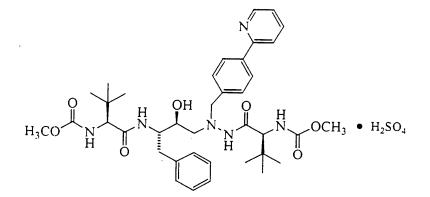
Atazanavir (ATV) is an azapeptide HIV-1 protease inhibitor (PI). The compound selectively inhibits the virus-specific
processing of viral Gag and Gag-Pol polyproteins in HIV-1 infected cells, thus preventing formation of mature virions.
Antiviral Activity in Cell Culture
Atazanavir exhibits anti-HIV-1 activity with a mean 50% effective concentration (EC50) in the
absence of human serum of 2 to 5 nM against a variety of laboratory and clinical HIV-1 isolates grown in peripheral blood mononuclear cells, macrophages, CEM-SS cells, and MT-2 cells. ATV has activity against HIV-1 Group M subtype viruses A, B, C, D, AE, AG, F, G, and J isolates in cell culture. ATV has variable activity against HIV-2 isolates (1.9 to 32 nM), with EC50 values above the EC50 values of failure isolates. Two-drug
combination antiviral activity studies with ATV showed no antagonism in cell culture with NNRTIs (delavirdine, efavirenz, and nevirapine), PIs (amprenavir,
indinavir, lopinavir, nelfinavir, ritonavir, and saquinavir), NRTIs (abacavir, didanosine, emtricitabine, lamivudine, stavudine, tenofovir, zalcitabine, and zidovudine), the HIV-1 fusion inhibitor enfuvirtide, and two compounds used in the treatment of viral hepatitis, adefovir and ribavirin, without enhanced cytotoxicity.
Resistance
In Cell Culture: HIV-1 isolates with a decreased susceptibility to ATV have been selected in cell culture and obtained from patients treated with ATV or atazanavir/ritonavir (ATV/RTV). HIV-1 isolates with 93- to 183-fold reduced susceptibility to ATV from three different viral strains were selected in cell culture by 5 months. The substitutions in these HIV-1 viruses that contributed to ATV resistance
include I50L, N88S, I84V, A71V, and M46I. Changes were also observed at the protease cleavage sites following drug selection. Recombinant viruses containing
the I50L substitution without other major PI substitutions were growth impaired and displayed increased susceptibility in cell culture to other PIs (amprenavir,
indinavir, lopinavir, nelfinavir, ritonavir, and saquinavir). The I50L and I50V substitutions yielded selective resistance to ATV and amprenavir, respectively,
and did not appear to be cross-resistant.
Clinical Studies of Treatment-Naive Patients: Comparison of Ritonavir-Boosted REYATAZ vs. Unboosted REYATAZ: Study AI424-089 compared REYATAZ 300 mg once daily with ritonavir 100 mg vs. REYATAZ 400 mg once daily when administered with lamivudine and extended-release stavudine in HIV-infected treatment-naive patients. A summary of the number of virologic failures and virologic failure isolates with ATV resistance in each arm is shown in Table 19.
Table 19: Summary of Virologic Failuresa at Week 96 in Study AI424-089: Comparison of Ritonavir Boosted REYATAZ vs. Unboosted REYATAZ: Randomized Patients| | REYATAZ 300 mg +
ritonavir 100 mg | REYATAZ 400 mg |
|---|
| (n=95) | (n=105) |
|---|
| a Virologic failure includes patients who were never suppressed through Week 96 and on study at
Week 96, had virologic rebound or discontinued due to insufficient viral load response. |
| b Percentage of Virologic Failure
Isolates with genotypic and phenotypic data. |
| c Mixture of I50I/L emerged in 2 other ATV 400 mg-treated patients. Neither isolate was phenotypically resistant to ATV. |
| Virologic Failure (≥50 copies/mL) at Week 96 | 15 (16%) | 34 (32%) |
| Virologic Failure with Genotypes and Phenotypes Data | 5 | 17 |
| Virologic Failure Isolates with ATV-resistance at Week 96 | 0/5 (0%)b | 4/17 (24%)b |
| Virologic Failure Isolates with I50L Emergence at Week 96c | 0/5 (0%)b | 2/17 (12%)b |
| Virologic Failure Isolates with Lamivudine Resistance at Week 96 | 2/5 (40%)b | 11/17 (65%)b |
Clinical Studies of Treatment-Naive Patients Receiving REYATAZ 300 mg With Ritonavir 100 mg: In Phase III study AI424-138, an as-treated genotypic and phenotypic analysis was conducted on samples from patients who experienced virologic failure (HIV-1 RNA ≥400 copies/mL) or discontinued before achieving suppression on ATV/RTV (n=39; 9%) and LPV/RTV (n=39; 9%) through 96 weeks of treatment. In the ATV/RTV arm, one of the virologic failure isolates had a 56-fold decrease in ATV susceptibility emerge on therapy with the development of PI resistance-associated substitutions L10F, V32I, K43T, M46I, A71I, G73S, I85I/V, and L90M. The NRTI resistance-associated substitution M184V also emerged on treatment in this isolate conferring emtricitabine resistance. Two ATV/RTV-virologic failure isolates had baseline phenotypic ATV resistance and IAS-defined major PI resistance-associated substitutions at baseline. The 150L substitution emerged on study in one of these failure isolates and was associated with a 17-fold decrease in ATV susceptibility from baseline and the other failure isolate with baseline ATV resistance and PI substitutions (M46M/I and I84I/V) had additional IAS-defined major PI substitutions (V32I, M46I, and I84V) emerge on ATV treatment associated with a 3-fold decrease in ATV susceptibiity from baseline. Five of the treatment failure isolates in the ATV/RTV arm developed phenotypic emtricitabine resistance with the emergence of either the M184I (n=1) or the M184V (n=4) substitution on therapy and none developed phenotypic tenofovir disoproxil resistance. In the LPV/RTV arm, one of the virologic failure patient isolates had a 69-fold decrease in LPV susceptibility emerge on therapy with the development of PI substitutions L10V, V11I, I54V, G73S, and V82A in addition to baseline PI substitutions L10L/I, V32I, I54I/V, A71I, G73G/S, V82V/A, L89V, and L90M. Six LPV/RTV virologic failure isolates developed the M184V substitution and phenotypic emtricitabine resistance and two developed phenotypic tenofovir disoproxil resistance.
Clinical Studies of Treatment-Naive Patients Receiving REYATAZ 400 mg Without Ritonavir: ATV-resistant clinical isolates from treatment-naive patients who experienced virologic failure on REYATAZ 400 mg treatment without ritonavir often developed an I50L substitution (after an average of 50 weeks of ATV therapy), often in combination with an A71V substitution, but also developed one or more other PI substitutions (eg, V32I, L33F, G73S, V82A, I85V, or N88S) with or without the I50L substitution. In treatment-naive patients, viral isolates that developed the I50L substitution, without other major PI substitutions, showed phenotypic resistance to ATV but retained in cell culture susceptibility to other PIs (amprenavir, indinavir, lopinavir, nelfinavir, ritonavir, and saquinavir); however, there are no clinical data available to demonstrate the effect of the I50L substitution on the efficacy of subsequently administered PIs.
Clinical Studies of Treatment-Experienced Patients: In studies of treatment-experienced
patients treated with ATV or ATV/RTV, most ATV-resistant isolates from patients who experienced virologic failure developed substitutions that were associated
with resistance to multiple PIs and displayed decreased susceptibility to multiple PIs. The most common protease substitutions to develop in the viral isolates of patients who failed treatment with ATV 300 mg once daily and RTV 100 mg once daily (together with tenofovir and an NRTI) included V32I, L33F/V/I, E35D/G, M46I/L, I50L, F53L/V, I54V, A71V/T/I, G73S/T/C, V82A/T/L, I85V, and L89V/Q/M/T. Other substitutions that developed on ATV/RTV treatment including E34K/A/Q, G48V, I84V, N88S/D/T, and L90M occurred in less than 10% of patient isolates. Generally, if multiple PI resistance substitutions were present in the HIV-1 virus of the patient at baseline, ATV resistance developed through substitutions associated with resistance to other PIs and could include the development of the I50L substitution. The I50L substitution has been detected in treatment-experienced patients experiencing virologic failure after long-term
treatment. Protease cleavage site changes also emerged on ATV treatment but their presence did not correlate with the level of ATV resistance.
Cross-Resistance
Cross-resistance among PIs has been observed. Baseline phenotypic and genotypic analyses of clinical isolates from ATV clinical trials of PI-experienced patients showed that isolates cross-resistant to multiple PIs were cross-resistant to ATV. Greater than 90% of the isolates
with substitutions that included I84V or G48V were resistant to ATV. Greater than 60% of isolates containing L90M, G73S/T/C, A71V/T, I54V, M46I/L, or a change at V82 were resistant to ATV, and 38% of isolates containing a D30N substitution in addition to other changes were resistant to ATV. Isolates
resistant to ATV were also cross-resistant to other PIs with >90% of the isolates resistant to indinavir, lopinavir, nelfinavir, ritonavir, and saquinavir,
and 80% resistant to amprenavir. In treatment-experienced patients, PI-resistant viral isolates that developed the I50L substitution in addition to other PI
resistance-associated substitution were also cross-resistant to other PIs.
Baseline Genotype/Phenotype and Virologic Outcome Analyses
Genotypic and/or phenotypic analysis of baseline virus may aid in determining ATV susceptibility before initiation
of ATV/RTV therapy. An association between virologic response at 48 weeks and the number and type of primary PI resistance-associated substitutions
detected in baseline HIV-1 isolates from antiretroviral-experienced patients receiving ATV/RTV once daily or lopinavir (LPV)/RTV twice daily in Study AI424-045
is shown in Table 20.
Overall, both the number and type of baseline PI substitutions affected response rates in treatment-experienced
patients. In the ATV/RTV group, patients had lower response rates when 3 or more baseline PI substitutions, including a substitution at position 36, 71,
77, 82, or 90, were present compared to patients with 1–2 PI substitutions, including one of these substitutions.
Table 20: HIV RNA Response by Number and Type of Baseline PI Substitution, Antiretroviral-Experienced Patients in Study AI424-045, As-Treated Analysis| Number and Type of Baseline PI Substitutionsa | Virologic Response = HIV RNA <400 copies/mLb |
|---|
ATV/RTV
(n=110) | LPV/RTV
(n=113) |
|---|
| a Primary substitutions include any change at D30, V32, M36, M46, I47, G48, I50, I54,
A71, G73, V77, V82, I84, N88, and L90. |
| b Results should be interpreted with caution because the subgroups were small. |
| c There were insufficient data (n<3) for PI substitutions V32I, I47V, G48V, I50V,
and F53L. |
| 3 or more primary PI substitutions including:c |
| D30N | 75% (6/8) | 50% (3/6) |
| M36I/V | 19% (3/16) | 33% (6/18) |
| M46I/L/T | 24% (4/17) | 23% (5/22) |
| I54V/L/T/M/A | 31% (5/16) | 31% (5/16) |
| A71V/T/I/G | 34% (10/29) | 39% (12/31) |
| G73S/A/C/T | 14% (1/7) | 38% (3/8) |
| V77I | 47% (7/15) | 44% (7/16) |
| V82A/F/T/S/I | 29% (6/21) | 27% (7/26) |
| I84V/A | 11% (1/9) | 33% (2/6) |
| N88D | 63% (5/8) | 67% (4/6) |
| L90M | 10% (2/21) | 44% (11/25) |
| Number of baseline primary PI substitutionsa |
| All patients, as-treated | 58% (64/110) | 59% (67/113) |
| 0–2 PI substitutions | 75% (50/67) | 75% (50/67) |
| 3–4 PI substitutions | 41% (14/34) | 43% (12/28) |
| 5 or more PI substitutions | 0% (0/9) | 28% (5/18) |
The response rates of antiretroviral-experienced patients in Study AI424-045 were analyzed by baseline phenotype (shift in susceptibility in cell culture relative to reference, Table 21). The analyses are based on a select patient population with 62% of patients receiving an NNRTI-based regimen before study entry compared to 35% receiving a PI-based regimen. Additional data are needed to determine clinically relevant break points for REYATAZ.
Table 21: Baseline Phenotype by Outcome, Antiretroviral-Experienced Patients in Study AI424-045, As-Treated Analysis| Baseline Phenotypea | Virologic Response = HIV RNA <400 copies/mLb |
|---|
ATV/RTV
(n=111) | LPV/RTV
(n=111) |
|---|
| a Fold change susceptibility in cell culture relative to the wild-type reference. |
| b Results should be interpreted with caution because the subgroups were small. |
| 0–2 | 71% (55/78) | 70% (56/80) |
| >2–5 | 53% (8/15) | 44% (4/9) |
| >5–10 | 13% (1/8) | 33% (3/9) |
| >10 | 10% (1/10) | 23% (3/13) |
Carcinogenesis
Long-term carcinogenicity studies in mice and rats were carried out with atazanavir for two years. In the mouse study, drug-related increases in hepatocellular adenomas were found in females at 360 mg/kg/day. The systemic drug exposure (AUC) at the NOAEL (no observable adverse effect level) in females, (120 mg/kg/day) was 2.8 times and in males (80 mg/kg/day) was 2.9 times higher than those in humans at the clinical dose (300 mg/day atazanavir boosted with 100 mg/day ritonavir, non-pregnant patients). In the rat study, no drug-related increases in tumor incidence were observed at doses up to 1200 mg/kg/day, for which AUCs were 1.1 (males) or 3.9 (females) times those measured in humans at the clinical dose.
Mutagenesis
Atazanavir tested positive in an in vitro clastogenicity test using primary human lymphocytes, in the absence and presence of metabolic activation. Atazanavir tested negative in the in vitro Ames reverse-mutation assay, in vivo micronucleus and DNA repair tests in rats, and in vivo DNA damage test in rat duodenum (comet assay).
Impairment of Fertility
At the systemic drug exposure levels (AUC) 0.9 (in male rats) or 2.3 (in female rats) times that of the human
clinical dose, (300 mg/day atazanavir boosted with 100 mg/day ritonavir) significant effects on mating, fertility, or early embryonic development were not observed.
Patient Information
REYATAZ® (RAY-ah-taz)
(generic name = atazanavir sulfate)
Capsules
ALERT: Find out about medicines that should NOT be taken with REYATAZ. Read
the section “What important information should I know about taking REYATAZ with other medicines?”
Read the Patient Information that comes with REYATAZ before you start using it and each time you get a refill. There may be new information. This leaflet provides a summary about REYATAZ and does not include everything there is to know about your medicine. This information does not take the place of talking with your healthcare provider about your medical condition or treatment.
What is REYATAZ?
REYATAZ is a prescription medicine used with other anti-HIV medicines to treat people 6 years of age and older who are infected with the human immunodeficiency virus (HIV). HIV is the virus that causes acquired immune deficiency syndrome (AIDS). REYATAZ is a type of anti-HIV medicine
called a protease inhibitor. HIV infection destroys CD4+ (T) cells, which are important to the immune system. The immune system helps fight infection. After a large number of (T) cells are destroyed, AIDS develops. REYATAZ helps to block HIV protease, an enzyme that is needed for the HIV virus to multiply. REYATAZ may lower the amount of HIV in your blood, help your body keep its supply of CD4+ (T) cells, and reduce the risk of death and illness associated
with HIV.
Does REYATAZ cure HIV or AIDS?
REYATAZ does not cure HIV infection or AIDS. At present there is no cure for HIV infection. People taking REYATAZ may still get opportunistic infections or other conditions that happen with HIV infection. Opportunistic infections are infections that develop because the immune system is weak. Some of these conditions are pneumonia, herpes virus infections, and Mycobacterium avium complex (MAC) infections. It is very important that you see your healthcare provider regularly while taking REYATAZ.
REYATAZ does not lower your chance of passing HIV to other people through sexual contact,
sharing needles, or being exposed to your blood. For your health and the health of others, it is important to always practice safer sex by using
a latex or polyurethane condom or other barrier to lower the chance of sexual contact with semen, vaginal secretions, or blood. Never use or share dirty
needles.
Who should not take REYATAZ?
Do not take REYATAZ if you:
- are taking certain medicines. (See “What important information should I know about taking REYATAZ with other medicines?”) Serious life-threatening side effects or death may happen. Before you take REYATAZ, tell your healthcare provider about all medicines you are taking or planning to take. These include other prescription and nonprescription medicines, vitamins, and herbal supplements.
- are allergic to REYATAZ or to any of its ingredients. The active ingredient is atazanavir sulfate. See the end of this leaflet for a complete list of ingredients in REYATAZ. Tell your healthcare provider if you think you have had an allergic reaction to any of these ingredients.
What should I tell my healthcare provider before I take REYATAZ?
Tell your healthcare provider:
- If you are pregnant or plan to become pregnant. REYATAZ use during pregnancy has not been associated with an increase in birth defects. Pregnant women have experienced serious side effects when taking REYATAZ with other HIV medicines called nucleoside analogues. You and your healthcare provider will need to decide if REYATAZ is right for you. If you use REYATAZ while you are pregnant, talk to your
healthcare provider about the Antiretroviral Pregnancy Registry.
- After your baby is born, tell your healthcare provider if your baby’s skin or the white part of his/her eyes turns yellow.
- If you are breast-feeding. You should not breast-feed if you are HIV-positive because of the chance of passing HIV to your baby. Also, it is not known if REYATAZ can pass into your breast milk and if it can harm your baby. If you are a woman who has or will have a baby, talk with your healthcare provider about the best way to feed your baby.
- If you have liver problems or are infected with the hepatitis B or C virus. See “What are the possible side effects of REYATAZ?”
- If you have end stage kidney disease managed with hemodialysis.
- If you have diabetes. See “What are the possible side effects of REYATAZ?”
- If you have hemophilia. See “What are the possible side effects of REYATAZ?”
- About all the medicines you take including prescription and nonprescription medicines, vitamins, and herbal supplements. Keep a list of your medicines with you to show your healthcare provider. For more information, see “What important information should I know about taking REYATAZ with other medicines?” and “Who should not take REYATAZ?” Some medicines can cause serious
side effects if taken with REYATAZ.
How should I take REYATAZ?
- Take REYATAZ once every day exactly as instructed by your healthcare provider.
Your healthcare provider will prescribe the amount of REYATAZ that is right for you.
- Always take REYATAZ with food (a meal or snack) to help it work better. Swallow the capsules whole. Do not open the capsules. Take REYATAZ at the same time each day.
- If you are taking antacids or didanosine (VIDEX® or VIDEX® EC), take REYATAZ 2 hours before or 1 hour after these medicines.
- If you are taking medicines for indigestion, heartburn, or ulcers such as AXID® (nizatidine), PEPCID AC® (famotidine), TAGAMET® (cimetidine), ZANTAC® (ranitidine), AcipHex® (rabeprazole), NEXIUM® (esomeprazole), PREVACID® (lansoprazole), PRILOSEC® (omeprazole), or PROTONIX® (pantoprazole), talk to your healthcare provider.
- Do not change your dose or stop taking REYATAZ without first talking with your healthcare provider. It is important to stay under a healthcare provider’s care while taking REYATAZ.
- When your supply of REYATAZ starts to run low, get more from your healthcare provider or pharmacy. It is important not to run out of REYATAZ. The amount of HIV in your blood may increase if the medicine is stopped for even a short time.
- If you miss a dose of REYATAZ, take it as soon as possible and then take your next scheduled dose at its regular time. If, however, it is within 6 hours of your next dose, do not take the missed dose. Wait and take the next dose at the regular time. Do not double the next dose. It is important that you do not miss any doses of REYATAZ or your other anti-HIV medicines.
- If you take more than the prescribed dose of REYATAZ, call your healthcare provider or poison control center right away.
What are the possible side effects of REYATAZ?
The following list of side effects is not complete. Report any new or continuing symptoms to your healthcare provider. If you have questions about side effects, ask your healthcare provider. Your healthcare provider may be able to help you manage these side effects.
The following side effects have been reported with REYATAZ:
- mild rash (redness and itching) without other symptoms sometimes occurs in patients taking REYATAZ, most often in the first few weeks after the medicine is started. Rashes usually go away within 2 weeks with no change in treatment. Tell your healthcare provider if rash occurs.
- severe rash: Rash may develop in association with other symptoms which could be serious and potentially cause death.
If you develop a rash with any of the following symptoms stop using REYATAZ and call your healthcare provider right away:
- shortness of breath
- general ill feeling or “flu-like” symptoms
- fever
- muscle or joint aches
- conjunctivitis (red or inflamed eyes, like “pink eye”)
- blisters
- mouth sores
- swelling of your face
- yellowing of the skin or eyes. These effects may be due to increases in bilirubin levels in the blood (bilirubin is made by the liver). Although these effects may not be damaging to your liver, skin, or eyes, call your healthcare provider promptly if your skin or the white part of your eyes turn yellow.
- a change in the way your heart beats (heart rhythm change). Call your healthcare provider right away if you get dizzy or lightheaded. These could be symptoms of a heart problem.
- diabetes and high blood sugar (hyperglycemia) sometimes happen in patients taking protease inhibitor medicines like REYATAZ. Some patients had diabetes before taking protease inhibitors while others did not. Some patients may need changes in their diabetes medicine.
- if you have liver disease including hepatitis B or C, your liver disease may get worse when you take anti-HIV medicines like REYATAZ.
- kidney stones have been reported in patients taking REYATAZ. If you develop signs or symptoms of kidney stones (pain in your side, blood in your urine, pain when you urinate) tell your healthcare provider promptly.
- some patients with hemophilia have increased bleeding problems with protease inhibitors like REYATAZ.
- changes in body fat. These changes may include an increased amount of fat in the upper back and neck (“buffalo hump”), breast, and around the trunk. Loss of fat from the legs, arms, and face may also happen. The cause and long-term health effects of these conditions are not known at this time.
- immune reconstitution syndrome. In some patients with advanced HIV infection (AIDS) and a history of opportunistic infection, signs and symptoms of inflammation from previous infections may occur soon after anti-HIV treatment, including REYATAZ, is started.
Other common side effects of REYATAZ taken with other anti-HIV medicines include nausea; headache; stomach pain; vomiting; diarrhea; depression; fever; dizziness; trouble sleeping; numbness, tingling, or burning of hands or feet; and muscle pain.
Gallbladder disorders (which may include gallstones and gallbladder inflammation) have been reported in patients taking REYATAZ.
What important information should I know about taking REYATAZ with other medicines?
Do not take REYATAZ if you take the following medicines (not all brands may be listed; tell your healthcare provider about all the medicines you take). REYATAZ may cause serious, life-threatening side effects or death when used with these medicines.
- Ergot medicines: dihydroergotamine, ergonovine, ergotamine, and methylergonovine such as CAFERGOT®, MIGRANAL®, D.H.E. 45®, ergotrate maleate, METHERGINE®, and others (used for migraine headaches).
- ORAP® (pimozide, used for Tourette’s disorder).
- PROPULSID® (cisapride, used for certain stomach problems).
- Triazolam, also known as HALCION® (used for insomnia).
- Midazolam, also known as VERSED® (used for sedation), when taken by mouth.
Do not take the following medicines with REYATAZ because of possible serious side effects:
- CAMPTOSAR® (irinotecan, used for cancer).
- CRIXIVAN® (indinavir, used for HIV infection). Both REYATAZ and CRIXIVAN sometimes cause increased levels of bilirubin in the blood.
- Cholesterol-lowering medicines MEVACOR® (lovastatin) or ZOCOR® (simvastatin).
- UROXATRAL® (alfuzosin, used to treat benign enlargement of the prostate).
- REVATIO® (sildenafil, used to treat pulmonary arterial hypertension).
Do not take the following medicines with REYATAZ because they may lower the amount of REYATAZ in your blood. This may lead to an increased HIV viral load. Resistance to REYATAZ or cross-resistance to other HIV medicines may develop:
- Rifampin (also known as RIMACTANE®, RIFADIN®, RIFATER®, or RIFAMATE®, used for tuberculosis).
- St. John’s wort (Hypericum perforatum), an herbal product sold as a dietary supplement, or products containing St. John’s wort.
- VIRAMUNE® (nevirapine, used for HIV infection).
The following medicines are not recommended with REYATAZ:
- SEREVENT DISKUS® (salmeterol) and ADVAIR® (salmeterol with fluticasone), used to treat asthma, emphysema/chronic obstructive pulmonary disease also known as COPD.
Do not take the following medicine if you are taking REYATAZ and NORVIR® together:
- VFEND® (voriconazole).
The following medicines may require your healthcare provider to monitor your therapy more closely (for some medicines a change in the dose or dose schedule may be needed):
- CIALIS® (tadalafil), LEVITRA® (vardenafil), or VIAGRA® (sildenafil), used to treat erectile dysfunction. REYATAZ may increase the chances of serious side effects that can happen with CIALIS, LEVITRA, or VIAGRA. Do not use CIALIS, LEVITRA, or VIAGRA while you are taking REYATAZ unless your healthcare provider tells you it is okay.
- ADCIRCA® (tadalafil) or TRACLEER® (bosentan), used to treat pulmonary arterial hypertension.
- LIPITOR® (atorvastatin) or CRESTOR® (rosuvastatin). There is an increased chance of serious side effects if you take REYATAZ with
this cholesterol-lowering medicine.
- Medicines for abnormal heart rhythm: CORDARONE® (amiodarone), lidocaine, quinidine (also known as CARDIOQUIN®, QUINIDEX®, and others).
- MYCOBUTIN® (rifabutin, an antibiotic used to treat tuberculosis).
- BUPRENEX®, SUBUTEX®, SUBOXONE® (buprenorphine or buprenorphine/naloxone, used to treat pain and addiction to narcotic painkillers).
- VASCOR® (bepridil, used for chest pain).
- COUMADIN® (warfarin).
- Tricyclic antidepressants such as ELAVIL® (amitriptyline), NORPRAMIN® (desipramine), SINEQUAN® (doxepin), SURMONTIL® (trimipramine), TOFRANIL® (imipramine),
or VIVACTIL® (protriptyline).
- Medicines to prevent organ transplant rejection: SANDIMMUNE® or NEORAL® (cyclosporin), RAPAMUNE® (sirolimus), or PROGRAF® (tacrolimus).
- The antidepressant trazodone (DESYREL® and others).
- Fluticasone propionate (FLONASE®, FLOVENT®), given by nose or inhaled to treat allergic symptoms or asthma. Your doctor may choose not to keep you on fluticasone,
especially if you are also taking NORVIR®.
- Colchicine (COLCRYS®), used to prevent or treat gout or treat familial Mediterranean fever.
The following medicines may require a change in the dose or dose schedule of either REYATAZ or the other medicine:
- INVIRASE® (saquinavir).
- NORVIR® (ritonavir).
- SUSTIVA® (efavirenz).
- Antacids or buffered medicines.
- VIDEX® (didanosine).
- VIREAD® (tenofovir disoproxil fumarate).
- MYCOBUTIN® (rifabutin).
- Calcium channel blockers such as CARDIZEM® or
TIAZAC® (diltiazem), COVERA-HS® or
ISOPTIN SR® (verapamil) and others.
- BIAXIN® (clarithromycin).
- Medicines for indigestion, heartburn, or ulcers such as AXID® (nizatidine), PEPCID AC® (famotidine), TAGAMET® (cimetidine), or ZANTAC® (ranitidine).
Talk to your healthcare provider about choosing an effective method of contraception. REYATAZ may affect the safety and effectiveness of hormonal contraceptives such as birth control pills or the contraceptive patch. Hormonal contraceptives do not prevent the spread of HIV to others.
Remember:
- Know all the medicines you take.
- Tell your healthcare provider about all the medicines you take.
- Do not start a new medicine without talking to your healthcare provider.
How should I store REYATAZ?
- Store REYATAZ Capsules at room temperature, 59° to 86° F (15° to 30° C). Do not store this medicine in a damp place such as a bathroom medicine cabinet or near the kitchen sink.
- Keep your medicine in a tightly closed container.
- Keep all medicines out of the reach of children and pets at all times. Do not keep medicine that is out of date or that you no longer need. Dispose of unused medicines through community take-back disposal programs when available or place REYATAZ in an unrecognizable, closed container in the household trash.
General information about REYATAZ
This medicine was prescribed for your particular condition. Do not use REYATAZ for another condition. Do not give REYATAZ to other people, even if they have the same symptoms you have. It may harm them. Keep REYATAZ and all medicines out of the reach of children and pets.
This summary does not include everything there is to know about REYATAZ. Medicines are sometimes prescribed for conditions that are not mentioned in patient information leaflets. Remember no written summary can replace careful discussion with your healthcare provider. If you would like more information, talk with your healthcare provider or you can call 1-800-321-1335.
What are the ingredients in REYATAZ?
Active Ingredient: atazanavir sulfate
Inactive Ingredients: Crospovidone, lactose monohydrate (milk sugar), magnesium stearate, gelatin, FD&C Blue #2, and titanium dioxide.
VIDEX® and REYATAZ® are registered trademarks of Bristol-Myers Squibb Company. COUMADIN® and SUSTIVA® are registered trademarks of Bristol-Myers Squibb Pharma Company. DESYREL® is a registered trademark of Mead Johnson and Company. Other brands listed are the trademarks of their respective owners and are not trademarks of Bristol-Myers Squibb Company.
Bristol-Myers Squibb Company
Princeton, NJ 08543 USA
1246226B0
Rev October 2011
Additional barcode labeling by:
Physicians Total Care, Inc.
Tulsa, Oklahoima 74146