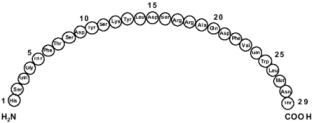
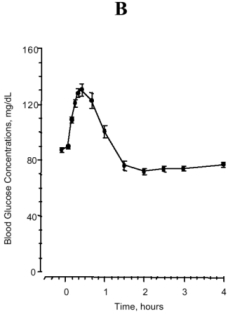
Glucagon increases blood glucose concentration and
is used in the treatment of hypoglycemia. Glucagon acts only on liver glycogen,
converting it to glucose.
Glucagon administered
through a parenteral route relaxes smooth muscle of the stomach, duodenum,
small bowel, and colon.
Glucagon is contraindicated in patients with known
hypersensitivity to it or in patients with known pheochromocytoma.
Glucagon should be administered cautiously to patients
with a history suggestive of insulinoma, pheochromocytoma, or both. In patients
with insulinoma, intravenous administration of glucagon may produce an initial
increase in blood glucose; however, because of glucagon's hyperglycemic
effect the insulinoma may release insulin and cause subsequent hypoglycemia.
A patient developing symptoms of hypoglycemia after a dose of glucagon should
be given glucose orally, intravenously, or by gavage, whichever is most appropriate.
Exogenous glucagon also stimulates the release of
catecholamines. In the presence of pheochromocytoma, glucagon can cause the
tumor to release catecholamines, which may result in a sudden and marked increase
in blood pressure. If a patient develops a sudden increase in blood pressure,
5 to 10 mg of phentolamine mesylate may be administered intravenously in an
attempt to control the blood pressure.
Generalized allergic reactions, including urticaria,
respiratory distress, and hypotension, have been reported in patients who
received glucagon by injection.
Glucagon is effective in treating hypoglycemia
only if sufficient liver glycogen is present. Because glucagon is of little
or no help in states of starvation, adrenal insufficiency, or chronic hypoglycemia,
hypoglycemia in these conditions should be treated with glucose.
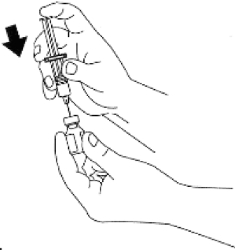
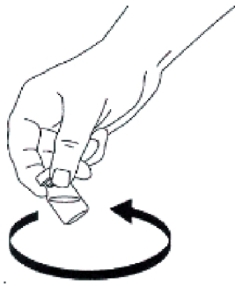
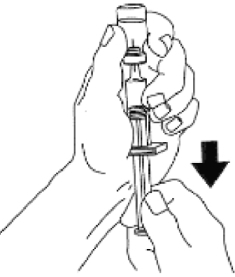
Refer patients and family members to the attached
Information for the User for instructions describing the method of preparing
and injecting glucagon. Advise the patient and family members to become familiar
with the technique of preparing glucagon before an emergency arises. Instruct
patients to use 1 mg (1 unit) for adults and 1/2 the adult dose (0.5 mg) [0.5 unit]
for pediatric patients weighing less than 44 lb (20 kg).
Patients and family members should be informed
of the following measures to prevent hypoglycemic reactions due to insulin:
- Reasonable uniformity from day to day with regard to diet, insulin,
and exercise.
- Careful adjustment of the insulin program so that the type (or types)
of insulin, dose, and time (or times) of administration are suited to the
individual patient.
- Frequent testing of the blood or urine for glucose so that a change
in insulin requirements can be foreseen.
- Routine carrying of sugar, candy, or other readily absorbable carbohydrate
by the patient so that it may be taken at the first warning of an oncoming
reaction.
To prevent severe hypoglycemia, patients and
family members should be informed of the symptoms of mild hypoglycemia and
how to treat it appropriately.
Family members
should be informed to arouse the patient as quickly as possible because prolonged
hypoglycemia may result in damage to the central nervous system. Glucagon
or intravenous glucose should awaken the patient sufficiently so that oral
carbohydrates may be taken.
Patients should
be advised to inform their physician when hypoglycemic reactions occur so
that the treatment regimen may be adjusted if necessary.
Blood glucose determinations should be obtained
to follow the patient with hypoglycemia until patient is asymptomatic.
Because glucagon is usually given in a single
dose and has a very short half-life, no studies have been done regarding carcinogenesis.
In a series of studies examining effects on the bacterial mutagenesis (Ames)
assay, it was determined that an increase in
colony counts was related to technical difficulties in running this assay
with peptides and was not due to mutagenic activities of the glucagon.
Reproduction studies have been performed in rats
at doses up to 2 mg/kg glucagon administered two times a day (up to 40 times
the human dose based on body surface area, mg/m2) and have revealed
no evidence of impaired fertility.
Pregnancy
Category B — Reproduction studies have not been performed with recombinant
glucagon. However, studies with animal-sourced glucagon were performed in
rats at doses up to 2 mg/kg glucagon administered two times a day (up to 40 times
the human dose based on body surface area, mg/m2), and have revealed
no evidence of impaired fertility or harm to the fetus due to glucagon. There
are, however, no adequate and well-controlled studies in pregnant women. Because
animal reproduction studies are not always predictive of human response, this
drug should be used during pregnancy only if clearly needed.
It is not known whether this drug is excreted
in human milk. Because many drugs are excreted in human milk, caution should
be exercised when glucagon is administered to a nursing woman. If the drug
is excreted in human milk during its short half-life, it will be hydrolyzed
and absorbed like any other polypeptide. Glucagon is not active when taken
orally because it is destroyed in the gastrointestinal tract before it can
be absorbed.
For the treatment of hypoglycemia: The use of
glucagon in pediatric patients has been reported to be safe and effective.2-6
For use as a diagnostic aid: Effectiveness has
not been established in pediatric patients.
Clinical studies of glucagon did not include sufficient
numbers of subjects aged 65 and over to determine whether they respond differently
from younger subjects. Other reported clinical experience has not identified
differences in responses between the elderly and younger patients. In general,
dose selection for an elderly patient should be cautious, usually starting
at the low end of the dosing range, reflecting the greater frequency of decreased
hepatic, renal, or cardiac function, and of concomitant disease or other drug
therapy.
Signs and
Symptoms — If overdosage occurs, nausea, vomiting, gastric hypotonicity,
and diarrhea would be expected without causing consequential toxicity.
Intravenous administration of glucagon has been shown to
have positive inotropic and chronotropic effects. A transient increase in
both blood pressure and pulse rate may occur following the administration
of glucagon. Patients taking β-blockers might be expected to have a greater
increase in both pulse and blood pressure, an increase of which will be transient
because of glucagon's short half-life. The increase in blood pressure
and pulse rate may require therapy in patients with pheochromocytoma or coronary
artery disease.
When glucagon was given in
large doses to patients with cardiac disease, investigators reported a positive
inotropic effect. These investigators administered glucagon in doses of 0.5 to
16 mg/hour by continuous infusion for periods of 5 to 166 hours. Total doses
ranged from 25 to 996 mg, and a 21-month-old infant received approximately
8.25 mg in 165 hours. Side effects included nausea, vomiting, and decreasing
serum potassium concentration. Serum potassium concentration could be maintained
within normal limits with supplemental potassium.
The
intravenous median lethal dose for glucagon in mice and rats is approximately
300 mg/kg and 38.6 mg/kg, respectively.
Because
glucagon is a polypeptide, it would be rapidly destroyed in the gastrointestinal
tract if it were to be accidentally ingested.
Treatment
— To obtain up-to-date information about the treatment of overdose,
a good resource is your certified Regional Poison Control Center. Telephone
numbers of certified poison control centers are listed in the Physicians'
Desk Reference (PDR). In managing overdosage, consider the possibility
of multiple drug overdoses, interaction among drugs, and unusual drug kinetics
in your patient.
In view of the extremely short
half-life of glucagon and its prompt destruction and excretion, the treatment
of overdosage is symptomatic, primarily for nausea, vomiting, and possible
hypokalemia.
If the patient develops a dramatic
increase in blood pressure, 5 to 10 mg of phentolamine mesylate has been shown
to be effective in lowering blood pressure for the short time that control
would be needed.
Forced diuresis, peritoneal
dialysis, hemodialysis, or charcoal hemoperfusion have not been established
as beneficial for an overdose of glucagon; it is extremely unlikely that one
of these procedures would ever be indicated.
Glucagon Emergency Kit for Low Blood Sugar (Glucagon
for Injection [rDNA origin]) (MS8031):
1 mg (1 unit) — (VL7529), with 1 mL of
diluting solution (Hyporet®* HY7530) (1s) NDC 54868-5070-0
*Hyporet® (disposable
syringe, Lilly).
Before
Reconstitution — Vials of Glucagon, as well as the Diluting Solution
for Glucagon, may be stored at controlled room temperature 20° to 25°C (68° to 77°F)[see
USP].
The USP defines controlled room temperature
by the following: A temperature maintained thermostatically that encompasses
the usual and customary working environment of 20° to 25°C (68° to 77°F);
that results in a mean kinetic temperature calculated to be not more than 25°C;
and that allows for excursions between 15° and 30°C (59° and 86°F) that are
experienced in pharmacies, hospitals, and warehouses.
After
Reconstitution — Glucagon for Injection (rDNA origin) should be
used immediately. Discard any unused portion.
Literature revised February 18, 2005
Eli Lilly and Company
Indianapolis,
IN 46285, USA
PA 2285 AMP
Copyright © 1999,
2005, Eli Lilly and Company. All rights reserved.
Additional barcode labeling by:
Physicians Total Care, Inc.
Tulsa, Oklahoma 74146