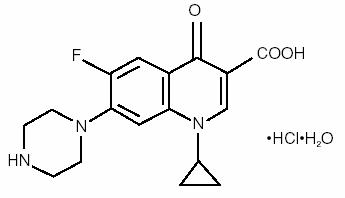
General
As with other antibacterial preparations, prolonged use of
ciprofloxacin may result in overgrowth of nonsusceptible organisms, including
fungi. If superinfection occurs, appropriate therapy should be initiated.
Whenever clinical judgment dictates, the patient should be examined with the aid
of magnification, such as slit lamp biomicroscopy and, where appropriate,
fluorescein staining.
Ciprofloxacin should be discontinued at the first appearance of a skin rash
or any other sign of hypersensitivity reaction.
In clinical studies of patients with bacterial corneal ulcer, a white
crystalline precipitate located in the superficial portion of the corneal defect
was observed in 35 (16.6%) of 210 patients. The onset of the precipitate was
within 24 hours to 7 days after starting therapy. In one patient, the
precipitate was immediately irrigated out upon its appearance. In 17 patients,
resolution of the precipitate was seen in 1 to 8 days (seven within the first
24-72 hours), in five patients, resolution was noted in 10-13 days. In nine
patients, exact resolution days were unavailable; however, at follow-up
examinations, 18-44 days after onset of the event, complete resolution of the
precipitate was noted. In three patients, outcome information was unavailable.
The precipitate did not preclude continued use of ciprofloxacin, nor did it
adversely affect the clinical course of the ulcer or visual outcome. (See ADVERSE
REACTIONS).
Information for patients
Do not touch dropper tip to any surface, as this may contaminate
the solution.
Drug interactions
Specific drug interaction studies have not been conducted with
ophthalmic ciprofloxacin. However, the systemic administration of some
quinolones has been shown to elevate plasma concentrations of theophylline,
interfere with the metabolism of caffeine, enhance the effects of the oral
anticoagulant, warfarin, and its derivatives and has been associated with
transient elevations in serum creatinine in patients receiving cyclosporine
concomitantly.
Carcinogenesis, mutagenesis, impairment of
fertility
Eight in vitro mutagenicity tests have
been conducted with ciprofloxacin and the test results are listed below:
Salmonella/Microsome Test (Negative)
E. coli DNA Repair Assay (Negative) Mouse Lymphoma Cell Forward Mutation Assay (Positive) Chinese Hamster V
79 Cell HGPRT Test (Negative) Syrian Hamster Embryo Cell Transformation Assay (Negative)
Saccharomyces cerevisiae Point Mutation Assay
(Negative)
Saccharomyces cerevisiae Mitotic Crossover and
Gene Conversion Assay (Negative) Rat Hepatocyte DNA Repair Assay (Positive)
Thus, two of the eight tests were positive, but the results of the following
three in vivo test systems gave negative results:
Rat Hepatocyte DNA Repair Assay Micronucleus Test (Mice) Dominant Lethal Test (Mice)
Long term carcinogenicity studies in mice and rats have been completed. After
daily oral dosing for up to two years, there is no evidence that ciprofloxacin
had any carcinogenic or tumorigenic effects in these species.
Pregnancy
Pregnancy Category C: Reproduction
studies have been performed in rats and mice at doses up to six times the usual
daily human oral dose and have revealed no evidence of impaired fertility or
harm to the fetus due to ciprofloxacin. In rabbits, as with most antimicrobial
agents, ciprofloxacin (30 and 100 mg/kg orally) produced gastrointestinal
disturbances resulting in maternal weight loss and an increased incidence of
abortion. No teratogenicity was observed at either dose. After intravenous
administration, at doses up to 20 mg/kg, no maternal toxicity was produced and
no embryotoxicity or teratogenicity was observed. There are no adequate and well
controlled studies in pregnant women. Ciprofloxacin Ophthalmic Solution should
be used during pregnancy only if the potential benefit justifies the potential
risk to the fetus.
Nursing mothers
It is not known whether topically applied ciprofloxacin is
excreted in human milk; however, it is known that orally administered
ciprofloxacin is excreted in the milk of lactating rats and oral ciprofloxacin
has been reported in human breast milk after a single 500 mg dose. Caution
should be exercised when Ciprofloxacin Ophthalmic Solution is administered to a
nursing mother.
Pediatric use
Safety and effectiveness in pediatric patients below the age of 1
year have not been established. Although ciprofloxacin and other quinolones
cause arthropathy in immature animals after oral administration, topical ocular
administration of ciprofloxacin to immature animals did not cause any
arthropathy and there is no evidence that the ophthalmic dosage form has any
effect on the weight bearing joints.
Geriatric use
No overall differences in safety or effectiveness have been
observed between elderly and younger patients.