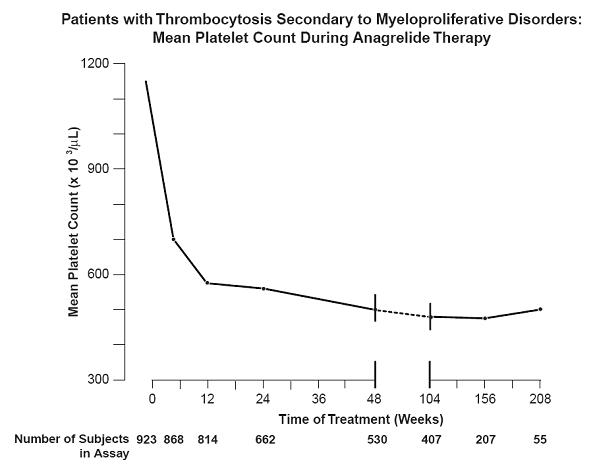
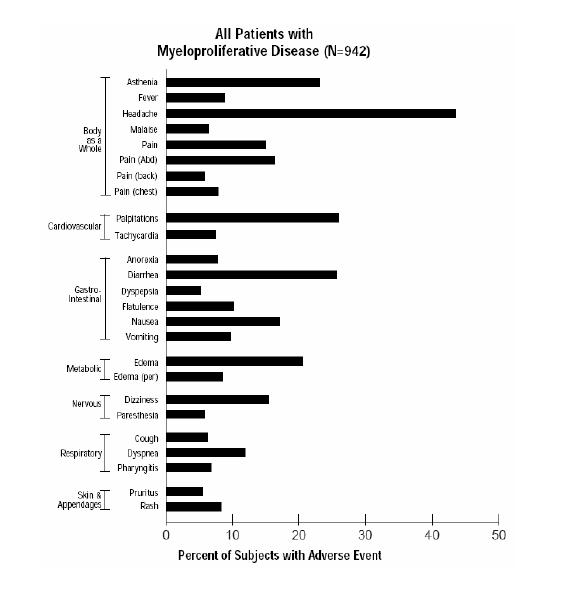
The mechanism by which anagrelide reduces blood platelet count is still under investigation. Studies in patients support a hypothesis of dose-related reduction in platelet production resulting from a decrease in megakaryocyte hypermaturation. In blood withdrawn from normal volunteers treated with anagrelide, a disruption was found in the postmitotic phase of megakaryocyte development and a reduction in megakaryocyte size and ploidy. At therapeutic doses, anagrelide does not produce significant changes in white cell counts or coagulation parameters, and may have a small, but clinically insignificant effect on red cell parameters. Anagrelide inhibits cyclic AMP phosphodiesterase III (PDEIII). PDEIII inhibitors can also inhibit platelet aggregation. However, significant inhibition of platelet aggregation is observed only at doses of anagrelide higher than those required to reduce platelet count.
Following oral administration of 14C-anagrelide in people, more than 70% of radioactivity was recovered in urine. Based on limited data, there appears to be a trend toward dose linearity between doses of 0.5 mg and 2 mg. At fasting and at a dose of 0.5 mg of anagrelide, the plasma half-life is 1.3 hours. The available plasma concentration time data at steady state in patients showed that anagrelide does not accumulate in plasma after repeated administration.
Two major metabolites have been identified (RL603 and 3-hydroxy anagrelide).
There were no apparent differences between patient groups (pediatric versus adult patients) for tmax and for t1/2 for anagrelide, 3-hydroxy anagrelide, or RL603.
Pharmacokinetic data obtained from healthy volunteers comparing the pharmacokinetics of anagrelide in the fed and fasted states showed that administration of a 1 mg dose of anagrelide with food decreased the Cmax by 14%, but increased the AUC by 20%.
Pharmacokinetic (PK) data from pediatric (age range 7 to 14 years) and adult (age range 16 to 86 years) patients with thrombocythemia secondary to a myeloproliferative disorder (MPD), indicate that dose- and body weight-normalized exposure, Cmax and AUCτ, of anagrelide were lower in the pediatric patients compared to the adult patients (Cmax 48%, AUCτ 55%).
Pharmacokinetic data from fasting elderly patients with ET (age range 65 to 75 years) compared to fasting adult patients (age range 22 to 50 years) indicate that the Cmax and AUC of anagrelide were 36% and 61% higher respectively in elderly patients, but that the Cmax and AUC of the active metabolite, 3-hydroxy anagrelide, were 42% and 37% lower respectively in the elderly patients.
A pharmacokinetic study at a single dose of 1 mg anagrelide in subjects with severe renal impairment (creatinine clearance < 30 mL/min) showed no significant effects on the pharmacokinetics of anagrelide.
A pharmacokinetic study at a single dose of 1 mg anagrelide in subjects with moderate hepatic impairment showed an 8 fold increase in total exposure (AUC) to anagrelide.