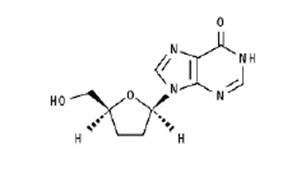
The pharmacokinetic parameters of didanosine in HIV-infected adult and pediatric patients are summarized in Table 7, by weight ranges that correspond to recommended doses (Table 1). Didanosine is rapidly absorbed, with peak plasma concentrations generally observed from 0.25 to 1.50 hours following oral dosing with a buffered formulation. Increases in plasma didanosine concentrations were dose proportional over the range of 50 to 400 mg. In adults, the mean (± standard deviation) oral bioavailability following single oral dosing with a buffered formulation is 42 (±12)%. After oral administration, the urinary recovery of didanosine is approximately 18 (±8)% of the dose. The CSF-plasma ratio following IV administration is 21 (±0.03)%. Steady-state pharmacokinetic parameters did not differ significantly from values obtained after a single dose. Binding of didanosine to plasma proteins in vitro was low (less than 5%). Based on data from in vitro and animal studies, it is presumed that the metabolism of didanosine in man occurs by the same pathways responsible for the elimination of endogenous purines.
Table 7: Pharmacokinetic Parameters for Didanosine in HIV-infected Patients | Pediatrics | Adults |
| Parameter
| 20 kg to less than 25 kg n = 10 | 25 kg to less than 60 kg n = 17 | At least 60 kg
n = 7 | At least 60 kg n = 44 |
| Apparent clearance (L/h) | 89.5 + 21.6 | 116.2 + 38.6 | 196 + 55.8 | 174.5 + 69.7 |
| Apparent volume of distribution (L) | 98.1 + 30.2 | 154.7 + 55 | 363 + 137.7 | 308.3 + 164.3 |
| Elimination half-life (h) | 0.75 + 0.13 | 0.92 + 0.09 | 1.26 + 0.19 | 1.19 + 0.21 |
Steady-state (AUC)
(mg•h/L) | 2.38 + 0.66 | 2.36 + 0.70 | 2.25 + 0.89 | 2.65 + 1.07 |
Comparison of Didanosine Formulations
In didanosine delayed-release capsules, the active ingredient, didanosine, is protected against degradation by stomach acid by the use of an enteric coating on the pellets in the capsule. The enteric coating dissolves when the pellets empty into the small intestine, the site of drug absorption. With buffered formulations of didanosine, administration with antacid provides protection from degradation by stomach acid.
In healthy volunteers, as well as subjects infected with HIV-1, the AUC is equivalent for didanosine administered as the didanosine delayed-release capsules formulation relative to a buffered tablet formulation. The peak plasma concentration (Cmax) of didanosine, administered as didanosine delayed-release capsules, is reduced approximately 40% relative to didanosine buffered tablets. The time to the peak concentration (Tmax) increases from approximately 0.67 hours for didanosine buffered tablets to 2 hours for didanosine delayed-release capsules.
Effect of Food
In the presence of food, the Cmax and AUC for didanosine delayed-release capsules were reduced by approximately 46% and 19%, respectively, compared to the fasting state [see Dosage and Administration (2)]. Didanosine delayed-release capsules should be taken on an empty stomach.
Special Populations
Renal Insufficiency: Data from two studies using a buffered formulation of didanosine indicated that the apparent oral clearance of didanosine decreased and the terminal elimination half-life increased as creatinine clearance decreased (see Table 8). Following oral administration, didanosine was not detectable in peritoneal dialysate fluid (n = 6); recovery in hemodialysate (n = 5) ranged from 0.6% to 7.4% of the dose over a 3 to 4 hour dialysis period. The absolute bioavailability of didanosine was not affected in patients requiring dialysis. [See Dosage and Administration (2.2).]
Table 8: Mean ± SD Pharmacokinetic Parameters for Didanosine Following a Single Oral Dose of a Buffered Formulation ND = not determined due to anuria.
CLcr = creatinine clearance.
CL/F = apparent oral clearance.
CLR = renal clearance.
|
| Creatinine Clearance (mL/min) | |
| Parameter | at least 90
n = 12 | 60-90
n = 6 | 30-59
n = 6 | 10-29
n = 3 | Dialysis Patients
n = 11 |
| CLcr (mL/min) | 112 + 22 | 68 + 8 | 46 + 8 | 13 + 5 | ND |
| CL/F (mL/min) | 2164 + 638 | 1566 + 833 | 1023 + 378 | 628 + 104 | 543 + 174 |
| CLR (mL/min) | 458 + 164 | 247 + 153 | 100 + 44 | 20 + 8 | less than 10 |
| T1/2 (h) | 1.42 + 0.33 | 1.59 + 0.13 | 1.75 + 0.43 | 2 + 0.3 | 4.1 + 1.2 |
Hepatic Impairment: The pharmacokinetics of didanosine have been studied in 12 non-HIV-infected subjects with moderate (n = 8) to severe (n = 4) hepatic impairment (Child-Pugh Class B or C). Mean AUC and Cmax values following a single 400 mg dose of didanosine were approximately 13% and 19% higher, respectively, in patients with hepatic impairment compared to matched healthy subjects. No dose adjustment is needed, because a similar range and distribution of AUC and Cmax values was observed for subjects with hepatic impairment and matched healthy controls. [See Dosage and Administration (2.3)].
Pediatric Patients: The pharmacokinetics of didanosine have been evaluated in HIV-exposed and HIV-infected pediatric patients from birth to adulthood.
A population pharmacokinetic analysis was conducted on pooled didanosine plasma concentration data from 9 clinical trials in 106 pediatric (neonate to 18 years of age) and 45 adult patients (greater than 18 years of age). Results showed that body weight is the primary factor associated with oral clearance. Based on the data analyzed, dosing schedule (once versus twice daily) and formulation (powder for oral solution, tablet, and delayed-release capsule) did not have an effect on oral clearance. Didanosine exposure similar to that at recommended adult doses can be achieved in pediatric patients with a weight-based dosing scheme [see Dosage and Administration (2)].
Geriatric Patients: Didanosine pharmacokinetics have not been studied in patients over 65 years of age [see Use in Specific Populations (8.5)].
Gender: The effects of gender on didanosine pharmacokinetics have not been studied.
Drug Interactions
Tables 9 and 10 summarize the effects on AUC and Cmax, with a 90% confidence interval (CI) when available, following coadministration of didanosine delayed-release capsules with a variety of drugs. For clinical recommendations based on drug interaction studies for drugs in bold font [see Dosage and Administration (2.3) and Drug Interactions (7.1)].
Table 9: Results of Drug Interaction Studies with Didanosine: Effects of Coadministered Drug on Didanosine Plasma AUC and Cmax Values↑ Indicates increase.
↓ Indicates decrease.
↔ Indicates no change, or mean increase or decrease of less than 10%. |
| % Change of Didanosine Pharmacokinetic Parameters
|
| Drug Didanosine Dosage n | AUC of Didanosine (90% CI) | Cmax of Didanosine (90% CI) |
tenofovir, All studies conducted in healthy volunteers at least 60 kg with creatinine clearance of at least 60 mL/min. , Tenofovir disoproxil fumarate. 300 mg once daily with a light meal 373 kcalories, 8.2 grams fat. tenofovir, , 300 mg once daily with a light meal tenofovir, , 300 mg once daily with a light meal methadone, chronic maintenance dose | 400 mg single dose fasting 2 hours before tenofovir 400 mg single dose with tenofovir and a light meal 200 mg single dose with tenofovir and a light meal 250 mg single dose with tenofovir and a light meal 325 mg single dose with tenofovir and a light meal 400 mg single dose | 26 25 33 33 33 15, 16
| ↑ 48% (31, 67%) ↑ 60% (44, 79%) ↑ 16% (6, 27%) Compared with didanosine delayed-release capsules 250 mg administered alone under fasting conditions. ↔ (-13, 5%) Compared with didanosine delayed-release capsules 400 mg administered alone under fasting conditions. ↑ 13% (3, 24%) ↓ 17% (-29, -2%) | ↑ 48% (25, 76%) ↑ 64% (41, 89%) ↓ 12% (-25, 3%) ↓ 20% (-32, -7%) ↓ 11% (-24, 4%) ↓ 16% (-33, 4%) |
Table 10: Results of Drug Interaction Studies with Didanosine Delayed-Release Capsule: Effects of Didanosine on Coadministered Drug Plasma AUC and Cmax Values| ↔ Indicates no change, or mean increase or decrease of less than 10%. |
| % Change of Coadministered Drug Pharmacokinetic Parameters,
|
Drug Didanosine Dosage n | AUC of Coadministered Drug (90% CI) | Cmax of Coadministered Drug (90% CI) |
ciprofloxacin, 750 mg single dose indinavir, 800 mg single dose ketoconazole, 200 mg single dose tenofovir, Tenofovir disoproxil fumarate. 300 mg once daily with a light meal 373 kcalories, 8.2 grams fat. tenofovir, 300 mg once daily with a light meal | 400 mg single dose 400 mg single dose 400 mg single dose 400 mg single dose fasting 2 hours before tenofovir 400 mg single dose with tenofovir and a light meal | 16 23 21 25 25 | ↔ ↔ ↔ ↔ ↔ | ↔ ↔ ↔ ↔ ↔ |
Didanosine Buffered Formulations: Tables 11 and 12 summarize the effects on AUC and Cmax, with a 90% or 95% CI when available, following coadministration of buffered formulations of didanosine delayed-release capsules with a variety of drugs. The results of these studies may be expected to apply to didanosine. For most of the listed drugs, no clinically significant pharmacokinetic interactions were noted. For clinical recommendations based on drug interaction studies for drugs in bold font [see Dosage and Administration (2.3 for Concomitant Therapy with Tenofovir Disoproxil Fumarate), Contraindications (4.1) and Drug Interactions (7.1)].
Table 11: Results of Drug Interaction Studies with Buffered Formulations of Didanosine: Effects of Coadministered Drug of Didanosine Plasma AUC and Cmax Values | % Change of Didanosine Pharmacokinetic Parameters
|
| Drug Didanosine Dosage n | AUC of Didanosine (95% CI) | Cmax of Didanosine (95% CI) |
allopurinol, renally impaired, 300 mg/day healthy volunteer, 300 mg/day for 7 days ganciclovir, 1000 mg every
8 hours, 2 hours after didanosine ciprofloxacin, 750 mg every
12 hours for 3 days, 2 hours before didanosine indinavir, 800 mg single dose simultaneous 1 hour before didanosine ketoconazole, 200 mg/day for
4 days, 2 hours before didanosine loperamide, 4 mg every 6 hours for 1 day metoclopramide, 10 mg single dose ranitidine, 150 mg single dose,
2 hours before didanosine rifabutin, 300 mg or 600 mg/day for
12 days ritonavir, 600 mg every 12 hours for 4 days stavudine, 40 mg every 12 hours for 4 days sulfamethoxazole, 1000 mg single dose trimethoprim, 200 mg single dose zidovudine, 200 mg every 8 hours for 3 days | 200 mg single dose 400 mg single dose 200 mg every 12 hours 200 mg every 12 hours for 3 days 200 mg single dose 200 mg single dose 375 mg every 12 hours for 4 days 300 mg single dose 300 mg single dose 375 mg single dose 167 mg or 250 mg every 12 hours for 12 days 200 mg every 12 hours for 4 days 100 mg every 12 hours for 4 days 200 mg single dose 200 mg single dose 200 mg every 12 hours for 3 days | 2 14 12 8 HIV-infected patients. 16 16 12 12 12 12 11 12 10 8 8 6 | ↑ 312% ↑ 113% ↑ 111% ↓ 16% ↔ ↓ 17% (-27, -7%) 90% CI. ↔ ↔ ↔ ↑ 14% ↑ 13% (-1, 27%) ↓ 13% (0, 23%) ↔ ↔ ↔ ↔ | ↑ 232% ↑ 69% NA ↓ 28% ↔ ↓ 13% (-28, 5%) ↓ 12% ↓ 23% ↑ 13% ↑ 13% ↑ 17% (-4, 38%) ↓ 16% (5, 26%) ↔ ↔ ↑ 17% (-23, 77%) ↔ |
↑ Indicates increase.
↓ Indicates decrease.
↔ Indicates no change, or mean increase or decrease of less than 10%. |
NA = Not available.
Table 12: Results of Drug Interaction Studies with Buffered Formulations of Didanosine: Effects of Didanosine on Coadministered Drug Plasma AUC and Cmax Values ↑ Indicates increase.
↓ Indicates decrease.
↔ Indicates no change, or mean increase or decrease of less than 10%.
NA = Not available. |
| % Change of Coadministered Drug Pharmacokinetic Parameters
|
Drug Didanosine Dosage n | AUC of Coadministered Drug (95% CI) | Cmax of Coadministered Drug (95% CI) |
dapsone, 100 mg single dose ganciclovir, 1000 mg every 8 hours, 2 hours after didanosine nelfinavir, 750 mg single dose, 1 hour after didanosine ranitidine, 150 mg single dose, 2 hours before didanosine ritonavir, 600 mg every 12 hours for 4 days stavudine, 40 mg every 12 hours for 4 days sulfamethoxazole, 1000 mg single dose trimethoprim, 200 mg single dose zidovudine, 200 mg every 8 hours for 3 days | 200 mg every 12 hours for 14 days 200 mg every 12 hours 200 mg single dose 375 mg single dose 200 mg every 12 hours for 4 days 100 mg every 12 hours for 4 days 200 mg single dose 200 mg single dose 200 mg every 12 hours for 3 days | 6 HIV-infected patients. 12 10 12 12 10 8 8 6 | ↔ ↓ 21% ↑ 12% ↓ 16% ↔ ↔ ↓ 11% (-17, -4%) ↑ 10% (-9, 34%) ↓ 10% (-27, 11%) | ↔ NA ↔ ↔ ↔ ↑ 17% ↓ 12% (-28, 8%) ↓ 22% (-59, 49%) ↓ 16.5% (-53, 47%) |
NA = Not available.