Other
For Oral Inhalation Only
PRESCRIBING INFORMATION
Hepatic Impairment: The effect of hepatic impairment on the pharmacokinetics of XOPENEX HFA Inhalation Aerosol has not been evaluated.
Renal Impairment: The effect of renal impairment on the pharmacokinetics of racemic albuterol was evaluated in 5 subjects with creatinine clearance of 7 to 53 mL/min, and the results were compared with those from healthy volunteers. Renal disease had no effect on the half-life, but there was a 67% decline in racemic albuterol clearance. Caution should be used when administering high doses of XOPENEX HFA Inhalation Aerosol to patients with renal impairment.
Adults and Adolescents: The efficacy and safety of XOPENEX HFA Inhalation Aerosol were established in two 8-week, multicenter, randomized, double-blind, active- and placebo-controlled trials in 748 adults and adolescents with asthma between the ages of 12 and 81 years. In these two trials, XOPENEX HFA Inhalation Aerosol (403 patients) was compared to an HFA-134a placebo MDI (166 patients), and the trials included a marketed albuterol HFA-134a MDI (179 patients) as an active control. Serial forced expiratory volume in 1 second (FEV1) measurements demonstrated that 90 mcg (2 inhalations) of XOPENEX HFA Inhalation Aerosol produced significantly greater improvement in FEV1 over the pretreatment value than placebo. The results from one of the trials are shown in Figure 1 as the mean percent change in FEV1 from test-day baseline at Day 1 (n=445) and Day 56 (n=387). The results from the second trial were similar.
Figure 1: Percent Change in FEV1 from Test-Day Baseline in Adults and Adolescents Aged 12 to 81 Years at Day 1 and Day 56
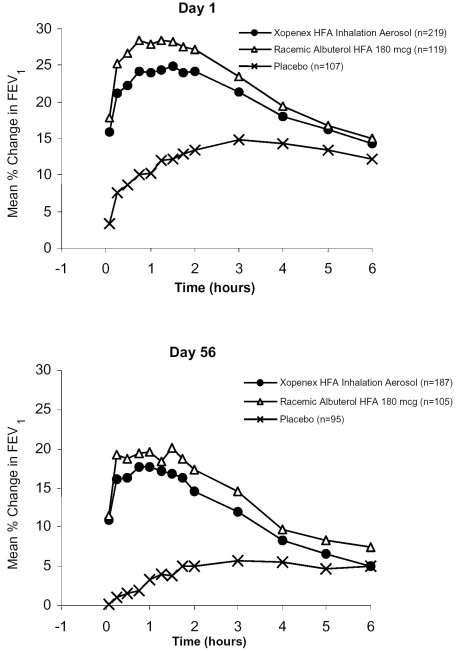
Figure 1 (Xop00 0004 02)
For XOPENEX HFA Inhalation Aerosol on Day 1, the median time to onset of a 15% increase in FEV1 ranged from 5.5 to 10.2 minutes and the median time to peak effect ranged from 76 to 78 minutes. In the responder population, on Day 1 the median duration of effect as measured by a 15% increase in FEV1 was 3 to 4 hours, with duration of effect in some patients of up to 6 hours.
Pediatrics: The efficacy and safety of XOPENEX HFA Inhalation Aerosol in children were established in a 4-week, multicenter, randomized, double-blind, active- and placebo-controlled trial in 150 pediatric patients with asthma between the ages of 4 and 11 years. In this trial, XOPENEX HFA Inhalation Aerosol (76 patients) was compared to a placebo HFA-134a MDI (35 patients), and the trial included a marketed albuterol HFA-134a MDI (39 patients) as an active control. Serial FEV1 measurements demonstrated that 90 mcg (2 inhalations) of XOPENEX HFA Inhalation Aerosol produced significantly greater improvement in FEV1 over the pretreatment value than placebo and were consistent with the efficacy findings in the adult studies.
For XOPENEX HFA Inhalation Aerosol, on Day 1 the median time to onset of a 15% increase in FEV1 was 4.5 minutes and the median time to peak effect was 77 minutes. In the responder population, the median duration of effect as measured by a 15% increase in FEV1 was 3 hours, with a duration of effect in some pediatric patients of up to 6 hours.
Adult and Pediatric Asthma: For treatment of acute episodes of bronchospasm or prevention of asthmatic symptoms, the usual dosage of XOPENEX HFA (levalbuterol tartrate) Inhalation Aerosol for adults and children 4 years of age and older is 2 inhalations (90 mcg) repeated every 4 to 6 hours; in some patients, 1 inhalation every 4 hours may be sufficient. More frequent administration or a larger number of inhalations is not routinely recommended. It is recommended to prime the inhaler before using for the first time and in cases where the inhaler has not been used for more than 3 days by releasing 4 test sprays into the air, away from the face.
If a previously effective dosage regimen fails to provide the usual response, this may be a marker of destabilization of asthma and requires reevaluation of the patient and the treatment regimen, giving special consideration to the possible need for anti-inflammatory treatment, e.g., corticosteroids.
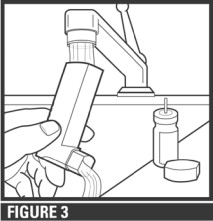
Cleaning: To maintain proper use of this product, it is critical that the actuator be washed and dried thoroughly at least once a week. The inhaler may cease to deliver medication if not properly cleaned and dried thoroughly. See Information for Patients. Keeping the plastic actuator clean is very important to prevent medication build-up and blockage. If the actuator becomes blocked with drug, washing the actuator will remove the blockage.