Admixture Incompatibility
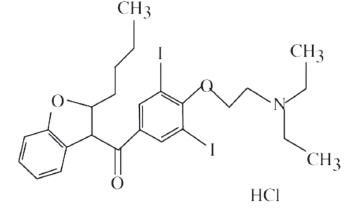
Amiodarone in D5W is incompatible with the drugs shown in Table 3.
Table 3: Y-SITE INJECTION INCOMPATIBILITY| Drug | Vehicle | Amiodarone Concentration | Comments |
|---|
| Aminophylline | D5W | 4 mg/mL | Precipitate |
| Cefamandole Nafate | D5W | 4 mg/mL | Precipitate |
| Cefazolin Sodium | D5W | 4 mg/mL | Precipitate |
| Mezlocillin Sodium | D5W | 4 mg/mL | Precipitate |
| Heparin Sodium | D5W | -- | Precipitate |
| Sodium Bicarbonate | D5W | 3 mg/mL | Precipitate |
Intravenous to Oral Transition
Patients whose arrhythmias have been suppressed by amiodarone may be switched to oral amiodarone. When changing to oral amiodarone therapy, clinical monitoring is recommended, particularly for elderly patients. See package insert for oral amiodarone.
Since grapefruit juice is known to inhibit CYP3A-mediated metabolism of oral amiodarone in the intestinal mucosa, resulting in increased plasma levels of amiodarone, do not drink grapefruit juice during treatment with oral amiodarone [see Drug Interactions (7)].
Table 4 provides suggested doses of oral amiodarone to be initiated after varying durations of amiodarone administration. These recommendations are made on the basis of a similar total body amount of amiodarone delivered by the intravenous and oral routes, based on 50% bioavailability of oral amiodarone.
Table 4: RECOMMENDATIONS FOR ORAL DOSAGE AFTER INTRAVENOUS INFUSION| Duration of Amiodarone Infusion Assuming a 720 mg/day infusion (0.5 mg/min). | Initial Daily Dose of Oral Amiodarone |
|---|
| < 1 week | 800 to 1600 mg |
| 1-3 weeks | 600 to 800 mg |
| > 3 weeks Intravenous amiodarone is not intended for maintenance treatment. | 400 mg |
Early-onset Pulmonary Toxicity
There have been postmarketing reports of acute-onset (days to weeks) pulmonary injury in patients treated with intravenous amiodarone. Findings have included pulmonary infiltrates and masses on X-ray, bronchospasm, wheezing, fever, dyspnea, cough, hemoptysis, and hypoxia. Some cases have progressed to respiratory failure or death.
ARDS
Two percent (2%) of patients were reported to have adult respiratory distress syndrome (ARDS) during clinical studies involving 48 hours of therapy.
Pulmonary Fibrosis
Only 1 of more than 1000 patients treated with intravenous amiodarone in clinical studies developed pulmonary fibrosis. In that patient, the condition was diagnosed 3 months after treatment with intravenous amiodarone, during which time the patient received oral amiodarone. Pulmonary toxicity is a well-recognized complication of long-term amiodarone use (see package insert for oral amiodarone).
Hyperthyroidism and Thyrotoxicosis
Hyperthyroidism occurs in about 2% of patients receiving amiodarone, but the incidence may be higher among patients with prior inadequate dietary iodine intake. Amiodarone-induced hyperthyroidism usually poses a greater hazard to the patient than hypothyroidism because of the possibility of thyrotoxicosis and arrhythmia breakthrough or aggravation, all of which may result in death. There have been reports of death associated with amiodarone-induced thyrotoxicosis. Consider the possibility of hyperthyroidism if any new signs of arrhythmia appear.
Identify hyperthyroidism by relevant clinical signs and symptoms, subnormal serum levels of thyroid stimulating hormone (TSH), abnormally elevated serum free T4, and elevated or normal serum T3. Since arrhythmia breakthroughs may accompany amiodarone-induced hyperthyroidism, aggressive medical treatment is indicated, including, if possible, dose reduction or withdrawal of amiodarone. Amiodarone hyperthyroidism may be followed by a transient period of hypothyroidism.
The institution of antithyroid drugs, β-adrenergic blockers or temporary corticosteroid therapy may be necessary. The action of antithyroid drugs may be especially delayed in amiodarone-induced thyrotoxicosis because of substantial quantities of preformed thyroid hormones stored in the gland. Radioactive iodine therapy is contraindicated because of the low radioiodine uptake associated with amiodarone-induced hyperthyroidism.
When aggressive treatment of amiodarone-induced thyrotoxicosis has failed or amiodarone cannot be discontinued because it is the only drug effective against the resistant arrhythmia, surgical management may be an option. Experience with thyroidectomy as a treatment for amiodarone-induced thyrotoxicosis is limited, and this form of therapy could induce thyroid storm. Therefore, surgical and anesthetic management require careful planning.
Neonatal Hypo- or Hyperthyroidism
Amiodarone can cause fetal harm when administered to a pregnant woman. Although amiodarone use during pregnancy is uncommon, there have been a small number of published reports of congenital goiter/hypothyroidism and hyperthyroidism associated with oral administration. Inform the patient of the potential hazard to the fetus if amiodarone is administered during pregnancy or if the patient becomes pregnant while taking amiodarone.
Hypothyroidism
Hypothyroidism has been reported in 2 to 4% of patients in most series, but in 8 to 10% in some series. This condition may be identified by relevant clinical symptoms and particularly by elevated serum TSH levels. In some clinically hypothyroid amiodarone-treated patients, free thyroxine index values may be normal. Manage hypothyroidism by reducing the amiodarone dose and considering the need for thyroid hormone supplement. However, therapy must be individualized, and it may be necessary to discontinue amiodarone in some patients.
Protease inhibitors:
Protease inhibitors are known to inhibit CYP3A to varying degrees. A case report of one patient taking amiodarone 200 mg and indinavir 800 mg three times a day resulted in increases in amiodarone concentrations from 0.9 mg/L to 1.3 mg/L. DEA concentrations were not affected. There was no evidence of toxicity. Consider monitoring for amiodarone toxicity and serial measurement of amiodarone serum concentration during concomitant protease inhibitor therapy.
Histamine H1 antagonists:
Loratadine, a non-sedating antihistaminic, is metabolized primarily by CYP3A. QT interval prolongation and TdP have been reported with the coadministration of loratadine and amiodarone.
Histamine H2 antagonists:
Cimetidine inhibits CYP3A and can increase serum amiodarone levels.
Antidepressants:
Trazodone, an antidepressant, is metabolized primarily by CYP3A. QT interval prolongation and TdP have been reported with the coadministration of trazodone and amiodarone.
Other substances:
Grapefruit juice given to healthy volunteers increased amiodarone AUC by 50% and Cmax by 84%, resulting in increased plasma levels of amiodarone. Do not take grapefruit juice during treatment with amiodarone.
Amiodarone inhibits p-glycoprotein and certain CYP450 enzymes, including CYP1A2, CYP2C9, CYP2D6, and CYP3A. This inhibition can result in unexpectedly high plasma levels of other drugs which are metabolized by those CYP450 enzymes or are substrates for p-glycoprotein. Reported examples of this interaction include the following:
Immunosuppressives:
Cyclosporine (CYP3A substrate) administered in combination with oral amiodarone has been reported to produce persistently elevated plasma concentrations of cyclosporine resulting in elevated creatinine, despite reduction in dose of cyclosporine.
HMG-CoA Reductase Inhibitors:
Simvastatin (CYP3A substrate) in combination with amiodarone has been associated with reports of myopathy/rhabdomyolysis.
Cardiovasculars:
Cardiac glycosides: In patients receiving digoxin therapy, administration of oral amiodarone regularly results in an increase in serum digoxin concentration that may reach toxic levels with resultant clinical toxicity. Amiodarone taken concomitantly with digoxin increases the serum digoxin concentration by 70% after one day. On administration of oral amiodarone, review the need for digitalis therapy and reduce the dose of digitalis by approximately 50% or discontinue digitalis. If digitalis treatment is continued, monitor serum levels closely and observe patients for clinical evidence of toxicity.
Antiarrhythmics:
Other antiarrhythmic drugs, such as quinidine, procainamide, disopyramide, and phenytoin, have been used concurrently with amiodarone. There have been case reports of increased steady-state levels of quinidine, procainamide, and phenytoin during concomitant therapy with amiodarone. Phenytoin decreases serum amiodarone levels. Amiodarone taken concomitantly with quinidine increases quinidine serum concentration by 33% after two days. Amiodarone taken concomitantly with procainamide for less than seven days increases plasma concentrations of procainamide and n-acetyl procainamide by 55% and 33%, respectively. Reduce quinidine and procainamide doses by one-third when either is administered with amiodarone.
Plasma levels of flecainide have been reported to increase in the presence of oral amiodarone; adjust the dose of flecainide when these drugs are administered concomitantly. In general, initiate any added antiarrhythmic drug at a lower than usual dose and monitor the patient carefully.
Reserve the combination of amiodarone with other antiarrhythmic therapy to patients with life-threatening ventricular arrhythmias who are incompletely responsive to a single agent or incompletely responsive to amiodarone. During transfer to oral amiodarone, reduce the dose levels of previously administered agents by 30 to 50% several days after the addition of oral amiodarone. Review the continued need for the other antiarrhythmic agent after the effects of amiodarone have been established, and attempt discontinuation. If the treatment is continued, carefully monitor these patients for adverse effects, especially for conduction disturbances and exacerbation of tachyarrhythmias. In amiodarone-treated patients who require additional antiarrhythmic therapy, the initial dose of such agents should be approximately half of the usual recommended dose.
Antihypertensives:
Use amiodarone with caution in patients receiving β-receptor blocking agents (e.g., propranolol, a CYP3A inhibitor) or calcium channel antagonists (e.g., verapamil, a CYP3A substrate, and diltiazem, a CYP3A inhibitor) because of the possible potentiation of bradycardia, sinus arrest, and AV block; if necessary, amiodarone can continue to be used after insertion of a pacemaker in patients with severe bradycardia or sinus arrest.
Anticoagulants:
Potentiation of warfarin-type (CYP2C9 and CYP3A substrate) anticoagulant response is almost always seen in patients receiving amiodarone and can result in serious or fatal bleeding. Since the concomitant administration of warfarin with amiodarone increases the prothrombin time by 100% after 3 to 4 days, reduce the dose of the anticoagulant by one-third to one-half, and monitor prothrombin times closely.
Clopidogrel, an inactive thienopyridine prodrug, is metabolized in the liver by CYP3A to an active metabolite. A potential interaction between clopidogrel and amiodarone resulting in ineffective inhibition of platelet aggregation has been reported.
Some drugs/substances are known to accelerate the metabolism of amiodarone by stimulating the synthesis of CYP3A (enzyme induction). This may lead to low amiodarone serum levels and potential decrease in efficacy. Reported examples of this interaction include the following:
Antibiotics:
Rifampin is a potent inducer of CYP3A. Administration of rifampin concomitantly with oral amiodarone has been shown to result in decreases in serum concentrations of amiodarone and desethylamiodarone.
Other substances, including herbal preparations:
St. John's Wort (Hypericum perforatum) induces CYP3A. Since amiodarone is a substrate for CYP3A, St. John's Wort likely reduces amiodarone levels.
Other reported interactions with amiodarone:
Fentanyl (CYP3A substrate) in combination with amiodarone may cause hypotension, bradycardia, and decreased cardiac output.
Sinus bradycardia has been reported with oral amiodarone in combination with lidocaine (CYP3A substrate) given for local anesthesia. Seizure, associated with increased lidocaine concentrations, has been reported with concomitant administration of intravenous amiodarone.
Dextromethorphan is a substrate for both CYP2D6 and CYP3A. Amiodarone inhibits CYP2D6.
Cholestyramine increases enterohepatic elimination of amiodarone and may reduce its serum levels and t½.
Disopyramide causes QT prolongation which could induce arrhythmia.
Fluoroquinolones, macrolide antibiotics, and azoles are known to cause QTc prolongation. There have been reports of QTc prolongation, with or without TdP, in patients taking amiodarone when fluoroquinolones, macrolide antibiotics, or azoles were administered concomitantly [see Warnings and Precautions (5.4)].
Hemodynamic and electrophysiologic interactions have also been observed after concomitant administration with propranolol, diltiazem, and verapamil.
Volatile Anesthetic Agents: Patients who are on amiodarone therapy may be more sensitive to the myocardial depressant and conduction defects of halogenated inhalational anesthetics [see Warnings and Precautions (5.9)].
In addition to the interactions noted above, chronic (> 2 weeks) oral amiodarone administration impairs metabolism of phenytoin, dextromethorphan, and methotrexate.
Disposition:
Amiodarone exhibits complex disposition characteristics after intravenous administration. Peak serum concentrations after single 5 mg/kg 15-minute intravenous infusions in healthy subjects range between 5 and 41 mg/L. Peak concentrations after 10-minute infusions of 150 mg intravenous amiodarone in patients with ventricular fibrillation (VF) or hemodynamically unstable ventricular tachycardia (VT) range between 7 and 26 mg/L. Due to rapid distribution, serum concentrations decline to 10% of peak values within 30 to 45 minutes after the end of the infusion. In clinical trials, after 48 hours of continued infusions (125, 500 or 1000 mg/day) plus supplemental (150 mg) infusions (for recurrent arrhythmias), amiodarone mean serum concentrations between 0.7 to 1.4 mg/L were observed (n=260).
Metabolism:
N-desethylamiodarone (DEA) is the major active metabolite of amiodarone in humans. DEA serum concentrations above 0.05 mg/L are not usually seen until after several days of continuous infusion but with prolonged therapy reach approximately the same concentration as amiodarone. Amiodarone is metabolized to DEA by the cytochrome P450 enzyme group, specifically cytochromes CYP3A and CYP2C8. The CYP3A isoenzyme is present in both the liver and intestines. The highly variable systemic availability of oral amiodarone may be attributed to large interindividual variability in CYP3A activity.
Distribution/Elimination:
From in vitro studies, the protein binding of amiodarone is >96%. Amiodarone and DEA cross the placenta and both appear in breast milk. Neither amiodarone nor DEA is dialyzable.
Amiodarone is eliminated primarily by hepatic metabolism and biliary excretion and there is negligible excretion of amiodarone or DEA in urine. In studies in healthy subjects following single intravenous administration (5 mg/kg of amiodarone over 15 min), the plasma concentration vs. time profile could be characterized by linear sum of four exponential terms with terminal elimination half-lives (t½) of 9 - 36 days for amiodarone and 9 - 30 days for DEA. The clearance of amiodarone and DEA ranged between 63 - 231 mL/hr/kg and 140 - 400 mL/hr/kg, respectively. In clinical studies of 2 to 7 days, clearance of amiodarone after intravenous administration in patients with VT and VF ranged between 220 and 440 mL/hr/kg.
Special Populations:
Effect of Age: The pharmacokinetics of amiodarone and DEA are affected by age. Normal subjects over 65 years of age show lower clearances (about 100 mL/hr/kg) than younger subjects (about 150 mL/hr/kg) and an increase in t½ from about 20 to 47 days.
Effect of Gender: Pharmacokinetics of amiodarone and DEA are similar in males and females.
Renal Impairment: Renal disease does not influence the pharmacokinetics of amiodarone or DEA.
Hepatic Impairment: After a single dose of intravenous amiodarone to cirrhotic patients, significantly lower Cmax and average concentration values are seen for DEA, but mean amiodarone levels are unchanged.
Cardiac Disease: In patients with severe left ventricular dysfunction, the pharmacokinetics of amiodarone are not significantly altered but the terminal elimination t½ of DEA is prolonged.
Although no dosage adjustment for patients with renal, hepatic, or cardiac abnormalities has been defined during chronic treatment with oral amiodarone, close clinical monitoring is prudent for elderly patients and those with severe left ventricular dysfunction.
Exposure-Response: There is no established relationship between drug concentration and therapeutic response for short-term intravenous use.
Manufactured for:
Bioniche Pharma USA LLC, Lake Forest IL 60045
Manufactured by:
Bioniche Teo., Inverin, Co. Galway, Ireland
0456L111
Additional barcode labeling by:Physicians Total Care, Inc.
Tulsa, Oklahoma 74146