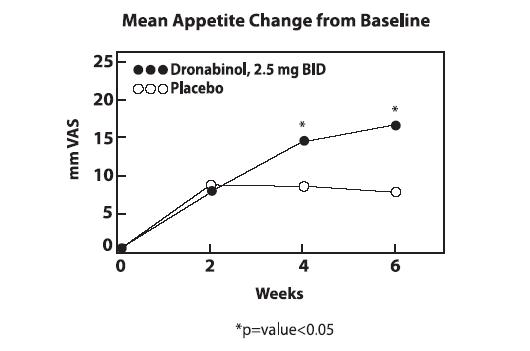
Appetite Stimulation: The appetite stimulant effect of dronabinol capsules in the treatment of AIDS-related anorexia associated with weight loss was studied in a randomized, double-blind, placebo-controlled study involving 139 patients. The initial dosage of dronabinol capsules in all patients was 5 mg/day, administered in doses of 2.5 mg one hour before lunch and one hour before supper. In pilot studies, early morning administration of dronabinol capsules appeared to have been associated with an increased frequency of adverse experiences, as compared to dosing later in the day. The effect of dronabinol capsules on appetite, weight, mood, and nausea was measured at scheduled intervals during the six-week treatment period. Side effects (feeling high, dizziness, confusion, somnolence) occurred in 13 of 72 patients (18%) at this dosage level and the dosage was reduced to 2.5 mg/day, administered as a single dose at supper or bedtime.
Of the 112 patients that completed at least 2 visits in the randomized, double-blind, placebo-controlled study, 99 patients had appetite data at 4-weeks (50 received dronabinol and 49 received placebo) and 91 patients had appetite data at 6-weeks (46 received dronabinol and 45 received placebo). A statistically significant difference between dronabinol capsules and placebo was seen in appetite as measured by the visual analog scale at weeks 4 and 6 (see figure). Trends toward improved body weight and mood, and decreases in nausea were also seen.
After completing the 6-week study, patients were allowed to continue treatment with dronabinol capsules in an open-label study, in which there was a sustained improvement in appetite.
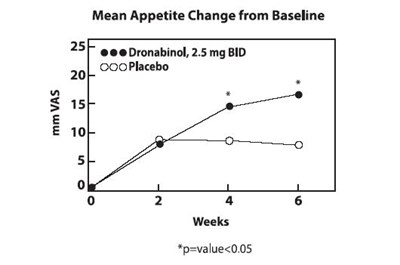
F94ee242-figure-02 (F94ee242 Figure 02)
Antiemetic: Dronabinol treatment of chemotherapy-induced emesis was evaluated in 454 patients with cancer, who received a total of 750 courses of treatment of various malignancies. The antiemetic efficacy of dronabinol was greatest in patients receiving cytotoxic therapy with MOPP for Hodgkin’s and non-Hodgkin’s lymphomas. Dronabinol capsules dosages ranged from 2.5 mg/day to 40 mg/day, administered in equally divided doses every four to six hours (four times daily). As indicated in the following table, escalating the dronabinol dose above 7 mg/m2 increased the frequency of adverse experiences, with no additional antiemetic benefit.
Dronabinol Dose: Response Frequency and Adverse Experiences*
(N = 750 treatment courses)
| *Nondysphoric events consisted of drowsiness, tachycardia, etc. |
Dronabinol
Dose | Response
Frequency (%) | Adverse Events
Frequency (%) |
| Complete | Partial | Poor | None | Nondysphoric | Dysphoric |
| <7 mg/m2 | 36 | 32 | 32 | 23 | 65 | 12 |
| >7 mg/m2 | 33 | 31 | 36 | 13 | 58 | 28 |
Combination antiemetic therapy with dronabinol capsules and a phenothiazine (prochlorperazine) may result in synergistic or additive antiemetic effects and attenuate the toxicities associated with each of the agents.
INDIVIDUALIZATION OF DOSAGES
The pharmacologic effects of dronabinol are dose-related and subject to considerable interpatient variability. Therefore, dosage individualization is critical in achieving the maximum benefit of dronabinol treatment.
Appetite Stimulation: In the clinical trials, the majority of patients were treated with 5 mg/day dronabinol capsules, although the dosages ranged from 2.5 to 20 mg/day. For an adult:
- Begin with 2.5 mg before lunch and 2.5 mg before supper. If CNS symptoms (feeling high, dizziness, confusion, somnolence) do occur, they usually resolve in 1 to 3 days with continued dosage.
- If CNS symptoms are severe or persistent, reduce the dose to 2.5 mg before supper. If symptoms continue to be a problem, taking the single dose in the evening or at bedtime may reduce their severity.
- When adverse effects are absent or minimal and further therapeutic effect is desired, increase the dose to 2.5 mg before lunch and 5 mg before supper or 5 and 5 mg. Although most patients respond to 2.5 mg twice daily, 10 mg twice daily has been tolerated in about half of the patients in appetite stimulation studies.
The pharmacologic effects of dronabinol capsules are reversible upon treatment cessation.
Antiemetic: Most patients respond to 5 mg three or four times daily. Dosage may be escalated during a chemotherapy cycle or at subsequent cycles, based upon initial results. Therapy should be initiated at the lowest recommended dosage and titrated to clinical response. Administration of dronabinol capsules with phenothiazines, such as prochlorperazine, has resulted in improved efficacy as compared to either drug alone, without additional toxicity.
Pediatrics: Dronabinol capsules are not recommended for AIDS-related anorexia in pediatric patients because it has not been studied in this population. The pediatric dosage for the treatment of chemotherapy-induced emesis is the same as in adults. Caution is recommended in prescribing dronabinol capsules for children because of the psychoactive effects.
Geriatrics: Caution is advised in prescribing dronabinol capsules in elderly patients because they may be more sensitive to the neurological, psychoactive and postural hypotensive effects of the drug. In general, dose selection for an elderly patient should be cautious, usually starting at the low end of the dosing range (See PRECAUTIONS.)
Dronabinol capsules should be used with caution when administered to elderly patients with dementia, who are at increased risk for falls as a result of their underlying disease state which may be exacerbated by the central nervous system effects of somnolence and dizziness associated with dronabinol capsules. These patients should be monitored closely and placed on fall precautions prior to initiating dronabinol therapy. In antiemetic studies, no difference in efficacy was apparent in patients >55 years old.