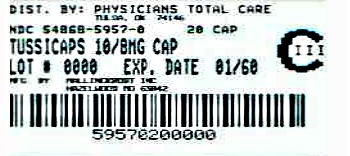
Respiratory Depression – As with all narcotics, TussiCaps® extended-release capsules produce dose-related respiratory depression by directly acting on brain stem respiratory centers. Hydrocodone affects the center that controls respiratory rhythm, and may produce irregular and periodic breathing. Caution should be exercised when TussiCaps® extended-release capsules are used postoperatively and in patients with pulmonary disease, or whenever ventilatory function is depressed. If respiratory depression occurs, it may be antagonized by the use of naloxone hydrochloride and other supportive measures when indicated (see OVERDOSAGE).
Head Injury and Increased Intracranial Pressure – The respiratory depressant effects of narcotics and their capacity to elevate cerebrospinal fluid pressure may be markedly exaggerated in the presence of head injury, other intracranial lesions, or a pre-existing increase in intracranial pressure. Furthermore, narcotics produce adverse reactions, which may obscure the clinical course of patients with head injuries.
Acute Abdominal Conditions – The administration of narcotics may obscure the diagnosis or clinical course of patients with acute abdominal conditions.
Obstructive Bowel Disease – Chronic use of narcotics may result in obstructive bowel disease especially in patients with underlying intestinal motility disorder.
Pediatric Use – The use of TussiCaps® extended-release capsules are contraindicated in children less than 6 years of age (see CONTRAINDICATIONS).
In pediatric patients, as well as adults, the respiratory center is sensitive to the depressant action of narcotic cough suppressants in a dose-dependent manner. Caution should be
exercised when administering TussiCaps® extended-release capsules to pediatric patients 6 years of age and older.
Overdose or concomitant administration of TussiCaps® extended-release capsules with other respiratory
depressants may increase the risk of respiratory depression in pediatric patients. Benefit to risk ratio should be carefully considered, especially in pediatric patients with respiratory embarrassment (e.g., croup) (see PRECAUTIONS).
Special Risk Patients – As with any narcotic agent, TussiCaps® extended-release capsules should be used with caution in elderly or debilitated patients and those with severe impairment of hepatic or renal function, hypothyroidism, Addison's disease, prostatic hypertrophy, or urethral stricture. The usual precautions should be observed and the possibility of respiratory depression should be kept in mind.
Cough Reflex – Hydrocodone suppresses the cough reflex; as with all narcotics, caution should be exercised when TussiCaps® extended-release capsules are used postoperatively, and in patients with pulmonary disease.
Signs and Symptoms – Serious overdosage with hydrocodone is characterized by respiratory depression (a decrease in respiratory rate and/or tidal volume, Cheyne-Stokes respiration, cyanosis), extreme somnolence progressing to stupor or coma, skeletal muscle flaccidity, cold and clammy skin, and sometimes bradycardia and hypotension. Although miosis is characteristic of narcotic overdose, mydriasis may occur in terminal narcosis or severe hypoxia. In severe overdosage, apnea, circulatory collapse, cardiac arrest and death may occur. The manifestations of chlorpheniramine overdosage may vary from central nervous system depression to stimulation.
Treatment – Primary attention should be given to the reestablishment of adequate respiratory exchange through provision of a patent airway and the institution of assisted or controlled ventilation. The narcotic antagonist naloxone hydrochloride is a specific antidote for respiratory depression which may result from overdosage or unusual sensitivity to narcotics including hydrocodone. Therefore, an appropriate dose of naloxone hydrochloride should be administered, preferably by the intravenous route, simultaneously with efforts at respiratory resuscitation. Since the duration of action of hydrocodone in this formulation may exceed that of the antagonist, the patient should be kept under continued surveillance and repeated doses of the antagonist should be administered as needed to maintain adequate respiration. For further information, see full prescribing information for naloxone hydrochloride. An antagonist should not be administered in the absence of clinically significant respiratory depression. Oxygen, intravenous fluids, vasopressors and other supportive measures should be employed as indicated. Gastric emptying may be useful in removing unabsorbed drug.
Adults and Children 12 Years and Older
One (1) full-strength TussiCaps® extended-release capsule (hydrocodone polistirex equivalent to 10 mg of hydrocodone bitartrate and chlorpheniramine polistirex equivalent to 8 mg of chlorpheniramine maleate) every 12 hours; do not exceed 2 capsules in 24 hours.
Children 6 to 11 Years of Age
One (1) half-strength TussiCaps® extended-release capsule (hydrocodone polistirex equivalent to 5 mg of hydrocodone bitartrate and chlorpheniramine polistirex equivalent to 4 mg of chlorpheniramine maleate) every 12 hours; do not exceed 2 capsules in 24 hours.
This medicine is contraindicated in children under 6 years of age (see CONTRAINDICATIONS).