Recommended Dosages
The recommended starting dose and the highest recommended dose of ALVESCO Inhalation Aerosol are listed in the following table.
|
Previous
Therapy
| Recommended
Starting Dose | Highest
Recommended Dose |
| Patients ≥ 12 years who received bronchodilators alone
| 80 mcg twice daily
| 160 mcg twice daily
|
Patients ≥ 12 years who received
inhaled corticosteroids
| 80 mcg twice daily
| 320 mcg twice daily
|
Patients ≥ 12 years who received
oral corticosteroids1 | 320 mcg twice daily
| 320 mcg twice daily
|
Adult and Adolescent 12 Years of Age and Older
Four of the five trials included a total of 624 patients ages 12 years and older (359 females and 265 males) with asthma of varying severity who were treated with ALVESCO 80 mcg, 160 mcg, or 320 mcg twice daily for 12 to 16 weeks. These studies included patients previously using either controller therapy (predominantly inhaled corticosteroids) or reliever therapy (bronchodilator therapy alone). In these trials, the mean age was 39.1 years, and the majority of the patients (79.0%) were Caucasian. In these trials, 52.3%, 59.8% and 54.1% of the patients in the ALVESCO 80 mcg, 160 mcg, and 320 mcg treatment groups, respectively, had at least one adverse event compared to 58.0% in the placebo group.
Table 1 includes adverse reactions for the recommended doses of ALVESCO that occurred at an incidence of ≥ 3% in any of the ALVESCO groups and which were more frequent with ALVESCO compared to placebo.
Table 1: Adverse Reactions with ≥ 3% Incidence Reported in Patients ≥ 12 Years of Age with ALVESCO in US Placebo-Controlled Clinical Trials in Patients Previously on Bronchodilators and/or Inhaled Corticosteroids
| Adverse Reaction
| | ALVESCO |
| Placebo
(N=507)
%
| 80 mcg BID
(N=325)
%
| 160 mcg BID
(N=127)
%
| 320 mcg BID
(N=172)
%
|
| Headache
| 7.3
| 4.9
| 11.0
| 8.7
|
| Nasopharyngitis
| 7.5
| 10.5
| 8.7
| 7.0
|
| Sinusitis
| 3.0
| 3.1
| 5.5
| 5.2
|
| Pharyngolaryngeal pain
| 4.3
| 4.3
| 2.4
| 4.7
|
| Upper respiratory Inf.
| 6.5
| 7.1
| 8.7
| 4.1
|
| Arthralgia
| 1.0
| 0.9
| 2.4
| 3.5
|
| Nasal congestion
| 1.6
| 1.8
| 5.5
| 2.9
|
| Pain in extremity
| 1.0
| 0.3
| 3.1
| 2.3
|
| Back pain
| 2.0
| 0.6
| 3.1
| 1.2
|
The following adverse reactions occurred in these clinical trials using ALVESCO with an incidence of less than 1% and occurred at a greater incidence with ALVESCO than with placebo.
Infections and Infestations: Oral candidiasis
Respiratory Disorders: Cough
Gastrointestinal Disorders: Dry mouth, nausea
General disorders and administrative site conditions: Chest discomfort
Respiratory, Thoracic, and Mediastinal Disorders: Dysphonia, dry throat
The fifth study was a 12-week clinical trial in asthma patients 12 years of age and older who previously required oral corticosteroids (average daily dose of oral prednisone of 12 mg/day), in which the effects of ALVESCO 320 mcg twice daily (n = 47) and 640 mcg twice daily (n = 49) were compared with placebo (n = 45) for the frequency of reported adverse reactions. The following adverse reactions occurred at an incidence of ≥ 3% in the ALVESCO-treated patients and were more frequent compared to placebo: sinusitis, hoarseness, oral candidiasis, influenza, pneumonia, nasopharyngitis, arthralgia, back pain, musculoskeletal chest pain, headache, urticaria, dizziness, gastroenteritis, face edema, fatigue, and conjunctivitis.
Pediatric Patients 4 to 11 Years of Age
The safety of ALVESCO in pediatric patients 4 to 11 years of age was evaluated in two studies in which ALVESCO 40 mcg, 80 mcg, and 160 mcg was administered once daily for 12 weeks [see Pediatric Use (8.4)].
Pediatric Patients under 4 Years of Age
Studies have not been conducted in patients under 4 years of age.
Long-Term Clinical Trials Experience
A total of 197 patients 12 years of age and older (82 males and 115 females) from one of the 12-week treatment placebo-controlled studies were re-randomized to ciclesonide 320 mcg twice daily and followed for one year. The safety profile from the one-year follow up was similar to that seen in the 12- and 16-week treatment studies. Long term safety information for pediatric patients 4 to 11 years of age is obtained from three open label one year safety studies [see Pediatric Use (8.4)].
Absorption
Ciclesonide and des-ciclesonide have negligible oral bioavailability (both are less than 1%) due to low gastrointestinal absorption and high first-pass metabolism. Serum concentrations of ciclesonide and des-ciclesonide were measured and compared following oral inhalation of 1280 mcg ALVESCO and intravenous administration of 800 mcg ciclesonide. The absolute bioavailability of ciclesonide was 22% and the relative systemic exposure of des-ciclesonide was 63%. The mean Cmax for des-ciclesonide was 1.02 ng/mL (range 0.6-1.5 ng/mL) in asthmatic patients following a single dose of 1280 mcg by oral inhalation. The mean Cmax (0.369 ng/mL) and AUC0-∞ (2.18 ng*hr/mL) of des-ciclesonide following multiple dose administration of ciclesonide 320 mcg once daily increased up to 26% compared to single dose administration.
Distribution
Following intravenous administration of 800 mcg of ciclesonide, the volumes of distribution of ciclesonide and des-ciclesonide was approximately 2.9 L/kg and 12.1 L/kg, respectively. The percentage of ciclesonide and des-ciclesonide bound to human plasma proteins averaged ≥ 99% each, with ≤ 1% of unbound drug detected in the systemic circulation. Des-ciclesonide is not significantly bound to human transcortin.
Metabolism
Ciclesonide is hydrolyzed to a biologically active metabolite, des-ciclesonide, by esterases. Des-ciclesonide undergoes further metabolism in the liver to additional metabolites mainly by the cytochrome P450 (CYP) 3A4 isozyme and to a lesser extent by CYP 2D6. The full range of potentially active metabolites of ciclesonide has not been characterized. After intravenous administration of 14C-ciclesonide, 19.3% of the resulting radioactivity in the plasma is accounted for by ciclesonide or des-ciclesonide; the remainder may be a result of other, as yet, unidentified multiple metabolites.
Elimination
Following intravenous administration of 800 mcg of ciclesonide, the clearances of ciclesonide and des-ciclesonide were high (approximately 152 L/hr and 228 L/hr, respectively). 14C-labeled ciclesonide was predominantly excreted via the feces after intravenous administration (66%) indicating that excretion through bile is the major route of elimination. Approximately 20% or less of des-ciclesonide was excreted in the urine. The mean half life of ciclesonide and des-ciclesonide was 0.71 hours and 6 to 7 hours respectively. Tmax of des-ciclesonide occurs at 1.04 hours following inhalation of ciclesonide.
Special Populations
Population pharmacokinetic analysis showed that characteristics of des-ciclesonide after oral inhalation of ciclesonide were not appreciably influenced by a variety of subject characteristics such as body weight, age, race, and gender.
Renal Insufficiency
Studies in renally-impaired patients were not conducted since renal excretion of des-ciclesonide is a minor route of elimination (≤ 20%).
Hepatic Insufficiency
Compared to healthy subjects, the systemic exposure of des-ciclesonide (Cmax and AUC) in patients with moderate to severe liver impairment increased in the range of 1.4 to 2.7 fold after 1280 mcg ex-actuator ciclesonide by oral inhalation. Dose adjustment in patients with liver impairment is not necessary.
Pediatric
In 2 clinical safety and efficacy studies conducted in patients 4 to 11 years of age with asthma, population pharmacokinetic samples were obtained in 53 patients for pharmacokinetic analysis. In these pediatric patients, treated with daily doses of 40, 80 or 160 mcg of ALVESCO, the median (min, max) Cmax values of des-ciclesonide were 41 pg/mL (not detectable, 146 pg/mL) (n=11), 113 pg/mL (35, 237 pg/mL) (n=13) and 128 pg/mL (12, 357 pg/mL) (n=14), respectively.
Drug-drug Interactions
In a drug interaction study, co-administration of orally inhaled ciclesonide and oral ketoconazole, a potent inhibitor of cytochrome P450 3A4, increased the exposure (AUC) of ciclesonide active metabolite, des-ciclesonide, by approximately 3.6-fold at steady state, while levels of ciclesonide remained unchanged [see Drug Interactions (7)].
In another single-dose drug interaction study, co-administration of orally inhaled ciclesonide and oral erythromycin, an inhibitor of cytochrome P450 3A4, had no effect on the pharmacokinetics of either ciclesonide and the active metabolite, des-ciclesonide, or erythromycin.
Based on in vitro studies in human liver microsomes, des-ciclesonide had no significant potential to inhibit or induce the metabolism of other drugs metabolized by CYP450 enzymes. The inhibitory potential of ciclesonide on CYP450 isoenzymes has not been studied. Based on in vitro human hepatocyte studies, ciclesonide and des-ciclesonide had no potential to induce major CYP450 isozymes.
In vitro studies demonstrated that the plasma protein binding of des-ciclesonide was not affected by warfarin or salicylic acid, indicating no potential for protein binding-based drug interactions.
In a population pharmacokinetic analysis including 98 subjects, co-administration of ALVESCO and albuterol had no effect on the pharmacokinetics of des-ciclesonide.
Concomitant administration of ALVESCO (640 mcg) and formoterol (24 mcg) did not change the pharmacokinetics of either des-ciclesonide or formoterol.
Adults and Adolescents 12 years of Age and Older
The efficacy of ALVESCO was evaluated in six randomized double-blind, placebo-controlled, parallel-group clinical trials in adult and adolescent patients 12 years of age and older with mild persistent to severe persistent asthma. The six trials include two trials in which patients were treated with ALVESCO administered once daily for 12 weeks, two trials in which patients were treated with ALVESCO twice daily for 12 weeks, and two trials in which patients were treated with ALVESCO using once daily and twice daily dosing regimens for 12 or 16 weeks. These trials included a total of 2843 patients (1167 males and 1676 females) of whom 296 were adolescents 12-17 years of age. The primary efficacy endpoint in four of the six trials was the mean change from baseline in pre-dose FEV1 at endpoint (last observation). FEV1 was measured prior to the morning dose of study medication (at the end of the 24-hour dosing interval for once daily administration, and at the end of the 12-hour dosing interval for twice daily administration). In one of the six trials, the primary endpoint was the change from baseline in the average of the pre-dose FEV1 at Weeks 12 and 16, and in another trial, reduction of oral corticosteroid use was the primary efficacy endpoint. Additional efficacy variables were asthma symptoms, use of albuterol for rescue, AM PEF, nighttime awakenings, and withdrawal due to asthma worsening.
The two once daily dosing trials were identically designed and were conducted to evaluate the efficacy of ALVESCO 80, 160, and 320 mcg given once daily in the morning for 12 weeks in patients with mild to moderate asthma maintained on inhaled bronchodilators and/or corticosteroids. The results of these trials, along with other trials that explored twice daily dosing, indicate that once daily dosing is not the optimum dosing regimen for ALVESCO.
Four trials were designed to evaluate the efficacy of ALVESCO administered twice daily in patients with asthma who were previously maintained on bronchodilators alone, patients who were previously maintained on inhaled corticosteroids, and patients who were previously maintained on oral corticosteroids.
Patients Previously Maintained on Bronchodilators Alone
The efficacy of ALVESCO was studied in a randomized, double-blind, placebo-controlled trial in 691 patients with mild-to-moderate persistent asthma (mean baseline percent predicted FEV1 of 72%) previously using reliever therapy (bronchodilator therapy alone). In this trial, patients were treated with ALVESCO 160 mcg once daily in the morning for 16 weeks, ALVESCO 80 mcg twice daily for 16 weeks, or ALVESCO 80 mcg twice daily for 4 weeks followed by ALVESCO 160 mcg once daily in the morning for 12 weeks or placebo for 16 weeks. Compared to placebo, all ALVESCO doses showed statistically significant improvement at week 16 in AM pre-dose FEV1. However, the increase in AM pre-dose FEV1 in the patients treated with ALVESCO 80 mcg twice daily was significantly greater than that observed in patients treated with ALVESCO 160 mcg administered once daily. Compared to placebo, increases in AM pre-dose FEV1 were 0.12 L or 5.0 % for ALVESCO 160 mcg once daily, 0.24 L or 10.4 % for ALVESCO 80 mcg twice daily, 0.13 L or 5.0 % for ALVESCO 80 mcg twice daily for 4 weeks followed by ALVESCO 160 mcg once daily. Other measures of asthma control AM PEF, and need for rescue albuterol also improved in all the ALVESCO treatment groups compared to placebo but the improvement was greatest with the ALVESCO 80 mcg twice daily treatment arm. Discontinuations from the study for lack of efficacy were lower in the ALVESCO treatment groups compared to placebo. Fewer patients receiving ALVESCO experienced asthma worsening than did patients receiving placebo. The AM pre-dose FEV1 results are shown in Figure 1 below.
Figure 1: A 16-Week Double-Blind Clinical Trial Evaluating ALVESCO Administered Once Daily, Twice Daily, or Twice Daily Initially for 4 Weeks Followed by Once Daily for 12 Weeks, in Adult and Adolescent Patients with Mild-to-Moderate Asthma Previously Maintained on Bronchodilators Alone:
Patients Previously Maintained on Inhaled Corticosteroids
The efficacy of ALVESCO in asthma patients previously maintained on inhaled corticosteroids was evaluated in two randomized double-blind placebo controlled trials of 12-weeks treatment duration. In one trial, asthmatic patients with mild to moderate persistent asthma (mean baseline percent predicted FEV1 of 79%), previously maintained on controller therapy (predominantly inhaled corticosteroids) were treated with ALVESCO 160 mcg once daily in the morning, ALVESCO 80 mcg twice daily or placebo.
The AM pre-dose FEV1 results are shown in Figure 2 below.
Figure 2: A 12-Week Double-Blind Clinical Trial Evaluating ALVESCO Administered Once and Twice Daily in Adult and Adolescent Patients with Mild-to-Moderate Asthma Previously Maintained on Inhaled Corticosteroids:
Statistically significantly more increases in AM pre-dose FEV1 compared to placebo were seen at 12 weeks for ALVESCO 160 mcg once daily (0.14 L or 5.7%) and ALVESCO 80 mcg twice daily (0.19 L or 7.5%). Asthma symptoms scores, AM PEF, and decreased need for rescue albuterol remained relatively stable in the ALVESCO treatment groups compared to slight worsening in the placebo. Compared to placebo, fewer patients receiving ALVESCO experienced worsening of asthma.
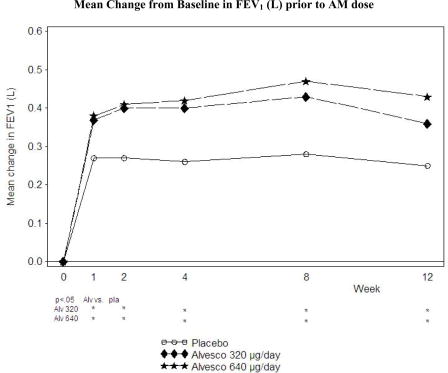
In the other trial, 257 patients with moderate to severe persistent asthma (mean baseline percent predicted FEV1 of 54%) were treated with ALVESCO 160 or 320 mcg twice daily for 12 weeks. The AM pre-dose FEV1 results are shown in Figure 3 below.
Figure 3: A 12-Week Double-Blind Clinical Trial Evaluating ALVESCO Administered Twice Daily in Adult and Adolescent Patients with Severe Asthma:
Compared to placebo, both ALVESCO doses showed statistically significantly more improvement in pre-dose FEV1 (0.11 L or 8.6% and 0.18 L or 11.8%). Other measures of asthma control, AM PEF, symptoms, and need for rescue albuterol also showed improvement compared to placebo. Compared to placebo, fewer patients treated with ALVESCO experienced worsening of asthma.
Patients treated with ALVESCO were also less likely to discontinue study participation due to asthma deterioration.
Patients Previously Maintained on Oral Corticosteroids
In a 12-week double-blind clinical trial, 140 patients with severe persistent asthma (mean FEV1 at baseline 53% predicted) who had failed prior efforts to eliminate oral prednisone use and had established their lowest effective prednisone dose were randomized to ALVESCO given by inhalation aerosol at doses of 320 or 640 mcg twice daily or placebo. The average prednisone dose at baseline was approximately 12 mg/day. Compared to patients on placebo whose prednisone requirements increased by 4%, those treated with ALVESCO 320 mcg and 640 mcg twice daily significantly reduced their prednisone requirements by 47% and 62% respectively. At the same time, patients on ALVESCO maintained asthma control as reflected by lung function, symptoms, and need for rescue albuterol. A significantly larger percentage of patients on ALVESCO were able to reduce oral prednisone use by 50% or more as compared to placebo (64% and 77% of the patients treated with 320 mcg and 640 mcg respectively twice daily as compared with 33% of patients on placebo). There was no statistically significant difference observed with ALVESCO 640 mcg twice daily compared to ALVESCO 320 mcg twice daily.
Pediatric Patients 4 To 11 Years of Age
Two identically designed randomized, double-blind, parallel, placebo-controlled clinical trials of 12 weeks treatment duration were conducted in 1018 patients aged 4 to 11 years with asthma but efficacy was not established [see Pediatric Use (8.4)].
Pediatric Patients under 4 Years of Age
Clinical trials have not been conducted in pediatric patients under 4 years of age [see Pediatric Use (8.4)].
ALVESCO®
(ciclesonide) Inhalation Aerosol 80 mcg
ALVESCO®
(ciclesonide) Inhalation Aerosol 160 mcg
For Oral Inhalation Only
Patient Instructions for Use
Read this leaflet carefully before starting to take this medicine. This leaflet provides a summary of information about ALVESCO, and does not contain the complete information about this medication. If you have any questions about ALVESCO, ask your health care provider or pharmacist.
What is ALVESCO?
Your health care provider has prescribed ALVESCO for the long-term treatment of your asthma. The medicine is available in 2 different strengths, and your health care provider has chosen the one most suitable for you.
ALVESCO contains ciclesonide, a man-made corticosteroid. Corticosteroids are natural anti-inflammatory substances found in the body. ALVESCO is used as maintenance treatment that helps prevent and control asthma symptoms because ALVESCO reduces airway inflammation.
When inhaled regularly, as prescribed by your health care provider, ALVESCO will help to prevent and control symptoms of asthma.
ALVESCO is not a bronchodilator. You should not use ALVESCO when you are having sudden symptoms of shortness of breath. Use an inhaled short-acting bronchodilator such as albuterol to relieve sudden symptoms of shortness of breath.
What Should I Tell My Health Care Provider Before Taking ALVESCO?
Tell your health care provider:
- If you are pregnant or plan to become pregnant.
- If you are breast-feeding.
- About any past or present medical problems or allergies.
- About all medicines that you are taking or plan to take, including those you can get without a prescription.
- If you have or had TB.
- If you are exposed to anyone with chicken pox or measles, or about any other infections you had before or while using ALVESCO.
Important Points to Remember About Using ALVESCO
- ALVESCO IS NOT A BRONCHODILATOR AND IS NOT INTENDED TO PROVIDE RAPID RELIEF OF BREATHING DIFFICULTIES DURING AN ASTHMA ATTACK.
- ALVESCO must be taken at regular intervals as recommended by your health care provider, and not as an emergency measure. Your health care provider may prescribe another medication (such as a bronchodilator) for rapid relief if an asthma attack occurs. Please contact your health care provider if:
- an asthma attack does not respond to the other medication.
- you require more of the other medication than usual.
- It is important that you inhale each dose of ALVESCO as your health care provider has advised. DO NOT inhale more doses or use your ALVESCO more often than your health care provider advises.
- It may take four weeks or longer to feel the full benefit of this medicine. Contact your health care provider if your symptoms do not improve in that time frame or if your condition worsens at any point during treatment.
- It is important that you continue to use ALVESCO regularly. Do not stop treatment even if you are feeling better unless told to do so by your health care provider.
- If you miss one dose of your medicine wait and take your regularly scheduled next dose.
- If you also use another medicine by inhalation, you should consult your health care provider for instructions on when to use it in relation to using ALVESCO.
- Use your ALVESCO Inhalation Aerosol canister with ALVESCO Inhalation Aerosol actuator only.
- Do not use the ALVESCO actuator with any other inhalation medications.
How to Use ALVESCO
Follow the instructions below. If you have any questions, ask your health care provider or pharmacist.
-
Your ALVESCO inhaler is fitted with a dose indicator which shows you how much of your medicine is left during use. The dose indicator display will move every tenth time you take a puff. The dose indicator display window will turn red when there are only 20 puffs remaining. This means that you need to replace your inhaler soon. The canister should be discarded when the dose indicator display window shows zero.
While your inhaler is fitted with a dose indicator to help determine the approximate number of puffs remaining, you should keep track of the number of puffs used from each canister of ALVESCO (see Step 8 below).
On the first use of your ALVESCO inhaler, as with all aerosol medicine, you should “test spray” the inhaler. To do this, remove the plastic cap and check the dose indicator on top of the inhaler to ensure that the dose indicator display window pointer is before the “60” inhalation mark before the first use. The “test spray” should also be done if the inhaler has not been used for more than 10 days. Spray 3 times into the air, away from the face by pressing firmly onto the center (not “off center”) of the dose indicator button, indicated by the middle of the three concentric rings on the button (see Figure 1). Be sure the canister is firmly seated in the plastic mouthpiece adapter before each use and that you press the inhaler slowly and firmly until it moves no further in the adapter for each spray.
You do not need to shake your ALVESCO inhaler before use. Check the dose indicator before the first use after the “test spray.” Check that the dose indicator display window shows that there are 60 inhalations left in the inhaler. If this is not the case, please return it to the pharmacy.
Steps for Inhalation:
- Remove the plastic cap.
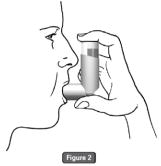
- Breathe out as fully as you comfortably can. Hold the inhaler as shown in Figure 2. Close your lips around the mouthpiece, keeping your tongue below it.
- While breathing in deeply and slowly, press down on the center (not “off center”) of the dose indicator with your finger. Fully depress the canister until it stops moving in the adapter while delivering your dose. When you have finished breathing in, hold your breath for about 10 seconds, or for as long as is comfortable. Note: It is normal to hear a soft click from the indicator as it counts down during use.
- Take your finger completely off the center of the dose indicator and remove the inhaler from your mouth. Breathe out gently.
- After use, always replace the cap to keep the mouthpiece clean. Note: The mouthpiece of your inhaler should be cleaned weekly with a clean, dry tissue or cloth.
- After you finish taking your dose, rinse your mouth with water and spit it out. Do not swallow.
- DO NOT WASH OR PUT ANY PART OF YOUR INHALER IN WATER.
- DISCARD THE ALVESCO INHALER WHEN THE DOSE INDICATOR DISPLAY WINDOW SHOWS ZERO. The correct amount of medicine in each inhalation cannot be assured after this point. Note: If the inhaler is dropped, do not rely on the dose indicator. It is recommended to keep track of the number of inhalations taken from your inhaler based on your records.
POSSIBLE SIDE EFFECTS WITH ALVESCO
Serious Side Effects may include:
- Adrenal insufficiency (your adrenal gland can not produce enough steroids since you were on oral steroid medicine). If you took steroids by mouth and are having them decreased (tapered) or you are being switched to ALVESCO, you should be followed closely by your doctor. Death can occur. Tell your doctor right away about any symptoms such as feeling tired or exhausted, weakness, nausea, vomiting or symptoms of low blood pressure (such as dizziness or faintness). If you are under stress, such as with surgery, after surgery or trauma, you may need steroids by mouth again.
- Decreased bone mass (bone mineral density). Patients who use inhaled steroid medicines for a long time may have an increased risk of decreased bone mass which can affect bone strength. Talk with your healthcare provider about any questions about bone health.
- Possible increased risk of infection due to a weakened immune system with using steroid medicines.
- Bronchospasm (spasm of the breathing tubes) can occur, with wheezing right after a dose of the medicine. Stop using ALVESCO and use an inhaled short-acting bronchodilator right away, such as albuterol. Tell your healthcare provider right away so that a new maintenance medicine can be prescribed for your or your child's asthma.
The most common side effects with ALVESCO include: headache, nasopharyngitis, sinusitis, pharyngolaryngeal pain, upper respiratory infection, arthralgia, nasal congestion, pain in extremity and back pain.
Tell your doctor about any side effects that bother you or do not go away. These are not all of the possible side effects with ALVESCO. For more information, ask your doctor or pharmacist.
How to Store ALVESCO
For best results, store and use ALVESCO at room temperature.
Keep out of reach of children.
CONTENTS UNDER PRESSURE. Do not puncture. Do not use or store near heat or open flame. Exposure to temperature above 120°F (49°C) may cause bursting. Never throw canister into fire or incinerator.
DO NOT USE after the expiration date, shown as “Exp” on the package label or box.
Further Information
REMEMBER: This medicine has been prescribed for you by your health care provider. DO NOT give this medicine to anyone else.
This leaflet does not contain the complete information about your medication. If you have any questions, or are not sure about something, then you should ask your health care provider or pharmacist.
Because you may want to refer to this leaflet again, you may want to keep it until you have finished your medicine.
Manufactured for:
Sepracor Inc.
Marlborough, MA 01752 USA
Made in the United Kingdom
ALVESCO is a registered trademark of Nycomed GmbH and is used with permission.
US Patent Nos. 5,482,934; 6,264,923
©2007 Nycomed
July 2008
901139R01