Other
Rx only
11001623
Revised February 2010
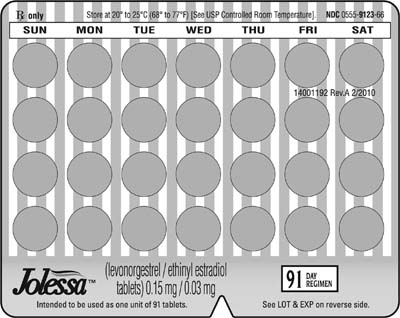
Jolessa™ (levonorgestrel / ethinyl estradiol tablets) 0.15 mg / 0.03 mg
Patients should be counseled that this product does not protect against HIV-infection (AIDS) and other sexually transmitted diseases.
that is effective.
| Method of control and outcome | 15-19 | 20-24 | AGE 25-29 | 30-34 | 35-39 | 40-44 |
| No fertility - control methods* | 7.0 | 7.4 | 9.1 | 14.8 | 25.7 | 28.2 |
| Oral
contraceptives non-smoker† | 0.3 | 0.5 | 0.9 | 1.9 | 13.8 | 31.6 |
| Oral
contraceptives smoker† | 2.2 | 3.4 | 6.6 | 13.5 | 51.1 | 117.2 |
| IUD† | 0.8 | 0.8 | 1.0 | 1.0 | 1.4 | 1.4 |
| Condom* | 1.1 | 1.6 | 0.7 | 0.2 | 0.3 | 0.4 |
| Diaphragm/ spermicide* | 1.9 | 1.2 | 1.2 | 1.3 | 2.2 | 2.8 |
| Periodic abstinence* | 2.5 | 1.6 | 1.6 | 1.7 | 2.9 | 3.6 |
*Deaths are birth related†Deaths are method related
3. Carcinoma of the Reproductive Organs and Breasts
Numerous epidemiological studies have been performed on the incidence of breast, endometrial, ovarian and cervical cancer in women using oral contraceptives. Although the risk of having breast cancer diagnosed may be slightly increased among current and recent users of combined oral contraceptives (RR=1.24), this excess risk decreases over time after combination oral contraceptive discontinuation and by 10 years after cessation the increased risk disappears. The risk does not increase with duration of use and no consistent relationships have been found with dose or type of steroid. The patterns of risk are also similar regardless of a woman’s reproductive history or her family breast cancer history. The subgroup for whom risk has been found to be significantly elevated is women who first used oral contraceptives before age 20, but because breast cancer is so rare at these young ages, the number of cases attributable to this early oral contraceptive use is extremely small. Breast cancers diagnosed in current or previous oral contraceptive users tend to be less clinically advanced than in never-users. Women who currently have or have had breast cancer should not use oral contraceptives because breast cancer is a hormone sensitive tumor.
Some studies suggest that oral contraceptive use has been associated with an increase in the risk of cervical intraepithelial neoplasia or invasive cervical cancer in some populations of women. However, there continues to be controversy about the extent to which such findings may be due to differences in sexual behavior and other factors. In spite of many studies of the relationship between oral contraceptive use and breast cancer and cervical cancers, a cause and-effect relationship has not been established.
4. Hepatic NeoplasiaBenign hepatic adenomas are associated with oral contraceptive use, although their occurrence is rare in the United States. Indirect calculations have estimated the attributable risk to be in the range of 3.3 cases/100,000 for users, a risk that increases after four or more years of use. Rupture of hepatic adenomas may cause death through intra-abdominal hemorrhage.
Studies from Britain have shown an increased risk of developing hepatocellular carcinoma in long-term (>8 years) oral contraceptive users. However, these cancers are extremely rare in the U.S., and the attributable risk (the excess incidence) of liver cancers in oral contraceptive users approaches less than one per million users.
5. Ocular LesionsThere have been clinical case reports of retinal thrombosis associated with the use of oral contraceptives that may lead to partial or complete loss of vision. Oral contraceptives should be discontinued if there is unexplained partial or complete loss of vision; onset of proptosis or diplopia; papilledema; or retinal vascular lesions. Appropriate diagnostic and therapeutic measures should be undertaken immediately.
6. Oral contraceptive Use Before or During Early PregnancyBecause women using Jolessa™ will likely have withdrawal bleeding only 4 times per year, pregnancy should be ruled out at the time of any missed menstrual period (see DOSAGE AND ADMINISTRATION section). Oral contraceptive use should be discontinued if pregnancy is confirmed.
Extensive epidemiological studies have revealed no increased risk of birth defects in women who have used oral contraceptives prior to pregnancy. Studies also do not suggest a teratogenic effect, particularly in so far as cardiac anomalies and limb-reduction defects are concerned, when taken inadvertently during early pregnancy (see CONTRAINDICATIONS section).
The administration of oral contraceptives to induce withdrawal bleeding should not be used as a test for pregnancy. Oral contraceptives should not be used during pregnancy to treat threatened or habitual abortion.
7. Gallbladder DiseaseEarlier studies have reported an increased lifetime relative risk of gallbladder surgery in users of oral contraceptives and estrogens. More recent studies, however, have shown that the relative risk of developing gallbladder disease among oral contraceptive users may be minimal. The recent findings of minimal risk may be related to the use of oral contraceptive formulations containing lower hormonal doses of estrogens and progestogens.
8. Carbohydrate and Lipid Metabolic EffectsOral contraceptives have been shown to cause glucose intolerance in a significant percentage of users. Oral contraceptives containing greater than 75 micrograms of estrogens cause hyperinsulinism, while lower doses of estrogen cause less glucose intolerance. Progestogens increase insulin secretion and create insulin resistance, this effect varying with different progestational agents. However, in the nondiabetic woman, oral contraceptives appear to have no effect on fasting blood glucose. Because of these demonstrated effects, prediabetic and diabetic women should be carefully observed while taking oral contraceptives.
A small proportion of women will have persistent hypertriglyceridemia while on the pill. As discussed earlier (see WARNINGS 1a. and 1d.), changes in serum triglycerides and lipoprotein levels have been reported in oral contraceptive users.
9. Elevated Blood PressureWomen with significant hypertension should not be started on hormonal contraceptive. An increase in blood pressure has been reported in women taking oral contraceptives and this increase is more likely in older oral contraceptive users and with continued use. Data from the Royal College of General Practitioners and subsequent randomized trials have shown that the incidence of hypertension increases with increasing concentrations of progestogens.
Women with a history of hypertension or hypertension-related diseases, or renal disease should be encouraged to use another method of contraception. If women with hypertension elect to use oral contraceptives, they should be monitored closely, and if significant elevation of blood pressure occurs, oral contraceptives should be discontinued (see CONTRAINDICATIONS section). For most women, elevated blood pressure will return to normal after stopping oral contraceptives, and there is no difference in the occurrence of hypertension among ever- and never-users.
10. HeadacheThe onset or exacerbation of migraine or development of headache with a new pattern that is recurrent, persistent, or severe requires discontinuation of oral contraceptives and evaluation of the cause. (See WARNINGS, 1c.)
11. Bleeding IrregularitiesWhen prescribing Jolessa™, the convenience of fewer planned menses (4 per year instead of 13 per year) should be weighed against the inconvenience of increased intermenstrual bleeding and/or spotting.
The clinical trial (SEA 301) that compared the efficacy of Jolessa™ (91-day cycles) to an equivalent dosage 28-day cycle regimen also assessed intermenstrual bleeding. The participants in the study were composed primarily of women who had used oral contraceptives previously as opposed to new users. Women with a history of breakthrough bleeding/spotting ≥10 consecutive days on oral contraceptives were excluded from the study. More Jolessa™ subjects, compared to subjects on the 28-day cycle regimen, discontinued prematurely for unacceptable bleeding (7.7% [Jolessa™] vs. 1.8% [28-day cycle regimen]).
Table 4 shows the percentages of women with ≥ 7 days and ≥ 20 days of intermenstrual spotting and/or bleeding in the Jolessa™ and the 28-day cycle treatment groups.
| Days of intermenstrual bleeding and/or spotting | Percentage of Subjects* | |
| Jolessa™ | Cycle 1 (N=385) | Cycle 4 (N=261) |
| ≥ 7 days | 65% | 42% |
| ≥ 20 days | 35% | 15% |
| 28-day regimen | Cycles 1-4 (N=194) | Cycles 10-13 (N=158) |
| ≥ 7 days | 38% | 39% |
| ≥ 20 days | 6% | 4% |
Total days of bleeding and/or spotting (withdrawal plus intermenstrual) were similar over one year of treatment for Jolessa™ subjects and subjects on the 28-day cycle regimen.
As in any case of bleeding irregularities, nonhormonal causes should always be considered and adequate diagnostic measures taken to rule out malignancy or pregnancy.
In the event of amenorrhea, pregnancy should be ruled out. Some women may encounter post-pill amenorrhea or oligomenorrhea (possibly with anovulation), especially when such a condition was preexistent.