Human Data
Congenital Malformations
The North American Antiepileptic Drug Pregnancy Registry reported 16 cases of congenital malformations among the offspring of 149 women with epilepsy who were exposed to valproic acid monotherapy during the first trimester of pregnancy at doses of approximately 1,000 mg per day, for a prevalence rate of 10.7% (95% CI 6.3%-16.9%). Three of the 149 offspring (2%) had neural tube defects and 6 of the 149 (4%) had less severe malformations. Among epileptic women who were exposed to other antiepileptic drug monotherapies during pregnancy (1,048 patients) the malformation rate was 2.9% (95% CI 2.0% to 4.1%). There was a 4-fold increase in congenital malformations among infants with valproic acid-exposed mothers compared with those treated with other antiepileptic monotherapies as a group (Odds Ratio 4.0; 95% CI 2.1 to 7.4). This increased risk does not reflect a comparison versus any specific antiepileptic drug, but the risk versus the heterogeneous group of all other antiepileptic drug monotherapies combined. The increased teratogenic risk from valproic acid in women with epilepsy is expected to be reflected in an increased risk in other indications (e.g., migraine or bipolar disorder).
The strongest association of maternal valproate usage with congenital malformations is with neural tube defects (as discussed under the next subheading). However, other congenital anomalies (e.g. craniofacial defects, cardiovascular malformations and anomalies involving various body systems), compatible and incompatible with life, have been reported. Sufficient data to determine the incidence of these congenital anomalies are not available.
Neural Tube Defects
The incidence of neural tube defects in the fetus is increased in mothers receiving valproate during the first trimester of pregnancy. The Centers for Disease Control (CDC) has estimated the risk of valproic acid exposed women having children with spina bifida to be approximately 1 to 2%. The American College of Obstetricians and Gynecologists (ACOG) estimates the general population risk for congenital neural tube defects as 0.14% to 0.2%.
Tests to detect neural tube and other defects using currently accepted procedures should be considered a part of routine prenatal care in pregnant women receiving valproate.
Evidence suggests that pregnant women who receive folic acid supplementation may be at decreased risk for congenital neural tube defects in their offspring compared to pregnant women not receiving folic acid. Whether the risk of neural tube defects in the offspring of women receiving valproate specifically is reduced by folic acid supplementation is unknown. Dietary folic acid supplementation both prior to and during pregnancy should be routinely recommended to patients contemplating pregnancy.
Other Adverse Pregnancy Effects
Patients taking valproate may develop clotting abnormalities [see Warnings and Precautions (5.6)]. A patient who had low fibrinogen when taking multiple anticonvulsants including valproate gave birth to an infant with afibrinogenemia who subsequently died of hemorrhage. If valproate is used in pregnancy, the clotting parameters should be monitored carefully.
Patients taking valproate may develop hepatic failure [see Warnings and Precautions (5.1)]. Fatal hepatic failures, in a newborn and in an infant, have been reported following the maternal use of valproate during pregnancy.
Animal Data
Reproduction studies have demonstrated valproate-induced teratogenicity. Increased incidences of malformations, as well as intrauterine growth retardation and death, have been observed in mice, rats, rabbits, and monkeys following prenatal exposure to valproate. Malformations of the skeletal system are the most common structural abnormalities produced in experimental animals; however, neural tube closure defects were observed in mice exposed during organogenesis to maternal plasma valproate concentrations 2.3 times the upper limit of the human therapeutic range.
In pregnant rats, oral administration during organogenesis of a dose ≥0.5 times the maximum recommended daily human dose on a mg/m2 basis (MRHD) produced malformations (e.g. skeletal, cardiac, and urogenital) and growth retardation in the offspring. These doses resulted in peak maternal plasma valproate levels of ≥3.4 times the upper limit of the human therapeutic range. Behavioral deficits have been reported in the offspring of rats given 0.5 times the MRHD on a mg/m2 basis throughout most of pregnancy.
Valproate produced skeletal and visceral malformations in the offspring of pregnant rabbits given an oral dose approximately 2 times the MRHD on a mg/m2 basis during organogenesis. Skeletal malformations, growth retardation, and death were observed in rhesus monkeys following an oral dose equal to the MRHD on a mg/m2 basis during organogenesis. This dose resulted in peak maternal plasma valproate levels 2.8 times the upper limit of the human therapeutic range.
Registry
To provide information regarding the effects of in utero exposure to divalproex sodium extended-release tablets, healthcare providers are advised to recommend that pregnant patients taking divalproex sodium extended-release tablets enroll in the North American Antiepileptic Drug (NAAED) Pregnancy Registry. This can be done by calling the toll free number 1-888-233-2334, and must be done by patients themselves. Information on the registry can also be found the website http://www.aedpregnancyregistry.org/.
Mania
A single 4-week outpatient, double-blind, placebo controlled study of 150 patients aged 10 – 17 years of age with pediatric bipolar disorder was conducted to evaluate the efficacy of divalproex sodium extended-release tablets in the treatment of pediatric bipolar disorder. Initial daily doses of 15mg/kg (max. 750mg/day) and flexible dosing was used to achieve a clinical response and/or a target serum valproate level of 80 – 125 mcg/ml with a maximum allowable dose set at 35mg/kg. Patients on stimulant medications at screening were allowed to continue and maintain current stimulant doses during the trial provided that doses were clinically stable. The trial efficacy endpoint was change from baseline on the YMRS scale at final visit.
Results from the trial revealed that the mean maximum daily dose of 1457 mg (27.1 mg/kg) with a mean final serum valproate concentration of 80mcg/ml was attained in this clinical trial.
Efficacy was not established in this study.
Migraine Prophylaxis
A single, double-blind, placebo-controlled, parallel-group, four equal armed (placebo, 250 mg, 500 mg and 1,000 mg) trial was performed to evaluate the efficacy of divalproex sodium extended-release tablets in adolescent patients with migraine (304 patients, ages 12-17 years old). The study consisted of a 4 week baseline period followed by a 12 week experimental period (including an initial 2 week titration phase).
The primary endpoint was the reduction from baseline in the 4 week migraine headache rate. Placebo was compared to each dose.
Efficacy was not established in this migraine study.
Epilepsy
Divalproex sodium extended-release tablets have not been proven to be safe and effective for epilepsy in children less than 10 years of age.
Pediatric Safety
Two six-month pediatric studies were conducted to evaluate the long-term safety of divalproex sodium extended-release tablets in the indication of mania (292 patients aged 10 to 17 years).
Two twelve-month pediatric studies were conducted to evaluate the long-term safety of divalproex sodium extended-release tablets in the indication of migraine (353 patients aged 12 to 17 years). One twelve-month study was conducted to evaluate the safety of divalproex sodium delayed-release sprinkles capsules in the indication of partial seizures (169 patients aged 3 to 10 years).
Safety Studies-Mania
Safety Study-Controlled Mania Trial
The incidence of treatment-emergent events for the pediatric population was based on the data from the single placebo-controlled clinical trial of divalproex sodium extended-release tablets in the treatment of manic or mixed episodes associated with bipolar disorder.
Table 8 includes those adverse reactions reported for pediatric patients in the placebo-controlled mania trial where the incidence rate in the valproate-treated group was >5% and was at least twice the rate than that for placebo patients.
Table 8:Common, Drug-Related Adverse Reactions reported by >5% of Divalproex Sodium Extended-Release Tablets Treated Patients during Placebo Controlled Trials for Pediatric Acute Mania| Adverse Reaction-preferred term | Divalproex Sodium Extended-Release Tablets
(N=76) | Placebo
(N=74) |
|---|
| Nausea | 9% | 1% |
| Upper abdominal Pain | 8% | 1% |
| Somnolence | 7% | 1% |
| Increased Ammonia | 5% | 0 |
| Gastritis | 5% | 0 |
| Rash | 5% | 1% |
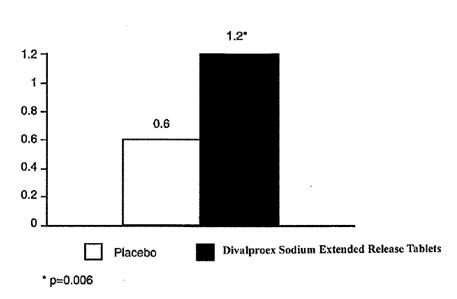
In addition, patients taking Divalproex Sodium Extended-Release Tablets had a statistically significant 1.5 lbs mean increase in weight and 0.4 unit BMI mean increase from baseline values over placebo treated patients.
Safety Study-Open Label Mania Safety Data
In the two long-term (six month) safety studies in pediatric patients (n=292) between the ages of 10 and 17 years old, no clinically meaningful differences in the adverse reaction profile were observed when compared to adults.
The safety and tolerability of Divalproex Sodium Extended-Release Tablets in pediatric patients were shown to be comparable to those in adults [see Adverse Reactions (6.1, 6.2, 6.3)]
Safety Study-Epilepsy (open label)
Safety and tolerability in this study was found comparable to that observed in adult epilepsy studies.
Safety Studies-Migraine (controlled and open label)
Safety and tolerability in this study was found comparable to that observed in adult migraine studies.
Prior Safety Experience
Experience has indicated that pediatric patients under the age of two years are at a considerably increased risk of developing fatal hepatotoxicity, especially those with the aforementioned conditions [see Boxed Warning, Warning and Precautions (5.1)]. When valproic acid is used in this patient group, it should be used with extreme caution and as a sole agent. The benefits of therapy should be weighed against the risks. Above the age of 2 years, experience in epilepsy has indicated that the incidence of fatal hepatotoxicity decreases considerably in progressively older patient groups.The variability in free fraction limits the clinical usefulness of monitoring total serum valproic acid concentrations. Interpretation of valproic acid concentrations in children should include consideration of factors that affect hepatic metabolism and protein binding.
The safety and effectiveness of valproic acid for the treatment of acute mania has not been established in individuals below the age of 18 years.
The safety and effectiveness of valproic acid for the prophylaxis of migraines has not been studied in individuals below the age of 12 years.
Nonclinical Developmental Toxicology
The basic toxicology and pathologic manifestations of valproate sodium in neonatal (4-day old) and juvenile (14-day old) rats are similar to those seen in young adult rats. However, additional findings, including renal alterations in juvenile rats and renal alterations and retinal dysplasia in neonatal rats, have been reported. These findings occurred at a dose approximately equal to the maximum recommended daily human dose (MRHD). They were not seen at a dose 0.4 times the MRHD.
Liver Disease
(see Boxed Warning, Contraindications(4), and Warnings And Precautions (5) and Clinical Pharmacology (12.3)]. Liver disease impairs the capacity to eliminate valproate.
Epilepsy
The therapeutic range in epilepsy is commonly considered to be 85 to 100 mcg/mL of total valproate, although some patients may be controlled with lower or higher plasma concentrations.
Mania
In placebo-controlled clinical trials of acute mania, patients were dosed to clinical response with trough plasma concentrations between 50 and 125 mcg/mL [see Dosage and Administration (2.1)].
Absorption/Bioavailability
The absolute bioavailability of divalproex sodium extended-release tablets administered as a single dose after a meal was approximately 90% relative to intravenous infusion.
When given in equal total daily doses, the bioavailability of divalproex sodium extended-release tablets is less than that of divalproex sodium delayed-release tablets. In five multiple-dose studies in healthy subjects (N=82) and in subjects with epilepsy (N=86), when administered under fasting and nonfasting conditions, divalproex sodium extended-release tablets given once daily produced an average bioavailability of 89% relative to an equal total daily dose of divalproex sodium delayed-release tablets given BID, TID, or QID. The median time to maximum plasma valproate concentrations (Cmax) after divalproex sodium extended-release tablets administration ranged from 4 to 17 hours. After multiple once-daily dosing of divalproex sodium extended-release tablets, the peak-to-trough fluctuation in plasma valproate concentrations was 10-20% lower than that of regular divalproex sodium delayed-release tablets given BID, TID, or QID.
Conversion from Divalproex Sodium Delayed-Release Tablets to Divalproex Sodium Extended-Release Tablets
When divalproex sodium extended-release tablets are given in doses 8 to 20% higher than the total daily dose of divalproex sodium delayed-release tablets, the two formulations are bioequivalent. In two randomized, crossover studies, multiple daily doses of divalproex sodium delayed-release tablets were compared to 8 to 20% higher oncedaily doses of divalproex sodium extended-release tablets. In these two studies, divalproex sodium extended-release tablets and divalproex sodium delayed-release tablets regimens were equivalent with respect to area under the curve (AUC; a measure of the extent of bioavailability). Additionally, valproate Cmax was lower, and Cmin was either higher or not different, for divalproex sodium extended-release tablets relative to divalproex sodium delayed-release tablets regimens (see Table 9).
Table 9. Bioavailability of Divalproex Sodium Extended-Release Tablets Relative to Divalproex Sodium Delayed-Release Tablets When Divalproex Sodium Extended-Release Tablets Dose is 8 to 20% Higher| Study Population | Regimens | Relative Bioavailability |
|---|
| Divalproex Sodium Extended-Release Tablets vs. Divalproex Sodium Delayed-Release Tablets | AUC24 | Cmax | Cmin |
|---|
| Healthy Volunteers (N=35) | 1000 & 1500 mg divalproex sodium extended-release tablets vs. 875 & 1250 mg divalproex sodium delayed-release tablets | 1.059 | 0.882 | 1.173 |
| Patients with epilepsy on concomitant enzyme-inducing antiepilepsy drugs (N=64) | 1000 to 5000 mg divalproex sodium extended-release tablets vs. 875 to 4250 mg divalproex sodium delayed-release tablets | 1.008 | 0.899 | 1.022 |
Concomitant antiepilepsy drugs (topiramate, phenobarbital, carbamazepine, phenytoin, and lamotrigine were evaluated) that induce the cytochrome P450 isozyme system did not significantly alter valproate bioavailability when converting between divalproex sodium delayed-release tablets and divalproex sodium extended-release tablets.
Distribution
Protein Binding
The plasma protein binding of valproate is concentration dependent and the free fraction increases from approximately 10% at 40 mcg/mL to 18.5% at 130 mcg/mL. Protein binding of valproate is reduced in the elderly, in patients with chronic hepatic diseases, in patients with renal impairment, and in the presence of other drugs (e.g., aspirin). Conversely, valproate may displace certain protein-bound drugs (e.g., phenytoin, carbamazepine, warfarin, and tolbutamide) [See Drug Interactions (7)] for more detailed information on the pharmacokinetic interactions of valproate with other drugs].
CNS Distribution
Valproate concentrations in cerebrospinal fluid (CSF) approximate unbound concentrations in plasma (about 10% of total concentration).
Metabolism
Valproate is metabolized almost entirely by the liver. In adult patients on monotherapy, 30-50% of an administered dose appears in urine as a glucuronide conjugate. Mitochondrial β-oxidation is the other major metabolic pathway, typically accounting for over 40% of the dose. Usually, less than 15-20% of the dose is eliminated by other oxidative mechanisms. Less than 3% of an administered dose is excreted unchanged in urine.
The relationship between dose and total valproate concentration is nonlinear; concentration does not increase proportionally with the dose, but rather, increases to a lesser extent due to saturable plasma protein binding. The kinetics of unbound drug are linear.
Elimination
Mean plasma clearance and volume of distribution for total valproate are 0.56 L/hr/1.73 m2 and 11 L/1.73 m2, respectively. Mean plasma clearance and volume of distribution for free valproate are 4.6 L/hr/1.73 m2 and 92 L/1.73 m2. Mean terminal half-life for valproate monotherapy ranged from 9 to 16 hours following oral dosing regimens of 250 to 1000 mg.
The estimates cited apply primarily to patients who are not taking drugs that affect hepatic metabolizing enzyme systems. For example, patients taking enzyme-inducing antiepileptic drugs (carbamazepine, phenytoin, and phenobarbital) will clear valproate more rapidly. Because of these changes in valproate clearance, monitoring of antiepileptic concentrations should be intensified whenever concomitant antiepileptics are introduced or withdrawn.
Special Populations
Effect of Age
Pediatric
The valproate pharmacokinetic profile following administration of divalproex sodium extended-release tablets was characterized in a multiple-dose, nonfasting, open label, multi-center study in children and adolescents. Divalproex sodium extended-release tablets once daily doses ranged from 250-1750 mg. Once daily administration of divalproex sodium extended-release tablets in pediatric patients (10-17 years) produced plasma VPA concentration-time profiles similar to those that have been observed in adults.
Elderly
The capacity of elderly patients (age range: 68 to 89 years) to eliminate valproate has been shown to be reduced compared to younger adults (age range: 22 to 26). Intrinsic clearance is reduced by 39%; the free fraction is increased by 44%. Accordingly, the initial dosage should be reduced in the elderly [see Dosage and Administration (2.3)].
Effect of Sex
There are no differences in the body surface area adjusted unbound clearance between males and females (4.8±0.17 and 4.7±0.07 L/hr per 1.73 m2, respectively).
Effect of Race
The effects of race on the kinetics of valproate have not been studied.
Effect of Disease
Liver Disease
Liver disease impairs the capacity to eliminate valproate. In one study, the clearance of free valproate was decreased by 50% in 7 patients with cirrhosis and by 16% in 4 patients with acute hepatitis, compared with 6 healthy subjects. In that study, the half-life of valproate was increased from 12 to 18 hours. Liver disease is also associated with decreased albumin concentrations and larger unbound fractions (2 to 2.6 fold increase) of valproate. Accordingly, monitoring of total concentrations may be misleading since free concentrations may be substantially elevated in patients with hepatic disease whereas total concentrations may appear to be normal [See Boxed Warning, Contraindications (4), Warnings and Precautions (5.1)].
Renal Disease
A slight reduction (27%) in the unbound clearance of valproate has been reported in patients with renal failure (creatinine clearance < 10 mL/minute); however, hemodialysis typically reduces valproate concentrations by about 20%. Therefore, no dosage adjustment appears to be necessary in patients with renal failure. Protein binding in these patients is substantially reduced; thus, monitoring total concentrations may be misleading.
Carcinogenesis
Valproic acid was administered orally to Sprague Dawley rats and ICR (HA/ICR) mice at doses of 80 and 170 mg/kg/day (approximately 10 to 50% of the maximum human daily dose on a mg/m2 basis) for two years. A variety of neoplasms were observed in both species. The primary findings were a statistically significant increase in the incidence of subcutaneous fibrosarcomas in high dose male rats receiving valproic acid and a statistically significant dose-related trend for benign pulmonary adenomas in male mice receiving valproic acid. The significance of these findings for humans is unknown.
Mutagenesis
Valproate was not mutagenic in an in vitro bacterial assay (Ames test), did not produce dominant lethal effects in mice, and did not increase chromosome aberration frequency in an in vivo cytogenetic study in rats. Increased frequencies of sister chromatid exchange (SCE) have been reported in a study of epileptic children taking valproate, but this association was not observed in another study conducted in adults. There is some evidence that increased SCE frequencies may be associated with epilepsy. The biological significance of an increase in SCE frequency is not known.
Fertility
Chronic toxicity studies in juvenile and adult rats and dogs demonstrated reduced spermatogenesis and testicular atrophy at oral doses of 400 mg/kg/day or greater in rats (approximately equivalent to or greater than the maximum human daily dose (MHD) on a mg/m2 basis) and 150 mg/kg/day or greater in dogs (approximately 1.4 times the MHD or greater on a mg/m2 basis). Fertility studies in rats have shown doses up to 350 mg/kg/day (approximately equal to the MHD on a mg/m2 basis) for 60 days to have no effect on fertility. The effect of valproate on testicular development and on sperm production and fertility in humans is unknown.
Manufactured by
Anchen Pharmaceuticals (Taiwan), Inc.
Zhongli City, Taoyuan County 320, Taiwan
Manufactured for
Anchen Pharmaceuticals, Inc.
Irvine, CA 92618
Revised: 07/09