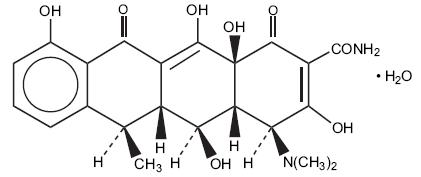
Tetracyclines are readily absorbed and are bound to plasma proteins in varying degrees. They are concentrated by the liver in the bile and excreted in the urine and feces at high concentrations in a biologically active form. Doxycycline is virtually completely absorbed after oral administration.
Following a 200 mg dose of doxycycline monohydrate, 24 normal adult volunteers averaged the following serum concentration values:
| Time (hr): | 0.5 | 1.0 | 1.5 | 2.0 | 3.0 | 4.0 | 8.0 | 12.0 | 24.0 | 48.0 | 72.0 | |
| Conc. | 1.02 | 2.26 | 2.67 | 3.01 | 3.16 | 3.03 | 2.03 | 1.62 | 0.95 | 0.37 | 0.15 | (μg/mL) |
Average Observed Values| Maximum Concentration | 3.61 μg/mL (± 0.9 sd) |
| Time of Maximum Concentration | 2.60 hr (± 1.10 sd) |
| Elimination Rate Constant | 0.049 per hr (± 0.030 sd) |
| Half-Life | 16.33 hr (± 4.53 sd) |
Excretion of doxycycline by the kidney is about 40%/72 hours in individuals with normal function (creatinine clearance about 75 mL/min). This percentage excretion may fall as low as 1-5%/72 hours in individuals with severe renal insufficiency (creatinine clearance below 10 mL/min). Studies have shown no significant difference in serum half-life of doxycycline (range 18-22 hours) in individuals with normal and severely impaired renal function.
Hemodialysis does not alter serum half-life.
Microbiology: The tetracyclines are primarily bacteriostatic and are thought to exert their antimicrobial effect by the inhibition of protein synthesis. The tetracyclines, including doxycycline, have a similar antimicrobial spectrum of activity against a wide range of gram-positive and gram-negative microorganisms. Cross-resistance of these microorganisms to tetracyclines is common.
Doxycycline has been shown to be active against most strains of the following microorganisms, both in vitro and in clinical infections as described in the INDICATIONS AND USAGE section.
Aerobic Gram-Positive Microorganisms:
Because many strains of the following groups of gram-positive microorganisms have been shown to be resistant to tetracyclines, culture and susceptibility testing are recommended.
Bacillus anthracis
Listeria monocytogenes
Staphylococcus aureus*
*Doxycycline is not the drug of choice in the treatment of any type of staphylococcal infection.
Up to 44 percent of strains of Streptococcus pyogenes and 74 percent of Streptococcus faecalis have been found to be resistant to tetracycline drugs. Therefore, tetracyclines should not be used to treat streptococcal infections unless the microorganism has been demonstrated to be susceptible.
Streptococcus pneumoniae
Aerobic Gram-Negative Microorganisms:
| Bartonella bacilliformis | Haemophilus ducreyi |
| Brucella species | Haemophilus influenzae |
| Calymmatobacterium granulomatis | Neisseria gonorrhoeae |
| Campylobacter fetus | Vibrio cholerae |
| Francisella tularensis | Yersinia pestis |
Because many strains of the following groups of gram-negative microorganisms have been shown to be resistant to tetracyclines, culture and susceptibility testing are recommended:
| Acinetobacter species | Klebsiella species |
| Enterobacter aerogenes | Shigella species |
| Escherichia coli | |
Anaerobic Microorganisms:
| Actinomyces israelii | Fusobacterium fusiforme |
| Clostridium species | |
Other Microorganisms:
| Borrelia recurrentis | Rickettsiae |
| Chlamydia psittaci | Treponema pallidum |
| Chlamydia trachomatis | Treponema pertenue |
| Mycoplasma pneumoniae | |
Susceptibility Tests:
Dilution Techniques:
Quantitative methods are used to determine antimicrobial minimum inhibitory concentrations (MIC’s). These MIC’s provide estimates of the susceptibility of bacteria to antimicrobial compounds. The MIC’s should be determined using a standardized procedure. Standardized procedures are based on a dilution method1,3 (broth or agar) or equivalent with standardized inoculum concentrations and standardized concentrations of tetracycline powder. The MIC values should be interpreted according to the following criteria:
| Interpretive criteria for Enterobacteriaceae, Staphylococcus aureus and Acinetobacter spp. |
| Microorganism | MIC Interpretive Standard (μg/mL) |
| Susceptible (S) | Intermediate (I) | Resistant (R) |
| Enterobacteriaceae |
≤ 4 |
8 |
≥ 16 |
| Staphylococcus aureus |
| Acinetobacter spp. |
Microorganisms that are susceptible to tetracycline are generally susceptible to doxycycline.
| Interpretive Criteria for Haemophilus spp. |
| Microorganism | MIC Interpretive Standard (μg/mL) |
| Susceptible (S) | Intermediate (I) | Resistant (R) |
| Haemophilus spp. | ≤ 2 | 4 | ≥ 8 |
Interpretive criteria for Haemophilus spp. are applicable only to tests performed by broth microdilution method using Haemophilus Test Medium (HTM).1,3
Microorganisms that are susceptible to tetracycline are generally susceptible to doxycycline.
| Interpretive Criteria for Neisseria gonorrhoeae |
| Microorganism | MIC Interpretive Standard (μg/mL) |
| Susceptible (S) | Intermediate (I) | Resistant (R) |
| Neisseria gonorrhoeae | ≤ 0.25 | 0.5 - 1 | ≥ 2 |
Interpretive criteria for Neisseria gonorrhoeae are applicable only to tests performed by agar dilution method using GC agar base with 1% defined growth supplement.1,3
Microorganisms that are susceptible to tetracycline are generally susceptible to doxycycline.
| Interpretive Criteria for Streptococcus pneumoniae |
| Microorganism | MIC Interpretive Standard (μg/mL) |
| Susceptible (S) | Intermediate (I) | Resistant (R) |
| Streptococcus pneumoniae | ≤ 2 | 4 | ≥ 8 |
Interpretive criteria for Streptococcus pneumoniae are applicable only to tests performed by broth microdilution method using Cation-Adjusted Mueller-Hinton broth with 2.5% - 5% lysed horse blood.1,3
Microoganisms that are susceptible to tetracycline are generally susceptible to doxycycline.
| Interpretive Criteria for Bacillus anthracis and Brucella spp. |
| Microorganism | MIC Interpretive Standard (μg/mL) |
| Susceptible (S) | Intermediate (I) | Resistant (R) |
| Bacillus anthracis | ≤ 1 | - | - |
| Brucella spp. |
Broth Microdilution performed in unsupplemented
Brucella broth pH adjusted to 7.1 ± 0.1 for
Brucella spp.
5For some organism/antimicrobial agent combinations, the absence or rare occurrence of resistant strains precludes defining results for categories other than “susceptible.” For strains yielding results suggestive of a “nonsusceptible” category, organism identification and antimicrobial susceptibility test results should be confirmed.
5Incubation in 5% CO2 may be required for growth of some strains of Brucella spp. especially B. abortus.
Incubation broth MIC tests in CO2 may decrease the MIC of tetracyclines, usually by one doubling dilution.5
Microorganisms that are susceptible to tetracycline are generally susceptible to doxycycline.
| Interpretive Criteria for Burkholderia mallei, Burkholderia pseudomallei and Yersinia pestis |
| Microorganism | MIC Interpretive Standard (μg/mL) |
| Susceptible (S) | Intermediate (I) | Resistant (R) |
| Burkholderia mallei | ≤ 4 | 8 | ≥ 16 |
| Burkholderia pseudomallei |
| Yersinia pestis |
Microorganisms that are susceptible to tetracycline are generally susceptible to doxycycline.
| Interpretive Criteria for Franciscella tularensis |
| Microorganism | MIC Interpretive Standard (μg/mL) |
| Susceptible (S) | Intermediate (I) | Resistant (R) |
| Franciscella tularensis | ≤ 4 | - | - |
Broth Microdilutions performed in Cation-Adjusted Mueller-Hinton broth with 2% defined growth supplement for Franciscella tularensis5
For some organism/antimicrobial agent combinations, the absence or rare occurrence of resistant strains precludes defining results for categories other than “susceptible.” For strains yielding results suggestive of a “nonsusceptible” category, organism identification and antimicrobial susceptibility test results should be confirmed.5
Microorganisms that are susceptible to tetracycline are generally susceptible to doxycycline.
A report of “Susceptible” indicates that the pathogen is likely to be inhibited if the antimicrobial compound in the blood reaches the concentrations usually achievable. A report of “Intermediate” indicates that the result should be considered equivocal, and, if the microorganism is not fully susceptible to alternative, clinically feasible drugs, the test should be repeated. This category implies possible clinical applicability in body sites where the drug is physiologically concentrated or in situations where high dosage of drug can be used. This category also provides a buffer zone which prevents small uncontrolled technical factors from causing major discrepancies in interpretation. A report of “Resistant” indicates that the pathogen is not likely to be inhibited if the antimicrobial compound in the blood reaches the concentrations usually achievable; other therapy should be selected.
Standardized susceptibility test procedures require the use of laboratory control microorganisms to control the technical aspects of the laboratory procedures. Standard tetracycline powder should provide the following MIC values:
Quality Control Ranges for MIC Broth Dilution MethodMicroorganism | ATCC Number |
Cation-Adjusted
Mueller-Hinton
(CAMHB)
MIC (μg/mL)
|
| Escherichia coli | 25922 | 0.5 - 2 |
| Haemophilus influenzae | 49247 | 4 - 32 |
| Neisseria gonorrhoeae | 49226 | 0.25 - 1 |
| Pseudomonas aeruginosa | 27853 | 8 - 32 |
| Staphylococcus aureus | 29213 | 0.12 - 1 |
| Streptococcus pneumoniae | 49619 | 0.06 - 0.5 |
Diffusion Techniques:
Quantitative methods that require measurement of zone diameters also provide reproducible estimates of the susceptibility of bacteria to antimicrobial compounds. One such standardized procedure2,3 requires the use of standardized inoculum concentrations. This procedure uses paper disks impregnated with 30-μg tetracycline or 30-μg doxycycline to test the susceptibility of microorganisms to doxycycline.
Reports from the laboratory providing results of the standard single-disk susceptibility test with a 30-μg tetracycline-class disk or the 30-μg doxycycline disk should be interpreted according to the following criteria:
| Interpretive Zone Diameters for Staphylococcus aureus |
| Antimicrobial Agent | Zone Diameter (nearest whole mm) |
| Susceptible (S) | Intermediate (I) | Resistant (R) |
| Tetracycline | ≥ 19 | 15 - 18 | ≤ 14 |
| Doxycycline | ≥ 16 | 13 - 15 | ≤ 12 |
| Interpretive Zone Diameters for Enterobacteriaceae. |
| Antimicrobial Agent | Zone Diameter (nearest whole mm) |
| Susceptible (S) | Intermediate (I) | Resistant (R) |
| Tetracycline | ≥ 15 | 12 - 14 | ≤ 11 |
| Doxycycline | ≥ 14 | 11 - 13 | ≤ 10 |
Minocycline | ≥ 16 | 13 - 15 | ≤ 12 |
| Interpretive Zone Diameters for Acinetobactor spp. |
| Antimicrobial Agent | Zone Diameter (nearest whole mm) |
| Susceptible (S) | Intermediate (I) | Resistant (R) |
| Tetracycline | ≥ 15 | 12 - 14 | ≤ 11 |
| Doxycycline | ≥ 13 | 10 - 12 | ≤ 9 |
| Minocycline | ≥ 16 | 13 - 15 | ≤ 12 |
| Interpretive Zone Diameters for Haemophilus spp. |
| Antimicrobial Agent | Zone Diameter (nearest whole mm) |
| Susceptible (S) | Intermediate (I) | Resistant (R) |
| Tetracycline | ≥ 29 | 26 - 28 | ≤ 25 |
Interpretive criteria applicable only to tests performed by disk diffusion method using a 30-μg tetracycline-class disk and using Haemophilus Test Medium (HTM).2,3
Microorganisms that are susceptible to tetracycline are generally susceptible to doxycycline.
| Interpretive Zone Diameters for Neisseria gonorrhoeae |
| Antimicrobial Agent | Zone Diameter (nearest whole mm) |
| Susceptible (S) | Intermediate (I) | Resistant (R) |
| Tetracycline | ≥ 38 | 31 - 37 | ≤ 30 |
Interpretive criteria applicable only to tests performed by disk diffusion method using a 30-μg tetracycline-class disk and using GC agar base with 1% defined growth supplement.
2,3Zone diameters ≤ 19 mm may indicate a plasmid-mediated tetracycline-resistant
Neisseria gonorrhoeae (TRNG) isolate. These TRNG strains should be confirmed by the dilution test (MIC ≥ 16 μg/mL).
Microorganisms that are susceptible to tetracycline are generally susceptible to doxycycline.
| Interpretive Zone Diameters for Streptococcus pneumoniae |
| Antimicrobial Agent | Zone Diameter (nearest whole mm) |
| Susceptible (S) | Intermediate (I) | Resistant (R) |
| Tetracycline | ≥ 23 | 19 - 22 | ≤ 18 |
Interpretative criteria applicable only to tests performed by disk diffusion method using a 30-μg tetracycline-class disk and using Mueller-Hinton agar with 5% defibrinated sheep blood and incubated in 5% CO2.2,3
Microorganisms that are susceptible to tetracycline are generally susceptible to doxycycline.
Interpretation should be as stated above for results using dilution techniques. Interpretation involves correlation of the diameter obtained in the disk test with the MIC for tetracycline or doxycycline, respectively.
As with standardized dilution techniques, diffusion methods require the use of laboratory control microorganisms that are used to control the technical aspects of the laboratory procedures. For the diffusion technique, the 30-μg tetracycline-class disk or the 30-μg doxycycline disk should provide the following zone diameters in these laboratory test quality control strains:
Quality Control Zone Diameters for Disk Diffusion Method| Microorganism |
ATCC
Number | Zone Diameter (mm) |
| Tetracycline | Doxycycline | Minocycline |
| Escherichia coli | 25922 | 18 - 25 | 18 - 24 | 19 - 25
|
| Haemophilus influenzae | 49247 | 14 - 22 | - | -
|
| Neisseria gonorrhoeae | 49226 | 30 - 42 | -
| -
|
| Staphylococcus aureus | 25923 | 24 - 30 | 23 - 29
| 25 - 30
|
| Streptococcus pneumoniae | 49619 | 27 - 31 | - | -
|
Anaerobic Techniques:For anaerobic bacteria, the susceptibility to tetracycline as MIC’s can be determined by standardized test methods.3,4 The MIC values obtained should be interpreted according to the following criteria:
Agar Dilution Interpretive Criteria for Anaerobes| Microorganism | MIC Interpretive Standard (μg/mL) |
| Susceptible (S) | Intermediate (I) | Resistant (R) |
| Anaerobes | ≤ 4 | 8 | ≥ 16 |
Microorganisms that are susceptible to tetracycline are generally susceptible to doxycycline.
Interpretation is identical to that stated above for results using dilution techniques.
As with other susceptibility techniques, the use of laboratory control microorganisms is required to control the technical aspects of the laboratory standardized procedures. Standardized tetracycline powder should provide the following MIC values:
Quality Control Ranges for MIC Agar Dilution Method| Microorganism | ATCC Number | MIC (μg/mL) |
| Bacteroides fragilis | 25285 | 0.125 - 0.5 |
| Bacteroides thetaiotamicron | 29741 | 8 - 32 |
Range applicable only to tests performed by the reference agar dilution method.