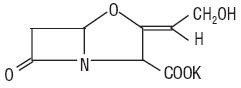
Amoxicillin is a semisynthetic antibiotic with a broad spectrum of bactericidal activity against many gram-positive and gram-negative microorganisms. Amoxicillin is, however, susceptible to degradation by β-lactamases, and therefore, the spectrum of activity does not include organisms which produce these enzymes. Clavulanic acid is a β-lactam, structurally related to the penicillins, which possesses the ability to inactivate a wide range of β-lactamase enzymes commonly found in microorganisms resistant to penicillins and cephalosporins. In particular, it has good activity against the clinically important plasmid-mediated β-lactamases frequently responsible for transferred drug resistance.
The formulation of amoxicillin and clavulanic acid in amoxicillin and clavulanate potassium protects amoxicillin from degradation by β-lactamase enzymes and effectively extends the antibiotic spectrum of amoxicillin to include many bacteria normally resistant to amoxicillin and other β-lactam antibiotics. Thus, amoxicillin and clavulanate potassium possesses the distinctive properties of a broad-spectrum antibiotic and a β-lactamase inhibitor.
Amoxicillin and clavulanic acid has been shown to be active against most strains of the following microorganisms, both in vitro and in clinical infections as described in INDICATIONS AND USAGE.
Gram-Positive Aerobes:
Staphylococcus aureus (β-lactamase and non-β-lactamase-producing)
Staphylococci which are resistant to methicillin/oxacillin must be considered resistant to amoxicillin and clavulanic acid.
Gram-Negative Aerobes:
Enterobacter species (Although most strains of Enterobacter species are resistant in vitro, clinical efficacy has been demonstrated with amoxicillin and clavulanate potassium in urinary tract infections caused by these organisms.)
Escherichia coli (β-lactamase and non-β-lactamase-producing)
Haemophilus influenzae (β-lactamase and non-β-lactamase-producing)
Klebsiella species (All known strains are β-lactamase-producing.)
Moraxella catarrhalis (β-lactamase and non-β-lactamase-producing)
The following in vitro data are available, but their clinical significance is unknown.
Amoxicillin and clavulanic acid exhibits in vitro minimal inhibitory concentrations (MICs) of 2 mcg/mL or less against most (≥90%) strains of Streptococcus pneumoniae
Because amoxicillin has greater in vitro activity against S. pneumoniae than does ampicillin or penicillin, the majority of S. pneumoniae strains with intermediate susceptibility to ampicillin or penicillin are fully susceptible to amoxicillin.
; MICs of 0.06 mcg/mL or less against most (≥90%) strains of
Neisseria gonorrhoeae; MICs of 4 mcg/mL or less against most (≥90%) strains of staphylococci and anaerobic bacteria; MICs of 8 mcg/mL or less against most (≥90%) strains of other listed organisms. However, with the exception of organisms shown to respond to amoxicillin alone, the safety and effectiveness of amoxicillin and clavulanic acid in treating clinical infections due to these microorganisms have not been established in adequate and well-controlled clinical trials.
Gram-Positive Aerobes:
Enterococcus faecalis
Adequate and well-controlled clinical trials have established the effectiveness of amoxicillin alone in treating certain clinical infections due to these organisms.
Staphylococcus epidermidis (β-lactamase and non-β-lactamase-producing)
Staphylococcus saprophyticus (β-lactamase and non-β-lactamase-producing)
Streptococcus pneumoniae These are non-β-lactamase-producing organisms, and therefore, are susceptible to amoxicillin alone.
Streptococcus pyogenes viridans group Streptococcus
Gram-Negative Aerobes:
Eikenella corrodens (β-lactamase and non-β-lactamase-producing)
Neisseria gonorrhoeae (β-lactamase and non-β-lactamase-producing)
Proteus mirabilis (β-lactamase and non-β-lactamase-producing)
Anaerobic Bacteria:
Bacteroides species, including Bacteroides fragilis (β-lactamase and non-β-lactamase-producing)
Fusobacterium species (β-lactamase and non-β-lactamase-producing)
Peptostreptococcus species