1 Indications And Usage
LASTACAFT™ is an H1 histamine receptor antagonist indicated for the prevention of itching associated with allergic conjunctivitis.
The following Structured Product Label (SPL) was submitted to the FDA by Physicians Total Care, Inc. for the product Lastacaft (NDC 54868-6294). This document serves as the official prescribing information, containing essential scientific data and clinical materials required for healthcare providers and patients.
This specific version of the label includes detailed information regarding 1 indications and usage, 2 dosage and administration, 3 dosage forms and strengths, 4 contraindications, 5.1 contamination of tip and solution, 5.2 contact lens use, 5.3 topical ophthalmic use only, 6 adverse reactions, and other regulatory disclosures. Use the navigation below to review specific sections of the FDA submission.
LASTACAFT™ is an H1 histamine receptor antagonist indicated for the prevention of itching associated with allergic conjunctivitis.
Instill one drop in each eye once daily.
Topical ophthalmic solution containing alcaftadine, 0.25% (2.5 mg/mL).
None.
To minimize contaminating the dropper tip and solution, care should be taken not to touch the eyelids or surrounding areas with the dropper tip of the bottle. Keep bottle tightly closed when not in use.
Patients should be advised not to wear a contact lens if their eye is red. LASTACAFT™ should not be used to treat contact lens-related irritation.
LASTACAFT™ should not be instilled while wearing contact lenses. Remove contact lenses prior to instillation of LASTACAFT™. The preservative in LASTACAFT™, benzalkonium chloride, may be absorbed by soft contact lenses. Lenses may be reinserted after 10 minutes following administration of LASTACAFT™.
LASTACAFT™ is for topical ophthalmic use only.
Because clinical trials are conducted under widely varying conditions, adverse reaction rates observed in the clinical trials of a drug cannot be directly compared to rates in the clinical trials of another drug and may not reflect the rates observed in clinical practice.
The most frequent ocular adverse reactions, occurring in < 4% of LASTACAFT™-treated eyes, were eye irritation, burning and/or stinging upon instillation, eye redness and eye pruritus.
The most frequent non-ocular adverse reactions, occurring in < 3% of subjects with LASTACAFT™-treated eyes, were nasopharyngitis, headache and influenza. Some of these events were similar to the underlying disease being studied.
Pregnancy Category B. Reproduction studies performed in rats and rabbits revealed no evidence of impaired female reproduction or harm to the fetus due to alcaftadine. Oral doses in rats and rabbits of 20 and 80 mg/kg/day, respectively, produced plasma exposure levels approximately 200 and 9000 times the plasma exposure at the recommended human ocular dose. There are however, no adequate and well controlled studies in pregnant women. Because animal reproduction studies are not always predictive of human response, this drug should be used during pregnancy only if clearly needed.
It is not known whether this drug is excreted in human milk. Because many drugs are excreted in human milk, caution should be exercised when LASTACAFT™ is administered to a nursing woman.
Safety and effectiveness in pediatric patients below the age of 2 years have not been established.
No overall differences in safety or effectiveness were observed between elderly and younger subjects.
LASTACAFT™ is a sterile, topically administered H1 receptor antagonist containing alcaftadine for ophthalmic use.
Alcaftadine is a white to yellow powder with an empirical formula of C19H21N3O and a molecular weight of 307.39.
Contains: Active: alcaftadine 0.25% (2.5 mg/mL). Preservative: benzalkonium chloride 0.005%. Inactives: edetate disodium, monobasic sodium phosphate, purified water, sodium chloride, sodium hydroxide and/or hydrochloric acid to adjust pH
Chemical Name: 6,11-dihydro-11-(1-methyl-4-piperidinylidene)-5H-imidazo[2,1-b] [3] benzazepine-3-carboxaldehyde
Structural Formula:
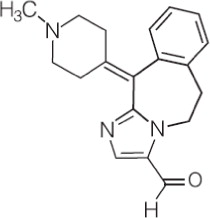
Structural Formula (Las00 0000 01)
The drug product has a pH of approximately 7 and an osmolality of approximately 290 mOsm/kg.
Alcaftadine is a H1 histamine receptor antagonist and inhibitor of the release of histamine from mast cells. Decreased chemotaxis and inhibition of eosinophil activation has also been demonstrated.
Absorption
Following bilateral topical ocular administration of alcaftadine ophthalmic solution, 0.25%, the mean plasma Cmax of alcaftadine was approximately 60 pg/mL and the median Tmax occurred at 15 minutes. Plasma concentrations of alcaftadine were below the lower limit of quantification (10 pg/mL) by 3 hours after dosing. The mean Cmax of the active carboxylic acid metabolite was approximately 3 ng/mL and occurred at 1 hour after dosing. Plasma concentrations of the carboxylic acid metabolite were below the lower limit of quantification (100 pg/mL) by 12 hours after dosing. There was no indication of systemic accumulation or changes in plasma exposure of alcaftadine or the active metabolite following daily topical ocular administration.
Distribution
The protein binding of alcaftadine and the active metabolite are 39.2% and 62.7%, respectively.
Metabolism
The metabolism of alcaftadine is mediated by non-CYP450 cytosolic enzymes to the active carboxylic acid metabolite.
Excretion
The elimination half-life of the carboxylic acid metabolite is approximately 2 hours following topical ocular administration. Based on data following oral administration of alcaftadine, the carboxylic acid metabolite is primarily eliminated unchanged in the urine.
In vitro studies showed that neither alcaftadine nor the carboxylic acid metabolite substantially inhibited reactions catalyzed by major CYP450 enzymes.
Alcaftadine was not mutagenic or genotoxic in the Ames test, the mouse lymphoma assay or the mouse micronucleus assay.
Alcaftadine was found to have no effect on fertility of male and female rats at oral doses up to 20 mg/kg/day (approximately 200 times the plasma exposure at the recommended human ocular dose).
Clinical efficacy was evaluated in conjunctival allergen challenge (CAC) studies. LASTACAFT™ was more effective than its vehicle in preventing ocular itching in patients with allergic conjunctivitis induced by an ocular allergen challenge, both at 3 minutes post-dosing and at 16 hours post-dosing of LASTACAFT™.
The safety of LASTACAFT™ was evaluated in a randomized clinical study of 909 subjects over a period of 6 weeks.
LASTACAFT™ (alcaftadine ophthalmic solution) 0.25% is supplied in an opaque, white low-density polyethylene bottle with a white polypropylene cap.
3 mL fill in 5 mL bottle NDC 54868-6294-0
Storage: Store at 15-25°C (59-77°F).
Patients should be advised to not touch dropper tip to any surface, as this may contaminate the contents.
Patients should be advised not to wear a contact lens if their eye is red. Patients should be advised that LASTACAFT™ should not be used to treat contact lens-related irritation. Patients should also be advised to remove contact lenses prior to instillation of LASTACAFT™. The preservative in LASTACAFT™, benzalkonium chloride, may be absorbed by soft contact lenses. Lenses may be reinserted after 10 minutes following administration of LASTACAFT™.
For topical ophthalmic administration only.
ALLERGAN
Manufactured for Allergan, Inc., Irvine, CA 92612, U.S.A.
© 2010 Allergan, Inc.
® and ™ marks owned by Allergan, Inc.
Manufactured in the U.S.A. by JHP Pharmaceuticals, LLC
72409US10B
Relabeling and Repackaging by:
Physicians Total Care, Inc., Tulsa, OK 74146
NDC 54868-6294-0
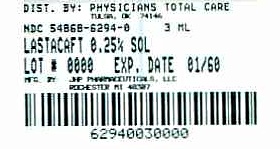
Image Of Package Label (6294)
LASTACAFT™
(alcaftadine ophthalmic
solution) 0.25%
3 mL Sterile
* Please review the disclaimer below.
