Important limitations of use — Safety and efficacy of AXIRON in males <18 years old have not been established [see Use in Specific Populations (8.4)].
Clinical Trials in Hypogonadal Men
Table 2 shows the treatment emergent adverse reactions that were reported by either >4% of 155 patients in a 120 day, Phase 3 study or by >4% of 71 patients who continued to use AXIRON for up to 180 days. These data reflect the experience primarily with a testosterone dose of 60 mg, which was taken by all patients at the start of the study, and was the maintenance dose for 97 patients. However, the doses used varied from 30 mg to 120 mg.
Table 2: Adverse Reactions Seen With the Use of AXIRON in either the 120 Day Clinical Trial or in the Extension to 180 Days (>4%)
| Event
| 120 Days
(155 Patients)
| 180 Days
(71 Patients)
|
|---|
| Application Site Irritation
| 11 (7%)
| 6 (8%)
|
| Application Site Erythema
| 8 (5%)
| 5 (7%)
|
| Headache
| 8 (5%)
| 4 (6%)
|
| Hematocrit Increased
| 6 (4%)
| 5 (7%)
|
| Diarrhea
| 4 (3%)
| 3 (4%)
|
| Vomiting
| 4 (3%)
| 3 (4%)
|
| PSA Increased
| 2 (1%)
| 3 (4%)
|
Other less common adverse reactions reported by at least 2 patients in the 120 day trial included: application site edema, application site warmth, increased hemoglobin, hypertension, erythema (general), increased blood glucose, acne, nasopharyngitis, anger and anxiety. Other less common adverse reactions reported in fewer than 1% of patients in the 120 day trial included: asthenia, affect lability, folliculitis, increased lacrimation, breast tenderness, increased blood pressure, increased blood testosterone, neoplasm prostate and elevated red blood cell count.
During the 120 day trial one patient discontinued treatment because of affect lability/anger which was considered possibly related to AXIRON administration.
During the 120 day clinical trial there was an increase in mean PSA values of 0.13 ± 0.68 ng/mL from baseline. At the end of the 180 day extension clinical trial, there was an overall increase in mean PSA values of 0.1 ± 0.54 ng/mL.
Following the 120 day study, seventy-one (71) patients entered a two-month extension study with AXIRON. Two patients (3%) had adverse reactions that led to discontinuation of treatment during the period from Day 120 to Day 180. These reactions were: one patient with application site irritation (considered possibly related to AXIRON application) and one patient with dry skin and erythema, but not at the application site (considered not related to AXIRON administration) and application site erythema (considered possibly related to AXIRON administration).
No serious adverse reactions to AXIRON were reported during either the 120 day trial, or the extension to 180 days.
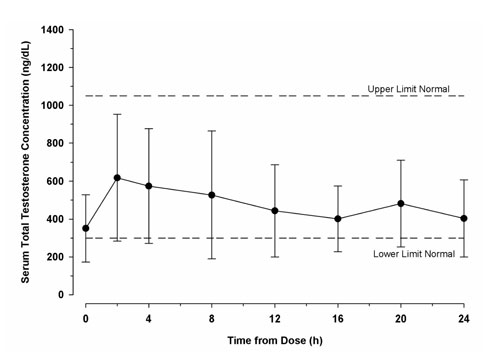
Absorption — AXIRON delivers physiologic circulating testosterone that approximate normal concentration range (i.e., 300 - 1050 ng/dL) seen in healthy men following application to the axilla.
On the skin, the ethanol and isopropyl alcohol evaporate leaving testosterone and octisalate. The skin acts as a reservoir from which testosterone is released into the systemic circulation over time (see
Figure 1). In general, steady-state serum concentrations are achieved by approximately 14 days of daily dosing.

Figure 1 (Axiron Pi F001 V1)
When AXIRON treatment is discontinued after achieving steady-state, serum testosterone concentrations returned to their pretreatment concentrations by 7 – 10 days after the last application.
Distribution — Circulating testosterone is primarily bound in the serum to sex hormone-binding globulin (SHBG) and albumin. Approximately 40% of testosterone in plasma is bound to SHBG, 2% remains unbound (free) and the rest is bound to albumin and other proteins.
Metabolism —Testosterone is metabolized to various 17-keto steroids through two different pathways. The major active metabolites of testosterone are estradiol and dihydrotestosterone (DHT).
DHT concentration increased in parallel with testosterone concentration during AXIRON treatment. The mean steady-state DHT/T ratio remained within normal limits and ranged from 0.17 to 0.26 across all doses on Days 15, 60, and 120.
Excretion — There is considerable variation in the half-life of testosterone as reported in the literature, ranging from 10 to 100 minutes. About 90% of a dose of testosterone given intramuscularly is excreted in the urine as glucuronic and sulfuric acid conjugates of testosterone and its metabolites; about 6% of a dose is excreted in the feces, mostly in the unconjugated form. Inactivation of testosterone occurs primarily in the liver.
Potential for testosterone transfer: The potential for testosterone transfer from males dosed with AXIRON to healthy females was evaluated in a clinical study conducted with a 2% testosterone formulation. 10 males were treated with 60 mg (2 pump actuations) of testosterone in each axilla (the maximum testosterone dose of 120 mg). At 2 hours after the application of AXIRON to the males, the females rubbed their outer forearms for 15 minutes on the axilla of the males. The males had covered the application area with a T-shirt. Serum concentrations of testosterone were monitored in the female subjects for 72 hours after the transfer procedure. Study results show a 13% and 17% increase in testosterone exposure (AUC[0-24]) and maximum testosterone concentration (Cmax), respectively, compared to baseline in these females. In a prior clinical study conducted with a 1% testosterone formulation under similar study conditions, direct skin-to-skin transfer showed a 131% and 297% increase in testosterone exposure (AUC[0-72]) and maximum testosterone concentration (Cmax), respectively, compared to when men had covered the application area with a T-shirt.
In a clinical study conducted with a 2% testosterone formulation to evaluate the effect of washing on the residual amount of testosterone at the axilla, 10 healthy male subjects received 60 mg (2 pump actuations) of testosterone to each axilla (the maximum testosterone dose of 120 mg). Following 5 minutes of drying time, the left axilla was wiped with alcohol towelettes which were assayed for testosterone content. Subjects were required to shower with soap and water 30 minutes after application. The right axilla was then wiped with alcohol towelettes which were assayed for testosterone content. A mean (SD) of 3.1 (2.8) mg of residual testosterone (i.e., 92.6% reduction compared to when axilla was not washed) was recovered after washing this area with soap and water. [See Dosage and Administration (2.2) and Warnings and Precautions (5.2)].
Use of deodorants and anti-perspirants: In a parallel designed clinical study evaluating the effect of deodorants and antiperspirants in healthy premenopausal females dosed with AXIRON, each subject applied either a combined deodorant/antiperspirant spray (6 subjects) or stick (6 subjects) or a deodorant spray (6 subjects) to a single axilla 2 minutes before the application of 30 mg (1 pump actuation) of testosterone to the same axilla. A control group of 6 subjects only applied 30 mg (1 pump actuation) of testosterone to a single axilla. Blood samples were collected for 72 hours from all subjects following AXIRON administration. Although a decrease of up to 33% of testosterone exposure (AUC[0-72]) was observed when antiperspirants or deodorants are used 2 minutes prior to AXIRON application, underarm deodorant or antiperspirant spray or stick products may be used 2 minutes prior to AXIRON application as part of normal, consistent, and daily routine. [See Dosage and Administration (2.2), and Patient Counseling Information (17.4)].
Effect of showering/washing: In a parallel designed clinical study to evaluate the effect of washing on the testosterone systemic exposure, two groups of 6 healthy premenopausal female subjects were each dosed with 30 mg (1 pump actuation) of testosterone to a single axilla. The application sites of each group were washed with soap and water 2 hours or 6 hours after the application of AXIRON. A control group of 6 female subjects applied 30 mg (1 pump actuation) of testosterone to a single axilla and did not wash the application site. Blood samples were collected for 72 hours from all subjects following dosing with AXIRON. A decrease of up to 35% of testosterone exposure (AUC[0-72]) was observed when applications sites were washed 2 hours and 6 hours after AXIRON application. Patients should be advised to avoid swimming or washing the application site until 2 hours following application of AXIRON. [See Dosage and Administration (2.2) and Patient Counseling Information (17.4)].
Literature revised December 2011
Marketed by: Lilly USA, LLC Indianapolis, IN 46285, USA
Copyright © 2010, 2011, Eli Lilly and Company. All rights reserved.
PV 8152 AMP
Distributed by:
Physicians Total Care, Inc.
Tulsa, OK 74146
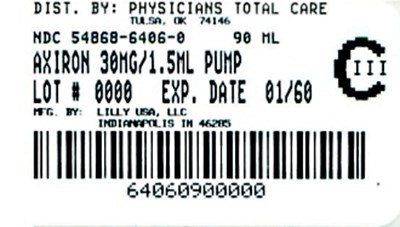
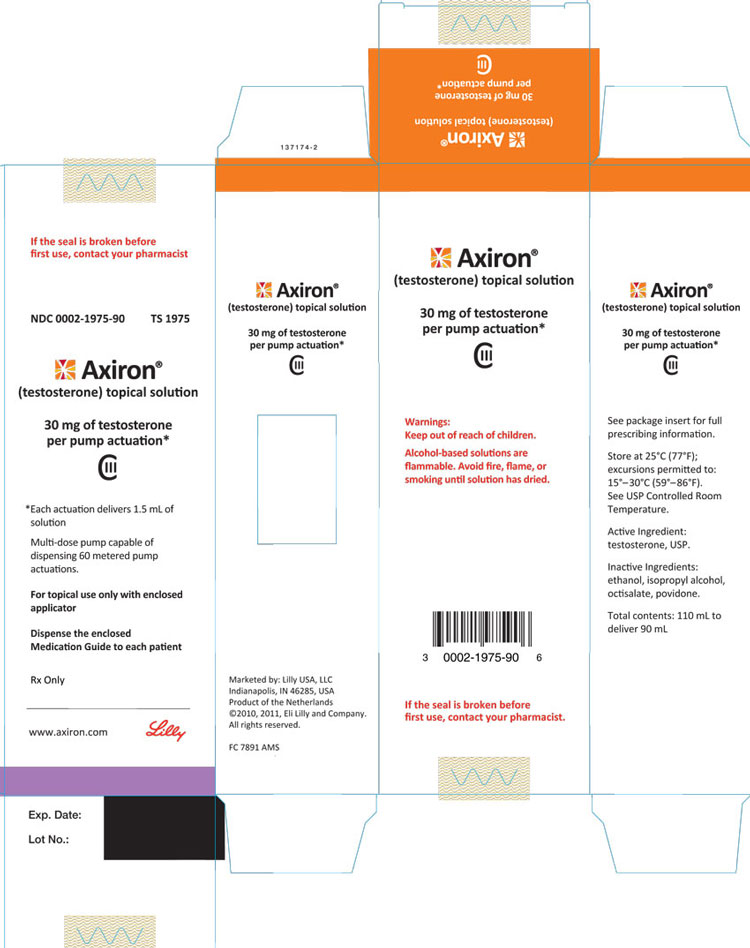
Image Of Package Label (54868 6406 0)