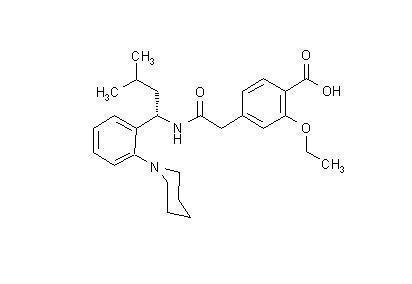
Drug interaction studies performed in healthy volunteers show that PRANDIN had no clinically relevant effect on the pharmacokinetic properties of digoxin, theophylline, or warfarin. Co-administration of cimetidine with PRANDIN did not significantly alter the absorption and disposition of repaglinide.
Additionally, the following drugs were studied in healthy volunteers with co-administration of PRANDIN. Listed below are the results:
CYP2C8 and CYP3A4 Inhibitors/Inducer
Gemfibrozil and Itraconazole: Co-administration of gemfibrozil (600 mg) and a single dose of 0.25 mg PRANDIN (after 3 days of twice-daily 600 mg gemfibrozil) resulted in an 8.1-fold higher repaglinide AUC and prolonged repaglinide half-life from 1.3 to 3.7 hr. Co-administration with itraconazole and a single dose of 0.25 mg PRANDIN (on the third day of a regimen of 200 mg initial dose, twice-daily 100 mg itraconazole) resulted in a 1.4-fold higher repaglinide AUC. Co-administration of both gemfibrozil and itraconazole with PRANDIN resulted in a 19-fold higher repaglinide AUC and prolonged repaglinide half-life to 6.1 hr. Plasma repaglinide concentration at 7 h increased 28.6-fold with gemfibrozil co-administration and 70.4-fold with the gemfibrozil-itraconazole combination (see CONTRAINDICATIONS, PRECAUTIONS, Drug-Drug Interactions).
Fenofibrate: Co-administration of 200 mg fenofibrate with a single dose of 0.25 mg repaglinide (after 5 days of once daily fenofibrate 200 mg) resulted in unchanged AUC and Cmax values for both drugs.
Ketoconazole: Co-administration of 200 mg ketoconazole and a single dose of 2 mg PRANDIN (after 4 days of once daily ketoconazole 200 mg) resulted in a 15% and 16% increase in repaglinide AUC and Cmax, respectively. The increases were from 20.2 ng/mL to 23.5 ng/mL for Cmax and from 38.9 ng/mL*hr to 44.9 ng/mL*hr for AUC.
Trimethoprim: Co-administration of 160 mg trimethoprim and a single dose of 0.25 mg PRANDIN (after 2 days of twice daily and one dose on the third day of trimethoprim 160 mg) resulted in a 61% and 41% increase in repaglinide AUC and Cmax, respectively. The increase in AUC was from 5.9 ng/mL*hr to 9.6 ng/mL*hr and the increase in Cmax was from 4.7 ng/mL to 6.6 ng/mL.
Cyclosporine: Co-administration of 100 mg cyclosporine with a single dose of 0.25 mg repaglinide (after two 100 mg doses of cyclosporine twelve hours apart) increased the repaglinide (0.25 mg) Cmax 1.8-fold and the AUC 2.5-fold in an interaction study with healthy volunteers (see PRECAUTIONS, Drug-Drug Interactions).
Rifampin: Co-administration of 600 mg rifampin and a single dose of 4 mg PRANDIN (after 6 days of once daily rifampin 600 mg) resulted in a 32% and 26% decrease in repaglinide AUC and Cmax, respectively. The decreases were from 40.4 ng/mL to 29.7 ng/mL for Cmax and from 56.8 ng/mL*hr to 38.7 ng/mL*hr for AUC.
In another study, co-administration of 600 mg rifampin and a single dose of 4 mg PRANDIN (after 6 days of once daily rifampin 600 mg) resulted in a 48% and 17% decrease in repaglinide median AUC and median Cmax respectively. The median decreases were from 54 ng/mL*hr to 28 ng/mL*hr for AUC and from 35 ng/mL to 29 ng/mL for Cmax. PRANDIN administered by itself (after 7 days of once daily rifampin 600 mg) resulted in an 80% and 79% decrease in repaglinide median AUC and Cmax respectively. The decreases were from 54 ng/mL*hr to 11 ng/mL*hr for AUC and from 35 ng/mL to 7.5 ng/mL for Cmax.
Levonorgestrel & Ethinyl Estradiol: Co-administration of a combination tablet of 0.15 mg levonorgestrel and 0.03 mg ethinyl estradiol administered once daily for 21 days with 2 mg PRANDIN administered three times daily (days 1-4) and a single dose on Day 5 resulted in 20% increases in repaglinide, levonorgestrel, and ethinyl estradiol Cmax. The increase in repaglinide Cmax was from 40.5 ng/mL to 47.4 ng/mL. Ethinyl estradiol AUC parameters were increased by 20%, while repaglinide and levonorgestrel AUC values remained unchanged.
Simvastatin: Co-administration of 20 mg simvastatin and a single dose of 2 mg PRANDIN (after 4 days of once daily simvastatin 20 mg and three times daily PRANDIN 2 mg) resulted in a 26% increase in repaglinide Cmax from 23.6 ng/mL to 29.7 ng/mL. AUC was unchanged.
Nifedipine: Co-administration of 10 mg nifedipine with a single dose of 2 mg PRANDIN (after 4 days of three times daily nifedipine 10 mg and three times daily PRANDIN 2 mg) resulted in unchanged AUC and Cmax values for both drugs.
Clarithromycin: Co-administration of 250 mg clarithromycin and a single dose of 0.25 mg PRANDIN (after 4 days of twice daily clarithromycin 250 mg) resulted in a 40% and 67% increase in repaglinide AUC and Cmax, respectively. The increase in AUC was from 5.3 ng/mL*hr to 7.5 ng/mL*hr and the increase in Cmax was from 4.4 ng/mL to 7.3 ng/mL.
Deferasirox: Co-administration of deferasirox (30 mg/kg/day for 4 days) and repaglinide (single dose of 0.5 mg) resulted in an increase in repaglinide systemic exposure (AUC) to 2.3-fold of control and an increase in Cmax of 62% (see PRECAUTIONS, Drug-Drug Interactions).
Renal Insufficiency: Single-dose and steady-state pharmacokinetics of repaglinide were compared between patients with type 2 diabetes and normal renal function (CrCl > 80 mL/min), mild to moderate renal function impairment (CrCl = 40 – 80 mL/min), and severe renal function impairment (CrCl = 20 – 40 mL/min). Both AUC and Cmax of repaglinide were similar in patients with normal and mild to moderately impaired renal function (mean values 56.7 ng/mL*hr vs 57.2 ng/mL*hr and 37.5 ng/mL vs 37.7 ng/mL, respectively.) Patients with severely reduced renal function had elevated mean AUC and Cmax values (98.0 ng/mL*hr and 50.7 ng/mL, respectively), but this study showed only a weak correlation between repaglinide levels and creatinine clearance. Initial dose adjustment does not appear to be necessary for patients with mild to moderate renal dysfunction. However, patients with type 2 diabetes who have severe renal function impairment should initiate PRANDIN therapy with the 0.5 mg dose – subsequently, patients should be carefully titrated. Studies were not conducted in patients with creatinine clearances below 20 mL/min or patients with renal failure requiring hemodialysis.
Hepatic Insufficiency: A single-dose, open-label study was conducted in 12 healthy subjects and 12 patients with chronic liver disease (CLD) classified by Child-Pugh scale and caffeine clearance. Patients with moderate to severe impairment of liver function had higher and more prolonged serum concentrations of both total and unbound repaglinide than healthy subjects (AUChealthy: 91.6 ng/mL*hr; AUCCLD patients: 368.9 ng/mL*hr; Cmax, healthy: 46.7 ng/mL; Cmax, CLD patients: 105.4 ng/mL). AUC was statistically correlated with caffeine clearance. No difference in glucose profiles was observed across patient groups. Patients with impaired liver function may be exposed to higher concentrations of repaglinide and its associated metabolites than would patients with normal liver function receiving usual doses. Therefore, PRANDIN should be used cautiously in patients with impaired liver function. Longer intervals between dose adjustments should be utilized to allow full assessment of response.
In vitro data indicate that PRANDIN is metabolized by cytochrome P450 enzymes 2C8 and 3A4. Consequently, repaglinide metabolism may be altered by drugs which influence these cytochrome P450 enzyme systems via induction and inhibition. Caution should therefore be used in patients who are on PRANDIN and taking inhibitors and/or inducers of CYP2C8 and CYP3A4. The effect may be very significant if both enzymes are inhibited at the same time resulting in a substantial increase in repaglinide plasma concentrations. Drugs that are known to inhibit CYP3A4 include antifungal agents like ketoconazole, itraconazole, and antibacterial agents like erythromycin. Drugs that are known to inhibit CYP2C8 include agents like trimethoprim, gemfibrozil and montelukast. Drugs that induce the CYP3A4 and/or 2C8 enzyme systems include rifampin, barbiturates, and carbamezapine. See CLINICAL PHARMACOLOGY section, Drug-Drug Interactions.
Repaglinide appears to be a substrate for active hepatic uptake transporter (organic anion transporting protein OATP1B1). Drugs that inhibit OATP1B1 (e.g. cyclosporine) may likewise have the potential to increase plasma concentrations of repaglinide. See CLINICAL PHARMACOLOGY section, Drug-Drug Interactions.
In vivo data from a study that evaluated the co-administration of a cytochrome P450 enzyme 3A4 inhibitor, clarithromycin, with PRANDIN resulted in a clinically significant increase in repaglinide plasma levels. In addition, an increase in repaglinide plasma levels was observed in studies that evaluated the co-administration of PRANDIN with trimethoprim and PRANDIN with deferasirox, both cytochrome P-450 enzyme 2C8 inhibitors. These increases in repaglinide plasma levels may necessitate a PRANDIN dose adjustment. See CLINICAL PHARMACOLOGY section, Drug-Drug Interactions.
Gemfibrozil significantly increased PRANDIN exposure. Therefore, patients should not take PRANDIN with gemfibrozil. See CLINICAL PHARMACOLOGY section, Drug-Drug Interactions, and CONTRAINDICATIONS.
The hypoglycemic action of oral blood glucose-lowering agents may be potentiated by certain drugs including nonsteroidal anti-inflammatory agents and other drugs that are highly protein bound, salicylates, sulfonamides, cyclosporine, chloramphenicol, coumarins, probenecid, monoamine oxidase inhibitors, and beta adrenergic blocking agents. When such drugs are administered to a patient receiving oral blood glucose-lowering agents, the patient should be observed closely for hypoglycemia. When such drugs are withdrawn from a patient receiving oral blood glucose-lowering agents, the patient should be observed closely for loss of glycemic control.
Certain drugs tend to produce hyperglycemia and may lead to loss of glycemic control. These drugs include the thiazides and other diuretics, corticosteroids, phenothiazines, thyroid products, estrogens, oral contraceptives, phenytoin, nicotinic acid, sympathomimetics, calcium channel blocking drugs, and isoniazid. When these drugs are administered to a patient receiving oral blood glucose-lowering agents, the patient should be observed for loss of glycemic control. When these drugs are withdrawn from a patient receiving oral blood glucose-lowering agents, the patient should be observed closely for hypoglycemia.