In three parallel, open-label studies (COL1620-004US, COL1620-005US, COL1620-009US), 127 women (aged 18-44) with hypothalamic amenorrhea or premature ovarian failure were randomized to receive either Crinone® 4% (n=62) or Crinone® 8% (n=65). All women were treated with either conjugated estrogens 0.625 mg daily (n=100) or transdermal estradiol (delivering 50 mcg/day) twice weekly (n=27).
Estrogen therapy was continuous for the entire three 28-day cycle studies. At Day 15 of the second cycle (six weeks after initiating estrogen replacement), women who demonstrated adequate response to estrogen therapy (by ultrasound) and who continued to be amenorrheic received Crinone® every other day for six doses (Day 15 through Day 25 of the cycle).
In cycle 2, Crinone® 4% induced bleeding in 79% of women and Crinone® 8% induced bleeding in 77% of women. In the third cycle, estrogen was continued and Crinone® was administered every other day beginning on Day 15 for six doses. On Day 24 an endometrial biopsy was performed. In 53 women who received Crinone® 4%, biopsy results were as follows: 7% proliferative, 40% late secretory, 19% mid secretory, 13% early secretory, 7% atrophic, 6% menstrual endometrium, 6% inactive endometrium and 2% negative endometrium. In 54 women who received Crinone® 8%, biopsy results were as follows: 44% late secretory, 19% mid secretory, 11% early secretory, 19% atrophic, 5% menstrual endometrium and 2% "oral contraceptive like" endometrium.
Crinone® 4% is indicated for the treatment of secondary amenorrhea. Crinone® 8% is indicated for use in women who have failed to respond to treatment with Crinone® 4%.
In three studies, 127 women with secondary amenorrhea received estrogen replacement therapy and Crinone® 4% or 8% every other day for six doses. Treatment emergent adverse events during estrogen and Crinone® treatment that occurred in 5% or more of women are shown in Table 5.
TABLE 5 Treatment-Emergent Adverse Events in ≥5% of Women Receiving Estrogen Treatment and Crinone® Every Other Day Studies COL1620-004US, COL1620-005US, COL1620-009US | Estrogen + Crinone® 4%
n=62 | Estrogen + Crinone® 8%
n=65 |
|---|
| Body as a Whole |
| Abdominal Pain | 3 (5%) | 6 (9%) |
| Appetite Increased | 3 (5%) | 5 (8%) |
| Bloating | 8 (13%) | 8 (12%) |
| Cramps NOS | 12 (19%) | 17 (26%) |
| Fatigue | 13 (21%) | 14 (22%) |
| Central and Peripheral Nervous System |
| Headache | 12 (19%) | 10 (15%) |
| Gastro-Intestinal System |
| Nausea | 5 (8%) | 4 (6%) |
| Musculo-Skeletal System |
| Back Pain | 5 (8%) | 2 (3%) |
| Myalgia | 5(8%) | 0(0%) |
| Psychiatric |
| Depression | 12 (19%) | 10 (15%) |
| Emotional Lability | 14 (23%) | 14 (22%) |
| Sleep Disorder | 11 (18%) | 12 (18%) |
| Reproductive, Female |
| Vaginal Discharge | 7 (11%) | 2 (3%) |
| Resistance Mechanism |
| Upper Respiratory Tract Infection | 3 (5%) | 5 (8%) |
| Skin and Appendages |
| Pruitis genital | 1 (2%) | 4 (6%) |
Additional adverse events reported in women at a frequency <5% in Crinone® ART and secondary amenorrhea studies and not listed in the tables above include:
Autonomic Nervous System–mouth dry, sweating increased
Body as a Whole–abnormal crying, allergic reaction, allergy, appetite decreased, asthenia, edema, face edema, fever, hot flushes, influenza-like symptoms, water retention, xerophthalmia
Cardiovascular, General–syncope
Central and Peripheral Nervous System–migraine, tremor
Gastro-Intestinal–dyspepsia, eructation, flatulence, gastritis, toothache
Metabolic and Nutritional–thirst
Musculo-Skeletal System–cramps legs, leg pain, skeletal pain
Neoplasm–benign cyst
Platelet, Bleeding & Clotting–purpura
Psychiatric–aggressive reactions, forgetfulness, insomnia
Red Blood Cell–anemia
Reproductive, Female–dysmenorrhea, premenstrual tension, vaginal dryness
Resistance Mechanism–infection, pharyngitis, sinusitis, urinary tract infection
Respiratory System–asthma, dyspnea, hyperventilation, rhinitis
Skin and Appendages–acne, pruritis, rash, seborrhea, skin discoloration, skin disorder, urticaria
Urinary System–cystitis, dysuria, micturition frequency
Vision Disorders–conjunctivitis
Crinone® 4% is administered vaginally every other day up to a total of six doses. For women who fail to respond, a trial of Crinone® 8% every other day up to a total of six doses may be instituted.
It is important to note that a dosage increase from the 4% gel can only be accomplished by using the 8% gel. Increasing the volume of gel administered does not increase the amount of progesterone absorbed.
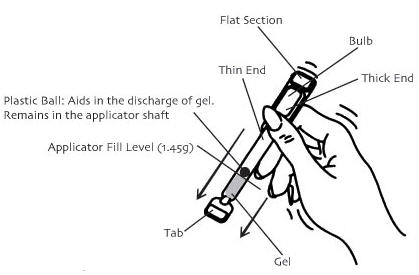
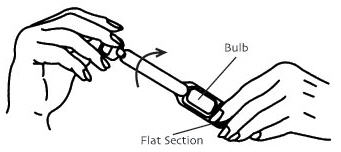
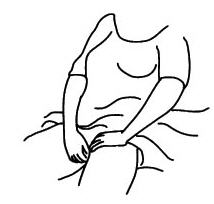
SEE Crinone® PATIENT INFORMATION SHEET - HOW TO USE Crinone® .
Note: The PATIENT INFORMATION SHEET contains special instructions for using the applicator at altitudes above 2500 feet in order to avoid a partial release of Crinone® before vaginal insertion.