Finasteride Tablet
Product Images NDC 55111-172

8 FDA label images from Dr. Reddy's Laboratories Limited · Packaging, Regulatory Labels, and Product Appearance

Product Visual Gallery

This gallery contains 8 technical images submitted to the FDA as part of the official labeling for Finasteride (NDC 55111-172). Unlike standard consumer photos, these assets often include clinical data figures, molecular chemical structures, and official manufacturer packaging layouts.

As provided by Dr. Reddy's Laboratories Limited, these visuals offer a comprehensive scientific overview of the product's physical and chemical identity, aiding pharmacists and researchers in product verification and study.

FDA Label Image

Carton (Carton)

Carton (Carton)
Packaging label for Finasteride Tablets, USP 5 mg, an oral prescription drug by Dr. Reddy's Laboratories Limited. The label shows 100 tablets packaged as 10 unit-dose blister cards each containing 10 tablets. Important warnings include storage instructions at 20-25°C and advisories against use by women or children, highlighting this carton is not for household use.*
FDA Label Image

Container (Container)

Container (Container)
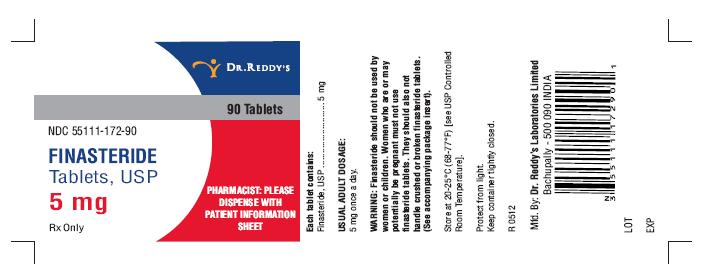
Label for Finasteride 5 mg tablets, USP, by Dr. Reddy's Laboratories Limited. The package contains 90 oral tablets and includes a pharmacist's notice to dispense with patient information. The label features the NDC number 55111-172-90 and usage and storage instructions.*
FDA Label Image

Figure1 (Figure1)

Figure1 (Figure1)
A line graph titled "Symptom Score in PLESS" showing mean change from baseline plus or minus one standard error over four years. The graph compares symptom scores between placebo and finasteride groups, with finasteride showing a greater decrease in symptom score over time compared to placebo.*
FDA Label Image

Figure2 (Figure2)

Figure2 (Figure2)
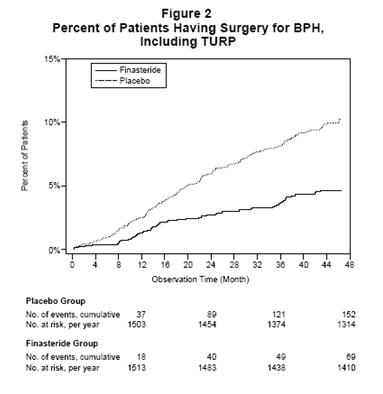
A line graph titled 'Percent of Patients Having Surgery for BPH, Including TURP' comparing Finasteride and placebo groups over 48 months. The y-axis shows percent of patients, and the x-axis shows observation time in months. The Finasteride line remains consistently lower than the placebo line, indicating fewer surgeries. Below the graph are cumulative event counts and patients at risk per year for both groups at intervals.*
FDA Label Image

Figure3 (Figure3)

Figure3 (Figure3)
Line graph titled 'Percent of Patients Developing Acute Urinary Retention (Spontaneous and Precipitated)' comparing Finasteride and Placebo groups over a 48-month observation period. The x-axis represents time in months, and the y-axis shows the percent of patients. The graph includes cumulative event numbers and patients at risk per year for both groups, illustrating a lower percentage of urinary retention events in the Finasteride group compared to placebo over time.*
FDA Label Image

Figure4 (Figure4)

Figure4 (Figure4)
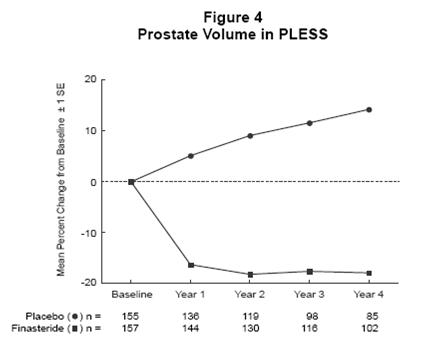
A line graph titled 'Prostate Volume in PLESS' showing mean percent change from baseline over four years for two groups: placebo and finasteride. The y-axis ranges from -20 to 20 percent change, and the x-axis shows time points from baseline to year 4. The finasteride group shows a decrease in prostate volume over time, while the placebo group shows an increase. Sample sizes for each group at each time point are listed below the x-axis.*
FDA Label Image

Figure5 (Figure5)

Figure5 (Figure5)
A line graph titled 'Cumulative Incidence of a 4-Point Rise in AUA Symptom Score by Treatment Group' depicting the percentage of events over approximately 5.5 years from randomization. It compares four groups: Placebo, Finasteride, Doxazosin, and Combination, showing cumulative incidence percentages on the y-axis and years on the x-axis.*
FDA Label Image

Structure (Structure)

Structure (Structure)
Chemical structure of Finasteride, showing its molecular formation including rings and functional groups as depicted in the image.*

* About these descriptions: Image descriptions on this page are generated by automated AI analysis of the product label images from the manufacturer's FDA label submission (SPL). They are provided for reference only and may contain errors or omissions. Always rely on the printed label itself and the official FDA labeling, and consult a pharmacist or healthcare professional with any questions about this product.