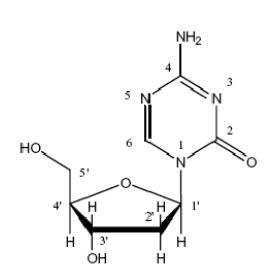
A randomized open-label, multicenter, controlled trial evaluated 170 adult patients with myelodysplastic syndromes (MDS) meeting French-American-British (FAB) classification criteria and International Prognostic Scoring System (IPSS) High-Risk, Intermediate-2 and Intermediate-1 prognostic scores. Eighty-nine patients were randomized to decitabine for injection therapy plus supportive care (only 83 received decitabine for injection), and 81 to Supportive Care (SC) alone. Patients with Acute Myeloid Leukemia (AML) were not intended to be included. Of the 170 patients included in the study, independent review (adjudicated diagnosis) found that 12 patients (9 in the decitabine for injection arm and 3 in the SC arm) had the diagnosis of AML at baseline. Baseline demographics and other patient characteristics in the Intent-to-Treat (ITT) population were similar between the 2 groups, as shown in Table 4.
Table 4 Baseline Demographics and Other Patient Characteristics (ITT)
| Supportive |
| Demographic or Other Patient | Decitabine For Injection | Care |
| Characteristic | N = 89 | N= 81 |
| Age (years) | |
| Mean (±SD) | 69±10 | 67±10 |
| Median (IQR) | 70 (65-76) | 70 (62-74) |
| (Range: min-max) | (31-85) | (30-82) |
| Gender n (%) | |
| Male | 59 (66) | 57 (70) |
| Female | 30 (34) | 24 (30) |
| Race n (%) | |
| White | 83 (93) | 76 (94) |
| Black | 4 (4) | 2 (2) |
| Other | 2 (2) | 3 (4) |
| Weeks Since MDS Diagnosis | |
| Mean (±SD) | 86±131 | 77±119 |
| Supportive |
| Median (IQR) | 29 (10-87) | 35 (7-98) |
| (Range: min-max) | (2-667) | (2-865) |
| Previous MDS Therapy n (%) | |
| Yes | 27 (30) | 19 (23) |
| No | 62 (70) | 62 (77) |
| RBC Transfusion Status n (%) | |
| Independent | 23 (26) | 27 (33) |
| Dependent | 66 (74) | 54 (67) |
| Platelet Transfusion Status n (%) | |
| Independent | 69 (78) | 62 (77) |
| Dependent | 20 (22) | 19 (23) |
| IPSS Classification n (%) | |
| Intermediate–1 | 28 (31) | 24 (30) |
| Intermediate–2 | 38 (43) | 36 (44) |
| High Risk | 23 (26) | 21 (26) |
| FAB Classification n (%) | |
| RA | 12 (13) | 12 (15) |
| RARS | 7 (8) | 4 (5) |
| RAEB | 47 (53) | 43 (53) |
| RAEB-t | 17 (19) | 14 (17) |
| CMML | 6 (7) | 8 (10) |
Patients randomized to the decitabine for injection arm received decitabine for injection intravenously infused at a dose of 15 mg/m2 over a 3-hour period, every 8 hours, for 3 consecutive days. This cycle was repeated every 6 weeks, depending on the patient’s clinical response and toxicity. Supportive care consisted of blood and blood product transfusions, prophylactic antibiotics, and hematopoietic growth factors. The study endpoints were overall response rate (complete response + partial response) and time to AML or death. Responses were classified using the MDS International Working Group (IWG) criteria; patients were required to be RBC and platelet transfusion independent during the time of response. Response criteria are given in Table 5:
Table 5 Response Criteria for Phase 3 MDS Trial*
| Complete Response (CR) ≥ 8 weeks | Bone Marrow | On repeat aspirates:
• < 5% myeloblasts
• No dysplastic changes |
| Peripheral Blood | In all samples during response:
• Hgb > 11 g/dL (no transfusions or erythropoietin
• ANC ≥ 1500/μL (no growth factor)
• Platelets ≥ 100,000/ μL (no thrombopoietic agent)
• No blasts and no dysplasia |
| Partial Response (PR) ≥ 8 weeks | Bone Marrow | On repeat aspirates:
• ≥ 50% decrease in blasts over pretreatment values OR
• Improvement to a less advanced MDS FAB classification |
| Peripheral Blood | Same as for CR |
* Cheson BD, Bennett JM, et al. Report of an International Working Group to Standardize Response Criteria for MDS. Blood. 2000; 96:3671-3674.
The overall response rate (CR+PR) in the ITT population was 17% in decitabine for injection-treated patients and 0% in the SC group (p<0.001). (See Table 6) The overall response rate was 21% (12/56) in decitabine for injection-treated patients considered evaluable for response (i.e., those patients with pathologically confirmed MDS at baseline who received at least 2 cycles of treatment). The median duration of response (range) for patients who responded to decitabine for injection was 288 days (116 to 388) and median time to response (range) was 93 days (55 to 272). All but one of the decitabine for injection-treated patients who responded did so by the fourth cycle. Benefit was seen in an additional 13% of decitabine for injection-treated patients who had hematologic improvement, defined as a response less than PR lasting at least 8 weeks, compared to 7% of SC patients. decitabine for injection treatment did not significantly delay the median time to AML or death versus supportive care.
Table 6 Analysis of Response (ITT)
| Parameter | Decitabine For Injection
N=89 | Supportive Care
N=81 |
Overall Response Rate (CR+PR)†
Complete Response (CR)
Partial Response (PR) | 15 (17%)**
8 (9%)
7 (8%) | 0 (0%)
0 (0%)
0 (0%) |
Duration of Response
Median time to (CR+PR) response - Days (range)
Median Duration of (CR+PR) response - Days (range) | 93 (55-272)
288 (116-388) | NA
NA |
**p-value <0.001 from two-sided Fisher’s Exact Test comparing Decitabine For Injection vs. Supportive Care.
†In the statistical analysis plan, a p-value of ≤ 0.024 was required to achieve statistical significance.
All patients with a CR or PR were RBC and platelet transfusion independent in the absence of growth factors.
Responses occurred in patients with an adjudicated baseline diagnosis of AML.