Single doses of 20 mg of quinapril hydrochloride provide over 80% inhibition ofplasma ACE for 24 hours. Inhibition of the pressor response to angiotensin I is shorter-lived, with a20 mg dose giving 75% inhibition for about 4 hours, 50% inhibition for about 8 hours, and 20%inhibition at 24 hours. With chronic dosing, however, there is substantial inhibition of angiotensin IIlevels at 24 hours by doses of 20 to 80 mg.
Administration of 10 to 80 mg of quinapril hydrochloride to patients with mild to severe hypertensionresults in a reduction of sitting and standing blood pressure to about the same extent with minimaleffect on heart rate. Symptomatic postural hypotension is infrequent although it can occur in patientswho are salt-and/or volume-depleted (see WARNINGS). Antihypertensive activity commences within1 hour with peak effects usually achieved by 2 to 4 hours after dosing. During chronic therapy, mostof the blood pressure lowering effect of a given dose is obtained in 1 to 2 weeks. In multiple-dosestudies, 10 to 80 mg per day in single or divided doses lowered systolic and diastolic blood pressurethroughout the dosing interval, with a trough effect of about 5 to 11/3 to 7 mm Hg. The trough effectrepresents about 50% of the peak effect. While the dose-response relationship is relatively flat,doses of 40 to 80 mg were somewhat more effective at trough than 10 to 20 mg, and twice dailydosing tended to give a somewhat lower trough blood pressure than once daily dosing with the sametotal dose. The antihypertensive effect of quinapril hydrochloride continues during long-term therapy,with no evidence of loss of effectiveness.
Hemodynamic assessments in patients with hypertension indicate that blood pressure reductionproduced by quinapril is accompanied by a reduction in total peripheral resistance and renalvascular resistance with little or no change in heart rate, cardiac index, renal blood flow, glomerularfiltration rate, or filtration fraction.
Use of quinapril hydrochloride with a thiazide diuretic gives a blood pressure lowering effect greaterthan that seen with either agent alone.
In patients with hypertension, quinapril hydrochloride 10 to 40 mg was similar in effectiveness tocaptopril, enalapril, propranolol, and thiazide diuretics.
Therapeutic effects appear to be the same for elderly (≥65 years of age) and younger adult patientsgiven the same daily dosages, with no increase in adverse events in elderly patients.
Quinapril hydrochloride is indicated for the treatment of hypertension. It may be used alone or incombination with thiazide diuretics.
In using quinapril hydrochloride, consideration should be given to the fact that another angiotensinconvertingenzyme inhibitor, captopril, has caused agranulocytosis, particularly in patients with renalimpairment or collagen vascular disease. Available data are insufficient to show that quinaprilhydrochloride does not have a similar risk (see WARNINGS).
Quinapril hydrochloride has been evaluated for safety in 4960 subjects and patients. Of these, 3203patients, including 655 elderly patients, participated in controlled clinical trials. Quinaprilhydrochloride has been evaluated for long-term safety in over 1400 patients treated for 1 year ormore.
Adverse experiences were usually mild and transient.
In placebo-controlled trials, discontinuation of therapy because of adverse events was required in4.7% of patients with hypertension.
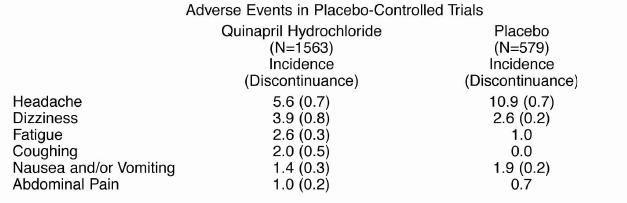
Adverse experiences probably or possibly related to therapy or of unknown relationship to therapyoccurring in 1% or more of the 1563 patients in placebo-controlled hypertension trials who weretreated with quinapril hydrochloride are shown below.
Hypertension
Clinical adverse experiences probably, possibly, or definitely related, or of uncertain relationship totherapy occurring in 0.5% to 1.0% (except as noted) of the patients with hypertension treated withquinapril hydrochloride (With or without concomitant diuretic) in controlled or uncontrolled trials(N=4847) and less frequent, clinically significant events seen in clinical trials or postmarketingexperience (the rarer events are in italics) include (listed by body system):