Although plasma protein binding and absolute bioavailability of metaxalone are not known, the apparent volume of distribution (V/F ~ 800 L) and lipophilicity (log P = 2.42) of metaxalone suggest that the drug is extensively distributed in the tissues. Metaxalone is metabolized by the liver and excreted in the urine as unidentified metabolites. Hepatic Cytochrome P450 enzymes play a role in the metabolism of metaxalone. Specifically, CYP1A2, CYP2D6, CYP2E1, and CYP3A4 and, to a lesser extent, CYP2C8, CYP2C9, and CYP2C19 appear to metabolize metaxalone.
Metaxalone does not significantly inhibit major CYP enzymes such as CYP1A2, CYP2A6, CYP2B6, CYP2C8, CYP2C9, CYP2C19, CYP2D6, CYP2E1, and CYP3A4. Metaxalone does not significantly induce major CYP enzymes such as CYP1A2, CYP2B6, and CYP3A4 in vitro.
Pharmacokinetics in Special Populations
Age:
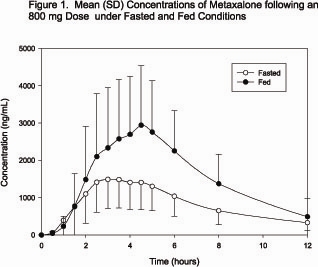
The effects of age on the pharmacokinetics of metaxalone were determined following single administration of two 400 mg tablets (800 mg) under fasted and fed conditions. The results were analyzed separately, as well as in combination with the results from three other studies. Using the combined data, the results indicate that the pharmacokinetics of metaxalone are significantly more affected by age under fasted conditions than under fed conditions, with bioavailability under fasted conditions increasing with age.
The bioavailability of metaxalone under fasted and fed conditions in three groups of healthy volunteers of varying age is shown in Table 2.
| Table 2: Mean (%CV) Pharmacokinetic Parameters Following Single Administration of Two 400 mg Metaxalone Tablets (800 mg) under Fasted and Fed Conditions |
| | Younger Volunteers | Older Volunteers |
| Age (years) | 25.6 ± 8.7 | 39.3 ± 10.8 | 71.5 ± 5.0 |
| N | 59 | 21 | 23 |
| Food | Fasted | Fed | Fasted | Fed | Fasted | Fed |
| Cmax
(ng/mL) | 1,816
(43) | 3,510
(41) | 2,719
(46) | 2,915
(55) | 3,168
(43) | 3,680
(59) |
| Tmax (h) | 3.0
(39) | 4.9
(48) | 3.0
(40) | 8.7
(91) | 2.6
(30) | 6.5
(67) |
| AUC0-t
(ng∙h/mL) | 14,531
(47) | 20,683
(41) | 19,836
(40) | 20,482
(37) | 23,797
(45) | 24,340
(48) |
| AUC∞
(ng∙h/mL) | 15,045
(46) | 20,833
(41) | 20,490
(39) | 20,815
(37) | 24,194
(44) | 24,704
(47) |
Gender:
The effect of gender on the pharmacokinetics of metaxalone was assessed in an open label study, in which 48 healthy adult volunteers (24 males, 24 females) were administered two metaxalone 400 mg tablets (800 mg) under fasted conditions. The bioavailability of metaxalone was significantly higher in females compared to males as evidenced by Cmax (2,115 ng/mL versus 1,335 ng/mL) and AUC∞ (17,884 ng·h/mL versus 10,328 ng·h/mL). The mean half-life was 11.1 hours in females and 7.6 hours in males. The apparent volume of distribution of metaxalone was approximately 22% higher in males than in females, but not significantly different when adjusted for body weight. Similar findings were also seen when the previously described combined dataset was used in the analysis.
Hepatic/Renal Insufficiency:
The impact of hepatic and renal disease on the pharmacokinetics of metaxalone has not been determined. In the absence of such information, metaxalone should be used with caution in patients with hepatic and/or renal impairment.