IMPACT II (Eptifibatide to Minimize Platelet Aggregation and Prevent Coronary Thrombosis II)
IMPACT II was a multicenter, double-blind, randomized, placebo-controlled study conducted in the United States in 4010 patients undergoing PCI. Major exclusion criteria included a history of bleeding diathesis, major surgery within 6 weeks of treatment, gastrointestinal bleeding within 30 days, any stroke or structural CNS abnormality, uncontrolled hypertension, PT >1.2 times control, hematocrit <30%, platelet count <100,000/mm3, and pregnancy.
Patient age ranged from 24 to 89 (mean 60) years, and 75% were male. The patients were 92% Caucasian, 5% Black, and 3% Hispanic. Forty-one percent of the patients underwent PCI for ongoing ACS. Patients were randomly assigned to 1 of 3 treatment regimens, each incorporating a bolus dose initiated immediately prior to PCI followed by a continuous infusion lasting 20 to 24 hours:
1) 135 mcg/kg bolus followed by a continuous infusion of 0.5 mcg/kg/min of eptifibatide (135/0.5);
2) 135 mcg/kg bolus followed by a continuous infusion of 0.75 mcg/kg/min of eptifibatide (135/0.75); or
3) a matching placebo bolus followed by a matching placebo continuous infusion.
Each patient received aspirin and an intravenous heparin bolus of 100 units/kg, with additional bolus infusions of up to 2,000 additional units of heparin every 15 minutes to maintain an ACT of 300 to 350 seconds.
The primary endpoint was the composite of death, MI, or urgent revascularization, analyzed at 30 days after randomization in all patients who received at least 1 dose of study drug.
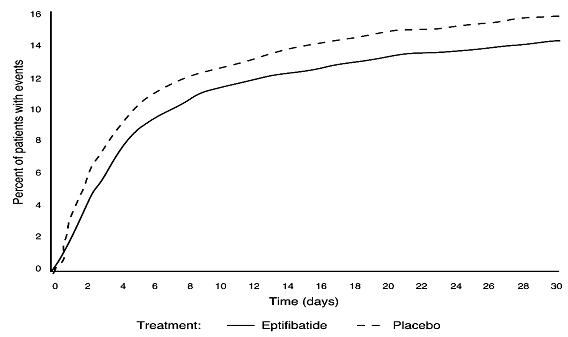
As shown in Table 7, each eptifibatide regimen reduced the rate of death, MI, or urgent intervention, although at 30 days, this finding was statistically significant only in the lower-dose eptifibatide group. As in the PURSUIT study, the effects of eptifibatide were seen early and persisted throughout the 30-day period.
Table 7: Clinical Events in the IMPACT II Study
* Kaplan-Meier estimate of event rate. |
| Placebo
n (%)
| Eptifibatide
(135 mcg/kg bolus
then
0.5 mcg/kg/min infusion)
n (%)
| Eptifibatide
(135 mcg/kg bolus
then
0.75 mcg/kg/min infusion)
n (%)
|
Patients
| 1285
| 1300
| 1286
|
Abrupt Closure
| 65 (5.1%)
| 36 (2.8%)
| 43 (3.3%)
|
p-value versus placebo
|
| 0.003
| 0.03
|
Death, MI, or Urgent Intervention
|
|
|
|
24 hours
| 123 (9.6%)
| 86 (6.6%)
| 89 (6.9%)
|
p-value versus placebo
|
| 0.006
| 0.014
|
48 hours
| 131 (10.2%)
| 99 (7.6%)
| 102 (7.9%)
|
p-value versus placebo
|
| 0.021
| 0.045
|
30 days (primary endpoint)
| 149 (11.6%)
| 118 (9.1%)
| 128 (10%)
|
p-value versus placebo
|
| 0.035
| 0.179
|
Death or MI
|
|
|
|
30 days
| 110 (8.6%)
| 89 (6.8%)
| 95 (7.4%)
|
p-value versus placebo
|
| 0.102
| 0.272
|
6 months
| 151 (11.9%)*
| 136 (10.6%)*
| 130 (10.3%)*
|
p-value versus placebo
|
| 0.297
| 0.182
|
ESPRIT (Enhanced Suppression of the Platelet IIb/IIIa Receptor with Eptifibatide Therapy)
The ESPRIT study was a multicenter, double-blind, randomized, placebo-controlled study conducted in the United States and Canada that enrolled 2064 patients undergoing elective or urgent PCI with intended intracoronary stent placement. Exclusion criteria included MI within the previous 24 hours, ongoing chest pain, administration of any oral antiplatelet or oral anticoagulant other than aspirin within 30 days of PCI (although loading doses of thienopyridine on the day of PCI were encouraged), planned PCI of a saphenous vein graft or subsequent “staged” PCI, prior stent placement in the target lesion, PCI within the previous 90 days, a history of bleeding diathesis, major surgery within 6 weeks of treatment, gastrointestinal bleeding within 30 days, any stroke or structural CNS abnormality, uncontrolled hypertension, PT >1.2 times control, hematocrit <30%, platelet count <100,000/mm3, and pregnancy.
Patient age ranged from 24 to 93 (mean 62) years, and 73% of patients were male. The study enrolled 90% Caucasian, 5% African American, 2% Hispanic, and 1% Asian patients. Patients received a wide variety of stents. Patients were randomized either to placebo or eptifibatide administered as an intravenous bolus of 180 mcg/kg followed immediately by a continuous infusion of 2 mcg/kg/min, and a second bolus of 180 mcg/kg administered 10 minutes later (180/2/180). Eptifibatide infusion was continued for 18 to 24 hours after PCI or until hospital discharge, whichever came first. Each patient received at least 1 dose of aspirin (162 to 325 mg) and 60 units/kg of heparin as a bolus (not to exceed 6,000 units) if not already receiving a heparin infusion. Additional boluses of heparin (10 to 40 units/kg) could be administered in order to reach a target ACT between 200 and 300 seconds.
The primary endpoint of the ESPRIT study was the composite of death, MI, urgent target vessel revascularization (UTVR), and “bailout” to open-label eptifibatide due to a thrombotic complication of PCI (TBO) (e.g., visible thrombus, “no reflow,” or abrupt closure) at 48 hours. MI, UTVR, and TBO were evaluated by a blinded Clinical Events Committee.
As shown in Table 8, the incidence of the primary endpoint and selected secondary endpoints was significantly reduced in patients who received eptifibatide. A treatment benefit in patients who received eptifibatide was seen by 48 hours and at the end of the 30-day observation period.
Table 8: Clinical Events in the ESPRIT Study
| * Eptifibatide was administered as 180 mcg/kg boluses at times 0 and 10 minutes and an infusion at 2 mcg/kg/min. |
| Placebo
(n = 1024)
| Eptifibatide*
(n = 1040)
| Relative Risk
(95% CI)
| p-value
|
Death, MI, UTVR, or Thrombotic “Bailout”
|
48 hours (primary endpoint)
| 108 (10.5%)
| 69 (6.6%)
| 0.629 (0.471, 0.84)
| 0.0015
|
30 days
| 120 (11.7%)
| 78 (7.5%)
| 0.64 (0.488, 0.84)
| 0.0011
|
Death, MI, or UTVR
|
48 hours
| 95 (9.3%)
| 62 (6%)
| 0.643 (0.472, 0.875)
| 0.0045
|
30 days (key secondary endpoint)
| 107 (10.4%)
| 71 (6.8%)
| 0.653 (0.49, 0.871)
| 0.0034
|
Death or MI
|
48 hours
| 94 (9.2%)
| 57 (5.5%)
| 0.597 (0.435, 0.82)
| 0.0013
|
30 days
| 104 (10.2%)
| 66 (6.3%)
| 0.625 (0.465, 0.84)
| 0.0016
|
The need for thrombotic “bailout” was significantly reduced with eptifibatide at 48 hours (2.1% for placebo, 1% for eptifibatide; p = 0.029). Consistent with previous studies of GP IIb/IIIa inhibitors, most of the benefit achieved acutely with eptifibatide was in the reduction of MI. Eptifibatide reduced the occurrence of MI at 48 hours from 9% for placebo to 5.4% (p = 0.0015) and maintained that effect with significance at 30 days.
There was no treatment difference with respect to sex in ESPRIT. Eptifibatide reduced the incidence of the primary endpoint in both men (95% confidence limits for relative risk: 0.54, 1.07) and women (0.24, 0.72) at 48 hours.
Follow-up (12-month) mortality data were available for 2024 patients (1017 on eptifibatide) enrolled in the ESPRIT trial (98.1% of the initial enrollment). Twelve-month clinical event data were available for 1964 patients (988 on eptifibatide), representing 95.2% of the initial enrollment. As shown in Table 9, the treatment effect of eptifibatide seen at 48 hours and 30 days appeared preserved at 6 months and 1 year. Most of the benefit was in reduction of MI.
Table 9: Clinical Events at 6 Months and 1 Year in the ESPRIT Study
| Placebo
(n = 1024)
| Eptifibatide
(n = 1040)
| Hazard Ratio
(95% CI)
|
Death, MI, or Target Vessel Revascularization
|
6 months
| 187 (18.5%)
| 146 (14.3%)
| 0.744 (0.599, 0.924)
|
1 year
| 222 (22.1%)
| 178 (17.5%)
| 0.762 (0.626, 0.929)
|
Death, MI
|
6 months
| 117 (11.5%)
| 77 (7.4%)
| 0.631 (0.473, 0.841)
|
1 year
| 126 (12.4%)
| 83 (8%)
| 0.63 (0.478, 0.832)
|
Percentages are Kaplan-Meier event rates.