A major depressive episode may be the initial presentation of bipolar disorder. It is generally believed (though not established in controlled studies) that treating such an episode with an antidepressant alone may increase the likelihood of precipitation of a mixed/manic episode in patients at risk for bipolar disorder. Whether any of the symptoms described above represent such a conversion is unknown. However, prior to initiating treatment with an antidepressant, patients with depressive symptoms should be adequately screened to determine if they are at risk for bipolar disorder; such screening should include a detailed psychiatric history, including a family history of suicide, bipolar disorder, and depression. It should be noted that TRINTELLIX is not approved for use in treating bipolar depression.
Angle Closure Glaucoma: The pupillary dilation that occurs following use of many antidepressant drugs, including TRINTELLIX, may trigger an angle closure attack in a patient with anatomically narrow angles who does not have a patent iridectomy.
TRINTELLIX was evaluated for safety in 4746 patients (18 years to 88 years of age) diagnosed with MDD who participated in premarketing clinical studies; 2616 of those patients were exposed to TRINTELLIX in 6 to 8 week, placebo-controlled studies at doses ranging from 5 mg to 20 mg once daily and 204 patients were exposed to TRINTELLIX in a 24 to 64 week placebo-controlled maintenance study at doses of 5 mg to 10 mg once daily. Patients from the 6 to 8 week studies continued into 12 month open-label studies. A total of 2586 patients were exposed to at least one dose of TRINTELLIX in open-label studies, 1727 were exposed to TRINTELLIX for six months and 885 were exposed for at least one year.
In pooled 6 to 8 week placebo-controlled studies the incidence of patients who received TRINTELLIX 5 mg/day, 10 mg/day, 15 mg/day and 20 mg/day and discontinued treatment because of an adverse reaction was 5%, 6%, 8% and 8%, respectively, compared to 4% of placebo-treated patients. Nausea was the most common adverse reaction reported as a reason for discontinuation.
The most commonly observed adverse reactions in MDD patients treated with TRINTELLIX in 6 to 8 week placebo-controlled studies (incidence ≥5% and at least twice the rate of placebo) were nausea, constipation and vomiting.
Difficulties in sexual desire, sexual performance and sexual satisfaction often occur as manifestations of psychiatric disorders, but they may also be consequences of pharmacologic treatment. In addition to the data from the MDD studies mentioned below, TRINTELLIX has been prospectively assessed for its effects in MDD patients with existing TESD induced by prior SSRI treatment and in healthy adults with normal sexual function at baseline [see Clinical Studies (14)].
In the MDD 6 to 8 week controlled trials of TRINTELLIX, voluntarily reported adverse reactions related to sexual dysfunction were captured as individual event terms. These event terms have been aggregated and the overall incidence was as follows. In male patients the overall incidence was 3%, 4%, 4%, 5% in TRINTELLIX 5 mg/day, 10 mg/day, 15 mg/day, 20 mg/day, respectively, compared to 2% in placebo. In female patients, the overall incidence was <1%, 1%, <1%, 2% in TRINTELLIX 5 mg/day, 10 mg/day, 15 mg/day, 20 mg/day, respectively, compared to <1% in placebo.
Because voluntarily reported adverse sexual reactions are known to be underreported, in part because patients and physicians may be reluctant to discuss them, the Arizona Sexual Experiences Scale (ASEX), a validated measure designed to identify sexual side effects, was used prospectively in seven placebo-controlled trials. The ASEX scale includes five questions that pertain to the following aspects of sexual function: 1) sex drive, 2) ease of arousal, 3) ability to achieve erection (men) or lubrication (women), 4) ease of reaching orgasm, and 5) orgasm satisfaction.
The presence or absence of sexual dysfunction among patients entering clinical studies was based on their self-reported ASEX scores. For patients without sexual dysfunction at baseline (approximately 1/3 of the population across all treatment groups in each study), Table 3 shows the incidence of patients that developed TESD when treated with TRINTELLIX or placebo in any fixed dose group. Physicians should routinely inquire about possible sexual side effects.
Discontinuation symptoms have been prospectively evaluated in patients taking TRINTELLIX 10 mg/day, 15 mg/day, and 20 mg/day using the Discontinuation-Emergent Signs and Symptoms (DESS) scale in clinical trials. Some patients experienced discontinuation symptoms such as headache, muscle tension, mood swings, sudden outbursts of anger, dizziness, and runny nose in the first week of abrupt discontinuation of TRINTELLIX 15 mg/day and 20 mg/day.
TRINTELLIX has not been associated with any clinically important changes in laboratory test parameters in serum chemistry (except sodium), hematology and urinalysis as measured in the 6 to 8 week placebo-controlled studies. Hyponatremia has been reported with the treatment of TRINTELLIX [see Warnings and Precautions (5.6)]. In the six month, double-blind, placebo-controlled phase of a long-term study in patients who had responded to TRINTELLIX during the initial 12 week, open-label phase, there were no clinically important changes in lab test parameters between TRINTELLIX and placebo-treated patients.
TRINTELLIX had no significant effect on body weight as measured by the mean change from baseline in the 6 to 8 week placebo-controlled studies. In the six month, double-blind, placebo-controlled phase of a long-term study in patients who had responded to TRINTELLIX during the initial 12 week, open-label phase, there was no significant effect on body weight between TRINTELLIX and placebo-treated patients.
TRINTELLIX has not been associated with any clinically significant effects on vital signs, including systolic and diastolic blood pressure and heart rate, as measured in placebo-controlled studies.
The following listing does not include reactions: 1) already listed in previous tables or elsewhere in labeling, 2) for which a drug cause was remote, 3) which were so general as to be uninformative, 4) which were not considered to have significant clinical implications, or 5) which occurred at a rate equal to or less than placebo.
Adverse reactions, some of which are serious or fatal, can develop in patients who use MAOIs or who have recently been discontinued from an MAOI and started on a serotonergic antidepressant(s) or who have recently had SSRI or SNRI therapy discontinued prior to initiation of an MAOI [see Dosage and Administration (2.4), Contraindications (4), Warnings and Precautions (5.2)].
- Based on the mechanism of action of TRINTELLIX and the potential for serotonin toxicity, serotonin syndrome may occur when TRINTELLIX is coadministered with other drugs that may affect the serotonergic neurotransmitter systems (e.g., SSRIs, SNRIs, triptans, buspirone, tramadol, and tryptophan products etc.). Closely monitor symptoms of serotonin syndrome if TRINTELLIX is coadministered with other serotonergic drugs. Treatment with TRINTELLIX and any concomitant serotonergic agents should be discontinued immediately if serotonin syndrome occurs [see Warnings and Precautions (5.2)].
Other CNS Active Agents
No clinically relevant effect was observed on steady-state lithium exposure following coadministration with multiple daily doses of TRINTELLIX. Multiple doses of TRINTELLIX did not affect the pharmacokinetics or pharmacodynamics (composite cognitive score) of diazepam. A clinical study has shown that TRINTELLIX (single dose of 20 or 40 mg) did not increase the impairment of mental and motor skills caused by alcohol (single dose of 0.6 g/kg). Details on the potential pharmacokinetic interactions between TRINTELLIX and bupropion can be found in Section 7.3.
Risk Summary
There are limited human data on TRINTELLIX use during pregnancy to inform any drug-associated risks. However, there are clinical considerations regarding neonates exposed to SSRIs and SNRIs, including TRINTELLIX, during the third trimester of pregnancy [see Clinical Considerations]. Vortioxetine administered to pregnant rats and rabbits during the period of organogenesis at doses ≥15 times and 10 times the maximum recommended human dose (MRHD), respectively, resulted in decreased fetal body weight and delayed ossification. No malformations were seen at doses up to 77 times and 58 times the MRHD, respectively. Vortioxetine administered to pregnant rats during gestation and lactation at oral doses ≥20 times the MRHD resulted in a decrease in the number of live-born pups and an increase in early postnatal pup mortality. Decreased pup weight at birth to weaning occurred at 58 times the MRHD and delayed physical development occurred at ≥20 times the MRHD. These effects were not seen at 5 times the MRHD [see Data]. Advise a pregnant woman of the potential risk to a fetus.
The estimated background risk of major birth defects and miscarriage for the indicated population is unknown. All pregnancies have a background risk of birth defect, loss or other adverse outcomes. In the U.S. general population, the estimated background risk of major birth defects and miscarriage in clinically recognized pregnancies is 2-4% and 15-20%, respectively.
Clinical Considerations
Disease-associated maternal and/or embryo/fetal risk
A prospective, longitudinal study followed 201 pregnant women with a history of major depressive disorder who were euthymic and taking antidepressants at the beginning of pregnancy. The women who discontinued antidepressants during pregnancy were more likely to experience a relapse of major depression than women who continued antidepressants. Consider the risks of untreated depression when discontinuing or changing treatment with antidepressant medication during pregnancy and postpartum.
Fetal/Neonatal adverse reactions
Exposure to serotonergic antidepressants, including TRINTELLIX, in late pregnancy may lead to an increased risk for neonatal complications requiring prolonged hospitalization, respiratory support, and tube feeding, and/or persistent pulmonary hypertension of the newborn (PPHN). Monitor neonates who were exposed to TRINTELLIX in the third trimester of pregnancy for PPHN and drug discontinuation syndrome [see Data].
Data
Human Data
Third Trimester Exposure
Neonates exposed to SSRIs or SNRIs, late in the third trimester have developed complications requiring prolonged hospitalization, respiratory support and tube feeding. These findings are based on postmarketing reports. Such complications can arise immediately upon delivery. Reported clinical findings have included respiratory distress, cyanosis, apnea, seizures, temperature instability, feeding difficulty, vomiting, hypoglycemia, hypotonia, hypertonia, hyperreflexia, tremor, jitteriness, irritability and constant crying. These features are consistent with either a direct toxic effect of SSRIs and SNRIs or possibly, a drug discontinuation syndrome. In some cases, the clinical picture was consistent with serotonin syndrome [see Warnings and Precautions (5.2)].
Exposure during late pregnancy to SSRIs may have an increased risk for persistent pulmonary hypertension of the newborn (PPHN). PPHN occurs in one to two per 1,000 live births in the general population and is associated with substantial neonatal morbidity and mortality. In a retrospective case-control study of 377 women whose infants were born with PPHN and 836 women whose infants were born healthy, the risk for developing PPHN was approximately six fold higher for infants exposed to SSRIs after the 20th week of gestation compared to infants who had not been exposed to antidepressants during pregnancy. A study of 831,324 infants born in Sweden in 1997 - 2005 found a PPHN risk ratio of 2.4 (95% CI 1.2-4.3) associated with patient-reported maternal use of SSRIs "in early pregnancy" and a PPHN risk ratio of 3.6 (95% CI 1.2-8.3) associated with a combination of patient-reported maternal use of SSRIs "in early pregnancy" and an antenatal SSRI prescription "in later pregnancy."
Animal Data
In pregnant rats and rabbits, no malformations were seen when vortioxetine was given during the period of organogenesis at oral doses up to 160 and 60 mg/kg/day, respectively. These doses are 77 and 58 times the maximum recommended human dose (MRHD) of 20 mg on a mg/m2 basis, in rats and rabbits, respectively. Developmental delay, seen as decreased fetal body weight and delayed ossification, occurred in rats and rabbits at doses equal to and greater than 30 and 10 mg/kg (15 and 10 times the MRHD, respectively) in the presence of maternal toxicity (decreased food consumption and decreased body weight gain). When vortioxetine was administered to pregnant rats at oral doses of 40 and 120 mg/kg (20 and 58 times the MRHD, respectively) throughout pregnancy and lactation, the number of live-born pups was decreased and early postnatal pup mortality was increased. Additionally, pup weights were decreased at birth to weaning at 120 mg/kg and development (specifically eye opening) was slightly delayed at 40 and 120 mg/kg. These effects were not seen at 10 mg/kg (5 times the MRHD).
Risk Summary
There is no information regarding the presence of vortioxetine in human milk, the effects on the breastfed infant, or the effects on milk production. Vortioxetine is present in rat milk [see Data]. The developmental and health benefits of breastfeeding should be considered along with the mother's clinical need for TRINTELLIX and any potential adverse effects on the breastfed child from TRINTELLIX or from the underlying maternal condition.
Data
Animal Data
Administration of [14C]-vortioxetine to lactating rats at an oral dose of 20 times the maximum recommended human dose (MRHD) of 20 mg on a mg/m2 basis, resulted in drug-related material in milk secretion. Milk to plasma ratio in lactating rats was 1, 1.2, 0.5, and 0.5 at 2, 6, 24, and 72 hours post dose.
Effect on Cardiac Repolarization
The effect of vortioxetine 10 mg and 40 mg administered once daily on QTc interval was evaluated in a randomized, double-blind, placebo-, and active-controlled (moxifloxacin 400 mg), four-treatment-arm parallel study in 340 male subjects. In the study the upper bound of the one-sided 95% confidence interval for the QTc was below 10 ms, the threshold for regulatory concern. The oral dose of 40 mg is sufficient to assess the effect of metabolic inhibition.
Effect on Driving Performance
In a clinical study in healthy subjects, TRINTELLIX did not impair driving performance, or have adverse psychomotor or cognitive effects following single and multiple doses of 10 mg/day.
Absorption
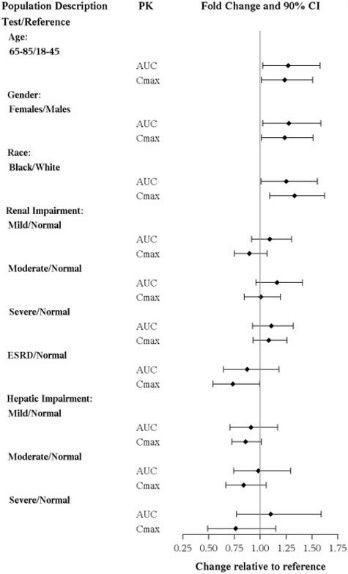
The maximal plasma vortioxetine concentration (Cmax) after dosing is reached within 7 to 11 hours postdose (Tmax). Steady-state mean Cmax values were 9, 18, and 33 ng/mL following doses of 5, 10, and 20 mg/day. Absolute bioavailability is 75%. No effect of food on the pharmacokinetics was observed.
Distribution
The apparent volume of distribution of vortioxetine is approximately 2600 L, indicating extensive extravascular distribution. The plasma protein binding of vortioxetine in humans is 98%, independent of plasma concentrations. No apparent difference in the plasma protein binding between healthy subjects and subjects with hepatic (mild, moderate or severe) or renal (mild, moderate, severe, ESRD) impairment is observed.
Metabolism and Elimination
Vortioxetine is extensively metabolized primarily through oxidation via cytochrome P450 isozymes CYP2D6, CYP3A4/5, CYP2C19, CYP2C9, CYP2A6, CYP2C8 and CYP2B6 and subsequent glucuronic acid conjugation. CYP2D6 is the primary enzyme catalyzing the metabolism of vortioxetine to its major, pharmacologically inactive, carboxylic acid metabolite, and poor metabolizers of CYP2D6 have approximately twice the vortioxetine plasma concentration of extensive metabolizers.
Following a single oral dose of [14C]-labeled vortioxetine, approximately 59% and 26% of the administered radioactivity was recovered in the urine and feces, respectively as metabolites. Negligible amounts of unchanged vortioxetine were excreted in the urine up to 48 hours. The presence of hepatic (mild, moderate or severe) or renal impairment (mild, moderate, severe and ESRD) did not affect the apparent clearance of vortioxetine.
Carcinogenesis
Carcinogenicity studies were conducted in which CD-1 mice and Wistar rats were given oral doses of vortioxetine up to 50 and 100 mg/kg/day for male and female mice, respectively, and 40 and 80 mg/kg/day for male and female rats, respectively, for two years. The doses in the two species were approximately 12, 24, 20, and 39 times, respectively, the maximum recommended human dose (MRHD) of 20 mg on a mg/m2 basis.
In rats, the incidence of benign polypoid adenomas of the rectum was statistically significantly increased in females at doses 39 times the MRHD, but not at 15 times the MRHD. These were considered related to inflammation and hyperplasia and possibly caused by an interaction with a vehicle component of the formulation used for the study. The finding did not occur in male rats at 20 times the MRHD.
In mice, vortioxetine was not carcinogenic in males or females at doses up to 12 and 24 times, respectively, the MRHD.
Mutagenicity
Vortioxetine was not genotoxic in the in vitro bacterial reverse mutation assay (Ames test), an in vitro chromosome aberration assay in cultured human lymphocytes, and an in vivo rat bone marrow micronucleus assay.
Impairment of Fertility
Treatment of rats with vortioxetine at doses up to 120 mg/kg/day had no effect on male or female fertility, which is 58 times the maximum recommended human dose (MRHD) of 20 mg on a mg/m2 basis.
Adults (aged 18 years to 75 years)
The efficacy of TRINTELLIX in patients aged 18 years to 75 years was demonstrated in five, 6 to 8 week, placebo-controlled studies (Studies 1 to 5 in Table 4). In these studies, patients were randomized to TRINTELLIX 5 mg, 10 mg, 15 mg or 20 mg or placebo once daily. For patients who were randomized to TRINTELLIX 15 mg/day or 20 mg/day, the final doses were titrated up from 10 mg/day after the first week.
The primary efficacy measures were the Hamilton Depression Scale (HAMD-24) total score in Study 2 and the Montgomery-Asberg Depression Rating Scale (MADRS) total score in all other studies. In each of these studies, at least one dose group of TRINTELLIX was superior to placebo in improvement of depressive symptoms as measured by mean change from baseline to endpoint visit on the primary efficacy measurement (see Table 4). Subgroup analysis by age, gender or race did not suggest any clear evidence of differential responsiveness. Two studies of the 5 mg dose in the U.S. (not represented in Table 4) failed to show effectiveness.
Elderly Study (aged 64 years to 88 years)
The efficacy of TRINTELLIX for the treatment of MDD was also demonstrated in a randomized, double-blind, placebo-controlled, fixed-dose study of TRINTELLIX in elderly patients (aged 64 years to 88 years) with MDD (Study 6 in Table 4). Patients meeting the diagnostic criteria for recurrent MDD with at least one previous major depressive episode before the age of 60 years and without comorbid cognitive impairment (Mini Mental State Examination score <24) received TRINTELLIX 5 mg or placebo.
Table 4. Primary Efficacy Results of 6 Week to 8 Week Clinical TrialsStudy No.
[Primary Measure] | Treatment Group | Number of Patients | Mean Baseline Score (SD) | LS Mean Change from Baseline (SE) | Placebo-subtracted Difference Difference (drug minus placebo) in least-squares mean change from baseline. (95% CI) |
|---|
| SD: standard deviation; SE: standard error; LS Mean: least-squares mean; CI: unadjusted confidence interval. |
Study 1
[MADRS]
Non-US Study | TRINTELLIX (5 mg/day) | 108 | 34.1 (2.6) | -20.4 (1.0) | -5.9 (-8.6, -3.2) |
TRINTELLIX (10 mg/day) | 100 | 34.0 (2.8) | -20.2 (1.0) | -5.7 (-8.5, -2.9) |
Placebo | 105 | 33.9 (2.7) | -14.5 (1.0) | -- |
Study 2
[HAMD-24]
Non-US Study | TRINTELLIX (5 mg/day) | 139 | 32.2 (5.0) | -15.4 (0.7) | -4.1 (-6.2, -2.1) |
TRINTELLIX (10 mg/day) | 139 | 33.1 (4.8) | -16.2 (0.8) | -4.9 (-7.0, -2.9) |
Placebo | 139 | 32.7 (4.4) | -11.3 (0.7) | -- |
Study 3
[MADRS]
Non-US Study | TRINTELLIX (15 mg/day) | 149 | 31.8 (3.4) | -17.2 (0.8) | -5.5 (-7.7, -3.4) |
TRINTELLIX (20 mg/day) | 151 | 31.2 (3.4) | -18.8 (0.8) | -7.1 (-9.2, -5.0) |
Placebo | 158 | 31.5 (3.6) | -11.7 (0.8) | -- |
Study 4
[MADRS]
US Study | TRINTELLIX (15 mg/day) | 145 | 31.9 (4.1) | -14.3 (0.9) | -1.5 (-3.9, 0.9) |
TRINTELLIX (20 mg/day) | 147 | 32.0 (4.4) | -15.6 (0.9) | -2.8 (-5.1, -0.4) |
Placebo | 153 | 31.5 (4.2) | -12.8 (0.8) | -- |
Study 5
[MADRS]
US Study | TRINTELLIX (10 mg/day) | 154 | 32.2 (4.5) | -13.0 (0.8) | -2.2 (-4.5, 0.1) |
TRINTELLIX (20 mg/day) | 148 | 32.5 (4.3) | -14.4 (0.9) | -3.6 (-5.9, -1.4) |
Placebo | 155 | 32.0 (4.0) | -10.8 (0.8) | -- |
Study 6 (elderly)
[HAMD-24]
US and Non-US | TRINTELLIX (5 mg/day) | 155 | 29.2 (5.0) | -13.7 (0.7) | -3.3 (-5.3, -1.3) |
Placebo | 145 | 29.4 (5.1) | -10.3 (0.8) | -- |
TRINTELLIX was superior to placebo on the Clinical Global Impression of Improvement (CGI-I) scale, which is a clinician's impression of how much the patient's clinical condition has improved or worsened relative to baseline on a scale of 1 (very much improved) to 7 (very much worse).
Time Course of Treatment Response
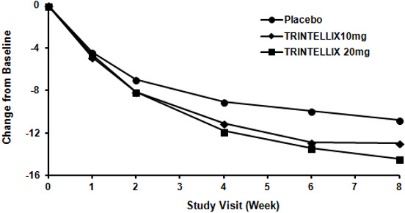
In the 6 to 8 week placebo-controlled studies, an effect of TRINTELLIX based on the primary efficacy measure was generally observed starting at Week 2 and increased in subsequent weeks with the full antidepressant effect of TRINTELLIX generally not seen until Study Week 4 or later. Figure 4 depicts time course of response in U.S. based on the primary efficacy measure (MADRS) in Study 5.
Figure 4. Change from Baseline in MADRS Total Score by Study Visit (Week) in Study 5
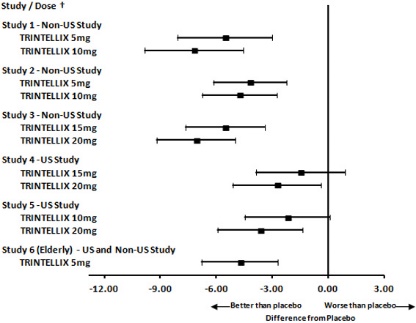
Figure 5. Difference from Placebo in Mean Change from Baseline in MADRS Total Score at Week 6 or Week 8
†Results (point estimate and unadjusted 95% confidence interval) are from mixed model for repeated measures (MMRM) analysis. In Studies 1 and 6, the primary analysis was not based on MMRM and in Studies 2 and 6 the primary efficacy measure was not based on MADRS.
Digit Symbol Substitution Test in Major Depressive Disorder
Two, eight week, randomized, double-blind, placebo-controlled studies were conducted to evaluate the effect of TRINTELLIX on the Digit Symbol Substitution Test (DSST) during the treatment of acute MDD. The DSST is a neuropsychological test that most specifically measures processing speed, an aspect of cognitive function that may be impaired in MDD. Patients are asked to match nine symbols with their corresponding number (1 to 9) according to a key; the score is the correct number of matches achieved in 90 seconds. For reference, the mean score for healthy 45 to 54 year-old subjects is 50 (SD=15).
- Study 7 randomized adult patients meeting the diagnostic criteria for recurrent MDD to receive TRINTELLIX 10 mg, TRINTELLIX 20 mg, or placebo once daily. Study 8 randomized adult patients meeting the diagnostic criteria for recurrent MDD and reporting subjective difficulty concentrating or slow thinking to receive a flexible dose of TRINTELLIX (10 or 20 mg) or placebo once daily. Neither study included patients whose MDD was in remission yet who continued to experience difficulty concentrating or slow thinking. Patients' mean age was 46 (SD=12) and 45 (SD=12) in Study 7 and 8, respectively. In both studies, patients in the TRINTELLIX group had a statistically significantly greater improvement in number of correct responses on the DSST (Table 5); depressed mood as assessed by change from baseline in MADRS total score also improved in both studies.
Table 5. Effect of TRINTELLIX on the Digit Symbol Substitution Test (DSST)| Study No. | Treatment Group | Number of Patients | Mean Baseline Score (SD) | LS Mean Change from Baseline (SE) | Placebo-subtracted Difference
Difference (drug minus placebo) in least-squares mean change from baseline. (95% CI) |
|---|
| SD: standard deviation; SE: standard error; LS Mean: least-squares mean; CI: unadjusted confidence interval. |
Study 7 | TRINTELLIX
(10 mg/day) Doses are statistically significantly superior to placebo. | 193 | 42.0 (12.6) | 9.0 (0.6) | 4.2 (2.5, 5.9) |
TRINTELLIX
(20 mg/day) | 204 | 41.6 (12.7) | 9.1 (0.6) | 4.3 (2.6, 5.9) |
Placebo | 194 | 42.4 (13.8) | 4.8 (0.6) | -- |
Study 8 | TRINTELLIX
(10/20 mg/day) | 175 | 42.1 (11.9) | 4.6 (0.5) | 1.8 (0.3, 3.2) |
Placebo | 167 | 43.0 (12.3) | 2.9 (0.5) | -- |
Maintenance Study
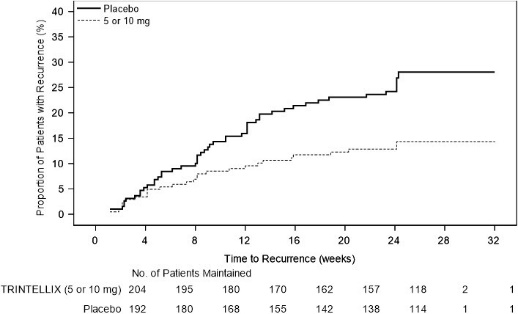
In a non-US maintenance study (Study 9 in Figure 6), 639 patients meeting DSM-IV-TR criteria for MDD received flexible doses of TRINTELLIX (5 mg or 10 mg) once daily during an initial 12 week open-label treatment phase; the dose of TRINTELLIX was fixed during Weeks 8 to 12. Three hundred ninety six (396) patients who were in remission (MADRS total score ≤10 at both Weeks 10 and 12) after open-label treatment were randomly assigned to continuation of a fixed dose of TRINTELLIX at the final dose they responded to (about 75% of patients were on 10 mg/day) during the open-label phase or to placebo for 24 to 64 weeks. Approximately 61% of randomized patients satisfied remission criterion (MADRS total score ≤10) for at least four weeks (since Week 8), and 15% for at least eight weeks (since Week 4). Patients on TRINTELLIX experienced a statistically significantly longer time to have recurrence of depressive episodes than did patients on placebo. Recurrence of depressive episode was defined as a MADRS total score ≥22 or lack of efficacy as judged by the investigator.
Figure 6. Kaplan-Meier Estimates of Proportion of Patients with Recurrence (Study 9)
Prospective Evaluation of Treatment Emergent Sexual Dysfunction (TESD)
Two, randomized, double-blind, active-controlled studies were conducted to prospectively compare the incidence of TESD between TRINTELLIX and SSRIs via a validated self-rated measure of sexual function, the Changes in Sexual Functioning Questionnaire Short Form (CSFQ-14). The CSFQ-14 is designed to measure illness- and medication-related changes in sexual functioning that consists of 14 items measuring sexual functioning as a total score. The CSFQ-14 consists of subscales that assess the three phases of the sexual response cycle (desire, arousal, and orgasm). Higher scores on the CSFQ-14 indicate greater sexual function and for reference, a 2-3 point change is considered clinically meaningful.
Effect of Switching from SSRI to TRINTELLIX on TESD
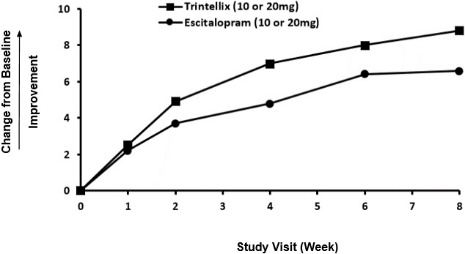
The effect of TRINTELLIX on TESD induced by prior SSRI treatment in MDD patients whose depressive symptoms were adequately treated was evaluated in an eight-week, randomized, double-blind, active-controlled (escitalopram), flexible-dose study (Study 10). Patients taking citalopram, sertraline, or paroxetine for at least eight weeks duration and who were experiencing sexual dysfunction attributed to their SSRI treatment were switched to TRINTELLIX (n=217) or escitalopram (n=207). For both TRINTELLIX and escitalopram, patients were started on 10 mg, increased to 20 mg at Week 1, followed by flexible dosing. The majority of subjects received the 20 mg dose of TRINTELLIX (65.6%) or the 20 mg dose of escitalopram (71.9%) during the study.
Improvement in TESD induced by prior SSRI treatment in subjects switched to TRINTELLIX was superior to the improvement observed in those subjects who switched to escitalopram (2.2 point improvement vs escitalopram on the change from Baseline in CSFQ-14 total score, with 95% confidence interval 0.48 – 4.02), after eight weeks of treatment, while both drugs maintained the subjects' prior antidepressant response. For change from Baseline in CSFQ-14, see Figure 7.
Figure 7. Change from Baseline in CSFQ-14 Total Score by Study Visit (Week) in Study 10
Effects in Healthy Volunteers with Normal Sexual Functioning at Baseline
In a randomized Healthy Volunteer study (Study 11) with 348 subjects aged 18 years to 40 years with normal sexual functioning without the confounding effect of depression, TESD with TRINTELLIX 10 mg (n=85), but not with TRINTELLIX 20 mg (n=91), was statistically significantly less than with paroxetine 20 mg (n=83) [see Adverse Reactions (6.1)]. Paroxetine 20 mg was statistically significantly worse than placebo (n=89), confirming assay sensitivity in this study. For change from Baseline in CSFQ-14, see Figure 8.
Figure 8. Change from Baseline in CSFQ-14 Total Score by Study Visit (Week) in Healthy Volunteers (Study 11)
Suicide Risk
Advise patients and caregivers to look for the emergence of suicidal ideation and behavior, especially early during treatment and when the dose is adjusted up or down [see Boxed Warning, Warnings and Precautions (5.1)].
Discontinuation of Treatment
Patients who are on TRINTELLIX 15 mg/day or 20 mg/day may experience headache, muscle tension, mood swings, sudden outburst of anger, dizziness and runny nose if they abruptly stop their medicine. Advise patients not stopping TRINTELLIX without talking to their healthcare provider [see Adverse Reactions (6)].
Concomitant Medication
Advise patients to inform their physicians if they are taking, or plan to take, any prescription or over-the-counter medications because of a potential for interactions. Instruct patients not to take TRINTELLIX with an MAOI or within 14 days of stopping an MAOI and to allow 21 days after stopping TRINTELLIX before starting an MAOI [see Dosage and Administration (2.4), Contraindications (4), Warnings and Precautions (5.2), Drug Interactions (7.1)].
Serotonin Syndrome
Caution patients about the risk of serotonin syndrome, particularly with the concomitant use of TRINTELLIX and triptans, tricyclic antidepressants, fentanyl, lithium, tramadol, tryptophan supplements, and St. John's Wort supplements [see Warnings and Precautions (5.2), Drug Interactions (7.1, 7.2)].
Abnormal Bleeding
Caution patients about the increased risk of abnormal bleeding when TRINTELLIX is given with NSAIDs, aspirin, warfarin, or other drugs that affect coagulation [see Warnings and Precautions (5.3)].
Activation of Mania/Hypomania
Advise patients and their caregivers to look for signs of activation of mania/hypomania [see Warnings and Precautions (5.4)].
Angle Closure Glaucoma
Patients should be advised that taking TRINTELLIX can cause mild pupillary dilation, which in susceptible individuals, can lead to an episode of angle closure glaucoma. Pre-existing glaucoma is almost always open-angle glaucoma because angle closure glaucoma, when diagnosed, can be treated definitively with iridectomy. Open-angle glaucoma is not a risk factor for angle closure glaucoma. Patients may wish to be examined to determine whether they are susceptible to angle closure, and have a prophylactic procedure (e.g., iridectomy), if they are susceptible [see Warnings and Precautions (5.5)].
Hyponatremia
Advise patients that if they are treated with diuretics, or are otherwise volume depleted, or are elderly, they may be at greater risk of developing hyponatremia while taking TRINTELLIX [see Warnings and Precautions (5.6)].
Nausea
Advise patients that nausea is the most common adverse reaction, and is dose related. Nausea commonly occurs within the first week of treatment, then decreases in frequency but can persist in some patients.
Alcohol
A clinical study has shown that TRINTELLIX (single dose of 20 or 40 mg/day) did not increase the impairment of mental and motor skills caused by alcohol.
Allergic Reactions
Advise patients to notify their healthcare provider if they develop an allergic reaction such as rash, hives, swelling, or difficulty breathing.
Pregnancy
Advise a pregnant woman or a woman planning to become pregnant that TRINTELLIX may cause withdrawal symptoms in the newborn or persistent pulmonary hypertension of the newborn (PPHN) [see Use in Specific Populations (8.1)].
Distributed and marketed by:
Takeda Pharmaceuticals America, Inc.
Deerfield, IL 60015
Marketed by:
Lundbeck
Deerfield, IL 60015
Distributed by:
Cardinal Health
Dublin, OH 43017
L72740721
L72750721
TRINTELLIX is a trademark of H. Lundbeck A/S registered with the U.S. Patent and Trademark Office and used under license by Takeda Pharmaceuticals America, Inc.
©2013-2019 Takeda Pharmaceuticals America, Inc.
LUN205 R19