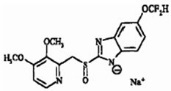
Recommended Dosage
The recommended adult dose is 40 mg pantoprazole given once daily by intravenous infusion for 7 to 10 days.
Treatment with PROTONIX® I.V. (pantoprazole sodium) for Injection should be discontinued as soon as the patient is able to receive treatment with PROTONIX Delayed-Release Tablets or Oral Suspension.
Administration and Preparation Instructions
Data on the safe and effective dosing for conditions other than those described [see Indications and Usage (1)] such as life-threatening upper gastrointestinal bleeds, are not available. PROTONIX I.V. 40 mg once daily does not raise gastric pH to levels sufficient to contribute to the treatment of such life-threatening conditions.
Fifteen Minute Infusion
PROTONIX I.V. for Injection should be reconstituted with 10 mL of 0.9% Sodium Chloride Injection, USP, and further diluted (admixed) with 100 mL of 5% Dextrose Injection, USP, 0.9% Sodium Chloride Injection, USP, or Lactated Ringer's Injection, USP, to a final concentration of approximately 0.4 mg/mL. The reconstituted solution may be stored for up to 6 hours at room temperature prior to further dilution. The admixed solution may be stored at room temperature and must be used within 24 hours from the time of initial reconstitution. Both the reconstituted solution and the admixed solution do not need to be protected from light.
PROTONIX I.V. for Injection admixtures should be administered intravenously over a period of approximately 15 minutes at a rate of approximately 7 mL/min.
Two Minute Infusion
PROTONIX I.V. for Injection should be reconstituted with 10 mL of 0.9% Sodium Chloride Injection, USP, to a final concentration of approximately 4 mg/mL. The reconstituted solution may be stored for up to 24 hours at room temperature prior to intravenous infusion and does not need to be protected from light. PROTONIX I.V. for Injection should be administered intravenously over a period of at least 2 minutes.
Recommended Dosage
The dosage of PROTONIX I.V. for Injection in patients with pathological hypersecretory conditions including Zollinger-Ellison Syndrome varies with individual patients. The recommended adult dosage is 80 mg intravenously every 12 hours. The frequency of dosing can be adjusted to individual patient needs based on acid output measurements. In those patients who need a higher dosage, 80 mg intravenously every 8 hours is expected to maintain acid output below 10 mEq/h. Daily doses higher than 240 mg or administered for more than 6 days have not been studied [see Clinical Studies (14)]. Transition from oral to intravenous and from intravenous to oral formulations of gastric acid inhibitors should be performed in such a manner to ensure continuity of effect of suppression of acid secretion. Patients with Zollinger-Ellison Syndrome may be vulnerable to serious clinical complications of increased acid production even after a short period of loss of effective inhibition.
Administration and Preparation Instructions
Fifteen Minute Infusion
Each vial of PROTONIX I.V. for Injection should be reconstituted with 10 mL of 0.9% Sodium Chloride Injection, USP. The contents of the two vials should be combined and further diluted (admixed) with 80 mL of 5% Dextrose Injection, USP, 0.9% Sodium Chloride Injection, USP, or Lactated Ringer's Injection, USP, to a total volume of 100 mL with a final concentration of approximately 0.8 mg/mL. The reconstituted solution may be stored for up to 6 hours at room temperature prior to further dilution. The admixed solution may be stored at room temperature and must be used within 24 hours from the time of initial reconstitution. Both the reconstituted solution and the admixed solution do not need to be protected from light.
PROTONIX I.V. for Injection should be administered intravenously over a period of approximately 15 minutes at a rate of approximately 7 mL/min.
Two minute Infusion
PROTONIX I.V. for Injection should be reconstituted with 10 mL of 0.9% Sodium Chloride Injection, USP, per vial to a final concentration of approximately 4 mg/mL. The reconstituted solution may be stored for up to 24 hours at room temperature prior to intravenous infusion and does not need to be protected from light. The total volume from both vials should be administered intravenously over a period of at least 2 minutes.
Gastroesophageal Reflux Disease (GERD)
Safety in nine randomized comparative US clinical trials in patients with GERD included 1,473 patients on oral pantoprazole (20 mg or 40 mg), 299 patients on an H2-receptor antagonist, 46 patients on another proton pump inhibitor, and 82 patients on placebo. The most frequently occurring adverse reactions are listed in Table 1.
The number of patients treated in comparative studies with I.V. pantoprazole is limited; however, the adverse reactions seen were similar to those seen in the oral studies. Thrombophlebitis was the only new adverse reaction identified with I.V. pantoprazole.
Table 1: Adverse Reactions Reported in Clinical Trials of Adult Patients with GERD at a Frequency of > 2% | PROTONIX
(n=1473)
% | Comparators
(n=345)
% | Placebo
(n=82)
% |
|---|
Headache | 12.2 | 12.8 | 8.5 |
Diarrhea | 8.8 | 9.6 | 4.9 |
Nausea | 7.0 | 5.2 | 9.8 |
Abdominal pain | 6.2 | 4.1 | 6.1 |
Vomiting | 4.3 | 3.5 | 2.4 |
Flatulence | 3.9 | 2.9 | 3.7 |
Dizziness | 3.0 | 2.9 | 1.2 |
Arthralgia | 2.8 | 1.4 | 1.2 |
Additional adverse reactions that were reported for PROTONIX in US clinical trials with a frequency of ≤ 2% are listed below by body system:
Body as a Whole: allergic reaction, fever, photosensitivity reaction, facial edema, thrombophlebitis (I.V. only)
Gastrointestinal: constipation, dry mouth, hepatitis
Hematologic: leukopenia (reported in ex-US clinical trials only), thrombocytopenia
Metabolic/Nutritional: elevated CPK (creatine phosphokinase), generalized edema, elevated triglycerides, liver function tests abnormal
Musculoskeletal: myalgia
Nervous: depression, vertigo
Skin and Appendages: urticaria, rash, pruritus
Special Senses: blurred vision
Zollinger-Ellison Syndrome
In clinical studies of Zollinger-Ellison Syndrome, adverse reactions reported in 35 patients taking PROTONIX 80 mg/day to 240 mg/day for up to 2 years were similar to those reported in adult patients with GERD.
Pregnancy Category B
Reproduction studies have been performed in rats at intravenous doses up to 20 mg/kg/day (4 times the recommended human dose based on body surface area) and rabbits at intravenous doses up to 15 mg/kg/day (6 times the recommended human dose based on body surface area) and have revealed no evidence of impaired fertility or harm to the fetus due to pantoprazole. There are, however, no adequate and well-controlled studies in pregnant women. Because animal reproduction studies are not always predictive of human response, this drug should be used during pregnancy only if clearly needed [see Nonclinical Toxicology (13.2)].
Antisecretory Activity
The magnitude and time course for inhibition of pentagastrin-stimulated acid output (PSAO) by single doses (20 to 120 mg) of PROTONIX I.V. for Injection were assessed in a single-dose, open-label, placebo-controlled, dose-response study. The results of this study are shown in Table 2. Healthy subjects received a continuous infusion for 25 hours of pentagastrin (PG) at 1 mcg/kg/h, a dose known to produce submaximal gastric acid secretion. The placebo group showed a sustained, continuous acid output for 25 hours, validating the reliability of the testing model. PROTONIX I.V. for Injection had an onset of antisecretory activity within 15 to 30 minutes of administration. Doses of 20 to 80 mg of PROTONIX I.V. for Injection substantially reduced the 24-hour cumulative PSAO in a dose-dependent manner, despite a short plasma elimination half-life. Complete suppression of PSAO was achieved with 80 mg within approximately 2 hours and no further significant suppression was seen with 120 mg. The duration of action of PROTONIX I.V. for Injection was 24 hours.
Table 2: Gastric Acid Output (mEq/hr, Mean ± SD) and Percent InhibitionCompared to individual subject baseline prior to treatment with PROTONIX I.V. for Injection. NA = not applicable.
(Mean ± SD) of Pentagastrin-Stimulated Acid Output Over 24 Hours Following a Single Dose of PROTONIX I.V. for InjectionInhibition of gastric acid output and the percent inhibition of stimulated acid output in response to PROTONIX I.V. for Injection may be higher after repeated doses.
in Healthy Subjects | ------2 hours------ | ------4 hours------ | ------12 hours------ | ------24 hours------ |
|---|
| Treatment Dose | Acid Output | % Inhibition | Acid Output | % Inhibition | Acid Output | % Inhibition | Acid Output | % Inhibition |
|---|
0 mg
(Placebo, n=4) | 39 ± 21 | NA | 26 ± 14 | NA | 32 ± 20 | NA | 38 ± 24 | NA |
20 mg
(n=4–6) | 13 ± 18 | 47 ± 27 | 6 ± 8 | 83 ± 21 | 20 ± 20 | 54 ± 44 | 30 ± 23 | 45 ± 43 |
40 mg
(n=8) | 5 ± 5 | 82 ± 11 | 4 ± 4 | 90 ± 11 | 11 ± 10 | 81 ± 13 | 16 ± 12 | 52 ± 36 |
80 mg
(n=8) | 0.1 ± 0.2 | 96 ± 6 | 0.3 ± 0.4 | 99 ± 1 | 2 ± 2 | 90 ± 7 | 7 ± 4 | 63 ± 18 |
In one study of gastric pH in healthy subjects, pantoprazole was administered orally (40 mg enteric coated tablets) or intravenously (40 mg) once daily for 5 days and pH was measured for 24 hours following the fifth dose. The outcome measure was median percent of time that pH was ≥ 4 and the results were similar for intravenous and oral medications; however, the clinical significance of this parameter is unknown.
Serum Gastrin Effects
Serum gastrin concentrations were assessed in two placebo-controlled studies.
In a 5-day study of oral pantoprazole with 40 and 60 mg doses in healthy subjects, following the last dose on day 5, median 24-hour serum gastrin concentrations were elevated by 3–4 fold compared to placebo in both 40 and 60 mg dose groups. However, by 24 hours following the last dose, median serum gastrin concentrations for both groups returned to normal levels.
In another placebo-controlled, 7-day study of 40 mg intravenous or oral pantoprazole in patients with GERD and a history of erosive esophagitis, the mean serum gastrin concentration increased approximately 50% from baseline and as compared with placebo, but remained within the normal range.
During 6 days of repeated administration of PROTONIX I.V. for Injection in patients with Zollinger-Ellison Syndrome, consistent changes of serum gastrin concentrations from baseline were not observed.
Enterochromaffin-Like (ECL) Cell Effects
There are no data available on the effects of intravenous pantoprazole on ECL cells.
In a nonclinical study in Sprague-Dawley rats, lifetime exposure (24 months) to pantoprazole at doses of 0.5 to 200 mg/kg/day resulted in dose-related increases in gastric ECL-cell proliferation and gastric neuroendocrine (NE)-cell tumors. Gastric NE-cell tumors in rats may result from chronic elevation of serum gastrin concentrations. The high density of ECL cells in the rat stomach makes this species highly susceptible to the proliferative effects of elevated gastrin concentrations produced by proton pump inhibitors. However, there were no observed elevations in serum gastrin following the administration of pantoprazole at a dose of 0.5 mg/kg/day. In a separate study, a gastric NE-cell tumor without concomitant ECL-cell proliferative changes was observed in 1 female rat following 12 months of dosing with pantoprazole at 5 mg/kg/day and a 9 month off-dose recovery [see Nonclinical Toxicology (13.1)].
Distribution
The apparent volume of distribution of pantoprazole is approximately 11.0–23.6 L, distributing mainly in extracellular fluid. The serum protein binding of pantoprazole is about 98%, primarily to albumin.
Metabolism
Pantoprazole is extensively metabolized in the liver through the cytochrome P450 (CYP) system. Pantoprazole metabolism is independent of the route of administration (intravenous or oral). The main metabolic pathway is demethylation, by CYP2C19, with subsequent sulfation; other metabolic pathways include oxidation by CYP3A4. There is no evidence that any of the pantoprazole metabolites have significant pharmacologic activity. CYP2C19 displays a known genetic polymorphism due to its deficiency in some sub-populations (e.g., 3% of Caucasians and African-Americans and 17–23% of Asians). Although these sub-populations of slow pantoprazole metabolizers have elimination half-life values from 3.5 to 10.0 hours, they still have minimal accumulation (≤ 23%) with once daily dosing.
Excretion
After administration of a single intravenous dose of 14C-labeled pantoprazole to healthy, extensive CYP2C19 metabolizers, approximately 71% of the dose was excreted in the urine with 18% excreted in the feces through biliary excretion. There was no renal excretion of unchanged pantoprazole.
Geriatric
After repeated I.V. administration in elderly subjects (65 to 76 years of age), pantoprazole AUC and elimination half-life values were similar to those observed in younger subjects. No dosage adjustment is recommended for elderly patients.
Gender
After oral administration there is a modest increase in pantoprazole AUC and Cmax in women compared to men. However, weight-normalized clearance values are similar in women and men. No dosage adjustment is warranted based on gender.
Renal Impairment
In patients with severe renal impairment, pharmacokinetic parameters for pantoprazole were similar to those of healthy subjects. No dosage adjustment is necessary in patients with renal impairment or in patients undergoing hemodialysis.
Hepatic Impairment
In patients with mild to severe hepatic impairment (Child-Pugh A to C cirrhosis), maximum pantoprazole concentrations increased only slightly (1.5-fold) relative to healthy subjects when pantoprazole was administered orally. Although serum half-life values increased to 7–9 hours and AUC values increased by 5- to 7-fold in hepatic-impaired patients, these increases were no greater than those observed in CYP2C19 poor metabolizers, where no dosage adjustment is warranted. These pharmacokinetic changes in hepatic-impaired patients result in minimal drug accumulation following once-daily, multiple-dose administration. No dosage adjustment is needed in patients with mild to severe hepatic impairment. Doses higher than 40 mg/day have not been studied in hepatically impaired patients.
Drug-Drug Interactions
Pantoprazole is metabolized mainly by CYP2C19 and to minor extents by CYPs 3A4, 2D6 and 2C9. In in vivo drug-drug interaction studies with CYP2C19 substrates (diazepam [also a CYP3A4 substrate] and phenytoin [also a CYP3A4 inducer]), nifedipine, midazolam, and clarithromycin (CYP3A4 substrates), metoprolol (a CYP2D6 substrate), diclofenac, naproxen and piroxicam (CYP2C9 substrates) and theophylline (a CYP1A2 substrate) in healthy subjects, the pharmacokinetics of pantoprazole were not significantly altered.
Clopidogrel: Clopidogrel is metabolized to its active metabolite in part by CYP2C19. In a crossover clinical study, 66 healthy subjects were administered clopidogrel (300 mg loading dose followed by 75 mg per day) alone and with pantoprazole (80 mg at the same time as clopidogrel) for 5 days. On Day 5, the mean AUC of the active metabolite of clopidogrel was reduced by approximately 14% (geometric mean ratio was 86%, with 90% CI of 79 to 93%) when pantoprazole was coadministered with clopidogrel as compared to clopidogrel administered alone. Pharmacodynamic parameters were also measured and demonstrated that the change in inhibition of platelet aggregation (induced by 5 µM ADP) was correlated with the change in the exposure to clopidogrel active metabolite. The clinical significance of this finding is not clear.
Mycophenolate Mofetil (MMF): Administration of pantoprazole 40 mg twice daily for 4 days and a single 1000 mg dose of MMF approximately one hour after the last dose of pantoprazole to 12 healthy subjects in a cross-over study resulted in a 57% reduction in the Cmax and 27% reduction in the AUC of MPA. Transplant patients receiving approximately 2000 mg per day of MMF (n=12) were compared to transplant patients receiving approximately the same dose of MMF and pantoprazole 40 mg per day (n=21). There was a 78% reduction in the Cmax and a 45% reduction in the AUC of MPA in patients receiving both pantoprazole and MMF.
In vivo studies also suggest that pantoprazole does not significantly affect the kinetics of other drugs (cisapride, theophylline, diazepam [and its active metabolite, desmethyldiazepam], phenytoin, warfarin, metoprolol, nifedipine, carbamazepine, midazolam, clarithromycin, naproxen, piroxicam and oral contraceptives [levonorgestrel/ethinyl estradiol]). Dosage adjustment of such drugs is not necessary when they are co-administered with pantoprazole. In other in vivo studies, digoxin, ethanol, glyburide, antipyrine, caffeine, metronidazole, and amoxicillin had no clinically relevant interactions with pantoprazole.
Based on studies evaluating possible interactions of pantoprazole with other drugs, no dosage adjustment is needed with concomitant use of the following: theophylline, cisapride, antipyrine, caffeine, carbamazepine, diazepam (and its active metabolite, desmethyldiazepam), diclofenac, naproxen, piroxicam, digoxin, ethanol, glyburide, an oral contraceptive (levonorgestrel/ethinyl estradiol), metoprolol, nifedipine, phenytoin, warfarin, midazolam, clarithromycin, metronidazole, or amoxicillin.
There was also no interaction with concomitantly administered antacids.
There have been postmarketing reports of increased INR and prothrombin time in patients receiving proton pump inhibitors, including PROTONIX, and warfarin concomitantly [see Drug Interactions (7.2)].
Although no significant drug-drug interactions have been observed in clinical studies, the potential for significant drug-drug interactions with more than once daily dosing with high doses of pantoprazole has not been studied in poor metabolizers or individuals who are hepatically impaired.
Other Effects
In a clinical pharmacology study, pantoprazole 40 mg given orally once daily for 2 weeks had no effect on the levels of the following hormones: cortisol, testosterone, triiodothyronine (T3), thyroxine (T4), thyroid-stimulating hormone, thyronine-binding protein, parathyroid hormone, insulin, glucagon, renin, aldosterone, follicle-stimulating hormone, luteinizing hormone, prolactin and growth hormone.
Reproductive Toxicology Studies
Reproduction studies have been performed in rats at oral doses up to 450 mg/kg/day (88 times the recommended human dose based on body surface area) and rabbits at oral doses up to 40 mg/kg/day (16 times the recommended human dose based on body surface area) and have revealed no evidence of impaired fertility or harm to the fetus due to pantoprazole.
Pfizer Injectables
Distributed by
Wyeth Pharmaceuticals Inc
A subsidiary of Pfizer Inc
Philadelphia, PA 19101
under license from
Takeda GmbH
D78467 Konstanz, Germany
Repackaged By:
Cardinal Health
Zanesville, OH 43701
L3804846F1014
LAB-0462-13.0