Other
Cold Agglutinin Disease
ENJAYMO (sutimlimab-jome) is indicated for the treatment of hemolysis in adults with cold agglutinin disease (CAD).
Undiluted preparation of ENJAYMO
Use aseptic technique to prepare ENJAYMO as follows:
- Remove ENJAYMO from the refrigerator. To minimize foaming, do not shake ENJAYMO.
- Inspect vials visually for particulate matter and discoloration prior to administration. ENJAYMO solution is a clear to slightly opalescent and colorless to slightly yellow liquid. Do not administer if discolored or if other foreign particulate matter is present.
- Withdraw the calculated volume of ENJAYMO from the appropriate number of vials based on the recommended dosage (see Table 1) and add to an empty infusion bag.
- Prior to administration, allow the infusion solution to adjust to room temperature (59°F to 77°F (15°C to 25°C). Refer to Table 1 for infusion rate. The infusion should be administered over 1 hour. Administer ENJAYMO infusion solution only through a 0.2 micron in-line filter with a polyethersulfone (PES) membrane.
- The infusion catheter and tubing should be primed with the dosing solution immediately before infusion and flushed immediately following completion of the infusion with a sufficient quantity (approximately 20 mL) of sterile 0.9% Sodium Chloride Injection, USP.
- If the ENJAYMO infusion solution is not used immediately, store refrigerated at 36°F to 46°F (2°C to 8°C).
- Once removed from refrigeration, allow the ENJAYMO infusion solution to adjust to room temperature 59°F to 77°F (15°C to 25°C) and administer within 8 hours. Total time from the time of preparation, including refrigeration, adjustment to room temperature and the expected infusion time should not exceed 36 hours. In-line infusion warmers may be used, do not exceed a temperature of 104°F (40°C).
- No incompatibilities have been observed between ENJAYMO infusion solution and infusion bags made of Di-(2-ethylhexyl)phthalate (DEHP) plasticized polyvinyl chloride (PVC), Ethyl Vinyl Acetate (EVA) and polyolefin (PO); administration sets made of DEHP-plasticized PVC, DEHP-free polypropylene (PP) and polyethylene (PE); and vial adapters made of polycarbonate (PC) and acrylonitrile-butadiene-styrene (ABS).
- Remove ENJAYMO from the refrigerator. To minimize foaming, do not shake ENJAYMO.
- Parenteral drug products should be inspected visually for particulate matter and discoloration prior to administration, whenever solution and container permit.
- ENJAYMO solution is a clear to slightly opalescent and colorless to slightly yellow solution. Do not administer if discolored or if foreign particulate matter is present.
- Withdraw the calculated volume of ENJAYMO from the appropriate number of vials based on the recommended dosage (see Table 1). Dilute the calculated volume with 0.9% Sodium Chloride Injection, USP to a total volume of 500 mL.
- Refer to Table 2 for infusion rate. Administer the infusion over 1 to 2 hours depending on the patient's body weight. Administer ENJAYMO infusion solution only through a 0.2 micron in-line filter with a polyethersulfone (PES) membrane.
- Prime the infusion tubing with the dosing solution immediately before infusion and flush immediately following completion of the infusion with a sufficient quantity (approximately 20 mL) of 0.9% Sodium Chloride Injection, USP.
- If the ENJAYMO infusion solution is not used immediately, store refrigerated at 36°F to 46°F (2°C to 8°C).
- Once removed from refrigeration, allow the ENJAYMO infusion solution to adjust to room temperature 59°F to 77°F (15°C to 25°C) and administer within 8 hours. Total time from the time of preparation, including refrigeration, adjustment to room temperature and the expected infusion time should not exceed 36 hours. In-line infusion warmers may be used; do not exceed a temperature of 104°F (40°C).
- No incompatibilities have been observed between ENJAYMO infusion solution and infusion bags made of Di-(2-ethylhexyl)phthalate (DEHP) plasticized polyvinyl chloride (PVC), Ethyl Vinyl Acetate (EVA) and polyolefin (PO); administration sets made of DEHP-plasticized PVC, DEHP-free polypropylene (PP) and polyethylene (PE); and vial adapters made of polycarbonate (PC) and acrylonitrile-butadiene-styrene (ABS).
- fever with or without shivers or the chills
- fever and a rash
- fever with chest pain and cough
- fever with breathlessness/fast breathing
- fever with high heart rate
- headache with nausea or vomiting
- headache and a fever
- headache with a stiff neck or stiff back
- confusion
- body aches with flu-like symptoms
- clammy skin
- eyes sensitive to light
| Body Weight Range | Dose | Number of ENJAYMO Vials Needed | ENJAYMO Volume | Maximum Infusion Rate |
|---|---|---|---|---|
| Greater than or equal to 39 kg to less than 75 kg | 6,500 mg | 6 | 130 mL | 130 mL/hour Patients with cardiopulmonary disease may receive the infusion over 120 minutes. |
| 75 kg or greater | 7,500 mg | 7 | 150 mL | 150 mL/hour |
Diluted preparation of ENJAYMO
Use aseptic technique to prepare ENJAYMO as follows:
| Body Weight Range | Dose | Number of ENJAYMO Vials Needed | ENJAYMO Volume | Volume of NaCl Diluent | Total Volume | Maximum Infusion Rate |
|---|---|---|---|---|---|---|
| 39 kg to less than 70 kg | 6,500 mg | 6 | 130 mL | 370 mL | 500 mL | 250 mL/hour |
| 70 kg to less than 75 kg | 6,500 mg | 6 | 130 mL | 370 mL | 500 mL | 500 mL/hour Patients with cardiopulmonary disease may receive the infusion over 120 minutes. |
| 75 kg or greater | 7,500 mg | 7 | 150 mL | 350 mL | 500 mL | 500 mL/hour |
Slow or stop the infusion in case of infusion reaction during ENJAYMO administration. Monitor the patient for at least two hours following completion of the initial infusion for signs or symptoms of an infusion and/or hypersensitivity reaction. Monitor the patient for one hour following completion of subsequent infusions for signs or symptoms of an infusion reaction.
CADENZA (Part A)
Serious adverse reaction occurred in 2/22 (9%) patients who received ENJAYMO. Serious adverse reactions included Raynaud's phenomenon (n=1) and febrile infection (n=1).
Permanent discontinuation of ENJAYMO due to an adverse reaction occurred in 2/22 (9%) patients. Adverse reactions which resulted in permanent discontinuation of ENJAYMO included Raynaud's phenomenon (n=1), acrocyanosis (n=1), and infusion related reactions (n=1).
Dosage interruptions of ENJAYMO due to an adverse reaction occurred in 3/22 patients. Adverse reactions which required dosage interruption included nasopharyngitis (n=1) and infusion related reaction (n=1), including pruritis (n=1) and chest discomfort (n=1).
The most common adverse reactions (≥18%) reported in the CADENZA study were rhinitis, headache, hypertension, acrocyanosis, and Raynaud's phenomenon.
| Adverse Reactions | ENJAYMO (N=22) | Placebo (N=20) |
|---|---|---|
| Headache | 5 (23%) | 2 (10%) |
| Hypertension | 5 (23%) | 0 |
| Rhinitis | 4 (18%) | 0 |
| Acrocyanosis | 4 (18%) | 0 |
| Raynaud's phenomenon | 4 (18%) | 0 |
CARDINAL
Serious adverse reactions occurred in 10/24 (42%) patients who received ENJAYMO. The most common adverse reaction (>5%) was acrocyanosis (n=2). A fatal adverse reaction of pneumonia klebsiella occurred in one patient who received ENJAYMO.
Permanent discontinuation of ENJAYMO due to an adverse reaction occurred in 2/24 (8%) patients. Adverse reactions which resulted in permanent discontinuation of ENJAYMO included pneumonia klebsiella (n=1) and acrocyanosis (n=2).
Dosage interruptions of ENJAYMO due to an adverse reaction occurred in 7/24 patients. Adverse reactions which required dosage interruption included pneumonia, COVID-19 pneumonia, abdominal pain upper, urinary tract infection bacterial, urosepsis, acrocyanosis, viral infection, blood creatinine increased and infusion-related reaction.
The most common adverse reaction (≥25%) reported in the CARDINAL study were urinary tract infection, respiratory tract infection, bacterial infection, dizziness, fatigue, peripheral edema, arthralgia, cough, hypertension, and nausea.
| Adverse Reaction/Body System | n (%) (N=24) |
|---|---|
| Please note: if a subject has multiple events in a grouped term the subject is only counted once. | |
| The following terms were combined for the analysis: | |
| INFECTIONS AND INFESTATIONS | |
| Urinary tract infection Urinary Tract Infection includes cystitis, urosepsis | 9 (38%) |
| Respiratory tract infection Respiratory tract infection includes upper respiratory tract infection, bronchitis, lower respiratory tract infection, COVID-19 pneumonia | 6 (25%) |
| Bacterial infection Bacterial infection includes Escherichia urinary tract infection, urinary tract infection bacteria, cystitis bacterial, Escherichia sepsis, pneumococcal sepsis, pneumonia klebsiella, streptococcal sepsis, wound infection staphylococcal | 6 (25%) |
| Nasopharyngitis | 5 (21%) |
| Viral infection Viral infection includes oral herpes, herpes zoster, respiratory tract infection viral, viral upper respiratory tract infection, Herpes simplex viraemia | 5 (21%) |
| NERVOUS SYSTEM DISORDERS | |
| Dizziness Dizziness includes dizziness postural and vertigo | 7 (29%) |
| Headache | 5 (21%) |
| GENERAL DISORDERS | |
| Fatigue Fatigue includes asthenia, malaise, mental fatigue | 8 (33%) |
| Peripheral edema Peripheral edema includes peripheral swelling | 6 (25%) |
| Pyrexia | 5 (21%) |
| MUSCULOSKELETAL AND CONNECTIVE TISSUE DISORDERS | |
| Arthralgia | 6 (25%) |
| VASCULAR DISORDERS | |
| Hypertension Hypertension includes, blood pressure increased, essential hypertension | 6 (25%) |
| Acrocyanosis | 5 (21%) |
| GASTROINTESTINAL DISORDERS | |
| Nausea | 6 (25%) |
| Abdominal pain Abdominal pain includes abdominal pain upper, abdominal tenderness | 5 (21%) |
| RESPIRATORY, THORACIC, AND MEDIASTINAL DISORDERS | |
| Cough Cough includes productive cough | 6 (25%) |
| INJURY, POISONING AND PROCEDURAL COMPLICATIONS | |
| Infusion-related reaction Infusion related reaction includes stress cardiomyopathy, feeling cold (All occurred within 24 hours of start of ENJAYMO infusion) | 4 (17%) |
Risk Summary
There are no available data on ENJAYMO use in pregnant women to evaluate for a drug-associated risk of major birth defects, miscarriage, or adverse maternal or fetal outcomes. Human immunoglobulin G (IgG) antibodies are known to cross the placental barrier; therefore, sutimlimab-jome may be transmitted from the mother to the developing fetus. In animal reproduction studies, intravenous administration of sutimlimab-jome to pregnant monkeys during organogenesis at doses 2 to 3 times the maximum recommended human doses did not result in adverse effects on pregnancy or offspring development (see Data).
The estimated background risk of major birth defects and miscarriage for the indicated population is unknown. All pregnancies have a background risk of birth defect, loss, or other adverse outcomes. In the U.S. general population, the estimated background risk of major birth defects and miscarriage in clinically recognized pregnancies is 2%-4% and 15%-20%, respectively.
Data
Animal data
Pregnant monkeys were administered sutimlimab-jome at doses of 60 and 180 mg/kg/dose via 30-minute intravenous infusion once-weekly from gestation Day 20 to parturition (approximately 21 doses) resulting in exposures 2 to 3 times the human exposures at the maximum recommended doses, based on area under the curve (AUC). Sutimlimab-jome was detectable in infants born to pregnant females exposed to 180 mg/kg/week. No effects on reproductive and developmental parameters were observed in maternal animals and offspring, respectively.
Risk Summary
There are no data on the presence of sutimlimab-jome in human milk, effects on the breastfed child, or the effects on milk production. Maternal IgG is known to be present in human milk. The effects of local gastrointestinal exposure and limited systemic exposure in the breastfed child to sutimlimab-jome are unknown. No conclusions can be drawn regarding whether or not ENJAYMO is safe for use during breastfeeding. The developmental and health benefits of breastfeeding should be considered along with the mother's clinical need for ENJAYMO and any potential adverse effects on the breastfed child from ENJAYMO or from the underlying maternal condition.
Distribution
Sutimlimab-jome binds to C1s in the serum. The volume of distribution at steady state was approximately 5.8 L in patients with CAD.
Elimination
The terminal elimination half-life and clearance varies at different doses due to target-mediated drug disposition at lower sutimlimab-jome concentrations. The terminal elimination half-life (t1/2β) of sutimlimab-jome is 21 days with a clearance (CL) of approximately 0.14 L/day at the approved recommended dosage.
Metabolism
Sutimlimab-jome is a protein. It is generally recognized that antibodies are metabolized by degradation into small peptides and individual amino acids.
Specific Populations
No clinically significant differences in the pharmacokinetics of sutimlimab-jome were observed based on sex, age (19 to 88 years of age), ethnicity (Japanese, non-Japanese), and mild to moderate renal impairment (30 to 89 mL/min/1.73 m2 measured by estimated glomerular filtration rate [eGFR]). The effects of severe renal impairment and hepatic impairment on the pharmacokinetics of sutimlimab-jome are unknown.
Body weight
Population pharmacokinetic analysis shows that sutimlimab-jome AUC at steady-state decreased up to 40% for a patient weighing 110 kg following the 7.5 g dose and increased up to 170% for a patient weighing 40 kg following the 6.5 g dose as compared with a patient weighing 70 kg following the 6.5 g dose. The effect of body weight on pharmacokinetics has been integrated in the recommended dose regimen tiered by body weight.
How Supplied
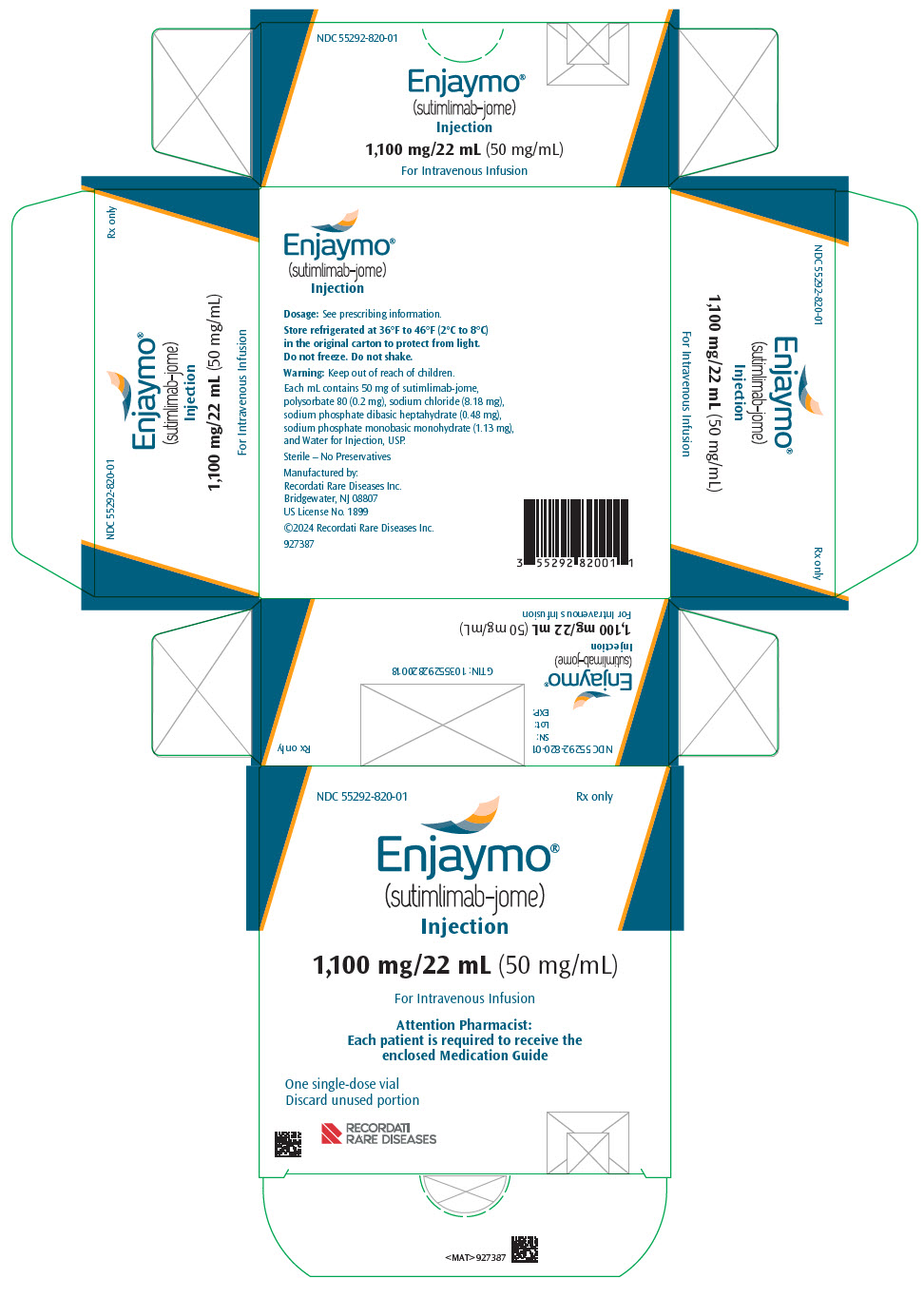
ENJAYMO (sutimlimab-jome) injection is a clear to slightly opalescent, colorless to slightly yellow, preservative-free solution supplied as one 1,100 mg/22 mL (50 mg/mL) single-dose vial per carton (NDC 55292-820-01).
Serious Infections Including Those Caused by Encapsulated Bacteria
Advise patients of the risk of serious infection. Inform patients of the need to complete or update their vaccinations against encapsulated bacteria at least 2 weeks prior to receiving the first dose of ENJAYMO. If urgent ENJAYMO therapy is indicated in a patient who is not up to date on their vaccines administer vaccine(s) as soon as possible. Inform the patient that they are required to be revaccinated according to current ACIP recommendations for encapsulated bacteria while on ENJAYMO therapy [see Warnings and Precautions (5.1)].
Inform patients that vaccination may not prevent serious infection and strongly advise the patient to seek immediate medical attention if signs or symptoms of serious infection occur. These signs and symptoms include the following:
Infusion-Related Reactions
Advise patients that administration of ENJAYMO may result in infusion-related reactions including hypersensitivity reactions. Hypersensitivity reactions may be serious or life-threatening (e.g., anaphylaxis). Educate patients on the symptoms of infusion-related reactions and advise them to seek medical attention if any new symptoms of infusion-related reactions occur [see Contraindications (4) and Warnings and Precautions (5.2)].
Risk of Autoimmune Disease
Educate patients that there may be an increased risk of developing an autoimmune disease such as SLE during ENJAYMO therapy. Advise patients on signs and symptoms of SLE and to report any new symptoms of SLE and seek medical attention [see Warnings and Precautions (5.3)].
Discontinuation
Inform patients with CAD that they may develop hemolysis due to CAD when ENJAYMO is discontinued and that they should be monitored by their healthcare provider following ENJAYMO discontinuation [see Warnings and Precautions (5.4)].
This product's labeling may have been updated. For the most recent prescribing information, please visit www.enjaymo.com.
Manufactured by:
Recordati Rare Diseases Inc.
Bridgewater, NJ 08807
US License No. 1899
©2024 Recordati Rare Diseases Inc. All rights reserved.