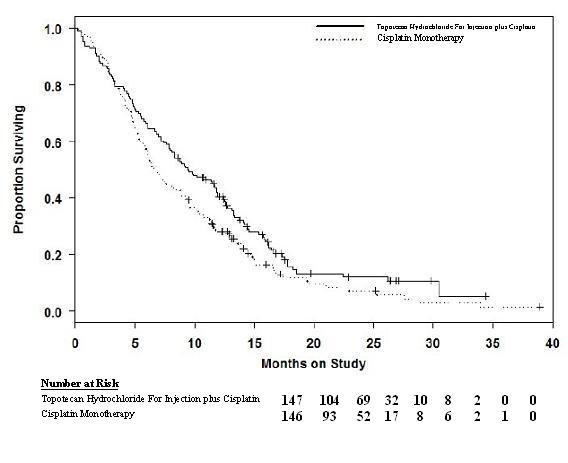
Because clinical trials are conducted under widely varying conditions, adverse reaction rates observed in the clinical trials of a drug cannot be directly compared with rates in the clinical trials of another drug and may not reflect the rates observed in practice.
Small Cell Lung Cancer: Data in the following section are based on the 426 patients with small cell lung cancer treated with topotecan hydrochloride for injection. Table 1 lists the principal hematologic adverse reactions and Table 2 lists non-hematologic adverse reactions occurring in at least 15% of patients.
Table 1. Hematologic Adverse Reactions Experienced in ≥15% Small Cell Lung Cancer Patients Receiving Topotecan Hydrochloride For Injection
| Hematologic Adverse Reaction | Patients
(n = 879)
%
Incidence |
Neutropenia
<1,500 cells/mm3
<500 cells/mm3 | 97
78 |
Leukopenia
<3,000 cells/mm3
<1,000 cells/mm3 | 97
32 |
Thrombocytopenia
<75,000/mm3
<25,000/mm3 | 69
27 |
Anemia
<10 g/dL
<8 g/dL | 89
37 |
Table 2. Non-hematologic Adverse Reactions Experienced by ≥15% of Small Cell Lung Cancer Patients Receiving Topotecan Hydrochloride For Injection
| Non-hematologicAdverse Reaction | Percentage of Patients with Adverse Reaction
(879 Patients) |
| | All Grades | Grade 3 | Grade 4 |
Infections and infestations
Sepsis or pyrexia/infection with neutropeniaa | 43 | NR | 23 |
Metabolism and nutrition disorders
Anorexia |
19 |
2 |
<1 |
Nervous system disorders
Headache | 18 | 1 | <1 |
Respiratory, thoracic, and mediastinal disorders
Dyspnea
Coughing | 22
15 | 5
1 | 3
0 |
Gastrointestinal disorders
Nausea
Vomiting
Diarrhea
Constipation
Abdominal pain
Stomatitis | 64
45
32
29
22
18 | 7
4
3
2
2
1 | 1
1
1
1
2
<1 |
Skin and subcutaneous tissue disorders
Alopecia
Rashb | 49
16 | NA
1 | NA
0 |
General disorders and administrative site conditions
Fatigue
Pyrexia
Painc
Asthenia | 29
28
23
25 | 5
1
2
4 | 0
<1
1
2 |
NA = Not applicable
NR = Not reported separately
a Does not include Grade 1 sepsis or pyrexia.
b Rash also includes pruritus, rash erythematous, urticaria, dermatitis, bullous eruption, and maculopapular rash.
c Pain includes body pain, back pain, and skeletal pain.
Nervous System Disorders: Paresthesia occurred in 7% of patients but was generally Grade 1.
Hepatobiliary Disorders: Grade 1 transient elevations in hepatic enzymes occurred in 8% of patients. Greater elevations, Grade 3/4, occurred in 4%. Grade 3/4 elevated bilirubin occurred in <2% of patients.
Table 3 shows the Grade 3/4 hematologic and major non-hematologic adverse reactions in the topotecan/CAV (cyclophosphamide-doxorubicin-vincristine) comparator trial in small cell lung cancer.
Table 3. Adverse Reactions Experienced by ≥5% of Small Cell Lung Cancer PatientsRandomized to Receive Topotecan Hydrochloride For Injection or CAV
| Adverse Reaction | Topotecan Hydrochloride For Injection
(n = 107) | CAV
(n = 104) |
| Hematologic Grade 3/4 | % | % |
| Grade 4 neutropenia (<500 cells/mm3) | 70 | 72 |
| Grade 3/4 anemia (Hgb <8 g/dL) | 42 | 20 |
| Grade 4 thrombocytopenia (<25,000 plts/mm3) | 29 | 5 |
| Pyrexia/Grade 4 neutropenia | 28 | 26 |
| Non-hematologic Grade 3/4 | % | % |
| Infections and infestationsDocumented sepsisa | 5 | 5 |
Respiratory, thoracic, and mediastinal disorders
Dyspnea
Pneumonia |
9
8 |
14
6 |
Gastrointestinal disorders
Abdominal pain
Nausea |
6
8 |
4
6 |
General disorders and administrative site conditions
Fatigue
Asthenia
Painb | 6
9
5 | 10
7
7
|
a Death related to sepsis occurred in 3% of patients receiving topotecan hydrochloride for injection , and 1% of patients receiving CAV.
b Pain includes body pain, skeletal pain, and back pain.
Cervical Cancer: In the comparative trial with topotecan hydrochloride for injection plus cisplatin versus cisplatin in patients with cervical cancer, the most common dose-limiting adverse reaction was myelosuppression. Table 4 shows the hematologic adverse reactions and Table 5 shows the non-hematologic adverse reactions in patients with cervical cancer.
Table 4. Hematologic Adverse Reactions in Patients with Cervical Cancer Treated withTopotecan Hydrochloride For Injection Plus Cisplatin or Cisplatin Monotherapya
| Hematologic Adverse Reaction | Topotecan Hydrochloride For Injection Plus Cisplatin (n = 140) | Cisplatin(n = 144) |
| Anemia | | |
| All Grades (Hgb <12 g/dL) | 131 (94%) | 130 (90%) |
| Grade 3 (Hgb <8-6.5 g/dL) | 47 (34%) | 28 (19%) |
| Grade 4 (Hgb <6.5 g/dL) | 9 (6%) | 5 (3%) |
| Leukopenia | | |
| All Grades (<3,800 cells/mm3) | 128 (91%) | 43 (30%) |
| Grade 3 (<2,000-1,000 cells/mm3) | 58 (41%) | 1 (1%) |
| Grade 4 (<1,000 cells/mm3) | 35 (25%) | 0 (0%) |
| Neutropenia | | |
| All Grades (<2,000 cells/mm3) | 125 (89%) | 28 (19%) |
| Grade 3 (<1,000-500 cells/mm3) | 36 (26%) | 1 (1%) |
| Grade 4 (<500 cells/mm3) | 67 (48%) | 1 (1%) |
| Thrombocytopenia | | |
| All Grades (<130,000 cells/mm3) | 104 (74%) | 21 (15%) |
| Grade 3 (<50,000-10,000 cells/mm3) | 36 (26%) | 5 (3%) |
| Grade 4 (<10,000 cells/mm3) | 10 (7%) | 0 (0%) |
a Includes patients who were eligible and treated.
Table 5. Non-hematologic Adverse Reactions Experienced by ≥5% of Patients with Cervical Cancer Treated with Topotecan Hydrochloride For Injection Plus Cisplatin or Cisplatin Monotherapya | Topotecan Hydrochloride For Injection Plus Cisplatin | Cisplatin |
| (n = 140) | (n = 144) |
| Adverse Reaction | All Gradesb | Grade 3 | Grade 4 | All Gradesb | Grade 3 | Grade 4 |
| General disorders and administrative site conditions | | | | | | |
| Constitutionalc | 96 (69%) | 11 (8%) | 0 | 89 (62%) | 17 (12%) | 0 |
| Paind | 82 (59%) | 28 (20%) | 3 (2%) | 72 (50%) | 18 (13%) | 5 (3%) |
| Gastrointestinal disorders | | | | | | |
| Vomiting | 56 (40%) | 20 (14%) | 2 (1%) | 53 (37%) | 13 (9%) | 0 |
| Nausea | 77 (55%) | 18 (13%) | 2 (1%) | 79 (55%) | 13 (9%) | 0 |
| Stomatitis-pharyngitis | 8 (6%) | 1 (<1%) | 0 | 0 | 0 | 0 |
| Other | 88 (63%) | 16 (11%) | 4 (3%) | 80 (56%) | 12 (8%) | 3 (2%) |
| Dermatology | 67 (48%) | 1 (<1%) | 0 | 29 (20%) | 0 | 0 |
| Metabolic-Laboratory | 55 (39%) | 13 (9%) | 7 (5%) | 44 (31%) | 14 (10%) | 1 (<1%) |
| Genitourinary | 51 (36%) | 9 (6%) | 9 (6%) | 49 (34%) | 7 (5%) | 7 (5%) |
| Nervous system disorders | | | | | | |
| Neuropathy | 4 (3%) | 1 (<1%) | 0 | 3 (2%) | 1 (<1%) | 0 |
| Other | 49 (35%) | 3 (2%) | 1 (<1%) | 43 (30%) | 7 (5%) | 2 (1%) |
| Infection-febrile neutropenia | 39 (28%) | 21 (15%) | 5 (4%) | 26 (18%) | 11 (8%) | 0 |
| Cardiovascular | 35 (25%) | 7 (5%) | 6 (4%) | 22 (15%) | 8 (6%) | 3 (2%) |
| Hepatic | 34 (24%) | 5 (4%) | 2 (1%) | 23 (16%) | 2 (1%) | 0 |
| Pulmonary | 24 (17%) | 4 (3%) | 0 | 23 (16%) | 5 (3%) | 3 (2%) |
| Vascular disorders | | | | | | |
| Hemorrhage | 21 (15%) | 8 (6%) | 1 (<1%) | 20 (14%) | 3 (2%) | 1 (<1%) |
| Coagulation | 8 (6%) | 4 (3%) | 3 (2%) | 10 (7%) | 7 (5%) | 0 |
| Musculoskeletal | 19 (14%) | 3 (2%) | 0 | 7 (5%) | 1 (<1%) | 1 (<1%) |
| Allergy-Immunology | 8 (6%) | 2 (1%) | 1 (<1%) | 4 (3%) | 0 | 1 (<1%) |
| Endocrine | 8 (6%) | 0 | 0 | 4 (3%) | 2 (1%) | 0 |
| Sexual reproduction function | 7 (5%) | 0 | 0 | 10 (7%) | 1 (<1%) | 0 |
| Ocular-visual | 7 (5%) | 0 | 0 | 7 (5%) | 1 (<1%) | 0 |
Data were collected using NCI Common Toxicity Criteria, v. 2.0.
a Includes patients who were eligible and treated.
b Grades 1 through 4 only. There were 3 patients who experienced Grade 5 deaths with investigator designated attribution. One was a Grade 5 hemorrhage in which the drug-related thrombocytopenia aggravated the event. A second patient experienced bowel obstruction, cardiac arrest, pleural effusion and respiratory failure which were not treatment related but probably aggravated by treatment. A third patient experienced a pulmonary embolism and adult respiratory distress syndrome, the latter was indirectly treatment-related.
c Constitutional includes fatigue (lethargy, malaise, asthenia), fever (in the absence of neutropenia), rigors, chills, sweating, and weight gain or loss.
d Pain includes abdominal pain or cramping, arthralgia, bone pain, chest pain (non-cardiac and non pleuritic), dysmenorrhea, dyspareunia, earache, headache, hepatic pain, myalgia, neuropathic pain, pain due to radiation, pelvic pain, pleuritic pain, rectal or perirectal pain, and tumor pain.