Pavblu Injection, Solution
Product Images NDC 55513-056

View Photos of Packaging, Regulatory Labels, and Product Appearance

Product Visual Gallery

This gallery contains 22 technical images submitted to the FDA as part of the official labeling for Pavblu (NDC 55513-056). Unlike standard consumer photos, these assets often include clinical data figures, molecular chemical structures, and official manufacturer packaging layouts.

As provided by Amgen, Inc, these visuals offer a comprehensive scientific overview of the product's physical and chemical identity, aiding pharmacists and researchers in product verification and study.

FDA Label Image

Figure 1 (Pavblu 01)

Figure 1 (Pavblu 01)
An instructional diagram of an intravitreal injection syringe for PAVBLU (aflibercept-ayyh) 2 mg/.05 mL. The diagram labels the syringe components including the syringe cap, luer lock, 0.05 mL dosing line, plunger, finger grip, and plunger rod.*
FDA Label Image

Figure 2 (Pavblu 02)

Figure 2 (Pavblu 02)
A black and white instructional illustration showing hands twisting the cap off a medical vial or syringe. The image includes a curved arrow indicating the twisting motion required to open the vial or syringe cap.*
FDA Label Image

Figure 3 (Pavblu 03)

Figure 3 (Pavblu 03)
Illustration showing hands preparing an intravitreal injection syringe by removing a cap or cover from the needle. Arrows indicate the direction of cap removal, highlighting the step prior to administering the injection.*
FDA Label Image

Figure 4 (Pavblu 04)

Figure 4 (Pavblu 04)
An instructional diagram showing a hand holding a syringe filled with solution and another hand tapping the side of the syringe. A zoomed inset highlights the syringe stopper, indicating the action to tap the syringe before use.*
FDA Label Image

Figure 5a (Pavblu 05)

Figure 5a (Pavblu 05)
An instructional diagram showing a close-up of a syringe held by a thumb and finger. The image labels key parts of the syringe including the air bubble inside, the solution, the dosing line, and the plunger dome edge.*
FDA Label Image

Figure 5b (Pavblu 06)

Figure 5b (Pavblu 06)
An instructional diagram showing how to align the plunger dome edge to the top of the dosing line on a syringe. It highlights the plunger dome and plunger dome edge within the syringe barrel, providing guidance for precise medication dosing.*
FDA Label Image

Figure 6 (Pavblu 07)

Figure 6 (Pavblu 07)
An instructional illustration showing hands removing or placing a cap or stopper on a small vial, likely representing preparation for an intravitreal injection such as PAVBLU (aflibercept-ayyh) injection solution.*
FDA Label Image

Figure 7 (Pavblu 08)

Figure 7 (Pavblu 08)
An instructional illustration showing hands holding a vial. One hand grips the vial's body while the other hand is removing or placing a flip-off cap on the vial's top, indicating a step in the preparation of an injection solution.*
FDA Label Image

Figure 8a (Pavblu 09)

Figure 8a (Pavblu 09)
An instructional illustration showing a hand holding a syringe while another hand is twisting and removing a cap or cover from the syringe tip. The arrows indicate the direction of twisting and pulling to remove the cap.*
FDA Label Image

Figure 8b (Pavblu 10)

Figure 8b (Pavblu 10)
An instructional illustration showing a hand holding a syringe with a filter needle attached at the tip. An arrow points to the filter needle, indicating its placement on the syringe, likely demonstrating preparation for intravitreal injection.*
FDA Label Image

Figure 9a & 9b (Pavblu 11)

Figure 9a & 9b (Pavblu 11)
An instructional illustration showing hands drawing solution from a vial into a syringe. A close-up inset highlights the vial's needle insertion with the needle bevel pointing downwards and the solution level inside the vial.*
FDA Label Image

Figure 10a (Pavblu 12)

Figure 10a (Pavblu 12)
An instructional illustration showing a hand holding a syringe labeled with volume markings, while the other hand is twisting or removing the needle cap. Arrows indicate the direction of the twisting motion, suggesting preparation of the injection device.*
FDA Label Image

Figure 10b (Pavblu 13)

Figure 10b (Pavblu 13)
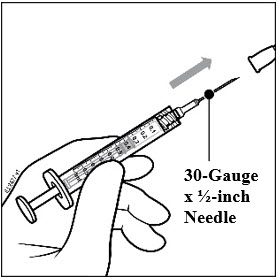
Illustration showing a hand holding a syringe with a 30-gauge, 1/2-inch needle attached. There is an arrow indicating the removal of the needle cap from the syringe tip for injection preparation.*
FDA Label Image

Figure 11 (Pavblu 14)

Figure 11 (Pavblu 14)
Illustration showing a close-up of hands holding a syringe and preparing an intravitreal injection. One hand holds the syringe, and the other hand points to the syringe barrel marked with measurement graduations.*
FDA Label Image

Figure 12a & 12b (Pavblu 15)

Figure 12a & 12b (Pavblu 15)
Illustration showing measurement and dosing instructions for PAVBLU (aflibercept-ayyh) injection solution. Figure 12a highlights the 0.05 mL dose line on the syringe. Figure 12b depicts the correct position of the flat plunger edge aligned with the dosing line after expelling air bubbles and excess drug to ensure accurate 0.05 mL dosage.*
FDA Label Image

Figure 13 (Pavblu 16)

Figure 13 (Pavblu 16)
This image contains two line graphs labeled VIEW 1 and VIEW 2 showing the mean change in visual acuity (letters) over 96 weeks. The graphs compare three treatments: Aflibercept 2 mg every 8 weeks, Aflibercept 2 mg every 4 weeks, and Ranibizumab 0.5 mg every 4 weeks, with their performance plotted across weeks observed.*
FDA Label Image

Figure 14 (Pavblu 17)

Figure 14 (Pavblu 17)
Two line graphs titled COPERNICUS and GALILEO showing mean change in visual acuity (letters) over 24 weeks. Each graph compares visual acuity changes between aflibercept 2 mg every 4 weeks (marked by black triangles) and a control group (gray circles). The aflibercept group shows increased visual acuity, while the control group's acuity remains stable or decreases slightly.*
FDA Label Image

Figure 15 (Pavblu 18)

Figure 15 (Pavblu 18)
A line graph titled 'VIBRANT' displaying mean change in visual acuity (letters) over 24 weeks. It compares two groups: one receiving Aflibercept 2 mg every 4 weeks and a control group, showing greater improvement in visual acuity in the Aflibercept group across the studied period.*
FDA Label Image

Figure 16 (Pavblu 19)

Figure 16 (Pavblu 19)
This image contains two line graphs titled VIVID and VISTA, showing mean change in visual acuity (letters) over weeks up to 100. Both graphs compare aflibercept 2 mg injections given every 8 weeks and every 4 weeks versus a control group, with respective data points represented by squares, triangles, and circles.*
FDA Label Image

Figure 17 (Pavblu 20)

Figure 17 (Pavblu 20)
A bar chart displaying the proportion of patients over time at weeks 8, 12, 24, 40, and 52 in a clinical study. It compares three groups: Control (sham), Aflibercept 2Q16, and Aflibercept 2Q8, showing increasing patient proportions with Aflibercept groups having higher values than control, with Aflibercept 2Q8 generally higher than 2Q16.*
FDA Label Image

Principal Display Panel (0.05 mL Syringe Carton)

Principal Display Panel (0.05 mL Syringe Carton)
The label for PAVBLU (aflibercept-ayyh) injection, 2 mg/0.05 mL solution, intravitreal use. The label shows the product name and strength prominently with instructions for storage refrigerated at 2°C to 8°C and protection from light. It mentions a single-dose prefilled syringe, no antimicrobial preservatives, and notes 'Not for Sale.' The labeler is Amgen, Inc.*
FDA Label Image

Principal Display Panel (0.05 mL Vial Carton)

Principal Display Panel (0.05 mL Vial Carton)
Label for PAVBLU (aflibercept-ayyh) injection, 2 mg/0.05 mL single-dose vial. The label includes the strength and dosage form, indicating sterile solution for intravitreal injection without antimicrobial preservatives. It displays the NDC 55513-065-01 and the manufacturer Amgen, Inc, with instructions to keep out of reach of children and discard unused portion.*

* About these descriptions: Image descriptions on this page are generated by automated AI analysis of the product label images from the manufacturer's FDA label submission (SPL). They are provided for reference only and may contain errors or omissions. Always rely on the printed label itself and the official FDA labeling, and consult a pharmacist or healthcare professional with any questions about this product.