Because clinical trials are conducted under widely varying conditions, adverse reaction rates observed in the clinical trials of a drug cannot be directly compared to rates in the clinical trials of another drug and may not reflect the rates observed in practice.
MRD-positive B-cell Precursor ALL
The safety of BLINCYTO in patients with MRD-positive B-cell precursor ALL was evaluated in two single-arm clinical studies in which 137 patients were treated with BLINCYTO. The median age of the study population was 45 years (range: 18 to 77 years).
The most common adverse reactions (≥ 20%) were pyrexia, infusion related reactions, headache, infections (pathogen unspecified), tremor, and chills. Serious adverse reactions were reported in 61% of patients. The most common serious adverse reactions (≥ 2%) included pyrexia, tremor, encephalopathy, aphasia, lymphopenia, neutropenia, overdose, device related infection, seizure, and staphylococcal infection. Adverse reactions of Grade 3 or higher were reported in 64% of patients. Discontinuation of therapy due to adverse reactions occurred in 17% of patients; neurologic events were the most frequently reported reasons for discontinuation. There were 2 fatal adverse events that occurred within 30 days of the end of BLINCYTO treatment (atypical pneumonia and subdural hemorrhage).
Table 9 summarizes the adverse reactions occurring at a ≥ 10% incidence for any grade or ≥ 5% incidence for Grade 3 or higher.
Table 9. Adverse Reactions Occurring at ≥ 10% Incidence for Any Grade or ≥ 5% Incidence for Grade 3 or Higher in BLINCYTO-Treated Patients with MRD-Positive B-cell Precursor ALL (N=137)| Adverse Reaction | Any Grade*
n (%) | ≥ Grade 3*
n (%) |
| Blood and lymphatic system disorders | | |
| Neutropenia1 | 21 (15) | 21 (15) |
| Leukopenia2 | 19 (14) | 13 (9) |
| Thrombocytopenia3 | 14 (10) | 8 (6) |
| Cardiac disorders | | |
| Arrhythmia4 | 17 (12) | 3 (2) |
| General disorders and administration site conditions | | |
| Pyrexia5 | 125 (91) | 9 (7) |
| Chills | 39 (28) | 0 (0) |
| Infections and infestations | | |
| Infections - pathogen unspecified | 53 (39) | 11 (8) |
| Injury, poisoning and procedural complications | | |
| Infusion related reaction6 | 105 (77) | 7 (5) |
| Investigations | | |
| Decreased immunoglobulins7 | 25 (18) | 7 (5) |
| Weight increased | 14 (10) | 1 (<1) |
| Hypertransaminasemia8 | 13 (9) | 9 (7) |
| Musculoskeletal and connective tissue disorders | | |
| Back pain | 16 (12) | 1 (<1) |
| Nervous system disorders | | |
| Headache | 54 (39) | 5 (4) |
| Tremor9 | 43 (31) | 6 (4) |
| Aphasia | 16 (12) | 1 (<1) |
| Dizziness | 14 (10) | 1 (<1) |
| Encephalopathy10 | 14 (10) | 6 (4) |
| Psychiatric disorders | | |
| Insomnia11 | 24 (18) | 1 (<1) |
| Respiratory, thoracic and mediastinal disorders | | |
| Cough | 18 (13) | 0 (0) |
| Skin and subcutaneous tissue disorders | | |
| Rash12 | 22 (16) | 1 (<1) |
| Vascular disorders | | |
| Hypotension | 19 (14) | 1 (<1) |
* Grading based on NCI Common Terminology for Adverse Events (CTCAE) version 4.0
1 Neutropenia includes febrile neutropenia, neutropenia, and neutrophil count decreased
2 Thrombocytopenia includes platelet count decreased and thrombocytopenia
3 Leukopenia includes leukopenia and white blood cell count decreased
4 Arrhythmia includes bradycardia, sinus arrhythmia, sinus bradycardia, sinus tachycardia, tachycardia and ventricular extrasystoles
5 Pyrexia includes body temperature increased and pyrexia
6 Infusion-related reaction is a composite term that includes the term infusion-related reaction and the following events occurring with the first 48 hours of infusion and the event lasted ≤ 2 days: cytokine release syndrome, eye swelling, hypertension, hypotension, myalgia, periorbital edema, pruritus generalized, pyrexia, and rash
7 Decreased immunoglobulins includes blood immunoglobulin A decreased, blood immunoglobulin G decreased, blood immunoglobulin M decreased, hypogammaglobulinemia, hypoglobulinemia, and immunoglobulins decreased
8 Hypertransaminasemia includes alanine aminotransferase increased, aspartate aminotransferase increased, and hepatic enzyme increased
9 Tremor includes essential tremor, intention tremor, and tremor
10 Encephalopathy includes cognitive disorder, depressed level of consciousness, disturbance in attention, encephalopathy, lethargy, leukoencephalopathy, memory impairment, somnolence, and toxic encephalopathy
11 Insomnia includes initial insomnia, insomnia, and terminal insomnia
12 Rash includes dermatitis contact, eczema, erythema, rash, and rash maculopapular |
Additional adverse reactions in patients with MRD-positive ALL that did not meet the threshold criteria for inclusion in Table 9 were:
Blood and lymphatic system disorders: anemia
General disorders and administration site conditions: edema peripheral, pain, and chest pain (includes chest pain and musculoskeletal chest pain)
Hepatobiliary disorders: blood bilirubin increased
Immune system disorders: hypersensitivity and cytokine release syndrome
Infections and infestations: viral infectious disorders, bacterial infectious disorders, and fungal infectious disorders
Injury, poisoning and procedural complications: medication error and overdose (includes overdose and accidental overdose)
Investigations: blood alkaline phosphatase increased
Musculoskeletal and connective tissue disorders: pain in extremity and bone pain
Nervous system disorders: seizure (includes seizure and generalized tonic-clonic seizure), speech disorder, and hypoesthesia
Psychiatric disorders: confusional state, disorientation, and depression
Respiratory, thoracic and mediastinal disorders: dyspnea and productive cough
Vascular disorders: hypertension (includes blood pressure increased and hypertension) flushing (includes flushing and hot flush), and capillary leak syndrome
Philadelphia Chromosome-negative Relapsed or Refractory B-cell Precursor ALL
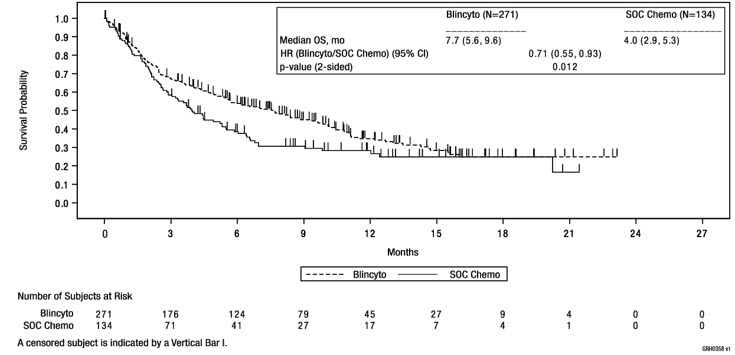
The safety data described below reflect exposure to BLINCYTO in a randomized, open-label, active-controlled clinical study (TOWER Study) in which 376 patients with Philadelphia chromosome-negative relapsed or refractory B-cell precursor ALL were treated with BLINCYTO (n = 267) or standard of care (SOC) chemotherapy (n = 109). The median age of BLINCYTO-treated patients was 37 years (range: 18 to 80 years), 60% were male, 84% were White, 7% Asian, 2% were Black or African American, 2% were American Indian or Alaska Native, and 5% were Multiple/Other.
The most common adverse reactions (≥ 20%) in the BLINCYTO arm were infections (bacterial and pathogen unspecified), pyrexia, headache, infusion-related reactions, anemia, febrile neutropenia, thrombocytopenia, and neutropenia. Serious adverse reactions were reported in 62% of patients. The most common serious adverse reactions (≥ 2%) included febrile neutropenia, pyrexia, sepsis, pneumonia, overdose, septic shock, CRS, bacterial sepsis, device related infection, and bacteremia. Adverse reactions of Grade 3 or higher were reported in 87% of patients. Discontinuation of therapy due to adverse reactions occurred in 12% of patients treated with BLINCYTO; neurologic events and infections were the most frequently reported reasons for discontinuation of treatment due to an adverse reaction. Fatal adverse events occurred in 16% of patients. The majority of the fatal events were infections.
The adverse reactions occurring at a ≥ 10% incidence for any grade or ≥ 5% incidence for Grade 3 or higher in the BLINCYTO-treated patients in first cycle of therapy are summarized in Table 10.
Table 10. Adverse Reactions Occurring at ≥ 10% Incidence for Any Grade or ≥ 5% Incidence for Grade 3 or Higher in BLINCYTO-treated Patients in First Cycle of Therapy| Adverse Reaction | BLINCYTO
(N = 267) | Standard of Care (SOC)
Chemotherapy
(N = 109) |
| Any Grade*
n (%) | ≥ Grade 3*
n (%) | Any Grade*
n (%) | ≥ Grade 3*
n (%) |
| Blood and lymphatic system disorders |
|
Neutropenia1 | 84 (31) | 76 (28) | 67 (61) | 61 (56) |
|
Anemia2 | 68 (25) | 52 (19) | 45 (41) | 37 (34) |
|
Thrombocytopenia3 | 57 (21) | 47 (18) | 42 (39) | 40 (37) |
|
Leukopenia4 | 21 (8) | 18 (7) | 9 (8) | 9 (8) |
| Cardiac disorders |
| Arrhythmia5 | 37 (14) | 5 (2) | 18 (17) | 0 (0) |
| General disorders and administration site conditions |
| Pyrexia | 147 (55) | 15 (6) | 43 (39) | 4 (4) |
| Edema6 | 48 (18) | 3 (1) | 20 (18) | 1 (1) |
| Immune system disorders |
| Cytokine release syndrome7 | 37 (14) | 8 (3) | 0 (0) | 0 (0) |
| Infections and infestations |
| Infections - pathogen unspecified | 74 (28) | 40 (15) | 50 (46) | 35 (32) |
| Bacterial infectious disorders | 38 (14) | 19 (7) | 35 (32) | 21 (19) |
| Viral infectious disorders | 30 (11) | 4 (1) | 14 (13) | 0 (0) |
| Fungal infectious disorders | 27 (10) | 13 (5) | 15 (14) | 9 (8) |
| Injury, poisoning and procedural complications |
| Infusion-related reaction8 | 79 (30) | 9 (3) | 9 (8) | 1 (1) |
| Investigations |
| Hypertransaminasemia9 | 40 (15) | 22 (8) | 13 (12) | 7 (6) |
| Nervous system disorders |
| Headache | 61 (23) | 1 (<1) | 30 (28) | 3 (3) |
| Skin and subcutaneous tissue disorders |
| Rash10 | 31 (12) | 2 (1) | 21 (19) | 0 (0) |
* Grading based on NCI Common Terminology Criteria for Adverse Events (CTCAE) version 4.0
1Neutropenia includes agranulocytosis, febrile neutropenia, neutropenia, and neutrophil count decreased
2Anemia includes anemia and hemoglobin decreased
3Thrombocytopenia includes platelet count decreased and thrombocytopenia
4Leukopenia includes leukopenia and white blood cell count decreased
5Arrhythmia includes arrhythmia, atrial fibrillation, atrial flutter, bradycardia, sinus bradycardia, sinus tachycardia, supraventricular tachycardia, and tachycardia
6Edema includes face edema, fluid retention, edema, edema peripheral, peripheral swelling, and swelling face
7Cytokine release syndrome includes cytokine release syndrome and cytokine storm
8Infusion-related reaction is a composite term that includes the term infusion-related reaction and the following events occurring with the first 48 hours of infusion and the event lasted ≤ 2 days: pyrexia, cytokine release syndrome, hypotension, myalgia, acute kidney injury, hypertension, and rash erythematous
9Hypertransaminasemia includes alanine aminotransferase increased, aspartate aminotransferase increased, hepatic enzyme increased, and transaminases increased
10Rash includes erythema, rash, rash erythematous, rash generalized, rash macular, rash maculo-papular, rash pruritic, skin exfoliation, and toxic skin eruption. |
Selected laboratory abnormalities worsening from baseline Grade 0-2 to treatment-related maximal Grade 3-4 in first cycle of therapy are shown in Table 11.
Table 11. Selected Laboratory Abnormalities Worsening from Baseline Grade 0-2 to Treatment-related Maximal Grade 3-4* in First Cycle of Therapy | BLINCYTO
Grade 3 or 4 (%) | SOC Chemotherapy
Grade 3 or 4 (%) |
| Hematology | | |
| Decreased lymphocyte count | 80 | 83 |
| Decreased white blood cell count | 53 | 97 |
| Decreased hemoglobin | 29 | 43 |
| Decreased neutrophil count | 57 | 68 |
| Decreased platelet count | 47 | 85 |
| Chemistry | | |
| Increased ALT | 11 | 11 |
| Increased bilirubin | 5 | 4 |
| Increased AST | 8 | 4 |
* Includes only patients who had both baseline and at least one laboratory measurement during first cycle of therapy available.
Relapsed or Refractory B-cell Precursor ALL
Other important adverse reactions from pooled relapsed or refractory B-cell precursor ALL studies were:
Blood and lymphatic system disorders: lymphadenopathy, hematophagic histiocytosis, and leukocytosis (includes leukocytosis and white blood cell count increased)
General disorders and administration site conditions: chills, chest pain (includes chest discomfort, chest pain, musculoskeletal chest pain, and non-cardiac chest pain), pain, body temperature increased, hyperthermia, and systemic inflammatory response syndrome
Hepatobiliary disorders: hyperbilirubinemia (includes blood bilirubin increased and hyperbilirubinemia)
Immune system disorders: hypersensitivity (includes hypersensitivity, anaphylactic reaction, angioedema, dermatitis allergic, drug eruption, drug hypersensitivity, erythema multiforme, and urticaria)
Injury, poisoning and procedural complications: medication error and overdose (includes overdose, medication error, and accidental overdose)
Investigations: weight increased, decreased immunoglobulins (includes immunoglobulins decreased, blood immunoglobulin A decreased, blood immunoglobulin G decreased, blood immunoglobulin M decreased, and hypogammaglobulinemia), blood alkaline phosphatase increased, and hypertransaminasemia
Metabolism and nutrition disorders: tumor lysis syndrome
Musculoskeletal and connective tissue disorders: back pain, bone pain, and pain in extremity
Nervous system disorders: tremor (resting tremor, intention tremor, essential tremor, and tremor), altered state of consciousness (includes altered state of consciousness, depressed level of consciousness, disturbance in attention, lethargy, mental status changes, stupor, and somnolence), dizziness, memory impairment, seizure (includes seizure, and atonic seizure), aphasia, cognitive disorder, speech disorder, hypoesthesia, encephalopathy, and cranial nerve disorders (trigeminal neuralgia, trigeminal nerve disorder, sixth nerve paralysis, cranial nerve disorder, facial nerve disorder, and facial paresis).
Psychiatric disorders: insomnia, disorientation, confusional state, and depression (includes depressed mood, depression, suicidal ideation, and completed suicide)
Respiratory, thoracic and mediastinal disorders: dyspnea (includes acute respiratory failure, dyspnea, dyspnea exertional, respiratory failure, respiratory distress, bronchospasm, bronchial hyperreactivity, tachypnea, and wheezing), cough, and productive cough
Vascular disorders: hypotension (includes blood pressure decreased, hypotension, hypovolemic shock, and circulatory collapse), hypertension (includes blood pressure increased, hypertension, and hypertensive crisis), flushing (includes flushing and hot flush), and capillary leak syndrome