Administration to Patients Who Have Difficulty Swallowing Solids
Disperse tablets in 120 mL (4 ounces) of non-carbonated, room-temperature water without crushing. No other liquids should be used. Stir until tablets are dispersed into small pieces (the tablets will not completely dissolve) and drink immediately or within 2 hours. The appearance of the mixture may range from pale yellow to bright yellow. Swallow the tablet dispersion. Do not chew pieces of the tablet. Rinse the container with an additional 120 mL (4 ounces) of water and drink. If the mixture is not consumed immediately, stir the mixture again to ensure that tablets are dispersed.
Non-Small Cell Lung Cancer
The safety of LUMAKRAS was evaluated in a subset of patients with KRAS G12C-mutated locally advanced or metastatic NSCLC in CodeBreaK 100 [see Clinical Studies (14)]. Patients received LUMAKRAS 960 mg orally once daily until disease progression or unacceptable toxicity (n = 204). Among patients who received LUMAKRAS, 39% were exposed for 6 months or longer and 3% were exposed for greater than one year.
The median age of patients who received LUMAKRAS was 66 years (range: 37 to 86); 55% female; 80% White, 15% Asian, and 3% Black.
Serious adverse reactions occurred in 50% of patients treated with LUMAKRAS. Serious adverse reactions in ≥ 2% of patients were pneumonia (8%), hepatotoxicity (3.4%), and diarrhea (2%). Fatal adverse reactions occurred in 3.4% of patients who received LUMAKRAS due to respiratory failure (0.8%), pneumonitis (0.4%), cardiac arrest (0.4%), cardiac failure (0.4%), gastric ulcer (0.4%), and pneumonia (0.4%).
Permanent discontinuation of LUMAKRAS due to an adverse reaction occurred in 9% of patients. Adverse reactions resulting in permanent discontinuation of LUMAKRAS in ≥ 2% of patients included hepatotoxicity (4.9%).
Dosage interruptions of LUMAKRAS due to an adverse reaction occurred in 34% of patients. Adverse reactions which required dosage interruption in ≥ 2% of patients were hepatotoxicity (11%), diarrhea (8%), musculoskeletal pain (3.9%), nausea (2.9%), and pneumonia (2.5%).
Dose reductions of LUMAKRAS due to an adverse reaction occurred in 5% of patients. Adverse reactions which required dose reductions in ≥ 2% of patients included increased ALT (2.9%) and increased AST (2.5%).
The most common adverse reactions (≥ 20%) were diarrhea, musculoskeletal pain, nausea, fatigue, hepatotoxicity, and cough. The most common laboratory abnormalities (≥ 25%) were decreased lymphocytes, decreased hemoglobin, increased aspartate aminotransferase, increased alanine aminotransferase, decreased calcium, increased alkaline phosphatase, increased urine protein, and decreased sodium.
Table 3 summarizes the common adverse reactions observed in CodeBreaK 100.
Table 3. Adverse Reactions (≥ 10%) of Patients With KRAS G12C-Mutated NSCLC Who Received LUMAKRAS in CodeBreaK 100Grading defined by NCI CTCAE version 5.0.
| Adverse Reaction | LUMAKRAS
N = 204 |
|---|
| All Grades (%) | Grade 3 to 4 (%) |
|---|
| Gastrointestinal disorders |
| Diarrhea | 42 | 5 |
| Nausea | 26 | 1 |
| Vomiting | 17 | 1.5 |
| Constipation | 16 | 0.5 |
| Abdominal pain Abdominal pain includes abdominal pain, abdominal pain upper, and abdominal pain lower. | 15 | 1.0 |
| Hepatobiliary disorders | | |
| Hepatotoxicity Hepatotoxicity includes alanine aminotransferase increased, aspartate aminotransferase increased, blood bilirubin increased, drug-induced liver injury, hepatitis, hepatotoxicity, liver function test increased, and transaminases increased. | 25 | 12 |
| Respiratory, thoracic, and mediastinal disorders |
| Cough Cough includes cough, productive cough, and upper-airway cough syndrome. | 20 | 1.5 |
| Dyspnea Dyspnea includes dyspnea and dyspnea exertional. | 16 | 2.9 |
| Musculoskeletal and connective tissue disorders |
| Musculoskeletal pain Musculoskeletal pain includes back pain, bone pain, musculoskeletal chest pain, musculoskeletal discomfort, musculoskeletal pain, myalgia, neck pain, non-cardiac chest pain, and pain in extremity. | 35 | 8 |
| Arthralgia | 12 | 1.0 |
| General disorders and administration site conditions |
| Fatigue Fatigue includes fatigue and asthenia. | 26 | 2.0 |
| Edema Edema includes generalized edema, localized edema, edema, edema peripheral, periorbital edema, and testicular edema. | 15 | 0 |
| Metabolism and nutrition disorders |
| Decreased appetite | 13 | 1.0 |
| Infections and infestations | | |
| Pneumonia Pneumonia includes pneumonia, pneumonia aspiration, pneumonia bacterial, and pneumonia staphylococcal. | 12 | 7 |
| Skin and subcutaneous tissue disorders | | |
| Rash Rash includes dermatitis, dermatitis acneiform, rash, rash-maculopapular, and rash pustular. | 12 | 0 |
Table 4 summarizes the selected laboratory adverse reactions observed in CodeBreaK 100.
Table 4. Select Laboratory Abnormalities (≥ 20%) That Worsened from Baseline in Patients With KRAS G12C-Mutated NSCLC Who Received LUMAKRAS in CodeBreaK 100| Laboratory Abnormalities | LUMAKRAS
N = 204N = number of patients who had at least one on-study assessment for the parameter of interest. |
|---|
Grades 1 to 4
(%) | Grades 3 to 4
(%) |
|---|
| Chemistry | | |
| Increased aspartate aminotransferase | 39 | 9 |
| Increased alanine aminotransferase | 38 | 11 |
| Decreased calcium | 35 | 0 |
| Increased alkaline phosphatase | 33 | 2.5 |
| Increased urine protein | 29 | 3.9 |
| Decreased sodium | 28 | 1.0 |
| Decreased albumin | 22 | 0.5 |
| Hematology | | |
| Decreased lymphocytes | 48 | 2 |
| Decreased hemoglobin | 43 | 0.5 |
| Increased activated partial thromboplastin time | 23 | 1.5 |
Acid-Reducing Agents
Coadministration of LUMAKRAS with gastric acid-reducing agents decreased sotorasib concentrations [see Clinical Pharmacology (12.3)], which may reduce the efficacy of sotorasib. Avoid coadministration of LUMAKRAS with proton pump inhibitors (PPIs), H2 receptor antagonists, and locally acting antacids. If coadministration with an acid-reducing agent cannot be avoided, administer LUMAKRAS 4 hours before or 10 hours after administration of a locally acting antacid [see Dosage and Administration (2.4)].
Strong CYP3A4 Inducers
Coadministration of LUMAKRAS with a strong CYP3A4 inducer decreased sotorasib concentrations [see Clinical Pharmacology (12.3)], which may reduce the efficacy of sotorasib. Avoid coadministration of LUMAKRAS with strong CYP3A4 inducers.
CYP3A4 Substrates
Coadministration of LUMAKRAS with a CYP3A4 substrate decreased its plasma concentrations [see Clinical Pharmacology (12.3)], which may reduce the efficacy of the substrate. Avoid coadministration of LUMAKRAS with CYP3A4 sensitive substrates, for which minimal concentration changes may lead to therapeutic failures of the substrate. If coadministration cannot be avoided, increase the sensitive CYP3A4 substrate dosage in accordance with its Prescribing Information.
P-glycoprotein (P-gp) Substrates
Coadministration of LUMAKRAS with a P-gp substrate (digoxin) increased digoxin plasma concentrations [see Clinical Pharmacology (12.3)], which may increase the adverse reactions of digoxin. Avoid coadministration of LUMAKRAS with P-gp substrates, for which minimal concentration changes may lead to serious toxicities. If coadministration cannot be avoided, decrease the P-gp substrate dosage in accordance with its Prescribing Information.
Risk Summary
There are no available data on LUMAKRAS use in pregnant women. In rat and rabbit embryo-fetal development studies, oral sotorasib did not cause adverse developmental effects or embryo-lethality at exposures up to 4.6 times the human exposure at the 960 mg clinical dose (see Data).
In the U.S. general population, the estimated background risk of major birth defects and miscarriage in clinically recognized pregnancies is 2% to 4% and 15% to 20%, respectively.
Data
Animal Data
In a rat embryo-fetal development study, once daily oral administration of sotorasib to pregnant rats during the period of organogenesis resulted in maternal toxicity at the 540 mg/kg dose level (approximately 4.6 times the human exposure based on area under the curve (AUC) at the clinical dose of 960 mg). Sotorasib did not cause adverse developmental effects and did not affect embryo-fetal survival at doses up to 540 mg/kg.
In a rabbit embryo-fetal development study, once daily oral administration of sotorasib during the period of organogenesis resulted in lower fetal body weights and a reduction in the number of ossified metacarpals in fetuses at the 100 mg/kg dose level (approximately 2.6 times the human exposure based on AUC at the clinical dose of 960 mg), which was associated with maternal toxicity including decreased body weight gain and food consumption during the dosing phase. Sotorasib did not cause adverse developmental effects and did not affect embryo-fetal survival at doses up to 100 mg/kg.
Risk Summary
There are no data on the presence of sotorasib or its metabolites in human milk, the effects on the breastfed child, or on milk production. Because of the potential for serious adverse reactions in breastfed children, advise women not to breastfeed during treatment with LUMAKRAS and for 1 week after the final dose.
Cardiac Electrophysiology
At the approved recommended dosage, LUMAKRAS does not cause large mean increases in the QTc interval (> 20 msec).
Absorption
The median time to sotorasib peak plasma concentration is 1 hour.
Effect of Food
When 960 mg LUMAKRAS was administered with a high-fat, high-calorie meal (containing approximately 800 to 1000 calories with 150, 250, and 500 to 600 calories from protein, carbohydrate and fat, respectively) in patients, sotorasib AUC0-24h increased by 25% compared to administration under fasted conditions.
Distribution
The sotorasib mean volume of distribution (Vd) at steady state is 211 L (CV: 135%). In vitro, sotorasib plasma protein binding is 89%.
Elimination
The sotorasib mean terminal elimination half-life is 5 hours (standard deviation (SD): 2). At 960 mg LUMAKRAS once daily, the sotorasib steady state apparent clearance is 26.2 L/hr (CV: 76%).
Metabolism
The main metabolic pathways of sotorasib are non-enzymatic conjugation and oxidative metabolism with CYP3As.
Excretion
After a single dose of radiolabeled sotorasib, 74% of the dose was recovered in feces (53% unchanged) and 6% (1% unchanged) in urine.
Specific Populations
No clinically meaningful differences in the pharmacokinetics of sotorasib were observed based on age (28 to 86 years), sex, race (White, Black and Asian), body weight (36.8 to 157.9 kg), line of therapy, ECOG PS (0, 1), mild and moderate renal impairment (eGFR: ≥ 30 mL/min/1.73 m2), or mild hepatic impairment (AST or ALT < 2.5 × ULN or total bilirubin < 1.5 × ULN). The effect of severe renal impairment or moderate to severe hepatic impairment on sotorasib pharmacokinetics has not been studied.
Drug Interaction Studies
Clinical Studies
Acid-Reducing Agents: Coadministration of repeat doses of omeprazole (PPI) with a single dose of LUMAKRAS decreased sotorasib Cmax by 65% and AUC by 57% under fed conditions, and decreased sotorasib Cmax by 57% and AUC by 42% under fasted conditions. Coadministration of a single dose of famotidine (H2 receptor antagonist) given 10 hours prior to and 2 hours after a single dose of LUMAKRAS under fed conditions decreased sotorasib Cmax by 35% and AUC by 38% .
Strong CYP3A4 Inducers: Coadministration of repeat doses of rifampin (a strong CYP3A4 inducer) with a single dose of LUMAKRAS decreased sotorasib Cmax by 35% and AUC by 51%.
Other Drugs: No clinically meaningful effect on the exposure of sotorasib was observed following coadministration of LUMAKRAS with itraconazole (a combined strong CYP3A4 and P-gp inhibitor) and a single dose of rifampin (an OATP1B1/1B3 inhibitor), or metformin (a MATE1/MATE2-K substrate).
CYP3A4 substrates: Coadministration of LUMAKRAS with midazolam (a sensitive CYP3A4 substrate) decreased midazolam Cmax by 48% and AUC by 53%.
P-gp substrates: Coadministration of LUMAKRAS with digoxin (a P-gp substrate) increased digoxin Cmax by 91% and AUC by 21%.
MATE1/MATE2-K substrates: No clinically meaningful effect on the exposure of metformin (a MATE1/MATE2-K substrate) was observed following coadministration of LUMAKRAS.
In Vitro Studies
Cytochrome P450 (CYP) Enzymes: Sotorasib may induce CYP2C8, CYP2C9 and CYP2B6. Sotorasib does not inhibit CYP1A2, CYP2B6, CYP2C8, CYP2C9, CYP2C19, or CYP2D6.
Transporter Systems: Sotorasib may inhibit BCRP.
How Supplied
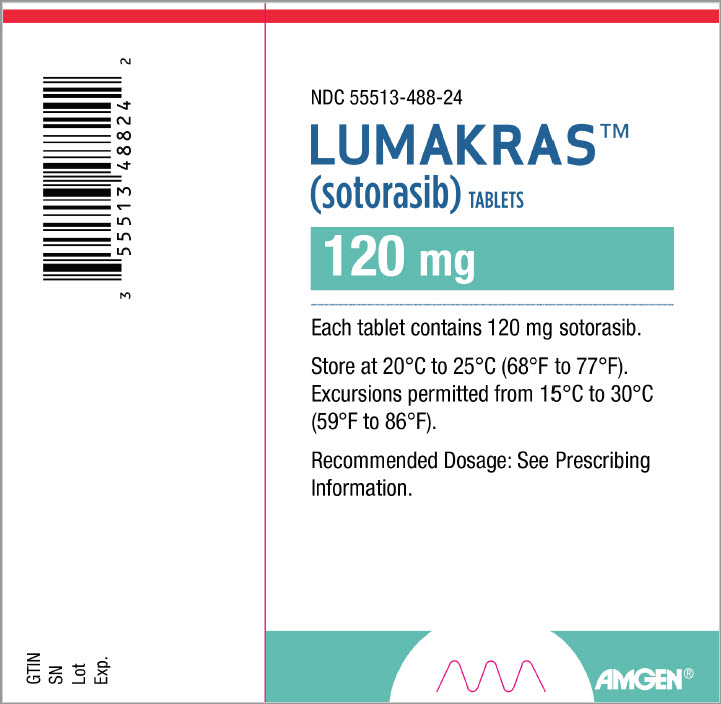
LUMAKRAS (sotorasib) 120 mg tablets are yellow, oblong-shaped, film-coated, debossed with "AMG" on one side and "120" on the opposite side are supplied as follows:
- Carton containing two bottles of 120 tablets with child-resistant closure, NDC 55513-488-02
- Carton containing one bottle of 240 tablets with child-resistant closure, NDC 55513-488-24
Hepatotoxicity
Advise patients to immediately contact their healthcare provider for signs and symptoms of liver dysfunction [see Warnings and Precautions (5.1)].
Interstitial Lung Disease (ILD)/Pneumonitis
Advise patients to contact their healthcare provider immediately to report new or worsening respiratory symptoms [see Warnings and Precautions (5.2)].
Lactation
Advise women not to breastfeed during treatment with LUMAKRAS and for 1 week after the final dose [see Use in Specific Populations (8.2)].
Drug Interactions
Advise patients to inform their healthcare provider of all concomitant medications, including prescription medicines, over-the-counter drugs, vitamins, dietary and herbal products. Inform patients to avoid proton pump inhibitors, and H2 receptor antagonists while taking LUMAKRAS [see Drug Interactions (7.1) and (7.2)].
If coadministration with an acid-reducing agent cannot be avoided, inform patients to take LUMAKRAS 4 hours before or 10 hours after a locally acting antacid [see Dosage and Administration (2.4)].
Missed Dose
If a dose of LUMAKRAS is missed by greater than 6 hours, resume treatment as prescribed the next day [see Dosage and Administration (2.2)].
LUMAKRAS™ (sotorasib)
Manufactured by:
Amgen Inc.
One Amgen Center Drive
Thousand Oaks, CA 91320-1799 U.S.A.
Patent: http://pat.amgen.com/lumakras/
© 2021 Amgen Inc. All rights reserved.
1XXXXXX – V1