Other
WARNING: ISCHEMIC HEART DISEASE:
Following abrupt cessation of therapy with certain beta-blocking agents, exacerbations of angina pectoris and, in some cases, myocardial infarction have occurred. When discontinuing chronically administered metoprolol succinate extended-release tablets, particularly in patients with ischemic heart disease, the dosage should be gradually reduced over a period of 1 - 2 weeks and the patient should be carefully monitored. If angina markedly worsens or acute coronary insufficiency develops, metoprolol succinate extended-release tablets administration should be reinstated promptly, at least temporarily, and other measures appropriate for the management of unstable angina should be taken. Warn patients against interruption or discontinuation of therapy without the physician's advice. Because coronary artery disease is common and may be unrecognized, it may be prudent not to discontinue metoprolol succinate extended-release tablets therapy abruptly even in patients treated only for hypertension (5.1).
Metoprolol succinate extended-release is an extended-release tablet intended for once daily administration. For treatment of hypertension and angina, when switching from immediate-release metoprolol to metoprolol succinate extended-release tablets, use the same total daily dose of metoprolol succinate extended-release tablets. Individualize the dosage of metoprolol succinate extended-release tablets. Titration may be needed in some patients.
Metoprolol succinate extended-release tablets are scored and can be divided; however, do not crush or chew the whole or half tablet.
25 mg tablets: White, oval, biconvex, film-coated tablet scored on both sides and debossed with "W" and "34" on either side of the score on one side.
50 mg tablets: White, circular, beveled edge, biconvex, film-coated tablet debossed with
"W" on one side and scored on other side.
735
100 mg tablets: White, circular, beveled edge, biconvex, film-coated tablet debossed with
"W" on one side and scored on other side.
736
200 mg tablets: White, oval, beveled edge, biconvex, film-coated tablet debossed with "W737"on one side and scored on other side.
Metoprolol succinate extended-release tablets are contraindicated in severe bradycardia, second or third degree heart block, cardiogenic shock, decompensated cardiac failure, sick sinus syndrome (unless a permanent pacemaker is in place), and in patients who are hypersensitive to any component of this product.
The following adverse reactions are described elsewhere in labeling:
- Worsening angina or myocardial infarction. [see Warnings and Precautions (5)]
- Worsening heart failure. [see Warnings and Precautions (5)]
- Worsening AV block. [see Contraindications (4)]
Signs and Symptoms - Overdosage of metoprolol succinate extended-release tablets may lead to severe bradycardia, hypotension, and cardiogenic shock. Clinical presentation can also include: atrioventricular block, heart failure, bronchospasm, hypoxia, impairment of consciousness/coma, nausea and vomiting.
Treatment - Consider treating the patient with intensive care. Patients with myocardial infarction or heart failure may be prone to significant hemodynamic instability. Seek consultation with a regional poison control center and a medical toxicologist as needed. Beta-blocker overdose may result in significant resistance to resuscitation with adrenergic agents, including beta-agonists. On the basis of the pharmacologic actions of metoprolol, employ the following measures.
There is very limited experience with the use of hemodialysis to remove metoprolol, however metoprolol is not highly protein bound.
Bradycardia: Administer intravenous atropine; repeat to effect. If the response is inadequate, consider intravenous isoproterenol or other positive chronotropic agents. Evaluate the need for transvenous pacemaker insertion.
Hypotension: Treat underlying bradycardia. Consider intravenous vasopressor infusion, such as dopamine or norepinephrine.
Bronchospasm: Administer a beta2-agonist, including albuterol inhalation, or an oral theophylline derivative.
Cardiac Failure: Administer diuretics or digoxin for congestive heart failure. For cardiogenic shock, consider IV dobutamine, isoproterenol, or glucagon.
Metoprolol succinate is a beta1-selective (cardioselective) adrenoceptor blocking agent, for oral administration, available as extended-release tablets. Metoprolol succinate extended-release tablet has been formulated to provide a controlled and predictable release of metoprolol for once-daily administration. The tablets comprise a multiple unit system containing metoprolol succinate in a multitude of controlled release pellets. Each pellet acts as a separate drug delivery unit and is designed to deliver metoprolol continuously over the dosage interval. The tablets contain 23.75, 47.5, 95 and 190 mg of metoprolol succinate equivalent to 25, 50, 100 mg and 200 mg of metoprolol tartrate, USP, respectively. Its chemical name is (±)1-(isopropylamino)-3-[p-(2-methoxyethyl) phenoxy]-2-propanol succinate (2:1) (salt). Its structural formula is:

Structure (Metosucertabs M Figure 01)
Metoprolol succinate is a white to off-white, fine crystalline powder with a molecular weight of 652.8. It is freely soluble in water; soluble in methanol; sparingly soluble in alcohol; slightly soluble in isopropyl alcohol. Inactive ingredients: microcrystalline cellulose, ethyl cellulose, triethyl citrate, methacrylic acid co-polymer dispersion, talc, polyethylene glycol, hypromellose, titanium dioxide, silicified microcrystalline cellulose, croscarmellose sodium and sodium stearyl fumarate.
In five controlled studies in normal healthy subjects, the same daily doses of metoprolol succinate extended-release tablets and immediate-release metoprolol were compared in terms of the extent and duration of beta1-blockade produced. Both formulations were given in a dose range equivalent to 100-400 mg of immediate-release metoprolol per day. In these studies, metoprolol succinate extended-release tablet was administered once a day and immediate-release metoprolol was administered once to four times a day. A sixth controlled study compared the beta1-blocking effects of a 50 mg daily dose of the two formulations. In each study, beta1-blockade was expressed as the percent change from baseline in exercise heart rate following standardized submaximal exercise tolerance tests at steady state. Metoprolol succinate extended-release tablets administered once a day, and immediate-release metoprolol administered once to four times a day, provided comparable total beta1-blockade over 24 hours (area under the beta1-blockade versus time curve) in the dose range 100-400 mg. At a dosage of 50 mg once daily, metoprolol succinate extended-release tablets produced significantly higher total beta1-blockade over 24 hours than immediate-release metoprolol. For metoprolol succinate extended-release tablets, the percent reduction in exercise heart rate was relatively stable throughout the entire dosage interval and the level of beta1-blockade increased with increasing doses from 50 to 300 mg daily. The effects at peak/trough (ie, at 24-hours post-dosing) were: 14/9, 16/10, 24/14, 27/22 and 27/20% reduction in exercise heart rate for doses of 50, 100, 200, 300 and 400 mg metoprolol succinate extended-release tablets once a day, respectively. In contrast to metoprolol succinate extended-release tablets, immediate-release metoprolol given at a dose of 50-100 mg once a day produced a significantly larger peak effect on exercise tachycardia, but the effect was not evident at 24 hours. To match the peak to trough ratio obtained with metoprolol succinate extended-release tablets over the dosing range of 200 to 400 mg, a t.i.d. to q.i.d. divided dosing regimen was required for immediate-release metoprolol. A controlled cross-over study in heart failure patients compared the plasma concentrations and beta1-blocking effects of 50 mg immediate-release metoprolol administered t.i.d., 100 mg and 200 mg metoprolol succinate extended-release tablets once daily. A 50 mg dose of immediate-release metoprolol t.i.d. produced a peak plasma level of metoprolol similar to the peak level observed with 200 mg of metoprolol succinate extended-release tablets. A 200 mg dose of metoprolol succinate extended-release tablets produced a larger effect on suppression of exercise-induced and Holter-monitored heart rate over 24 hours compared to 50 mg t.i.d. of immediate-release metoprolol.
In a double-blind study, 1092 patients with mild-to-moderate hypertension were randomized to once daily metoprolol succinate extended-release tablets (25, 100, or 400 mg), PLENDIL® (felodipine extended-release tablets), the combination, or placebo. After 9 weeks, metoprolol succinate extended-release tablets alone decreased sitting blood pressure by 6-8/4-7 mmHg (placebo-corrected change from baseline) at 24 hours post-dose. The combination of metoprolol succinate extended-release tablets with PLENDIL has greater effects on blood pressure.
In controlled clinical studies, an immediate-release dosage form of metoprolol was an effective antihypertensive agent when used alone or as concomitant therapy with thiazide-type diuretics at dosages of 100-450 mg daily. Metoprolol succinate extended-release tablets, in dosages of 100 to 400 mg once daily, produces similar β1-blockade as conventional metoprolol tablets administered two to four times daily. In addition, metoprolol succinate extended-release tablet administered at a dose of 50 mg once daily lowered blood pressure 24-hours post-dosing in placebo-controlled studies. In controlled, comparative, clinical studies, immediate-release metoprolol appeared comparable as an antihypertensive agent to propranolol, methyldopa, and thiazide-type diuretics, and affected both supine and standing blood pressure. Because of variable plasma levels attained with a given dose and lack of a consistent relationship of antihypertensive activity to drug plasma concentration, selection of proper dosage requires individual titration.
Tablets containing metoprolol succinate equivalent to the indicated weight of metoprolol tartrate, USP, are white, biconvex, film-coated, and scored.
*The 25 mg tablet is scored on both sides. | |||||||
| Tablet | Shape | Debossed | Bottle of 30 NDC 64679- | Bottle of 100 NDC 64679- | Bottle of 500 NDC 64679- | Unit Dose Packages of 100 NDC 64679- | Dispenser Carton Pack (12 Bottles x 30 Tablets) NDC 64679- |
| 25 mg* | Oval | W and 34 | 734-01 | 734-02 | 734-03 | 734-05 | 734-09 |
| 50 mg | Circular, beveled edge | W 735 | 735-01 | 735-02 | 735-03 | 735-05 | 735-09 |
| 100 mg | Circular, beveled edge | W 736 | 736-01 | 736-02 | 736-03 | 736-05 | 736-09 |
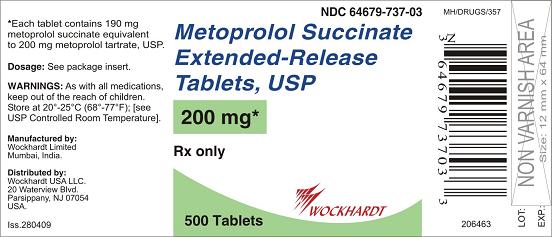
| 200 mg | Oval, beveled edge | W737 | 737-01 | 737-02 | 737-03 | 737-05 | --- |
Store at 20°-25°C (68°-77°F); [see USP Controlled Room Temperature].
Advise patients to take metoprolol succinate extended-release tablets regularly and continuously, as directed, preferably with or immediately following meals. If a dose is missed, the patient should take only the next scheduled dose (without doubling it). Patients should not interrupt or discontinue metoprolol succinate extended-release tablets without consulting the physician.
Advise patients (1) to avoid operating automobiles and machinery or engaging in other tasks requiring alertness until the patient's response to therapy with metoprolol succinate extended-release tablets has been determined; (2) to contact the physician if any difficulty in breathing occurs; (3) to inform the physician or dentist before any type of surgery that he or she is taking metoprolol succinate extended-release tablets.
Heart failure patients should be advised to consult their physician if they experience signs or symptoms of worsening heart failure such as weight gain or increasing shortness of breath.
PLENDIL is trademark of the AstraZeneca group of companies.
Manufactured by:
Wockhardt Limited
Mumbai, India.
Distributed by:
Wockhardt USA LLC.
20 Waterview Blvd.
Parsippany, NJ 07054
USA.
Rev.110713