Other
Amiodarone injection is indicated for initiation of treatment and prophylaxis of frequently recurring ventricular fibrillation (VF) and hemodynamically unstable ventricular tachycardia (VT) in patients refractory to other therapy. Amiodarone also can be used to treat patients with VT/VF for whom oral amiodarone is indicated, but who are unable to take oral medication. During or after treatment with amiodarone, patients may be transferred to oral amiodarone therapy [see Dosage and Administration (2)].
Use amiodarone for acute treatment until the patient's ventricular arrhythmias are stabilized. Most patients will require this therapy for 48 to 96 hours, but amiodarone may be safely administered for longer periods if necessary.
Amiodarone shows considerable interindividual variation in response. Although a starting dose adequate to suppress life-threatening arrhythmias is needed, close monitoring with adjustment of dose is essential. The recommended starting dose of amiodarone is about 1000 mg over the first 24 hours of therapy, delivered by the following infusion regimen:
| Loading infusions | First Rapid: | 150 mg over the FIRST 10 minutes (15 mg/min). Add 3 mL of amiodarone (150 mg) to 100 mL D5W (concentration = 1.5 mg/mL). Infuse 100 mL over 10 minutes. |
Followed by Slow: | 360 mg over the NEXT 6 hours (1 mg/min). Add 18 mL of amiodarone (900 mg) to 500 mL D5W (concentration = 1.8 mg/mL) | |
| Maintenance infusion | 540 mg over the REMAINING 18 hours (0.5 mg/min). Decrease the rate of the slow loading infusion to 0.5 mg/min. |
After the first 24 hours, continue the maintenance infusion rate of 0.5 mg/min (720 mg per 24 hours) utilizing a concentration of 1 to 6 mg/mL (Use a central venous catheter for amiodarone concentrations greater than 2 mg/mL). The rate of the maintenance infusion may be increased to achieve effective arrhythmia suppression.
In the event of breakthrough episodes of VF or hemodynamically unstable VT, use 150 mg supplemental infusions of amiodarone (mixed in 100 mL of D5W and infused over 10 minutes to minimize the potential for hypotension).
The first 24-hour dose may be individualized for each patient; however, in controlled clinical trials, mean daily doses above 2100 mg were associated with an increased risk of hypotension. Do not exceed an initial infusion rate of 30 mg/min.
Based on the experience from clinical studies of intravenous amiodarone, a maintenance infusion of up to 0.5 mg/min can be continued for 2 to 3 weeks regardless of the patient's age, renal function, or left ventricular function. There has been limited experience in patients receiving intravenous amiodarone for longer than 3 weeks.
The surface properties of solutions containing injectable amiodarone are altered such that the drop size may be reduced. This reduction may lead to underdosage of the patient by up to 30% if drop counter infusion sets are used. Amiodarone must be delivered by a volumetric infusion pump.
Administer amiodarone, whenever possible, through a central venous catheter dedicated to that purpose. Use an in-line filter during administration.
Intravenous amiodarone loading infusions at much higher concentrations and rates of infusion much faster than recommended have resulted in hepatocellular necrosis and acute renal failure, leading to death [see Warnings and Precautions (5.3)].
Intravenous amiodarone concentrations greater than 3 mg/mL in D5W have been associated with a high incidence of peripheral vein phlebitis; however, concentrations of 2.5 mg/mL or less appear to be less irritating. Therefore, for infusions longer than 1 hour, do not exceed amiodarone concentrations of 2 mg/mL, unless a central venous catheter is used [see Adverse Reactions (6.2)].
Amiodarone infusions exceeding 2 hours must be administered in glass or polyolefin bottles containing D5W. Do not use evacuated glass containers for admixing, as incompatibility with a buffer in the container may cause precipitation.
Amiodarone adsorbs to polyvinyl chloride (PVC) tubing, but all of the clinical experience as been with PVC tubing and the concentrations and rates of infusion provided in DOSAGE AND ADMINISTRATION reflect dosing in these studies.
Amiodarone has been found to leach out plasticizers, including DEHP [di-(2-ethylhexyl)phthalate] from intravenous tubing (including PVC tubing). The degree of leaching increases when infusing amiodarone at higher concentrations and lower flow rates than provided in DOSAGE AND ADMINISTRATION. Polysorbate 80, a component of amiodarone injection, is also known to leach DEHP from PVC [see Description (11)].
Amiodarone does not need to be protected from light during administration.
NOTE: Inspect parenteral drug products for particulate matter and discoloration prior to administration, whenever solution and container permit.
| Concentration | |||
| Solution | (mg/mL) | Container | Comments |
| 5% Dextrose in Water (D5W) | 1 - 6 | PVC | Physically compatible, with amiodarone loss <10% at 2 hours at room temperature. |
| 5% Dextrose in Water (D5W) | 1 - 6 | Polyolefin, Glass | Physically compatible, with no amiodarone loss at 24 hours at room temperature. |
Admixture Incompatibility
Amiodarone in D5W is incompatible with the drugs shown in Table 3.
Drug | Vehicle | Amiodarone Concentration | Comments |
| Aminophylline | D5W | 4 mg/mL | Precipitate |
| Cefamandole Nafate | D5W | 4 mg/mL | Precipitate |
| Cefazolin Sodium | D5W | 4 mg/mL | Precipitate |
| Mezlocillin Sodium | D5W | 4 mg/mL | Precipitate |
| Heparin Sodium | D5W | -- | Precipitate |
| Sodium Bicarbonate | D5W | 3 mg/mL | Precipitate |
Intravenous to Oral Transition
Patients whose arrhythmias have been suppressed by amiodarone may be switched to oral amiodarone. When changing to oral amiodarone therapy, clinical monitoring is recommended, particularly for elderly patients. See package insert for oral amiodarone.
Since grapefruit juice is known to inhibit CYP3A-mediated metabolism of oral amiodarone in the intestinal mucosa, resulting in increased plasma levels of amiodarone, do not drink grapefruit juice during treatment with oral amiodarone [see Drug Interactions (7)].
Table 4 provides suggested doses of oral amiodarone to be initiated after varying durations of amiodarone administration. These recommendations are made on the basis of a similar total body amount of amiodarone delivered by the intravenous and oral routes, based on 50% bioavailability of oral amiodarone.
# Assuming a 720 mg/day infusion (0.5 mg/min). | |
* Intravenous amiodarone is not intended for maintenance treatment. | |
| Duration of Amiodarone Infusion# | Initial Daily Dose of Oral Amiodarone |
| < 1 week | 800-1600 mg |
| 1-3 weeks | 600-800 mg |
| > 3 weeks* | 400 mg |
Injection, 50 mg/mL
Amiodarone is contraindicated in patients with:
- Known hypersensitivity to any of the components of amiodarone, including iodine. Hypersensitivity reactions may involve rash, angioedema, cutaneous/mucosal hemorrhage (bleeding), fever, arthralgias (joint pains), eosinophilia (abnormal blood counts), uritcaria (hives), thrombotic thrombocytopenic purpura, or severe periarteritis (inflammation around blood vessels).
- Cardiogenic shock.
- Marked sinus bradycardia.
- Second- or third-degree atrio-ventricular (AV) block unless a functioning pacemaker is available.
Amiodarone should be administered only by physicians who are experienced in the treatment of life-threatening arrhythmias, who are thoroughly familiar with the risks and benefits of amiodarone therapy, and who have access to facilities adequate for monitoring the effectiveness and side effects of treatment.
Amiodarone is metabolized to the active metabolite desethylamiodarone by the cytochrome P450 (CYP450) enzyme group, specifically cytochromes P4503A4 (CYP3A) and CYP2C8. The CYP3A isoenzyme is present in both the liver and intestines.
Amiodarone is an inhibitor of CYP3A. Therefore, amiodarone has the potential for interactions with drugs or substances that may be substrates, inhibitors or inducers of CYP3A. While only a limited number of in vivo drug-drug interactions with amiodarone have been reported, chiefly with the oral formulation, the potential for other interactions should be anticipated. This is especially important for drugs associated with serious toxicity, such as other antiarrhythmics. If such drugs are needed, reassess their dose and, where appropriate, measure plasma concentrations. In view of the long and variable half-life of amiodarone, potential for drug interactions exists not only with concomitant medication but also with drugs administered after discontinuation of amiodarone.
Since amiodarone is a substrate for CYP3A and CYP2C8, drugs/substances that inhibit these isoenzymes may decrease the metabolism and increase serum concentration of amiodarone. Reported examples include the following:
Protease inhibitors:
Protease inhibitors are known to inhibit CYP3A to varying degrees. A case report of one patient taking amiodarone 200 mg and indinavir 800 mg three times a day resulted in increases in amiodarone concentrations from 0.9 mg/L to 1.3 mg/L. DEA concentrations were not affected. There was no evidence of toxicity. Consider monitoring for amiodarone toxicity and serial measurement of amiodarone serum concentration during concomitant protease inhibitor therapy.
Histamine H1 antagonists:
Loratadine, a non-sedating antihistaminic, is metabolized primarily by CYP3A. QT interval prolongation and TdP have been reported with the co-administration of loratadine and amiodarone.
Histamine H2 antagonists:
Cimetidine inhibits CYP3A and can increase serum amiodarone levels.
Antidepressants:
Trazodone, an antidepressant, is metabolized primarily by CYP3A. QT interval prolongation and TdP have been reported with the co-administration of trazodone and amiodarone.
Other substances:
Grapefruit juice given to healthy volunteers increased amiodarone AUC by 50% and Cmax by 84%, resulting in increased plasma levels of amiodarone. Do not take grapefruit juice during treatment with amiodarone.
Amiodarone inhibits p-glycoprotein and certain CYP450 enzymes, including CYP1A2, CYP2C9, CYP2D6, and CYP3A. This inhibition can result in unexpectedly high plasma levels of other drugs which are metabolized by those CYP450 enzymes or are substrates for p-glycoprotein. Reported examples of this interaction include the following:
Immunosuppressives:
Cyclosporine (CYP3A substrate) administered in combination with oral amiodarone has been reported to produce persistently elevated plasma concentrations of cyclosporine resulting in elevated creatinine, despite reduction in dose of cyclosporine.
HMG-CoA Reductase Inhibitors:
Simvastatin (CYP3A substrate) in combination with amiodarone has been associated with reports of myopathy/rhabdomyolysis.
Cardiovasculars:
Cardiac glycosides: In patients receiving digoxin therapy, administration of oral amiodarone regularly results in an increase in serum digoxin concentration that may reach toxic levels with resultant clinical toxicity. Amiodarone taken concomitantly with digoxin increases the serum digoxin concentration by 70% after one day. On administration of oral amiodarone, review the need for digitalis therapy and reduce the dose of digitalis by approximately 50% or discontinue digitalis. If digitalis treatment is continued, monitor serum levels closely and observe patients for clinical evidence of toxicity.
Antiarrhythmics:
Other antiarrhythmic drugs, such as quinidine, procainamide, disopyramide, and phenytoin, have been used concurrently with amiodarone. There have been case reports of increased steady-state levels of quinidine, procainamide, and phenytoin during concomitant therapy with amiodarone. Phenytoin decreases serum amiodarone levels. Amiodarone taken concomitantly with quinidine increases quinidine serum concentration by 33% after two days. Amiodarone taken concomitantly with procainamide for less than seven days increases plasma concentrations of procainamide and n-acetyl procainamide by 55% and 33%, respectively. Reduce quinidine and procainamide doses by one-third when either is administered with amiodarone.
Plasma levels of flecainide have been reported to increase in the presence of oral amiodarone; adjust the dose of flecainide when these drugs are administered concomitantly. In general, initiate any added antiarrhythmic drug at a lower than usual dose and monitor the patient carefully.
Reserve the combination of amiodarone with other antiarrhythmic therapy to patients with life-threatening ventricular arrhythmias who are incompletely responsive to a single agent or incompletely responsive to amiodarone. During transfer to oral amiodarone, reduce the dose levels of previously administered agents by 30 to 50% several days after the addition of oral amiodarone. Review the continued need for the other antiarrhythmic agent after the effects of amiodarone have been established, and attempt discontinuation. If the treatment is continued, carefully monitor these patients for adverse effects, especially for conduction disturbances and exacerbation of tachyarrhythmias. In amiodarone-treated patients who require additional antiarrhythmic therapy, the initial dose of such agents should be approximately half of the usual recommended dose.
Antihypertensives:
Use amiodarone with caution in patients receiving ß-receptor blocking agents (e.g., propranolol, a CYP3A inhibitor) or calcium channel antagonists (e.g., verapamil, a CYP3A substrate, and diltiazem, a CYP3A inhibitor) because of the possible potentiation of bradycardia, sinus arrest, and AV block; if necessary, amiodarone can continue to be used after insertion of a pacemaker in patients with severe bradycardia or sinus arrest.
Anticoagulants:
Potentiation of warfarin-type (CYP2C9 and CYP3A substrate) anticoagulant response is almost always seen in patients receiving amiodarone and can result in serious or fatal bleeding. Since the concomitant administration of warfarin with amiodarone increases the prothrombin time by 100% after 3 to 4 days, reduce the dose of the anticoagulant by one-third to one-half, and monitor prothrombin times closely.
Clopidogrel, an inactive thienopyridine prodrug, is metabolized in the liver by CYP3A to an active metabolite. A potential interaction between clopidogrel and amiodarone resulting in ineffective inhibition of platelet aggregation has been reported.
Some drugs/substances are known to accelerate the metabolism of amiodarone by stimulating the synthesis of CYP3A (enzyme induction). This may lead to low amiodarone serum levels and potential decrease in efficacy. Reported examples of this interaction include the following:
Antibiotics:
Rifampin is a potent inducer of CYP3A. Administration of rifampin concomitantly with oral amiodarone has been shown to result in decreases in serum concentrations of amiodarone and desethylamiodarone.
Other substances, including herbal preparations:
St. John's Wort (Hypericum perforatum) induces CYP3A. Since amiodarone is a substrate for CYP3A, St. John's Wort likely reduces amiodarone levels.
Other reported interactions with amiodarone:
Fentanyl (CYP3A substrate) in combination with amiodarone may cause hypotension, bradycardia, and decreased cardiac output.
Sinus bradycardia has been reported with oral amiodarone in combination with lidocaine (CYP3A substrate) given for local anesthesia. Seizure, associated with increased lidocaine concentrations, has been reported with concomitant administration of intravenous amiodarone.
Dextromethorphan is a substrate for both CYP2D6 and CYP3A. Amiodarone inhibits CYP2D6.
Cholestyramine increases enterohepatic elimination of amiodarone and may reduce its serum levels and t½.
Disopyramide causes QT prolongation which could induce arrhythmia.
Fluoroquinolones, macrolide antibiotics, and azoles are known to cause QTc prolongation. There have been reports of QTc prolongation, with or without TdP, in patients taking amiodarone when fluoroquinolones, macrolide antibiotics, or azoles were administered concomitantly [see Warnings and Precautions (5.4)].
Hemodynamic and electrophysiologic interactions have also been observed after concomitant administration with propranolol, diltiazem, and verapamil.
Volatile Anesthetic Agents: Patients who are on amiodarone therapy may be more sensitive to the myocardial depressant and conduction defects of halogenated inhalational anesthetics [see Warnings and Precautions (5.9)].
In addition to the interactions noted above, chronic (> 2 weeks) oral amiodarone administration impairs metabolism of phenytoin, dextromethorphan, and methotrexate.
There have been cases, some fatal, of amiodarone overdose. Effects of an inadvertent overdose of intravenous amiodarone include hypotension, cardiogenic shock, bradycardia, AV block, and hepatotoxicity. Treat hypotension and cardiogenic shock by slowing the infusion rate or with standard therapy: vasopressor drugs, positive inotropic agents, and volume expansion. Bradycardia and AV block may require temporary pacing. Monitor hepatic enzyme concentrations closely. Amiodarone is not dialyzable.
Amiodarone injection contains amiodarone HCl (C25H29I2NO3•HCl), a class III antiarrhythmic drug. Amiodarone HCl is (2-butyl-3-benzo-furanyl)[4-[2-(diethylamino)ethoxy]-3,5-diiodophenyl]methanone hydrochloride.
Amiodarone HCl has the following structural formula:
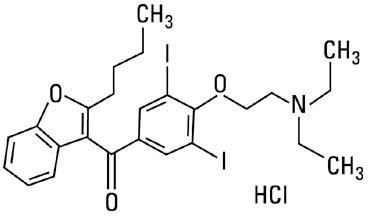
Structure (Amiohclinj M Figure 01)
Amiodarone HCl is a white to slightly yellow crystalline powder, and is very slightly soluble in water. It has a molecular weight of 681.78 and contains 37.3% iodine by weight. Amiodarone injection is a sterile clear, pale-yellow micellar solution visually free from particulates. Each milliliter of the amiodarone formulation contains 50 mg of amiodarone HCl USP, 20.2 mg of benzyl alcohol, 100 mg of polysorbate 80, and water for injection.
Amiodarone injection contains polysorbate 80, which is known to leach di-(2-ethylhexyl)phthalate (DEHP) from polyvinylchloride (PVC) [(see Dosage and Administration (2)].
Apart from studies in patients with VT or VF, described below, there are two other studies of amiodarone showing an antiarrhythmic effect before significant levels of DEA could have accumulated. A placebo-controlled study of intravenous amiodarone (300 mg over 2 hours followed by 1200 mg/day) in post-coronary artery bypass graft patients with supraventricular and 2- to 3-consecutive-beat ventricular arrhythmias showed a reduction in arrhythmias from 12 hours on. A baseline-controlled study using a similar IV regimen in patients with recurrent, refractory VT/VF also showed rapid onset of antiarrhythmic activity; amiodarone therapy reduced episodes of VT by 85% compared to baseline.
The acute effectiveness of intravenous amiodarone in suppressing recurrent VF or hemodynamically unstable VT is supported by two randomized, parallel, dose-response studies of approximately 300 patients each. In these studies, patients with at least two episodes of VF or hemodynamically unstable VT in the preceding 24 hours were randomly assigned to receive doses of approximately 125 or 1000 mg over the first 24 hours, an 8-fold difference. In one study, a middle dose of approximately 500 mg was evaluated. The dose regimen consisted of an initial rapid loading infusion, followed by a slower 6-hour loading infusion, and then an 18-hour maintenance infusion. The maintenance infusion was continued up to hour 48. Additional 10-minute infusions of 150 mg intravenous amiodarone were given for "breakthrough" VT/VF more frequently to the 125 mg dose group, thereby considerably reducing the planned 8-fold differences in total dose to 1.8- and 2.6-fold, respectively, in the two studies.
The prospectively defined primary efficacy end point was the rate of VT/VF episodes per hour. For both studies, the median rate was 0.02 episodes per hour in patients receiving the high dose and 0.07 episodes per hour in patients receiving the low dose, or approximately 0.5 versus 1.7 episodes per day (p=0.07, 2-sided, in both studies). In one study, the time to first episode of VT/VF was significantly prolonged (approximately 10 hours in patients receiving the low dose and 14 hours in patients receiving the high dose). In both studies, significantly fewer supplemental infusions were given to patients in the high-dose group. At the end of double-blind therapy or after 48 hours, all patients were given open access to whatever treatment (including intravenous amiodarone) was deemed necessary. Mortality was not affected in these studies.
Amiodarone Hydrochloride Injection, 50 mg/mL, is available, as follows:
NDC 64679-739-01, 150 mg in 3 mL, single-dose vial, carton of 1 vial.
NDC 64679-739-04, 150 mg in 3 mL, single-dose vial, carton of 5 vials.
NDC 64679-739-02, 150 mg in 3 mL, single-dose vial, carton of 10 vials.
NDC 64679-780-01, 900 mg/18 mL, multiple dose vial, carton of 1 vial.
Store at 20° to 25°C (68° to 77°F) [see USP Controlled Room Temperature].
Protect from light and excessive heat.
Use carton to protect contents from light until used.
This container closure is not made with natural rubber latex.
Amiodarone has the potential to cause serious side effects that limit its use to life-threatening and hemodynamically unstable cardiac arrhythmias. Advise female patients to discontinue nursing while being treated with amiodarone, as breast-feeding could expose the nursing infant to a significant dose of the drug. Recommend that patients avoid grapefruit juice, over-the-counter cough medicine (which commonly contain dextromethorphan), and St. John's Wort. Inform patients that most manufacturers of corneal refractive laser surgery devices contraindicate corneal refractive laser surgery in patients taking amiodarone. Discuss the symptoms of hypo- and hyper-thyroidism, particularly if patients will be transitioned to oral amiodarone.
Manufactured by:
Wockhardt Limited
Mumbai, India.
Distributed by:
Wockhardt USA LLC.
20 Waterview Blvd.
Parsippany, NJ 07054
USA.
Rev.171012
