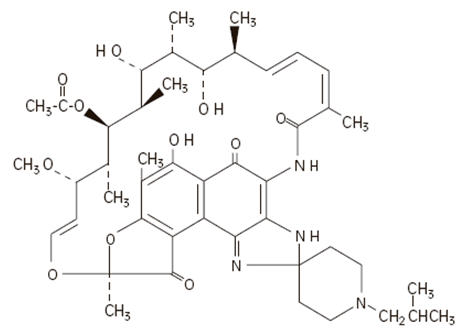
Considering data from the 023 and 027 pivotal trials, and from other clinical studies, MYCOBUTIN appears to be a likely cause of the following adverse events which occurred in less than 1% of treated patients: flu-like syndrome, hepatitis, hemolysis, arthralgia, myositis, chest pressure or pain with dyspnea, skin discoloration, thrombocytopenia, pancytopenia and jaundice.
The following adverse events have occurred in more than one patient receiving MYCOBUTIN, but an etiologic role has not been established: seizure, paresthesia, aphasia, confusion, and non-specific T wave changes on electrocardiogram.
When MYCOBUTIN was administered at doses from 1050 mg/day to 2400 mg/day, generalized arthralgia and uveitis were reported. These adverse experiences abated when MYCOBUTIN was discontinued.
Mild to severe, reversible uveitis has been reported less frequently when MYCOBUTIN is used at 300 mg as monotherapy in MAC prophylaxis versus MYCOBUTIN in combination with clarithromycin for MAC treatment (see also
WARNINGS).
Uveitis has been infrequently reported when MYCOBUTIN is used at 300 mg/day as montherapy in MAC prophylaxis of HIV-infected persons, even with the concomitant use of fluconazole and/or macrolide antibacterials. However, if higher doses of MYCOBUTIN are administered in combination with these agents, the incidence of uveitis is higher. FDA proposes moving this paragraph from below with some revisions.
Patients who developed uveitis had mild to severe symptoms that resolved after treatment with corticosteroids and/or mydriatic eye drops; in some severe cases, however, resolution of symptoms occurred after several weeks.
When uveitis occurs, temporary discontinuance of MYCOBUTIN and ophthalmologic evaluation are recommended. In most mild cases, MYCOBUTIN may be restarted; however, if signs or symptoms recur, use of MYCOBUTIN should be discontinued (Morbidity and Mortality Weekly Report, September 9, 1994).
Corneal deposits have been reported during routine ophthalmologic surveillance of some HIV-positive pediatric patients receiving MYCOBUTIN as part of a multiple drug regimen for MAC prophylaxis. The deposits are tiny, almost transparent, asymptomatic peripheral and central corneal deposits, and do not impair vision.
The following table enumerates the changes in laboratory values that were considered as laboratory abnormalities in Studies 023 and 027.
Table 4 Percentage of Patients With Laboratory Abnormalities| Laboratory abnormalities | MYCOBUTIN
(n = 566) %
| PLACEBO
(n = 580) %
|
|---|
| Includes grades 3 or 4 toxicities as specified: |
| Chemistry | | |
| Increased alkaline phosphatase
All values >450 U/L | <1 | 3 |
| Increased SGOT
| 7 | 12 |
| Increased SGPT
| 9 | 11 |
| Hematology | | |
| Anemia
All hemoglobin values <8.0 g/dL | 6 | 7 |
| Eosinophilia | 1 | 1 |
| Leukopenia
All WBC values <1,500/mm
3 | 17 | 16 |
| Neutropenia
All ANC values <750/mm
3 | 25 | 20 |
| Thrombocytopenia
All platelet count values <50,000/mm
3 | 5 | 4 |
The incidence of neutropenia in patients treated with MYCOBUTIN was significantly greater than in patients treated with placebo (p = 0.03). Although thrombocytopenia was not significantly more common among patients treated with MYCOBUTIN in these trials, MYCOBUTIN has been clearly linked to thrombocytopenia in rare cases. One patient in Study 023 developed thrombotic thrombocytopenic purpura, which was attributed to MYCOBUTIN.