Gabapentin
Product Images NDC 55695-017

13 FDA label images from Department Of State Health Services, Pharmacy Branch · Packaging, Regulatory Labels, and Product Appearance

Product Visual Gallery

This gallery contains 13 technical images submitted to the FDA as part of the official labeling for Gabapentin (NDC 55695-017). Unlike standard consumer photos, these assets often include clinical data figures, molecular chemical structures, and official manufacturer packaging layouts.

As provided by Department Of State Health Services, Pharmacy Branch, these visuals offer a comprehensive scientific overview of the product's physical and chemical identity, aiding pharmacists and researchers in product verification and study.

FDA Label Image

Label2 (Label2)

Label2 (Label2)
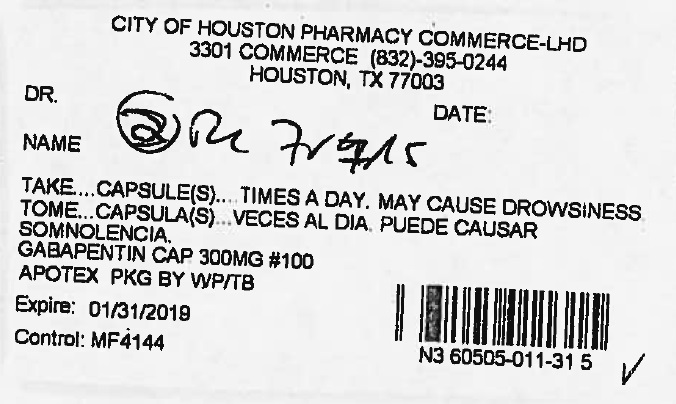
Pharmacy label from City of Houston Pharmacy Commerce-LHD for Gabapentin capsules, 300 mg, package of 100. The label includes dosing instructions in English and Spanish mentioning possible drowsiness. It also shows the labeler Apotex and an expiration date of 01/31/2019 with barcode and control number MF4144.*
FDA Label Image

Gabapentin-1 (Gabapentin 1)

Gabapentin-1 (Gabapentin 1)
An illustration showing a formula to calculate creatinine clearance (CLCr) using age, weight, sex adjustment factor (0.85 for females), and serum creatinine in mg/dL.*
FDA Label Image

Gabapentin-10 (Gabapentin 10)

Gabapentin-10 (Gabapentin 10)
Gabapentin tablet bottle label from the Department of State Health Services, Pharmacy Branch, displaying the proprietary name Gabapentin. The round white tablet is also visible next to the bottle, suggesting oral solid dosage form.*
FDA Label Image

Gabapentin-11 (Gabapentin 11)

Gabapentin-11 (Gabapentin 11)
Gabapentin oral solution bottle label from the Department of State Health Services, Pharmacy Branch. The label displays essential information including active ingredient (Gabapentin), without specifying strength or volume details visible in the image. The package is a clear amber bottle with a white child-resistant cap.*
FDA Label Image

Gabapentin-12 (Gabapentin 12)

Gabapentin-12 (Gabapentin 12)
Gabapentin oral solution bottle label from Department of State Health Services, Pharmacy Branch. The label shows a white and red color scheme with product name Gabapentin prominently visible on the front. The bottle has a child-resistant cap and contains a clear solution. The label also includes dosage instructions and patient information.*
FDA Label Image

Gabapentin-2 (Gabapentin 2)

Gabapentin-2 (Gabapentin 2)
Gabapentin oral tablet bottle label showing the product name Gabapentin. The label includes the Department of State Health Services, Pharmacy Branch as the labeler. The bottle appears to be white with black text and includes details such as tablet strength and counting information, though specific strengths are not fully legible in the image.*
FDA Label Image

Gabapentin-3 (Gabapentin 3)

Gabapentin-3 (Gabapentin 3)
Gabapentin tablet packaging label showing the product name Gabapentin. The label is primarily white and light blue, with the name Gabapentin prominently printed on it. The label also indicates it is provided by the Department of State Health Services, Pharmacy Branch. The image focuses on the strip or blister pack blister holding the tablets.*
FDA Label Image

Gabapentin-4 (Gabapentin 4)

Gabapentin-4 (Gabapentin 4)
Gabapentin capsule bottle label from the Department of State Health Services, Pharmacy Branch. The label includes dosage form as capsules and the product NDC 55695-017, with branding for Gabapentin. The label features a quantitative statement of capsule count and usage instructions in text.*
FDA Label Image

Gabapentin-5 (Gabapentin 5)

Gabapentin-5 (Gabapentin 5)
Chemical structure diagram displaying the molecular arrangement of gabapentin. The image shows a cyclohexane ring with carbon atoms connected, featuring side groups including an amino group (CH2NH2) and a carboxyl group (CH2CO2H) attached to the ring.*
FDA Label Image

Gabapentin-6 (Gabapentin 6)

Gabapentin-6 (Gabapentin 6)
A line graph showing mean pain scores over 8 weeks, comparing placebo and Gabapentin 3600 mg/day. The x-axis represents weeks, starting from baseline to week 8, divided into a 4-week dose titration period and a 4-week fixed dose period. The y-axis shows mean pain scores ranging from 0 to 10. Gabapentin shows a decreasing pain score trend over time, while placebo remains relatively stable.*
FDA Label Image

Gabapentin-7 (Gabapentin 7)

Gabapentin-7 (Gabapentin 7)
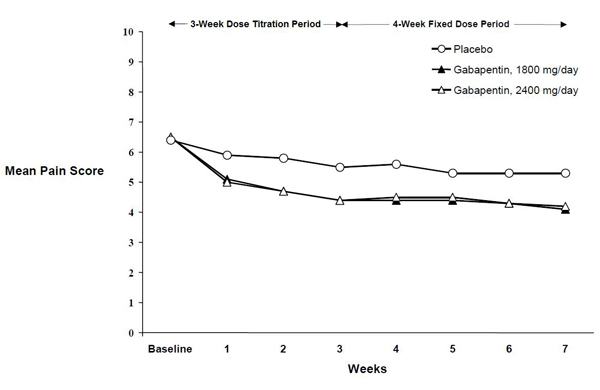
A line graph showing mean pain score changes over a 7-week period for placebo and two dosages of Gabapentin (1800 mg/day and 2400 mg/day). The X-axis represents weeks from baseline, divided into a 3-week dose titration period and a 4-week fixed dose period. The Y-axis shows mean pain scores ranging from 0 to 10. Gabapentin groups show a decline in pain scores over time compared to placebo.*
FDA Label Image

Gabapentin-8 (Gabapentin 8)

Gabapentin-8 (Gabapentin 8)
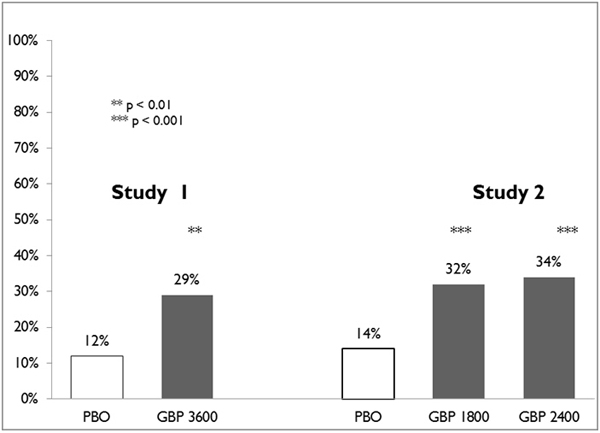
A bar chart comparing the percentage responses from two studies involving Gabapentin (GBP) and placebo (PBO). Study 1 shows results for placebo and GBP 3600 with percentages of 12% and 29%, respectively. Study 2 includes placebo, GBP 1800, and GBP 2400 with percentages of 14%, 32%, and 34%, respectively. Statistical significance is indicated with asterisks for p-values less than 0.01 and 0.001.*
FDA Label Image

Gabapentin-9 (Gabapentin 9)

Gabapentin-9 (Gabapentin 9)
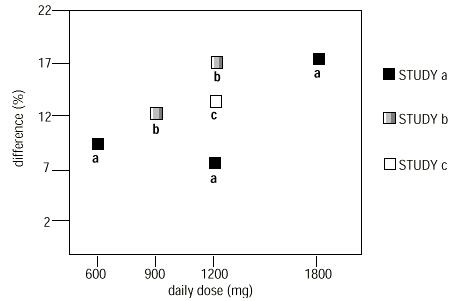
A scatter plot showing percentage difference on the y-axis versus daily dose in milligrams on the x-axis. Data points represent results from three different studies labeled a, b, and c, with doses ranging approximately from 600 mg to 1800 mg. Study a uses black squares, Study b uses gray squares, and Study c uses white squares, each with annotations for statistical significance.*

* About these descriptions: Image descriptions on this page are generated by automated AI analysis of the product label images from the manufacturer's FDA label submission (SPL). They are provided for reference only and may contain errors or omissions. Always rely on the printed label itself and the official FDA labeling, and consult a pharmacist or healthcare professional with any questions about this product.