Phocal Apf
FDA Label NDC 55918-001

Full FDA labeling including Indications, Dosage, Usage, and Precautions

Structured Product Label

The following Structured Product Label (SPL) was submitted to the FDA by U.s.i.a. Inc for the product Phocal Apf (NDC 55918-001). This document serves as the official prescribing information, containing essential scientific data and clinical materials required for healthcare providers and patients.

This specific version of the label includes detailed information regarding other, purpose and indications, description, directions for use, method 1 – insertion of flat phocal disks, method 2 – insertion of folded phocal disks, warnings, responsibility of the professional, and other regulatory disclosures. Use the navigation below to review specific sections of the FDA submission.

Other

easy interproximal therapy

Purpose And Indications

  • Phocal disks are topical delivery vehicles designed to fluoridate interproximal tooth surfaces. This action aids in the prevention of dental caries on intact surfaces, arrests progress on surfaces with incipient carious lesions and enhances remineralization. Phocal disks are also effective at tooth restoration margins and furcations.
  • Phocal disks are to be applied only by dental professionals at selected sites to achieve the desired benefits.

Description

  • The patented Phocal topical fluoride disks are provided in two forms:
    • - pink acidulated phosphate fluoride Apf disks
    • - yellow non-acidic sodium fluoride pHn disks
    • These thin, round disks contain 1.23% fluoride ions. Once positioned interproximally they rapidly expand, soften into a gel and release fluoride for approximately 10 minutes before biodegrading. This release period can be increased as explained in the Directions for Use.
    • Each Phocal Apf disk contains 0.103mg of sodium fluoride and 0.009mg of hydrogen fluoride in a matrix of FD&C red 3, gum arabic, gelatin (of marine origin), propolis wax, phosphoric acid, sodium benzoate and water. These disks induce an optimized low pH environment that cleans and etches tooth surfaces and facilitates fluoride penetration and stimulates remineralization.
    • Each Phocal pHn disk contains 0.122mg of sodium fluoride in a matrix of gum arabic, gelatin (of marine origin), propolis wax, sodium benzoate and water. These disks are less acidic than the Phocal Apf disks and will not etch ceramic crowns or tooth-colored restorations while inducing fluoridation and remineralization.

Directions For Use

  • There are different methods for the placement of Phocal fluoride disks.
  • The choice of placement method and Phocal type is subject to the discretion of the dental professional and is usually dependent upon the nature of the site being treated, interproximal tightness and the strength and type of adjacent restorations and teeth.
  • Prior to treatment using either of the placement methods below, all debris and calculus should be removed from the selected site(s) and the site(s) should remain dry during placement. Premature wetting softens the disks and can compromise correct interproximal placement.

Method 1 – Insertion Of Flat Phocal Disks

Recommended for anterior teeth and where spacing allows.
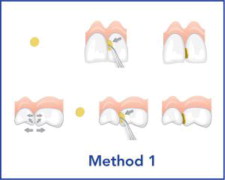
  • - When spacing allows, insert the flat Phocal disk interproximally with forceps and/or by hand directly between the contact points of the two adjacent teeth.
  • - In some cases, separation with wedges may be necessary prior to insertion.
    Figure (Pho01 0003 01)

    Figure (Pho01 0003 01)

Method 2 – Insertion Of Folded Phocal Disks

Recommended for posterior teeth and where spacing is restrictive.

  • - Where spacing is restricted, or where the apical regions such as tooth restoration margins must be reached, the disk can be folded into a V shape and easily inserted below the contact point.
  • - To fold the Phocal disk, lightly dampen the tips of a pair of thin forceps and shake off excess water, while keeping your hands completely dry. Use the tip of the thin forceps to moisten only the midline of the disk by moving the forceps tip back and forth along the midline. Be sure that midline is damp enough so the disk can fold without snapping.
  • - Then hold the disk at the midline with the thin forceps and gently fold the disk into a V shape with dry fingers. If you feel that the disk could snap, stop folding and repeat the midline moistening step.
  • - Insert the folded Phocal disk by hand and/or with forceps interproximally, with the apex at or below the contact area but over the gingival papillae and with each folded flap in contact with the wall of the adjacent teeth.
  • - The folded Phocal disk apex can be pushed further into the contact area. To accomplish this, insert a thin probe under the fold of the disk to apply coronal pressure alone, or simultaneously with an apical wedge force from the interproximal occlusal surface.
    Figure (Pho01 0003 02)

    Figure (Pho01 0003 02)

    • In rare cases nickel titanium springs, elastic O-rings or Maxian strips can be used to separate teeth but this is usually a slower process which requires two visits: one for separation and then one for disk placement.
    • To accelerate the initial reactions of Phocal disks a curing light can be applied for 3-10 seconds.
    • To extend the fluoride release time period, a varnish can be applied to partially cover the interproximal site or disk occlusally, buccally or/and lingually. However the disk should not be completely coated with varnish.
    • To shorten the release time the disks can be removed using an appropriate instrument, dental floss and/or aspiration.
    • If Phocal Apf is used, in order to guard against possible etching of porcelain crowns or tooth-colored restorations, a protective matrix should be used. With Phocal pHn there is no risk of etching.
    • Advise the patient not to eat, drink or rinse for at least 30 minutes after treatment.
    • If multiple applications are necessary, treat no more than 8 sites at a time and delay subsequent Phocal applications for at least a day.
    • If deemed necessary, patients may be recalled at intervals of 2 to 12 months for repeated treatments.
    • Phocal disks are versatile, and with specific gentle moisturization they can be trimmed, rolled, or folded to fit other inaccessible areas such as furcations.

Warnings

  • In rare cases, sensitivity or adverse reactions may be experienced. In such cases immediately remove the disks while preventing swallowing and refer the patient to a physician.
  • Patients less than 12 years old and patients with special needs should remain under professional supervision until the Phocal disks have biodegraded or have been removed.
  • The disks are not intended for systemic ingestion and should be kept out of children's reach. If more than 20 disks are accidently swallowed, seek immediate medical assistance.
  • Phocal should not be applied in sites with: gingival inflammation, immediately prior to or after oral soft tissue surgery and in cases of known allergies to any of the Phocal ingredients.
  • Phocal is to be sold as unbroken boxes with all disks sealed within the blister packs and is to be used for application in the dental office by professionals only.
  • When Phocal treatment is utilized, routine systemic and topical administrations of fluoride should be suspended during the day of application.
  • Since the propolis wax and gelatin used in Phocal disks are natural products, they may occasionally interact to produce brownish spots or discoloration. This does not indicate that there is any hazard or danger in using the product.
  • Recommended storage temperatures are 40°F-75°F (5°C-25°C).

Responsibility Of The Professional

  • Phocal disks have been developed for use only by licensed professionals in the dental care setting. Colldent Ltd warrants the quality of the products for the uses described and when used in the manners outlined here and in our sales and delivery documents. It is the responsibility of the professional to use the products in such manner.
  • For additional information
    www.Phocaltherapy.com • 888-Phocal-3 (746-2253)

Quick Reference Insertion Guide

The interproximal sites and disk must be kept dry during placement.

Method 1 – Insertion of flat Phocal disks

Recommended for anterior teeth and where spacing allows
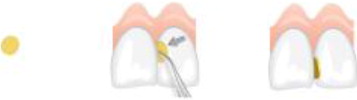
Figure (Pho01 0003 03)

Figure (Pho01 0003 03)

When spacing allows, insert the disk with forceps and/or by hand.
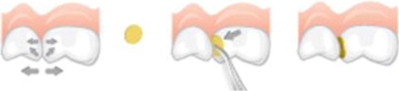
Figure (Pho01 0003 04)

Figure (Pho01 0003 04)

In some cases, separation with wedges may be necessary prior to insertion.

Method 2 – Insertion of folded Phocal disks

Recommended for posterior teeth and where spacing is restrictive

When spacing is restrictive, the disk can be folded and easily inserted below the contact point.
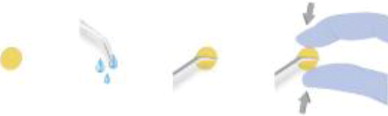
Figure (Pho01 0003 05)

Figure (Pho01 0003 05)

To fold, lightly dampen the tips of a pair of thin forceps and shake off excess water, while keeping your hands completely dry.

Use the tip of the thin forceps to moisten only the midline of the disk by moving the forceps tip back and forth along the midline. Then hold the disk along the midline with the thin forceps and gently fold the disk into a V shape with dry fingers.

If you feel that the disk could snap, stop folding and repeat the midline moistening step.
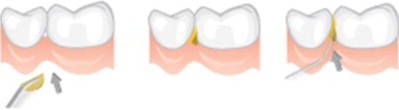
Figure (Pho01 0003 06)

Figure (Pho01 0003 06)

Insert the folded disk below the contact area as shown.

Use a thin probe to push the disk further into the contact area.

Package Label.Principal Display Panel

Principal Display panel – Box Label

fluoride treatment disks
for professional use only

phocal™ Apf

easy interproximal therapy

20 disks,
4.5mg each

phocal

Apf disks

Principal Display Panel – Box Label (Pho01 0003 07)

Principal Display Panel – Box Label (Pho01 0003 07)

* Please review the disclaimer below.