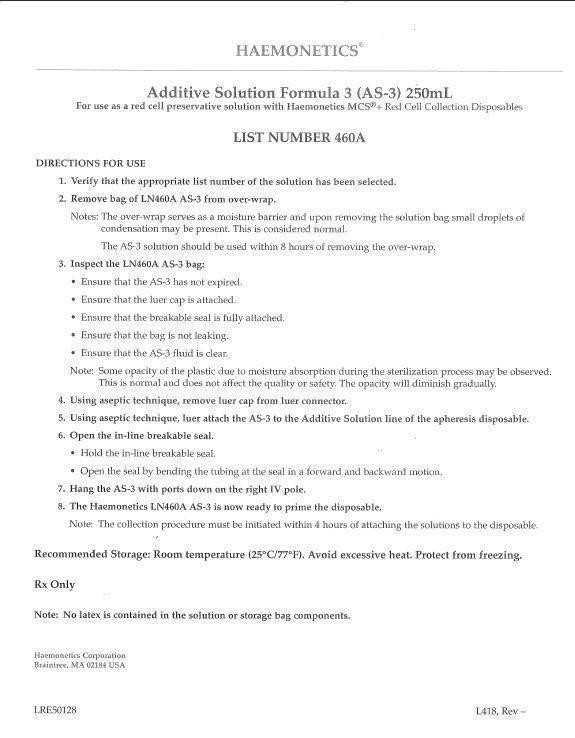
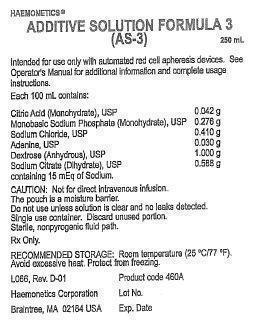
Studies of the effectiveness of 250mL CP2D and 250mL AS-3 made by Haemonetics Corporation Union, South Carolina facility included
in vivo survival data in healthy subjects at one test site and
in vitro characterization of stored red blood cells at three test sites.
Haemonetics Clinical Evaluation #95012, involved autologous in vivo recovery and survival studies, and
in vitro red blood cell characterization conducted at a single site. RBC results collected with Haemonetics CP2D/AS-3 were compared to crossover controls of manually collected RBCs from the same donors using CP2D/AS-3 made by Medsep Corporation (crossover manual controls). In addition, results were compared to data from other RBC apheresis donors using CP2D/AS-3 solutions manufactured by MedSep (unmatched apheresis controls). Test parameters included hematocrit, hemoglobin, RBC and WBC counts, ATP levels, pH, supernatant potassium, free hemoglobin, supernatant glucose levels, and product weight. The RBC quality of test units after 42-day storage was equivalent or slightly superior to those of the control units. RBCs collected by the two different collection protocols (Red Blood Cells with or without Plasma) showed no significant differences in terms of RBC quality and red blood cells from all groups met FDA and AABB guidelines for 24-hour recovering at 42 days storage.
Study #98001 was performed using 250mL CP2D and 250mL AS-3 to confirm,
in vitro, the results of Clinical Evaluation #95012. Three test sites each performed three RBCP and three 2RBC apheresis procedures using the MCS+ LN8150 and associated collection sets. In addition, each site collected six manual whole blood units as concurrent (unmatched) controls using Medsep sets and prepared RBCs according to standard procedures.
In vitro tests of red blood cell functional and physical integrity were conducted at Days 0 and 42 of storage. All plasma units from the RBCP and manual procedures were evaluated on Day 0 for
in vitro product characteristics. Group t-tests (two tailed) were performed to examine any statistically significant differences between the properties of apheresis and manual RBCs. Statistically significant differences
(p<n; 0.05) were evaluated in terms of clinical significance. Differences in glucose or lactate levels, hematocrit, pH, and supernatant potassium were not considered clinically relevant because these parameters have not been found to correlate significantly with the
in vivo 24 hour percent recovery.
The results from this study confirmed the observations from Clinical Evaluation #95012. The quality of stored RBC products collected by apheresis is similar to RBC products collected manually. A difference in ATP and hemolysis levels, both after processing and on day 42 of storage, for the apheresis units were not statistically significant when compared to ATP and hemolysis levels from manually collected RBCs and were similar to historical reference values.
AS-3 300mL was used in conjunction with an automated closed system, the Haemonetics Model 215 (now called the ACP) in Clinical Evaluation #97002. Five test sites were used in this study. 100 samples were tested in vitro and 30
in vivo. Red blood cells derived from CPDA-1 whole blood units were used. AS-1 red blood cells were used as a control. A total of 140 red blood cell units were glycerolized and deglycerolized. The
in vitro RBC quality and
in vivo RBC viability data obtained on these units demonstrate that red cell units glycerolized and deglycerolized using the Model 215 System and resuspended in 300mL AS-3 solution manufactured by Haemonetics, Union, South Carolina are processed in a closed system and can be stored for 15 days at 4°C.
Clinical report TR-CLN-100229-B summarizes a study conducted to support the use of CP2D for the collection of FFP and PF24 (plasma collected and stored Plasma collected using the 822, 822-2P and 822F-2P disposable sets may be frozen within 8 hours (FFP) or within 24 hours which includes 8 hours room temperature storage and 16 hours refrigeration storage (PF24). The following tables provide a summary of the results of this evaluation.
Note: Table 1, Table 2, and Table 3 below demonstrate the results of a clinical study conducted for various coagulation factors on plasma that was frozen within 8 hours (FPP) versus plasma frozen within 24 hours, which includes 8 hours room temperature storage and 16 hours refrigeration storage (PF24).
As noted in Table 1 below, significant differences were observed between PF24 and FFP for assays Prothrombin Time, Partial Thromboplastin Time, FVIIa, and FVIII.
Table 2 provides the results for Plasma Sample A and Plasma Sample B, which were outliers and subsequently excluded from the analysis.
Table 3 provides a summary of how many samples tested in each group differed by >20% when FFP and PF24 were compared.
Table 1, Summary of FFP and PF24 plasma product assays (N=59)| *Sample size = 58. The outlier pair was excluded from the analysis based on the statistical criteria or laboratory errors. |
| Assay | Mean
(SD) | | Median | | (Min, Max) | | Mean difference (PF24, FFP)
(95% confidence interval) |
| FFP | PF24 | FFP | PF24 | FFP | PF24 | |
Prothrombin Time
(sec)
| 12.0 (0.50) | 12.1 (0.59) | 11.9 | 12.1 | (11.2, 13.8) | (10.5, 14.0) | 0.15 (0.09, 0.20) |
| Activated Partial Thromboplastin Time (sec) | 29.4 (3.32) | 30.3 (3.34) | 28.8 | 29.8 | (23.1, 38.5) | (24.1, 39.5) | 0.86 (0.64, 1.08) |
| Factor V (%) | 120.1 (23.93) | 120.0 (23.88) | 120.0 | 120.0 | (61.0, 181.0) | (59.0, 182.0) | -0.14
(-2.03, 1.76)
|
Factor VIIa
(mU/mL)*
| 60.5 (26.95) | 45.0 (24.72) | 54.0 | 41.5 | (21.0, 131.0) | (12.0, 159.0) | -15.50
(-19.23, -11.77)
|
| Factor VIII:C (%)* | 94.3 (34.24) | 81.7 (27.31) | 88.5 | 82.5 | (33.0, 194.0) | (34.0, 152.0) | -12.67
(-15.97, -9.38)
|
| AT-III (%) | 97.8 (12.24) | 94.7 (15.97) | 98.0 | 95.0 | (71.0, 126.0) | (19.0, 134.0) | -3.05
(-6.30, 0.20)
|
| Factor XI (%) | 112.2 (17.42) | 112.8 (18.46) | 113.0 | 113.0 | (81.0, 151.0) | (82.0, 155.0) | 0.63
(-0.70, 1.95)
|
| vWF (R:Co) (% function) | 89.5 (35.65) | 89.4 (35.58) | 85.0 | 87.0 | (35.0, 179.0) | (37.0, 185.0) | -0.15
(-2.21, 1.91)
|
Protein S
(% activity)
| 74.9 (19.61) | 73.4 (20.76) | 72.0 | 71.0 | (33.0, 125.0) | (39.0, 126.0) | -1.49
(-3.81, 0.83)
|
Protein C
(% activity)
| 117.1 (17.59) | 117.7 (17.49) | 115.0 | 118.0 | (65.0, 157.0) | (68.0, 162.0) | 0.53
(-0.54, 1.59)
|
| Fibrinopeptide F 1.2 (pmol/L)* | 136.4 (63.34) | 133.1 (55.15) | 113.0 | 114.0 | (80.0, 344.0) | (80.0, 331.0) | -3.29
(-8.37, 1.78)
|
Thrombin-
Antithrombin
Complex (ng/mL)
| 2.3 (1.38) | 2.1 (0.40) | 2.0 | 2.0 | (2.0, 12.4) | (2.0, 4.8) | -0.17
(-0.53, 0.18)
|
One sample (Plasma Sample A) showed significantly increased levels for Factor VIIa and F1.2. Another sample (Plasma Sample B) showed significantly decreased level of Factor VIII:C for the FFP sample (Table 2). These data were excluded from Table 1 since the values for VIIa and F1.2 were more than 4 SD from the mean. The factor VIII:C was not more than 4 SD from the mean but was significantly lower in FFP as compared to PF24. While other parameters in this sample did not show significant differences when compared to the control FFP, the FDA could not exclude the possibility that the activation found in the PF24 sample was related to the preparation procedure. The rate of such event occurrence was unknown and, based on review of published values for PF24 products, is most likely very rare. The clinical significance of the elevated markers of clotting activation for transfusion recipients is undetermined.
Table 2, Three outlier pairs in plasma measurements| Subject # | Measurement | FFP | PF24 | Range without the outliers | | | |
| | | | FFP | | PF24 | |
| | | | Min | Max | Min | Max |
| RBCP16 | Factor FVIIa (mU/mL) | 220 | 767 | 21 | 131 | 12 | 159 |
| RBCP16 | F1.2 (pmol/L) | 702 | 1940 | 80 | 344 | 80 | 331 |
| RBCP01 | Factor VIII: C (%) | 2 | 63 | 33 | 194 | 34 | 152 |
Table 3, Proportion of Paired Sample: PF24 is greater than or less than FFP by more than 20%| Assay | PF24>FFP by more than 20% | PF24<FFP by more than 20% |
| Prothrombin Time (sec) | 0% (0/59) | 0% (0/59) |
| Partial Thromboplastin Time (sec) | 0% (0/59) | 0% (0/59) |
| Factor V (%) | 1.7% (1/59) | 0% (0/59) |
| Factor VIIa (mU/mL) | 3.4% (2/58) | 89.7% (52/58) |
| AT-III (%) | 1.7% (1/59) | 8.5% (5/59) |
| Factor VIII:C (%) | 1.7% (1/58) | 22.4% (13/58) |
| Factor XI (%) | 0% (0/59) | 0% (0/59) |
| Fibrinopeptide 1.2 (pmol/L) | 0% (0/58) | 1.7% (1/58) |
| Protein C (% activity) | 0% (0/59) | 0% (0/59) |
| Protein S (% activity) | 5.1% (3/59) | 1.7% (1/59) |
Thrombin-Antithrombin Complex
(ng/mL)
| 1.7% (1/59) | 3.4% (2/59) |
| vWF (% activity) | 3.4% (2/59) | 1.7% (1/59) |
Note: Plasma collected may be labeled as FFP or Plasma Frozen within 24 Hours (PF24).
Note: For FFP, the plasma should be placed in a freezer within 8 hours from the completion of collection. The plasma should be frozen at -18°C or colder.
For product intended to be labeled as PF24, the plasma should be refrigerated within 8 hours of collection at 1 – 6°C and frozen within 24 hours of collection.
FFP and PF24 should be frozen at -18°C or colder.