Other
RESPIRATORY DEPRESSION
Fatal respiratory depression has occurred in patients treated with immediate-release transmucosal fentanyl, including following use in opioid non-tolerant patients and improper dosing. The substitution of ABSTRAL for any other fentanyl product may result in fatal overdose.
Due to the risk of respiratory depression, ABSTRAL is contraindicated in the management of acute or postoperative pain including headache/migraine and in opioid non-tolerant patients. [see Contraindications (4)]
ABSTRAL must be kept out of reach of children. [see Patient Counseling Information (17.1) and How Supplied/Storage and Handling (16.1)]
The concomitant use of ABSTRAL with CYP3A4 inhibitors may result in an increase in fentanyl plasma concentrations, and may cause potentially fatal respiratory depression. [see Drug Interactions (7)]
MEDICATION ERRORS
Substantial differences exist in the pharmacokinetic profile of ABSTRAL compared to other fentanyl products that result in clinically important differences in the extent of absorption of fentanyl that could result in fatal overdose.
- When prescribing, do not convert patients on a mcg per mcg basis from any other fentanyl products to ABSTRAL. (2.1)- When dispensing, do not substitute an ABSTRAL prescription for other fentanyl products.
ABUSE POTENTIAL
ABSTRAL contains fentanyl, an opioid agonist and a Schedule II controlled substance, with an abuse liability similar to other opioid analgesics. ABSTRAL can be abused in a manner similar to other opioid agonists, legal or illicit. This should be considered when prescribing or dispensing ABSTRAL in situations where the physician or pharmacist is concerned about an increased risk of misuse, abuse or diversion.
Because of the risk for misuse, abuse, addiction, and overdose, ABSTRAL is available only through a restricted program, required by the Food and Drug Administration, called a Risk Evaluation and Mitigation Strategy (REMS). Under the TIRF (Transmucosal Immediate Release Fentanyl) REMS Access program, outpatients, healthcare professionals who prescribe to outpatients, pharmacies, and distributors must enroll in the program [see Warnings and Precautions (5.10)]. Further information is available at www.TIRFREMSAccess.com or by calling1-866-822-1483.
Titration Steps: If adequate analgesia was not obtained with the first 100 mcg dose, continue dose escalation in a stepwise manner over consecutive breakthrough episodes until adequate analgesia with tolerable side effects is achieved. Increase the dose by 100 mcg multiples up to 400 mcg as needed. If adequate analgesia is not obtained with a 400 mcg dose, the next titration step is 600 mcg. If adequate analgesia is not obtained with a 600 mcg dose, the next titration step is 800 mcg. During titration, patients can be instructed to use multiples of 100 mcg tablets and/or 200 mcg tablets for any single dose. Instruct patients not to use more than 4 tablets at one time. If adequate analgesia is not obtained 30 minutes after the use of ABSTRAL, the patient may repeat the same dose of ABSTRAL. No more than two doses of ABSTRAL may be used to treat an episode of breakthrough pain. Rescue medication as directed by the health care provider can be used if adequate analgesia is not achieved after use of ABSTRAL.
The efficacy and safety of doses higher than 800 mcg have not been evaluated in clinical studies in patients.
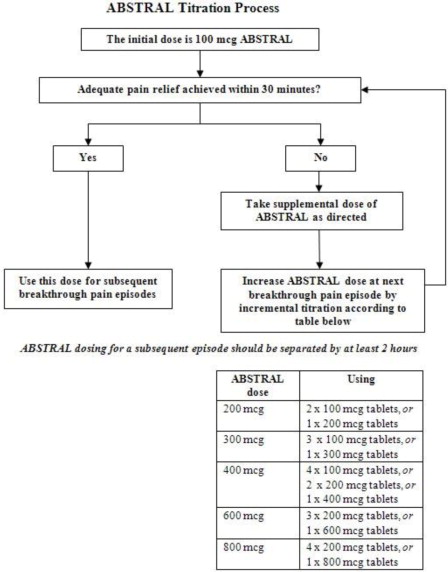
Figure (Abs02 0001 01)
In order to minimize the risk of ABSTRAL-related adverse reactions and to identify the appropriate dose, it is imperative that patients be supervised closely by health professionals during the titration process.
Central Nervous System
The precise mechanism of the analgesic action is unknown although fentanyl is known to be a μ-opioid receptor agonist. Specific CNS opioid receptors for endogenous compounds with opioid-like activity have been identified throughout the brain and spinal cord and play a role in the analgesic effects of this drug.
Fentanyl produces respiratory depression by direct action on brain stem respiratory centers. The respiratory depression involves both a reduction in the responsiveness of the brain stem to increases in carbon dioxide and to electrical stimulation.
Fentanyl causes miosis even in total darkness. Pinpoint pupils are a sign of opioid overdose but are not pathognomonic (e.g., pontine lesions of hemorrhagic or ischemic origin may produce similar findings).
Gastrointestinal System
Fentanyl causes a reduction in motility associated with an increase in smooth muscle tone in the antrum of the stomach and in the duodenum. Digestion of food is delayed in the small intestine and propulsive contractions are decreased. Propulsive peristaltic waves in the colon are decreased, while tone may be increased to the point of spasm resulting in constipation. Other opioid induced-effects may include a reduction in gastric, biliary and pancreatic secretions, spasm of the sphincter of Oddi, and transient elevations in serum amylase.
Cardiovascular System
Fentanyl may produce release of histamine with or without associated peripheral vasodilation. Manifestations of histamine release and/or peripheral vasodilation may include pruritus, flushing, red eyes, sweating, and/or orthostatic hypotension.
Endocrine System
Opioid agonists have been shown to have a variety of effects on the secretion of hormones. Opioids inhibit the secretion of ACTH, cortisol, and luteinizing hormone (LH) in humans. They also stimulate prolactin secretion, growth hormone (GH) secretion, and pancreatic secretion of insulin and glucagon in humans and other species (e.g., rats and dogs). Thyroid stimulating hormone (TSH) has been shown to be both inhibited and stimulated by opioids.
Respiratory System
All opioid mu-receptor agonists, including fentanyl, produce dose-dependent respiratory depression. The risk of respiratory depression is less in patients receiving chronic opioid therapy who develop tolerance to these effects. Peak respiratory depressive effects may be seen as early as 15 to 30 minutes from the start of oral transmucosal fentanyl citrate administration and may persist for several hours.
Serious or fatal respiratory depression can occur even at recommended doses. Fentanyl depresses the cough reflex as a result of its CNS activity. Although not observed with oral transmucosal fentanyl products in clinical trials, fentanyl given rapidly by intravenous injection in large doses may cause rigidity in the muscles of respiration resulting in respiratory difficulties. Therefore, be aware of this potential complication [see Boxed Warning - Warnings: Importance Of Proper Patient Selection and Potential for Abuse, Contraindications (4), Warnings And Precautions (5.1), Adverse Reactions (6), and Overdosage (10)].
Absorption
Fentanyl is a highly lipophilic drug. Orally administered fentanyl undergoes pronounced hepatic and intestinal first pass effects. Absorption of fentanyl from ABSTRAL sublingual tablets is mainly through the oral mucosa.
The bioavailability of ABSTRAL sublingual tablets has been calculated to be 54%.
Dose proportionality across the 100 mcg to 800 mcg ABSTRAL dose range has been demonstrated (Table4). Mean plasma fentanyl levels following single doses of ABSTRAL are shown in Figure 1. The median time to maximum plasma concentration (Tmax) across these four doses of ABSTRAL varied from 30 to 60 minutes (range of 15 - 240 minutes).
Figure 1: Mean (+/- SD) Plasma Fentanyl Concentration versus Time after Administration of Single Doses of 100 mcg, 200 mcg, 400 mcg and 800 mcg ABSTRAL to Healthy Subjects
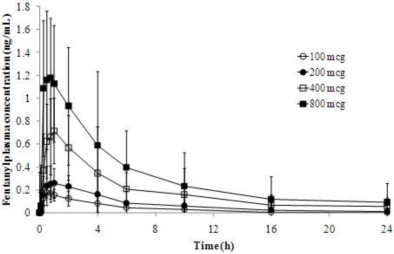
Figure 1 (Abs02 0001 03)
Pharmacokinetic parameters are presented in Table 4.
a: median (range) | |||||
| Parameter | Unit | Abstral dose | |||
| 100 mcg | 200 mcg | 400 mcg | 800 mcg | ||
| Cmax | (ng/mL) | 0.187 (33) | 0.302 (31) | 0.765 (38) | 1.42 (33) |
| Tmaxa | (min) | 30 [19-120] | 52 [16-240] | 60 [30-120] | 30 [15-60] |
| AUC0-inf | (ng.h/mL) | 0.974 (34) | 1.92 (27) | 5.49 (35) | 8.95 (33) |
| T1/2 | (h) | 5.02 (51) | 6.67 (30) | 13.5 (37) | 10.1 (34) |
In another study, dose proportionality between 800 mcg and 1600 mcg in Cmax and AUC has also been demonstrated.
Pharmacokinetic studies have shown that multiple tablets are bioequivalent to single tablets of the equivalent dose.
Distribution
Fentanyl is highly lipophilic. Animal data showed that following absorption, fentanyl is rapidly distributed to the brain, heart, lungs, kidneys and spleen followed by a slower redistribution to muscles and fat. The plasma protein binding of fentanyl is 80-85%. The main binding protein is alpha-1-acid glycoprotein, but both albumin and lipoproteins contribute to some extent. The free fraction of fentanyl increases with acidosis. The mean volume of distribution at steady state (Vss) was 4 L/kg. Metabolism
Fentanyl is metabolized in the liver and in the intestinal mucosa to norfentanyl by cytochrome P450 3A4 isoform. Norfentanyl was not found to be pharmacologically active in animal studies [see Drug Interactions (7)].
Elimination
Fentanyl is more than 90% eliminated by biotransformation to N-dealkylated and hydroxylated inactive metabolites. Less than 7% of the dose is excreted unchanged in the urine, and only about 1% is excreted unchanged in the feces. The metabolites are mainly excreted in the urine, while fecal excretion is less important. The total plasma clearance of fentanyl was 0.5 L/hr/kg (range 0.3 - 0.7 L/ hr/kg).