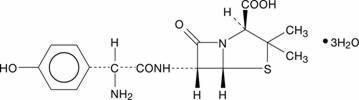
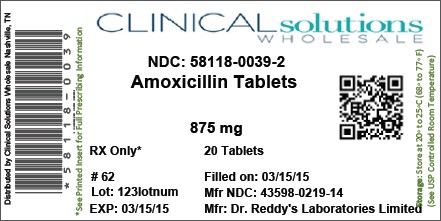
Absorption: Amoxicillin is stable in the presence of gastric acid and is rapidly absorbed after oral administration. The effect of food on the absorption of amoxicillin from the tablets and suspension of amoxicillin has been partially investigated; 400-mg and 875-mg formulations have been studied only when administered at the start of a light meal.
Orally administered doses of 250-mg and 500-mg amoxicillin capsules result in average peak blood levels 1 to 2 hours after administration in the range of 3.5 mcg/mL to 5.0 mcg/mL and 5.5 mcg/mL to 7.5 mcg/mL, respectively.
Mean amoxicillin pharmacokinetic parameters from an open, two-part, single-dose crossover bioequivalence study in 27 adults comparing 875 mg of amoxicillin with 875 mg of AUGMENTIN® (amoxicillin/clavulanate potassium) showed that the 875-mg tablet of amoxicillin produces an AUC0-∞ of 35.4 ± 8.1 mcg∙hr/mL and a Cmax of 13.8 ± 4.1 mcg/mL. Dosing was at the start of a light meal following an overnight fast.
Orally administered doses of amoxicillin suspension, 125 mg/5 mL and 250 mg/5 mL, result in average peak blood levels 1 to 2 hours after administration in the range of 1.5 mcg/mL to 3.0 mcg/mL and 3.5 mcg/mL to 5.0 mcg/mL, respectively.
Oral administration of single doses of 400-mg chewable tablets and 400 mg/5 mL suspension of amoxicillin to 24 adult volunteers yielded comparable pharmacokinetic data:
Table 3. Mean Pharmacokinetic Parameters of Amoxicillin (400 mg chewable tablets and 400 mg/5 mL suspension) in Healthy Adults| Dose* | AUC0-∞ (mcg∙hr/mL) | Cmax (mcg/mL)† |
|---|
Amoxicillin | Amoxicillin (±S.D.) | Amoxicillin (±S.D.) |
400 mg (5 mL of suspension) | 17.1 (3.1) | 5.92 (1.62) |
400 mg (1 chewable tablet) | 17.9 (2.4) | 5.18 (1.64) |
*Administered at the start of a light meal.
†Mean values of 24 normal volunteers. Peak concentrations occurred approximately 1 hour after the dose.
Distribution: Amoxicillin diffuses readily into most body tissues and fluids, with the exception of brain and spinal fluid, except when meninges are inflamed. In blood serum, amoxicillin is approximately 20% protein-bound. Following a 1-gram dose and utilizing a special skin window technique to determine levels of the antibiotic, it was noted that therapeutic levels were found in the interstitial fluid.
Metabolism and Excretion: The half-life of amoxicillin is 61.3 minutes. Approximately 60% of an orally administered dose of amoxicillin is excreted in the urine within 6 to 8 hours. Detectable serum levels are observed up to 8 hours after an orally administered dose of amoxicillin. Since most of the amoxicillin is excreted unchanged in the urine, its excretion can be delayed by concurrent administration of probenecid [see DRUG INTERACTIONS (7.1)].
Mechanism of Action
Amoxicillin is similar to penicillin in its bactericidal action against susceptible bacteria during the stage of active multiplication. It acts through the inhibition of cell wall biosynthesis that leads to the death of the bacteria.
Method of Resistance
Resistance to amoxicillin is mediated primarily through enzymes called beta-lactamases that cleave the beta-lactam ring of amoxicillin, rendering it inactive.
Amoxicillin has been shown to be active against most isolates of the bacteria listed below, both in vitro and in clinical infections as described in the INDICATIONS AND USAGE section (1).
| Gram-Positive Bacteria | Gram-Negative Bacteria |
|---|
Enterococcus faecalis | Escherichia coli |
Staphylococcus spp. | Haemophilus influenzae |
Streptococcus pneumoniae | Neisseria gonorrhoeae |
Alpha and β-hemolytic streptococci | Proteus mirabilis |
| Helicobacter pylori |
Susceptibility Test Methods: (susceptibility to amoxicillin can be determined using ampicillin powder and a 10 mcg ampicillin disk)
When available, clinical microbiology should provide the results of in vitro susceptibility test results for antimicrobial drugs used in resident hospitals to the physician as periodic reports that describe the susceptibility profile of nosocomial and community-acquired pathogens. These reports should aid the physician in selecting an antimicrobial drug product for treatment.
Dilution Techniques: Quantitative methods are used to determine antimicrobial minimum inhibitory concentrations (MICs). These MICs provide estimates of the susceptibility of bacteria to antimicrobial compounds. The MICs should be determined using a standardized procedure. Standardized procedures are based on dilution methods (broth or agar)2,3 or equivalent with standardized inoculum concentrations and standardized concentrations of ampicillin powder. The MIC values should be interpreted according to the criteria in Table 4.
Diffusion Techniques: Quantitative methods that require measurement of zone diameters also provide reproducible estimates of the susceptibility of bacteria to antimicrobial compounds. One such standardized procedure3 requires the use of standardized inoculum concentrations. This procedure uses paper disks impregnated with 10 mcg ampicillin to test the susceptibility of bacteria to ampicillin. Interpretation involves correlation of the diameter obtained in the disk test with the MIC for amoxicillin. Reports from the laboratory providing results of the standard single-disk susceptibility test with a 10 mcg ampicillin disk should be interpreted according to the criteria listed in Table 4.
Table 4. Susceptibility Test Interpretive Criteria for Amoxicillin | Minimum Inhibitory Concentration (mcg/mL) | Disk Diffusion (zone diameter in mm) |
|---|
| Susceptible | Intermediate | Resistant | Susceptible | Intermediate | Resistant |
Enterococcus spp. | ≤ 8 | - | ≥ 16 | ≥ 17 | - | ≤ 16 |
Staphylococcus spp. | ≤ 0.25 | | ≥ 0.5 | ≥ 29 | | ≤ 28 |
Streptococci, viridians group
(alpha-hemolytic streptococci) | ≤ 0.25 | 0.5 to 4 | ≥ 8 | - | - | - |
β-hemolytic streptococci | ≤ 0.25 | - | - | ≥ 24 | - | - |
Streptococcus pneumoniae (non-meningitis isolates)* | ≤ 2 | 4 | ≥ 8 | - | - | - |
Enterobacteriaceae | ≤ 8 | 16 | ≥ 32 | ≥ 17 | 14 to 16 | ≤ 13 |
Haemophilus influenzae | ≤ 1 | 2 | ≥ 4 | ≥ 22 | 19 to 21 | ≤ 18 |
Neisseria gonorrhoeae** | - | - | - | - | - | - |
*S. pneumoniae should be tested using a 1-mcg oxacillin disk. Isolates with oxacillin zone sizes of ≥ 20 mm are susceptible to amoxicillin. An amoxicillin MIC should be determined on isolates of S. pneumoniae with oxacillin zone sizes of ≤ 19 mm.
** A positive beta lactamase test indicates resistance to amoxicillin. Isolates that are resistant to penicillin by MIC testing are also expected to be resistant to amoxicillin.
A report of “Susceptible” indicates the pathogen is likely to be inhibited if the antimicrobial compound in the blood reaches concentrations that are usually achievable. A report of “Intermediate” indicates that result should be considered equivocal, and, if the microorganism is not fully susceptible to alternative, clinically feasible drugs, the test should be repeated. The intermediate category implies possible clinical applicability in body sites where the drug is physiologically concentrated or in situations where high dosage of drug can be used. The intermediate category also provides a buffer zone, which prevents small uncontrolled technical factors from causing major discrepancies in interpretation. A report of “Resistant” indicates the pathogen is not likely to be inhibited if the antimicrobial compound in the blood reaches concentrations that are usually achievable and other therapy(ies) are likely to be preferred.
Quality Control:
Susceptibility techniques require use of laboratory control microorganisms to control the technical aspects of the laboratory standardized procedures.2,3,4 Standard ampicillin powder should provide the MIC values described below. For the diffusion technique using the 10-mcg ampicillin disk, the criteria are provided in Table 5.
Table 5. Acceptable Quality Control Ranges for Amoxicillin| Bacteria | ATCC# | MIC Range (mcg/mL) | Disc Diffusion Zone Range (mm) |
|---|
Escherichia coli | 25922 | 2 to 8 | 16 to 22 |
Enterococcus faecalis | 29212 | 0.5 to 2 | |
Haemophilus influenzae | 49247 | 2 to 8 | 13 to 21 |
Staphylococcus aureus | 29213 | 0.5 to 2 | |
25923 | | 27 to 35 |
Streptococcus pneumoniae | 49619 | 0.06 to 0.25 | |
# ATCC = American Type Culture Collection
Susceptibility Testing for Helicobacter pylori : Amoxicillin in vitro susceptibility testing methods for determining minimum inhibitory concentrations (MICs) and zone sizes have not been standardized, validated, or approved for testing H. pylori. Specimens for H. pylori and clarithromycin susceptibility test results should be obtained on isolates from patients who fail triple therapy. If clarithromycin resistance is found, a non-clarithromycin-containing regimen should be used.
Capsules: Each capsule of amoxicillin, with royal blue opaque cap and pink opaque body, contains 250 mg or 500 mg amoxicillin as the trihydrate. The cap and body of the 250-mg capsule are imprinted with the product name AMOXIL and 250; the cap and body of the 500 mg capsule are imprinted with AMOXIL and 500.
250-mg Capsule
NDC 43598-225-01: Bottles of 100
NDC 43598-225-05: Bottles of 500
500-mg Capsule
NDC 43598-205-01: Bottles of 100
NDC 43598-205-05: Bottles of 500
Tablets: Each tablet contains 500 mg or 875 mg amoxicillin as the trihydrate. Each film-coated, capsule-shaped, pink tablet is debossed with AMOXIL centered over 500 or 875, respectively. The 875-mg tablet is scored on the reverse side.
500-mg Tablet
NDC 43598-224-14: Bottles of 20
NDC 43598-224-01: Bottles of 100
NDC 43598-224-05: Bottles of 500
875-mg Tablet
NDC 43598-219-14: Bottles of 20
NDC 43598-219-01: Bottles of 100
Powder for Oral Suspension: Each 5 mL of reconstituted strawberry-flavored suspension contains 125 mg amoxicillin as the trihydrate. Each 5 mL of reconstituted bubble-gum-flavored suspension contains 200 mg, 250 mg or 400 mg amoxicillin as the trihydrate.
125 mg/5 mL
NDC 43598-222-80: 80-mL bottle
NDC 43598-222-52: 100-mL bottle
NDC 43598-222-53: 150-mL bottle
200 mg/5 mL
NDC 43598-223-50: 50-mL bottle
NDC 43598-223-51: 75-mL bottle
NDC 43598-223-52: 100-mL bottle
250 mg/5 mL
NDC 43598-209-80: 80-mL bottle
NDC 43598-209-52: 100-mL bottle
NDC 43598-209-53: 150-mL bottle
400 mg/5 mL
NDC 43598-207-50: 50-mL bottle
NDC 43598-207-51: 75-mL bottle
NDC 43598-207-52: 100-mL bottle
Store at or below 25°C (77°F)