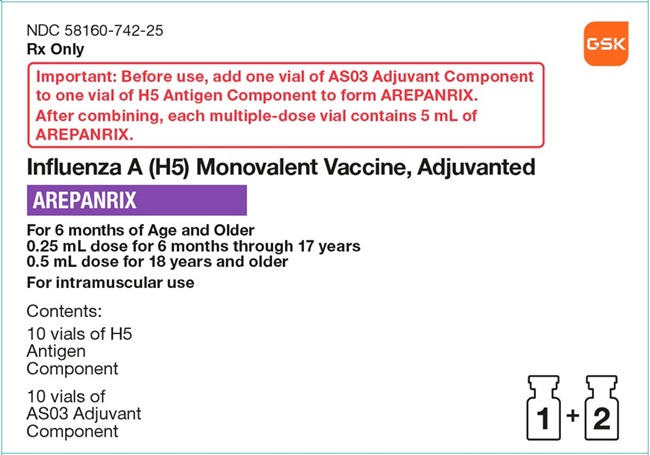
Because clinical trials are conducted under widely varying conditions, adverse reaction rates observed in the clinical trials of a vaccine cannot be directly compared with rates in the clinical trials of another vaccine and may not reflect the rates observed in practice. It is possible that broad use of AREPANRIX could reveal adverse reactions not observed in clinical trials.
Safety data accrued with AREPANRIX containing hemagglutinin (HA) from influenza virus strain A/Indonesia/05/2005 (H5N1) [referred to as AREPANRIX (Original)] are relevant to AREPANRIX containing HA from influenza virus strain A/Astrakhan/3212/2020‑like (H5N8) [referred to as AREPANRIX (H5N8)] because the antigens contained in the vaccines are manufactured according to a similar process.
In individuals 18 years of age and older, the most common solicited local and general reactions with AREPANRIX (Original) were injection site pain (83%) and muscle aches (45%), respectively.
In individuals 6 months through 17 years of age, the most common solicited local reaction with AREPANRIX (Original) was injection site pain: 47% (6 through 35 months of age), 71% (3 through 8 years of age), and 82% (9 through 17 years of age). The most common solicited general reactions were irritability (51% in 6 through 35 months of age, and 30% in 3 through 5 years of age) and muscle aches (35% in 6 through 8 years of age, and 42% in 9 through 17 years of age).
Adults
Study 1
In Study 1, a randomized, placebo-controlled, observer-blind, multicenter study, conducted in the U.S. and Canada, 4,561 subjects 18 years of age and older received AREPANRIX (Original) (n = 3,422) or saline placebo (n = 1,139) as a 2-dose vaccination series. Among adults 18 through 64 years of age, the mean age was 39 years (range: 18 through 64 years) and included 57% female subjects and 86% White subjects. Among adults 65 years of age and older, the mean age was 72 years (range: 65 through 91 years) and included 55% female subjects and 94% White subjects.
Solicited Adverse Reactions: Data on adverse reactions were collected using standardized forms for 7 days following receipt of AREPANRIX (Original) or placebo (i.e., day of vaccination and the next 6 days). The reported frequencies of solicited local and general adverse reactions are presented in Table 2.
Table 2. Percentage of Subjects with Solicited Local and General Adverse Reactions within 7 Daysa of Any Vaccination in Adults| n = Number of subjects who received at least 1 dose and for whom safety data were available. |
| a Within 7 days defined as day of vaccination or placebo injection and the next 6 days. |
| b Any swelling/erythema defined as >20 mm. Any fever defined as ≥100.4°F (38.0°C). |
| c Grade 2: Pain defined as pain on moving the limb that interferes with normal activities or requires repeated use of pain relievers. Swelling and erythema defined as >50 mm. Fever defined as ≥101.3°F (38.5°C). For all other reactions, defined as some interference with normal everyday activities or requires repeated use of pain relievers (for headache, joint pain, or muscle aches). |
| d Grade 3: Pain defined as significant pain at rest; prevents normal activities as assessed by inability to attend/do work or school. Swelling and erythema defined as >100 mm. Fever defined as ≥102.2°F (39.0°C). All other reactions were defined as those that prevented normal everyday activities, as assessed by inability to attend/do work or school, or those that required intervention of a physician/healthcare provider. |
| AREPANRIX (Original) (n = 3,375-3,376) % | Saline Placebo (n = 1,122-1,123) % |
Anyb | Grade 2c or 3d | Grade 3d | Anyb | Grade 2c or 3d | Grade 3d |
Local | | | | | | |
Injection site pain | 83 | 37 | 5 | 20 | 4 | 1 |
Injection site swelling | 10 | 3 | 0.1 | 1 | 0.3 | 0 |
Injection site erythema | 9 | 2 | 0.1 | 1 | 0.1 | 0 |
General | | | | | | |
Muscle aches | 45 | 21 | 3 | 21 | 7 | 2 |
Headache | 35 | 15 | 3 | 28 | 10 | 2 |
Fatigue | 34 | 16 | 3 | 23 | 9 | 2 |
Arthralgia | 25 | 11 | 2 | 12 | 4 | 1 |
Shivering | 17 | 7 | 2 | 10 | 5 | 1 |
Sweating | 11 | 4 | 1 | 7 | 3 | 1 |
Fever | 5 | 2 | 1 | 3 | 1 | 1 |
Unsolicited Adverse Events: The incidences of unsolicited adverse events reported during the 21‑day postvaccination periods for subjects who received AREPANRIX (Original) (n = 3,422) or placebo (n = 1,139) were 38.5% and 35.2%, respectively. Events reported in the AREPANRIX (Original) group at a rate of ≥0.5% of subjects and at a rate at least twice that of the placebo group were injection site pruritus (1.8% vs. 0.4%), dizziness (1.4% vs. 0.7%), injection site warmth (1.3% vs. 0.2%), injection site reaction (0.6% vs. 0.2%), and rash (0.6% vs. 0.3%).
Serious Adverse Events (SAEs): SAEs were reported for 0.5% of recipients of AREPANRIX (Original) (n = 3,422) and for 0.3% of placebo recipients (n = 1,139) through Day 42 (21 days following the second dose of vaccine or placebo). During the approximately one-year safety follow-up (Day 364), SAEs were reported for 3.3% of recipients of AREPANRIX (Original) and for 4.1% of placebo recipients.
The following SAEs reported through Day 182 in subjects who received AREPANRIX (Original) are noted due to a temporal association with vaccination or because no alternative plausible causes for the event were identified: cerebral vascular accidents on Day 1 and Day 9 following the second vaccine dose (1 subject), pulmonary embolism (1 subject) on Day 21 following the first vaccine dose, and corneal transplant rejection (1 subject) 18 years posttransplant on Day 103 following the second vaccine dose.
The following additional SAEs reported through Day 364 are noted because they were reported exclusively in subjects who received AREPANRIX (Original) and because no alternative plausible causes were identified: convulsion (3 subjects) on Days 35, 252, and 346 and thyroid cancer (3 subjects) on Days 21, 29, and 223.
Potential Immune-Mediated Diseases: Based on a prespecified list of events, 14 new onset potential immune-mediated diseases were reported through Day 364, for 13 subjects (0.4%) who received AREPANRIX (Original) (n = 3,422). An additional event was reported for 1 subject (0.09%) who received saline placebo (n = 1,139). Events reported following AREPANRIX (Original) included polymyalgia rheumatica (2 subjects), psoriasis (2 subjects), and 1 of each of the following: autoimmune hepatitis, celiac disease, cranial nerve IV palsy, Crohn’s disease, erythema nodosum, facial palsy, radiculitis, rheumatoid arthritis, rheumatoid lung, and temporal arteritis. An additional case of psoriasis was reported following placebo.
Study 2
Study 2 was a Phase 1/2, observer‑blind, multicenter trial conducted in the U.S., in which 129 adults received at least 1 dose of AREPANRIX (H5N8). Among 65 adults in the 18 through 64 years of age group, the mean age was 42 years (range: 21 through 63 years), 37% were female, 63% were White, 31% were Black or African American, 2% were Asian, 2% were Native Hawaiian or Other Pacific Islanders, and 34% were Hispanic or Latino. Among 64 adults ages 65 years and older, the mean age was 72 years (range: 65 through 87 years), 50% were female, 78% were White, 20% were Black or African American, 2% were Asian, and 20% were Hispanic or Latino.
Solicited Adverse Reactions: Data on adverse reactions were collected using standardized forms for 7 days following receipt of AREPANRIX (H5N8) (i.e., day of vaccination and the next 6 days). Solicited adverse reactions in Study 2 (AREPANRIX H5N8) were not reported at greater frequencies compared with Study 1 (AREPANRIX Original) The most frequent solicited local and systemic adverse reactions in both studies were injection site pain and muscle ache, respectively.
Serious Adverse Events (SAEs): SAEs were reported for 0.8% of subjects who received AREPANRIX (H5N8) (n = 129) to Day 43 (21 days following the second dose of vaccine). During the approximately 6‑month safety follow‑up (Day 201), SAEs were reported for 2.3% of subjects who received AREPANRIX (H5N8). None of the reported SAEs were considered related to vaccination.
Potential Immune-Mediated Diseases: No potential immune‑mediated diseases were reported during the approximately 6‑month safety follow‑up (Day 201).
Individuals 6 Months through 17 Years of Age
In Study 3, a randomized, placebo-controlled, observer-blind, multicenter trial, conducted in the U.S., Canada, and Thailand, 838 subjects 6 months through 17 years of age received AREPANRIX (Original) (n = 607) or saline placebo (n = 231) as a 2-dose vaccination series. In the overall population, the mean age was 7 years (range: 6 months through 17 years); 52% were male; 45% were White, 15% Black, 36% Asian, and 4% other racial groups; 11% were Hispanic or Latino. An uncontrolled crossover study was subsequently conducted in which 155 subjects who initially received placebo, then received AREPANRIX (Original) as a 2-dose series.
Solicited Adverse Reactions: Data on adverse events were collected using standardized forms for 7 days following receipt of AREPANRIX (Original) or placebo (i.e., day of vaccination and the next 6 days). The reported frequencies of solicited local and general adverse reactions are presented in Tables 3 through 5.
Table 3. Percentage of Subjects with Solicited Local and General Adverse Reactions within 7 Daysa of Any Vaccination in Individuals 6 through 35 Months of Age| n = Number of subjects who received at least 1 dose and for whom safety data were available. |
| a Within 7 days defined as day of vaccination or placebo injection and the next 6 days. |
| b Any swelling/erythema defined as >0 mm. Any fever defined as ≥100.4°F (38.0°C). |
| c Grade 2: Pain defined as cries/protests to touch. Fever defined as ≥101.3°F (38.5°C). For all other reactions, defined as some interference with normal everyday activities. |
| d Grade 3: Pain defined as cries when limb moved/spontaneously painful. Fever defined as ≥102.2°F (39.0°C). Loss of appetite defined as not eating at all. For all other reactions, defined as those that prevented normal everyday activities. |
| AREPANRIX (Original) % | Saline Placebo % |
Anyb | Grade 2c or 3d or >20 mm | Grade 3d or >50 mm | Anyb | Grade 2c or 3d or >20 mm | Grade 3d or >50 mm |
Local | n = 196 | n = 196 | n = 196 | n = 73 | n = 73 | n = 73 |
Injection site pain | 47.4 | 15.3 | 2.6 | 30.1 | 4.1 | 2.7 |
Injection site erythema | 33.7 | 4.1 | 0.5 | 26.0 | 0 | 0 |
Injection site swelling | 28.6 | 3.1 | 0.5 | 15.1 | 0 | 0 |
General | | | | | | |
Irritability/fussiness | 50.5 | 16.3 | 4.1 | 39.7 | 15.1 | 2.7 |
Drowsiness | 37.8 | 14.8 | 4.1 | 30.1 | 11.0 | 2.7 |
Loss of appetite | 29.1 | 10.2 | 3.1 | 32.9 | 15.1 | 5.5 |
Fever | 22.4 | 10.7 | 4.6 | 16.4 | 12.3 | 5.5 |
Table 4. Percentage of Subjects with Solicited Local and General Adverse Reactions within 7 Daysa of Any Vaccination in Individuals 3 through 8 Years of Age| n = Number of subjects who received at least 1 dose and for whom safety data were available. |
| a Within 7 days defined as day of vaccination or placebo injection and the next 6 days. |
| b Any swelling/erythema defined as >0 mm. Any fever defined as ≥100.4°F (38.0°C). |
| c Grade 2: Pain defined as cries/protests to touch (for those younger than 6 years) or pain on moving the limb that interferes with normal activities or requires repeated use of pain relievers. Fever defined as ≥101.3°F (38.5°C). For all other reactions, defined as some interference with normal everyday activities or requires repeated use of pain relievers (for headache, joint pain, or muscle aches). |
| d Grade 3: Pain defined as cries when limb moved/spontaneously painful (for those younger than 6 years) or significant pain at rest; prevents normal activities as assessed by inability to attend/do work or school. Fever defined as ≥102.2°F (39.0°C). Loss of appetite defined as not eating at all. For all other reactions, defined as those that prevented normal everyday activities, as assessed by inability to attend/do work or school for those 6 years and older, or those that required intervention of a healthcare provider. |
| e Nausea, vomiting, diarrhea, and/or abdominal pain. |
| AREPANRIX (Original) % | Saline Placebo % |
Anyb | Grade 2c or 3d or >20 mm | Grade 3d or >50 mm | Anyb | Grade 2c or 3d or >20 mm | Grade 3d or >50 mm |
Local | n = 197 | n = 197 | n = 197 | n = 76 | n = 76 | n = 76 |
Injection site pain | 71.1 | 24.4 | 5.1 | 38.2 | 2.6 | 0 |
Injection site erythema | 31.0 | 5.6 | 2.0 | 13.2 | 0 | 0 |
Injection site swelling | 27.9 | 7.1 | 2.0 | 18.4 | 1.3 | 1.3 |
General | | | | | | |
3 Years through 5 Years | n = 98 | n = 98 | n = 98 | n = 49 | n = 49 | n = 49 |
Irritability/fussiness | 29.6 | 7.1 | 2.0 | 22.4 | 4.1 | 0 |
Drowsiness | 27.6 | 4.1 | 1.0 | 14.3 | 2.0 | 0 |
Loss of appetite | 22.4 | 5.1 | 2.0 | 10.2 | 4.1 | 0 |
Fever | 15.3 | 9.2 | 5.1 | 18.4 | 8.2 | 2.0 |
6 Years through 8 Years | n = 99 | n = 99 | n = 99 | n = 27 | n = 27 | n = 27 |
Muscle aches | 35.4 | 8.1 | 3.0 | 18.5 | 0 | 0 |
Headache | 29.3 | 10.1 | 2.0 | 7.4 | 0 | 0 |
Fatigue | 22.2 | 10.1 | 0 | 3.7 | 0 | 0 |
Gastrointestinale | 17.2 | 5.1 | 1.0 | 22.2 | 3.7 | 0 |
Joint pain | 14.1 | 4.0 | 1.0 | 7.4 | 0 | 0 |
Sweating | 6.1 | 0 | 0 | 0 | 0 | 0 |
Shivering | 4.0 | 1.0 | 1.0 | 0 | 0 | 0 |
Fever | 13.1 | 6.1 | 4.0 | 0 | 0 | 0 |
Table 5. Percentage of Subjects with Solicited Local and General Adverse Reactions within 7 Daysa of Any Vaccination in Individuals 9 through 17 Years of Age| n = Number of subjects who received at least 1 dose and for whom safety data were available. |
| a Within 7 days defined as day of vaccination or placebo injection and the next 6 days. |
| b Any swelling/erythema defined as >0 mm. Any fever defined as ≥100.4°F (38.0°C). |
| c Grade 2: Pain defined as pain on moving the limb that interferes with normal activities or requires repeated use of pain relievers. Fever defined as ≥101.3°F (38.5°C). For all other reactions, defined as some interference with normal everyday activities or requires repeated use of pain relievers (for headache, joint pain, or muscle aches). |
| d Grade 3: Pain defined as significant pain at rest; prevents normal activities as assessed by inability to attend/do work or school. Fever defined as ≥102.2°F (39.0°C). For all other reactions, defined as those that prevented normal everyday activities, as assessed by inability to attend/do work or school, or those that required intervention of a healthcare provider. |
| e Nausea, vomiting, diarrhea, and/or abdominal pain. |
| AREPANRIX (Original) % | Saline Placebo % |
Anyb | Grade 2c or 3d or >20 mm | Grade 3d or >50 mm | Anyb | Grade 2c or 3d or >20 mm | Grade 3d or >50 mm |
Local | n = 210 | n = 210 | n = 210 | n = 80 | n = 80 | n = 80 |
Injection site pain | 81.9 | 24.8 | 4.8 | 22.5 | 5.0 | 2.5 |
Injection site erythema | 25.7 | 3.3 | 0.5 | 12.5 | 0 | 0 |
Injection site swelling | 28.6 | 8.6 | 1.9 | 8.8 | 0 | 0 |
General | | | | | | |
Muscle aches | 41.9 | 14.3 | 1.9 | 15.0 | 3.8 | 1.3 |
Headache | 33.8 | 10.5 | 2.9 | 20.0 | 6.3 | 3.8 |
Fatigue | 31.9 | 10.0 | 1.9 | 22.5 | 5.0 | 2.5 |
Joint pain | 17.1 | 5.7 | 0.5 | 8.8 | 1.3 | 0 |
Gastrointestinale | 12.4 | 6.2 | 1.4 | 15.0 | 3.8 | 2.5 |
Shivering | 10.0 | 3.3 | 0.5 | 8.8 | 3.8 | 1.3 |
Sweating | 9.0 | 3.3 | 1.0 | 5.0 | 1.3 | 0 |
Fever | 2.9 | 0.5 | 0.5 | 3.8 | 1.3 | 1.3 |
Unsolicited Adverse Events: The incidences of unsolicited adverse events reported during the 21‑day postvaccination periods for subjects who received AREPANRIX (Original) (n = 607) or placebo (n = 231) were 39.4% and 42.0%, respectively. Events reported in the AREPANRIX (Original) group at a rate of ≥0.5% of subjects and at a rate at least twice that of the placebo group were all injection site reactions combined (1.6% vs. 0.4%), gastroenteritis (1.2% vs. 0.4%), eye infections (1.0% vs. 0.4%), varicella (0.7% vs. 0%), and fatigue (0.5% vs. 0%).
Serious Adverse Events (SAEs): SAEs were reported for 2 (0.3%) subjects who received AREPANRIX (Original) (n = 607) and for 0 subjects who received placebo (n = 231) through Day 42 (21 days following the second dose of vaccine or placebo). During the approximately one-year safety follow-up (Day 385), SAEs were reported for 8 (1.3%) subjects who received AREPANRIX (Original), and for 4 (1.7%) subjects who received placebo. One SAE of febrile convulsion was reported on Day 11 following the first vaccine dose in a 30-month-old subject who received AREPANRIX (Original); although no fever occurred during the first 7 days postvaccination, febrile convulsion is noted due to the temporal association with vaccination and because no alternative plausible cause for the event is identified.
Potential Immune-Mediated Diseases: Based on a prespecified list of events, 1 potential immune-mediated disease (alopecia) was reported through Day 385 in a subject who received AREPANRIX (Original) (n = 607). One event (Type 1 diabetes) was reported for 1 subject who received placebo (n = 231).
Uncontrolled Crossover Study: One hundred fifty-five subjects who initially received placebo, received a 2-dose series of AREPANRIX (Original) in the crossover study. Two (1.3%) subjects reported SAEs, which were not related to vaccination, through the one-year safety follow-up (Day 385). No potential immune-mediated diseases were reported.
Additional Safety Experience with AS03-Adjuvanted Influenza Vaccine (H1N1) in Individuals 6 Months through 9 Years of Age
In a randomized, controlled, observer-blind, multicenter trial, conducted in 8 countries outside of the U.S., a total of 6,145 subjects 6 months through 9 years of age were randomized 1:1:1 to receive: 1 dose of a non-U.S. licensed influenza A (H1N1) virus vaccine adjuvanted with AS03 (manufactured by GlaxoSmithKline); 2 doses of the same vaccine administered 21 days apart; or 2 doses of a non-U.S. licensed, unadjuvanted influenza A (H1N1) virus vaccine (manufactured by GlaxoSmithKline) administered 21 days apart.
Serious Adverse Events (SAEs): SAE rates in subjects who received the adjuvanted vaccine (one or two doses) and the unadjuvanted vaccine were similar (0.4% in these groups through Day 42, and 3.5% and 3.3% in these groups, respectively, through Day 385). The following SAEs reported through Day 385 in subjects who received the adjuvanted vaccine are noted because no alternative plausible causes for the event were identified or due to the temporal association with vaccination. One death was reported within 42 days of any vaccination: a 6-month-old with a prior episode of pneumonia developed symptoms described as pneumonia and asthma exacerbation beginning on Day 7 following the first dose of the adjuvanted vaccine and died of sepsis on Day 19. The following nonfatal SAEs were reported through Day 385: hepatitis and nasopharyngitis on Day 5 following vaccination (1 subject), appendicitis on Days 8 or 9 following vaccination (3 subjects), and papillary thyroid cancer on Day 84 following vaccination (1 subject).
Potential Immune-Mediated Diseases: Based on a prespecified list of events, 7 subjects (0.2%) in the adjuvanted arms (n = 4,096) reported new-onset potential immune-mediated diseases through Day 385; four subjects (0.2%) in the unadjuvanted arms (n = 2,049) reported such events. Events reported following administration of the adjuvanted vaccine were alopecia areata (2 subjects), glomerulonephritis (2 subjects), hypothyroidism (2 subjects), and idiopathic thrombocytopenic purpura (1 subject). Events reported following administration of the unadjuvanted vaccine were glomerulonephritis (2 subjects), Guillain-Barré syndrome (1 subject), and erythema multiforme (1 subject).