Risk Summary
Based on animal data and its mechanism of action, Gleostine can cause fetal harm when administered to a pregnant woman
[see Clinical Pharmacology (
12.1)]
. There are no available data on Gleostine exposure in pregnant women. Lomustine was teratogenic in rats and embryotoxic in rabbits at total dose levels approximately two to four times the total human dose of 130 mg/m
2 over 6 weeks (0.18 to 0.27 times the single human dose of 130 mg/m
2) based on BSA
[see Data]. Advise pregnant women of the potential risk to a fetus.
In the U.S. general population, the estimated background risk of major birth defects and miscarriage in clinically recognized pregnancies is 2-4% and 15-20%, respectively.
Data
Animal Data
Lomustine was administered by intraperitoneal injection daily to pregnant rats during the period of organogenesis at dose levels of 0, 2, 4, 6, and 8 mg/kg. Resorption rates and post-implantation loss occurred at doses greater than or equal to 4 mg/kg (approximately 0.18 times the clinical dose of 130 mg/m
2 based on BSA or approximately twice the total clinical dose of lomustine over 6 weeks). Malformations (omphalocele, ectopia cordis, scoliosis, syndactyly, hydrocephalus, microphthalmia, anophthalmia, anomalies of aortic arch, dextrocardia, malpositioning of the ovaries and testes, sternoschisis, and shortened/misshapen bone of the fore or hind limbs) and decreased fetal body weight occurred at all dose levels. In pregnant rabbits treated with lomustine at 3 mg/kg (approximately 0.27 times the 130 mg/m
2 clinical dose based on BSA or approximately four times the total clinical dose of lomustine over 6 weeks) during organogenesis, there were increases in abortions and decreases in surviving pup weight that persisted postnatally.
Risk Summary
There is no information on the presence of lomustine or its metabolites in human milk, its effects on the breastfed infant, or its effects on milk production. Because of the potential for serious adverse reactions in breastfed infants from Gleostine, advise women not to breastfeed during treatment with Gleostine and for 2 weeks after the final dose.
Females
Based on animal data and its mechanism of action, Gleostine can cause fetal harm
[see Use in Specific Populations (
8.1)]
. Advise females of reproductive potential to use effective contraception during treatment and for 2 weeks after the final dose.
Males
Based on Gleostine's mechanism of action, advise males with female partners of reproductive potential to use effective contraception during treatment with Gleostine and for 3.5 months after the final dose
[see Clinical Pharmacology (
12.1)]
.
Infertility
Based on animal findings and its mechanism of action, Gleostine may result in reduced fertility in males and females of reproductive potential
[see Nonclinical Toxicology (
13.1)]
.
Distribution
Lomustine crosses the blood-brain barrier.
Elimination
The serum half-life of lomustine metabolites ranges from 16 hours to 48 hours.
Metabolism
Metabolic pathways involved in the elimination of lomustine have not been characterized.
Excretion
Following oral administration of radioactive lomustine at doses ranging from 30 mg/m
2 to 100 mg/m
2, approximately half of the radioactivity administered was excreted in the urine in the form of degradation products within 24 hours.
Specific Populations
The impact of patient specific (e.g., age, sex, and race) or disease (e.g., renal or hepatic impairment) characteristics on the pharmacokinetics of lomustine is unknown.
Myelosuppression
Advise patients that periodic assessment of their blood counts are required. Advise patients to contact their healthcare provider for new onset of bleeding or fever or symptoms of infection
[see Warnings and Precautions (
5.1)].
Overdosage
Advise patients that toxicity including fatal toxicity occurs with Gleostine overdosage
[see Warnings and Precautions (
5.2), Overdosage (
10), Dosage and Administration (
2.1)].
Advise patients to take Gleostine as directed:
- Gleostine is taken as a single oral dose that will not be repeated for at least 6 weeks.
- Use of the recommended dose at less than 6 week intervals leads to toxicities including fatal toxicities.
- Each dose may consist of 2 or more different strengths and colors of capsules.
Pulmonary Fibrosis
Advise patients to contact their healthcare provider for new or worsening cough, chest pain, or shortness of breath
[see Warnings and Precautions (
5.3)]
.
Hepatotoxicity
Inform patients that Gleostine can cause hepatotoxicity and that liver function monitoring during treatment is necessary
[see Warnings and Precautions (
5.5)].
Nephrotoxicity
Inform patients that Gleostine can cause nephrotoxicity and that renal function and electrolyte monitoring during treatment is necessary
[see Warnings and Precautions (
5.6)].
Embryo-Fetal Toxicity
Advise females of reproductive potential of the potential risk to a fetus and to inform their healthcare provider of a known or suspected pregnancy
[see Warnings and Precautions (
5.7), Use in Specific Populations (
8.1)]
.
Advise females of reproductive potential to use effective contraception during treatment with Gleostine and for at least 2 weeks after the final dose
[see Use in Specific Populations (
8.3)].
Advise male patients with female partners of reproductive potential to use condoms during treatment with Gleostine and for 3.5 months after the final dose
[see Use in Specific Populations (
8.3)]
.
Lactation
Advise women not to breastfeed during treatment with Gleostine and for 2 weeks after the final dose
[see Use in Specific Populations (
8.2)].
Infertility
Advise females and males of reproductive potential of the potential for reduced fertility from Gleostine
[see Use in Specific Populations (
8.3) and Nonclinical Toxicology (
13.1)].
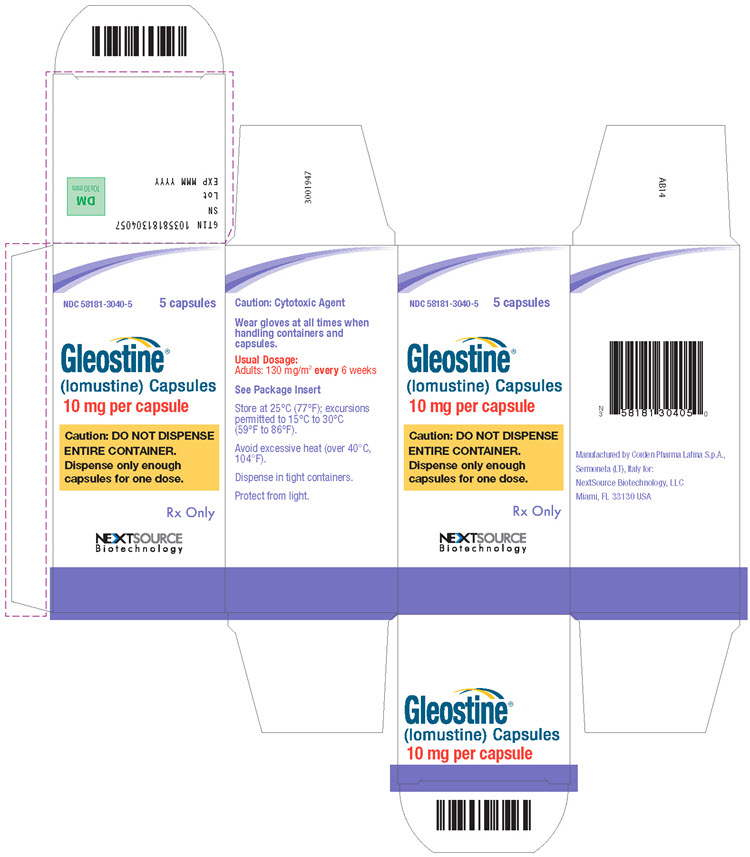
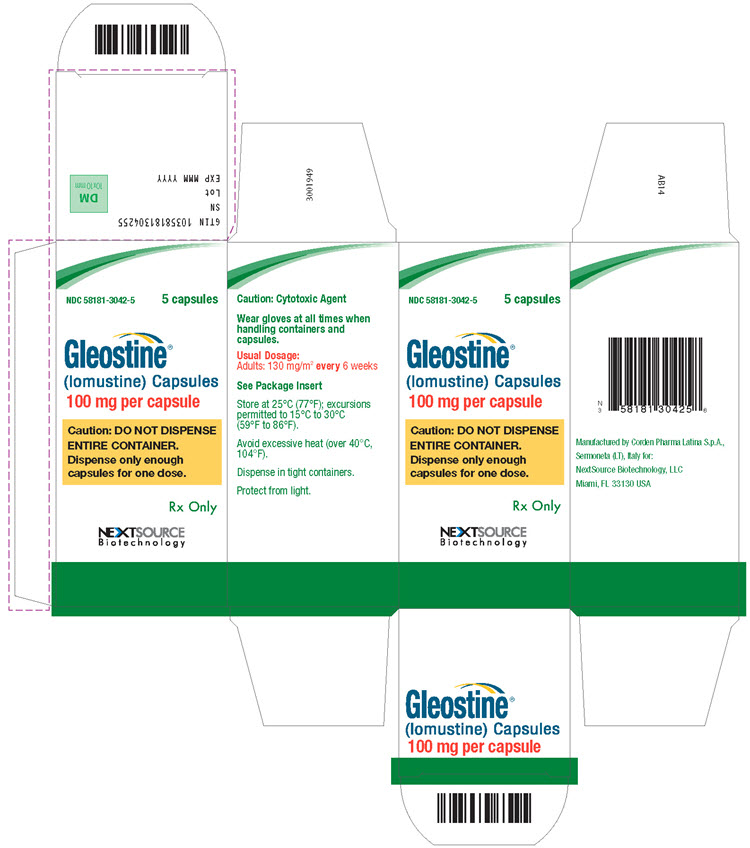
Manufactured by Corden Pharma Latina S.p.A., Sermoneta (LT), Italy for:
NextSource Biotechnology, LLC
Miami, FL 33130 USA